

What this guide covers
This guide covers what chip seal is made of, how it is built, why loose stone happens and what controls it, which pavement is a candidate, what moves the price, and how chip seal compares with slurry seal, micro surfacing, sealcoating, and an asphalt overlay.
The idea to carry through the whole article: chip seal is assembled on the pavement, not in a plant. Binder and stone arrive separately and are married together in a few seconds by a roller. Almost everything owners like and dislike about the finished surface traces back to how well that one step went.
Pricing the work? Browse chip seal contractors to compare firms by market, or start at the pavement preservation category if you are still choosing between treatments.
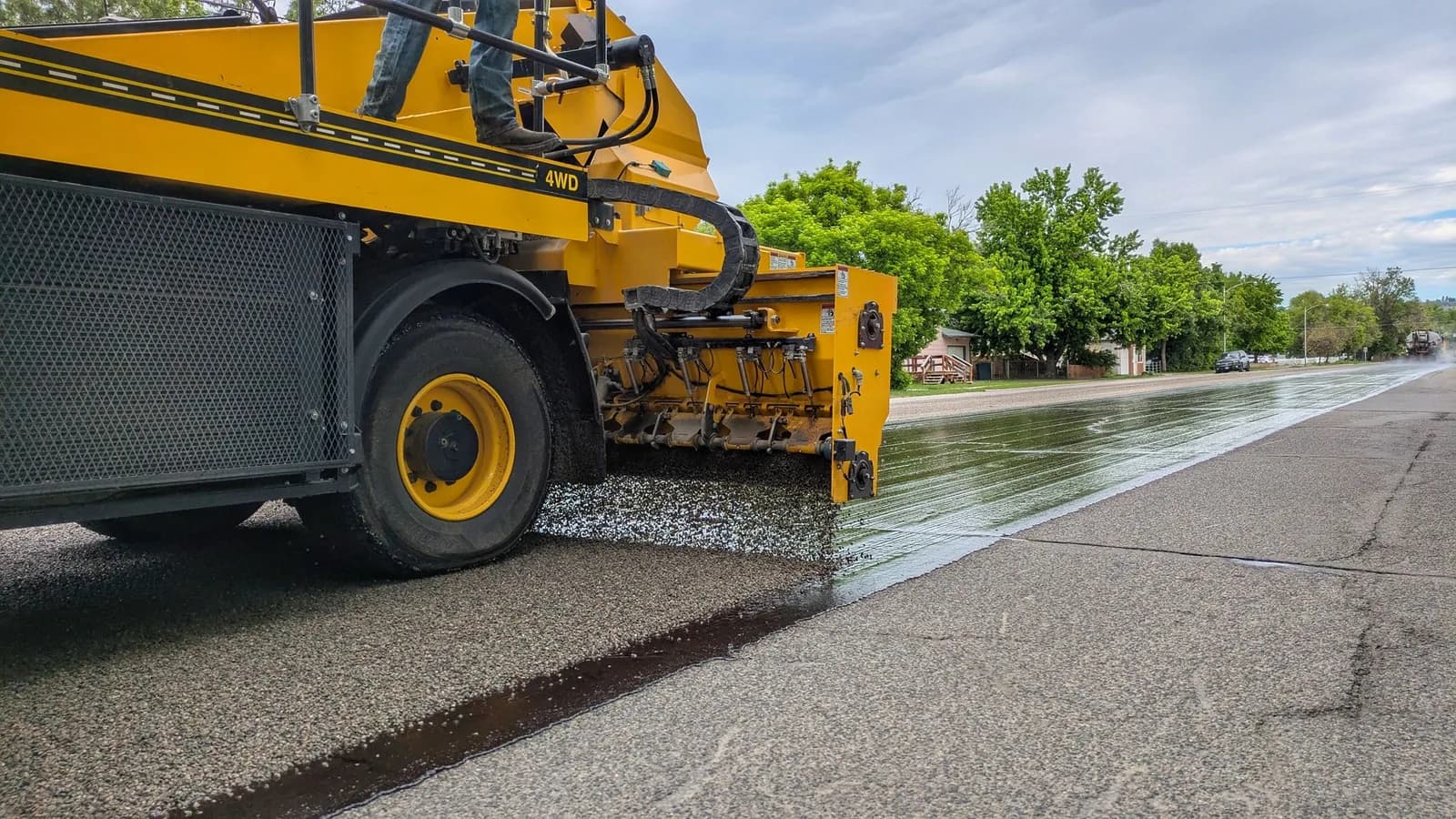
What chip seal actually is
Hot-mix asphalt arrives at a site already finished. Aggregate and binder were proportioned, heated, and blended at a plant, and the paver's job is to place a material that is already a material.
Chip seal inverts that. Two ingredients show up separately and become a surface only after both are on the ground:
- Asphalt binder. Sprayed across the prepared pavement at a controlled rate by a distributor truck. It glues the stone down and seals the surface underneath against water and air.
- Aggregate chips. Crushed stone of a specified size, spread over the wet binder within seconds by a chip spreader, then rolled until each stone is pressed into the binder and held.
That is the whole treatment. There is no mixing, no paver, and no mat. What you drive on afterward is a single layer of stone, standing on the pavement, held there by a film of binder.
Two consequences follow directly, and they explain most of what comes later in this guide. First, the surface is as coarse as the stone that was spread, because the stone is the surface. Second, the treatment only works if the stone is actually held. A chip that never embedded is not part of the pavement — it is loose gravel sitting on a road.
How a chip seal goes down
The sequence is short, and the timing inside it is unforgiving. Binder has a working window measured in seconds to a minute or two, and every step exists to get stone into that window and rolled before it closes.
- Inspect the pavement and identify what has to be repaired before treatment.
- Complete patching, crack repair, and edge work, and let repairs cure.
- Sweep the surface clean — binder does not stick to dust.
- Spray asphalt binder at the specified rate with a distributor truck.
- Spread aggregate immediately behind the distributor with a chip spreader.
- Roll the aggregate to seat and embed the stone in the binder.
- Let the treatment set under controlled or restricted traffic.
- Sweep the loose stone that did not embed.
- Return to sweep again after traffic has worked the surface.
- Restripe where markings were covered.
The whole operation is a convoy: distributor, spreader, and rollers moving as one unit down the pavement. If any part of it falls behind, the binder in front of it starts to set before stone arrives.
This is also why chip seal is weather-sensitive work. Cold pavement, rain, and late-season temperatures all shorten or ruin the window, and a contractor who postpones for weather is protecting the result rather than being difficult.
Why chip seal has loose stone, and what controls it
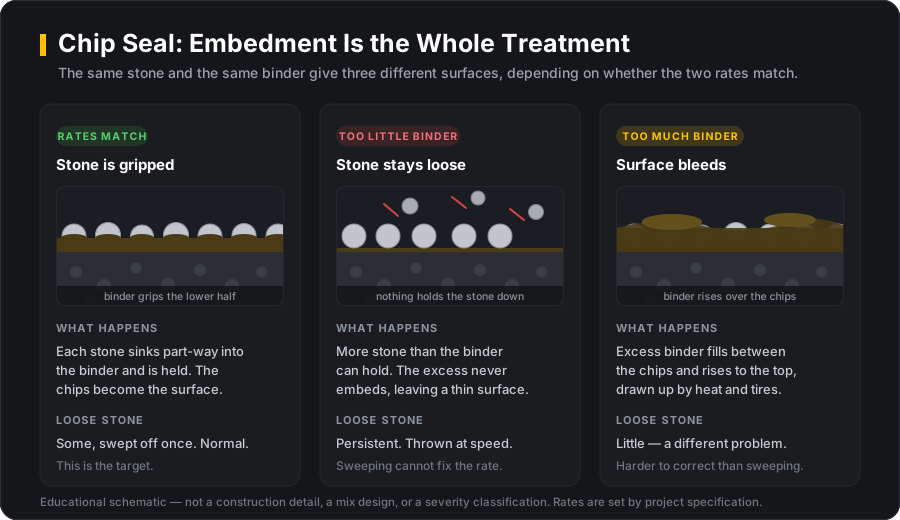
Loose stone is the single most common complaint about chip seal, and the reason it happens is specific rather than mysterious. The rate of binder and the rate of aggregate have to match. When they do, each stone sinks part-way into the binder, is gripped, and stays. When they do not, one of two things goes wrong:
- Not enough binder for the stone spread over it. The excess chips have nothing to hold them. They stay loose, get swept up, get thrown by tires, and leave a thinner surface than the design intended.
- Too much binder for the stone. The excess binder can rise into the surface and pick up on tires in hot weather, a condition known as bleeding or flushing, which is far harder to correct than sweeping up chips.
Some loose stone after a chip seal is normal and expected. The chips that never seat are supposed to be swept off — that is a scheduled step, not a failure. What is not normal is loose stone still moving weeks later across the whole surface, which points at the rates rather than at the sweeping.
This is why the practical questions to ask a chip seal contractor are about sweeping and stone size rather than about the treatment in the abstract. Ask when the first sweep happens, whether a second sweep is included, and what aggregate size is proposed. A smaller chip is less aggressive when it does come loose, which matters more on a property with parked cars than on a rural road.
Chip seal compared with the alternatives
Chip seal gets proposed alongside several other treatments for a worn but sound pavement. They are not interchangeable, and the differences that matter are texture, closure time, and whether anything structural is being added.
| Treatment | How it is built | Adds structure? | Finished texture | Best suited to |
|---|---|---|---|---|
| Chip seal | Binder sprayed, stone spread into it, rolled | No | Coarsest of the group; loose stone at first | Roads, private roads, large yards, long driveways |
| Slurry seal | Emulsion, fine aggregate, and water mixed on site and spread | No | Moderate; matte gray, uniform | Sound pavement whose surface has worn or lost fines |
| Micro surfacing | Polymer-modified slurry with a chemically controlled set | No | Moderate; can be laid thick enough to fill ruts | The same pavement, where traffic cannot be closed long |
| Sealcoating | A coating applied over the existing surface | No | Smooth and black; the original surface remains | Parking lots and driveways with an intact surface |
| Asphalt overlay | A new layer of hot-mix asphalt, placed and compacted | Yes, some | Smooth asphalt mat | Pavement needing added strength or a corrected profile |
Read the third column first. Four of these five add no structural capacity whatsoever. If cracking runs in interconnected patterns, if an area flexes under a loaded truck, or if the lot ponds after every rain, none of the four is the answer, and choosing between them is the wrong conversation.
The closest comparisons in practice are chip seal and slurry seal. Both put down aggregate and emulsion, both cost far less than paving, and both need sound pavement underneath. The split is texture and setting: slurry arrives premixed and cures to a fairly uniform matte surface with no loose stone, while chip seal is coarser, noisier under tires, and produces chips to sweep. On a customer parking lot that difference usually decides it. On two miles of private road, so does the price.
Which pavement qualifies, and which does not
Chip seal is a reasonable candidate when the pavement below it can still carry the traffic on it. Signs that point toward it:
- The surface is dry, gray, and open-textured, with binder oxidized and fines worn away.
- Cracking is limited and isolated, and can be sealed or patched before treatment.
- The pavement is not deforming, rutting, or flexing visibly under a loaded vehicle.
- Water drains off rather than standing after a rain.
- The finished texture and initial loose stone are acceptable for how the surface is used.
The disqualifying conditions are the same ones that disqualify every surface treatment, and they are worth being blunt about. Widespread alligator cracking means the pavement is failing under load and the base has stopped supporting it. Potholes mean material has already been lost. Deep rutting means something below the surface is moving. Persistent ponding means water is getting into the structure and will keep doing so.
A chip seal placed over any of those will look correct for a season and then reproduce the problem, because the process never touched the cause. If a proposal recommends chip seal for a lot with those conditions and does not price repairs alongside it, that is the thing to question — not the price.
What has to be repaired first
Preparation is not a formality on a chip seal, because binder will not bond to a dirty or unstable surface and stone will not stay on one. Typical pre-treatment work:
- Pothole repair and full-depth patching of failed areas.
- Crack sealing, with cure time before the treatment goes down.
- Repair of broken and crumbling pavement edges.
- Correction of failed utility trenches and settled areas.
- Drainage work where water is standing or entering the pavement.
- Vegetation removal at edges and through cracks.
- Sweeping the full area clean of dust and debris.
Ask for these as separate line items rather than folded into a square-foot rate. Two chip seal bids on the same road are usually not the same job, and the difference is almost always in this list.
Single chip seal, double chip seal, and cape seal
Chip seal is not one specification. Three variants come up in proposals, and they should never be compared as though they cost the same because they carry the same words:
- Single chip seal. One binder application and one aggregate application. The standard treatment.
- Double chip seal. Two full applications, usually with a larger stone first and a smaller stone second. It costs more, produces a more substantial surface, and is common where traffic is heavier or the existing surface is rougher.
- Cape seal. A chip seal followed by a slurry seal or micro surfacing placed over it. The slurry fills the voids between chips, which knocks down the coarse texture and largely eliminates the loose-stone problem, at a cost between chip seal and paving.
Cape seal is the answer to the most common objection to chip seal — that the surface is too coarse and throws stone — and it is worth asking about specifically on properties where that matters. Note that the directory lists cape seal as a service rather than a category, because the national contractor count for it is small. Ask chip seal contractors and slurry seal contractors in your market whether they do the combined system.
A proposal that says only "chip seal" without stating single or double has not told you the scope.
What chip seal costs
The Pavement Directory does not publish a national per-square-foot range for chip seal, and the reason is worth stating plainly rather than filling the gap with a number: the spread between project types is wider than the range would be useful across. A county resurfacing twenty lane-miles and a homeowner treating a 4,000-square-foot driveway are not buying the same thing at different volumes. They are buying different economics.
What actually sets the price on a specific job:
- Mobilization. A distributor truck, a chip spreader, rollers, aggregate trucks, a sweeper, and a crew have to arrive whether the job is one acre or forty. On a small property that fixed cost dominates the total, and the per-square-foot figure stops meaning anything.
- Single versus double application. A double chip seal is close to twice the material and twice the passes.
- Aggregate. Stone type, size, and haul distance from the quarry.
- Binder specification. The emulsion or binder system called for by the project.
- Repairs before treatment. Patching, crack sealing, and edge work, priced separately.
- Sweeping. Initial and follow-up passes, which should be in the scope rather than assumed.
- Traffic control. Flagging, phasing, and restricted hours on occupied or public routes.
- Striping. Restoring markings the treatment covered.
The honest way to budget it: chip seal is generally the least expensive way to put a new wearing surface across a large area, and generally more expensive per square foot than sealcoating on a small one. Both halves of that sentence matter. Get written proposals from firms that do this work at your scale rather than scaling a roadway unit price down to a driveway.
For the treatments where the directory does publish researched ranges, see asphalt paving cost and sealcoating cost.
How long chip seal lasts
There is no defensible universal service life, and a contractor who leads with one is selling a number rather than an assessment. Performance is set by the pavement it went over and the quality of the day it went down.
What actually governs it:
- Condition of the pavement underneath, which matters more than everything else combined.
- Whether repairs were completed and allowed to cure before treatment.
- Binder and aggregate specification, and whether the rates matched.
- Traffic volume, vehicle weight, and turning movements.
- Climate, particularly freeze-thaw cycling and summer heat.
- Drainage, and whether water sits anywhere on the surface.
- Snowplowing, which is hard on any surface treatment.
- Whether sweeping was completed on schedule.
The more useful question than "how many years" is whether this pavement is in a condition where a surface treatment can do anything for it. A chip seal over sound pavement is a preservation step in a maintenance program. A chip seal over failing pavement is a cosmetic delay, and the years it lasts are not the point.
Reopening traffic, sweeping, and speed
The period right after installation is where chip seal asks the most of a property, and it is the part most often left out of a conversation about price.
Three things need to be settled in writing before the crew arrives:
- When the surface reopens, and under what restrictions. This depends on binder, weather, and traffic type, so get the plan for your property and season rather than a general figure.
- When sweeping happens, and how many passes are included. Loose stone is swept once the surface has set, and usually again after traffic has worked it. Confirm both are in the scope.
- What speed restriction applies, and for how long. New chip seal throws stone at speed. Temporary limits protect vehicles and the surface at the same time, and on a private road somebody has to actually post them.
Speed matters more than owners expect. Loose chips thrown by a car at 45 mph chip windshields and paint on the car behind, and that complaint lands with the property, not the contractor. On an HOA or a business park, plan the notice to residents and tenants alongside the work.
Chip seal on driveways and private roads
Chip seal is a common and often sensible choice for a long rural driveway or a private road, and a poor fit for a short suburban one. The dividing line is length and setting rather than anything technical.
Where it tends to work:
- Long driveways where paving the same area in hot mix is out of budget.
- Rural and semi-rural properties where a coarse, natural-looking surface suits the setting.
- Private roads shared by an association, where cost per square foot drives the decision.
- Gravel drives being upgraded, where the base has been properly prepared first.
- Sloped drives where the coarse texture adds useful traction.
Where it tends not to: short driveways, where mobilization makes the unit cost unattractive; properties where the finished appearance needs to match adjacent asphalt; anywhere loose stone will end up tracked into a garage or thrown at parked cars.
One caution on gravel. "Chip seal over gravel" is sometimes offered as a cheap way to turn a gravel drive into a paved one, and it is not that. A durable chip seal needs a shaped, compacted, properly drained base underneath. Spraying binder onto loose gravel produces a surface that looks paved for a season. If the drive has never been built as a road, the work below the chip seal matters more than the chip seal.
What a chip seal proposal has to state
"Chip seal roadway — $X" is not a proposal you can compare against another one. A usable proposal identifies:
- The exact work area, with square footage or lane quantities.
- Single or double chip seal, and whether a fog seal or cape seal is included.
- Binder specification and application rate.
- Aggregate specification, size, and application rate.
- Surface preparation and sweeping before treatment.
- Patching, crack sealing, and edge repair, as separate line items with quantities.
- Rolling: equipment and number of passes.
- Initial sweeping and follow-up sweeping, with timing.
- Traffic control, phasing, and any speed restrictions.
- Striping restoration, with stall or marking counts.
- Weather limitations and what triggers a postponement.
- Exclusions and the change-order procedure for conditions found during preparation.
- Warranty terms, and specifically what voids them.
If two bids differ by a wide margin, the difference is nearly always in the preparation, the number of applications, or the sweeping — not in the stone. Compare those three before comparing the totals. How to compare asphalt paving bids covers the same discipline for paving work and transfers cleanly.
Frequently asked questions
What is chip seal?
Chip seal is a pavement surface treatment built in two steps at the job site. Asphalt binder is sprayed onto prepared pavement, aggregate chips are spread into it immediately, and rollers press the stone into the binder until it is held. The embedded stone becomes the new wearing surface.
Is chip seal the same as asphalt paving?
No. Hot-mix asphalt is blended at a plant and arrives as a finished material that a paver places and rollers compact into a dense mat. Chip seal brings binder and stone to the site separately and combines them on the pavement. The result is a thin aggregate surface rather than a structural asphalt layer.
Is chip seal cheaper than asphalt?
Across a large area, usually yes — it is generally the least expensive way to put a new wearing surface on a road or a long driveway. On a small property, the gap narrows or closes, because mobilizing a distributor, spreader, rollers, and aggregate trucks costs roughly the same whether the job is one acre or forty.
How long does chip seal last?
There is no reliable universal figure. Service life depends most on the condition of the pavement underneath, then on whether repairs were completed first, whether binder and aggregate rates matched, and on traffic, climate, drainage, plowing, and whether sweeping was done on schedule.
Why does chip seal have loose stones?
Some chips never embed into the binder, and those are swept off as a scheduled step rather than a failure. Persistent loose stone across the whole surface weeks later usually means the binder rate and the aggregate rate did not match, leaving more stone than the binder could grip.
How long before you can drive on chip seal?
It varies with binder, weather, aggregate, and traffic type, so use the contractor's plan for your property and season rather than a general number. Traffic returning too early can dislodge stone, pick up binder, and degrade the surface before it has set.
Why are there speed limits after chip sealing?
A new chip seal carries loose stone until it is swept and the surface has been worked in. At speed, tires throw those chips hard enough to damage windshields and paint on following vehicles, and fast traffic also displaces stone that would otherwise have seated. Temporary limits protect both.
Can chip seal fix potholes or alligator cracking?
No. Both indicate that the pavement structure has failed — material lost in one case, load-related fatigue in the other. Chip seal adds no structural capacity and never reaches the base. Those areas need patching, full-depth repair, or reconstruction before any surface treatment is worth applying.
Can chip seal be applied over gravel?
Only over a gravel road that has been properly shaped, compacted, and drained first. Spraying binder onto a loose gravel driveway is not the same thing and does not produce a durable surface. On an unbuilt drive, the base preparation is the real project and the chip seal is the finish on top of it.
What is the difference between chip seal and slurry seal?
Chip seal sprays binder and then spreads stone into it, so the stone is exposed and the texture is coarse. Slurry seal arrives as a premixed emulsion, fine aggregate, and water, spread as a thin uniform layer that cures to a matte gray finish with no loose stone. Slurry is generally the better fit for parking lots; chip seal for roads and large low-speed areas.
What is a cape seal?
A cape seal is a chip seal with a slurry seal or micro surfacing placed over it. The slurry fills the voids between chips, which reduces the coarse texture and largely removes the loose-stone problem. It costs more than a chip seal alone and less than paving.
Does chip seal need to be sealed or maintained afterward?
It needs sweeping on the schedule the contractor sets, and some projects add a fog seal — a light binder application over the finished chip seal — to lock down surface stone. Beyond that, it is maintained like any pavement: keep water off it, and repair cracks and failures as they appear rather than waiting for the next treatment cycle.
Before you hire: The Pavement Directory does not guarantee contractor performance, pricing, licensing, insurance, or availability. Business information may be submitted by contractors or gathered from public sources and should be independently verified before hiring. Always confirm licensing, insurance, references, scope of work, and written contract terms.
For property owners
Looking for a pavement contractor?
Use The Pavement Directory to search asphalt, concrete, sealcoating, striping, ADA access, and pavement maintenance contractors by service and location. Always verify license, insurance, references, and written scope before hiring.
Find chip seal contractorsFor contractors
Are you a pavement contractor?
Contractors can add or claim a company profile to help property owners find pavement professionals by service, location, and specialty.