

What this guide covers
Asphalt bids often look comparable because they all have a total price — that total may hide major differences in scope, thickness, and preparation.
This article focuses on comparing multiple bids against each other. For checking whether a single proposal document is complete, see the Asphalt Paving Proposal Checklist. For warning signs in a suspiciously low bid, see Cheap Asphalt Paving Bid Red Flags.
Use the directory to compare asphalt paving contractor profiles before requesting formal bids. If you want a planning number to check the bids against first, the asphalt paving cost guide sets out current per-square-foot ranges by project type.
Related contractor categories
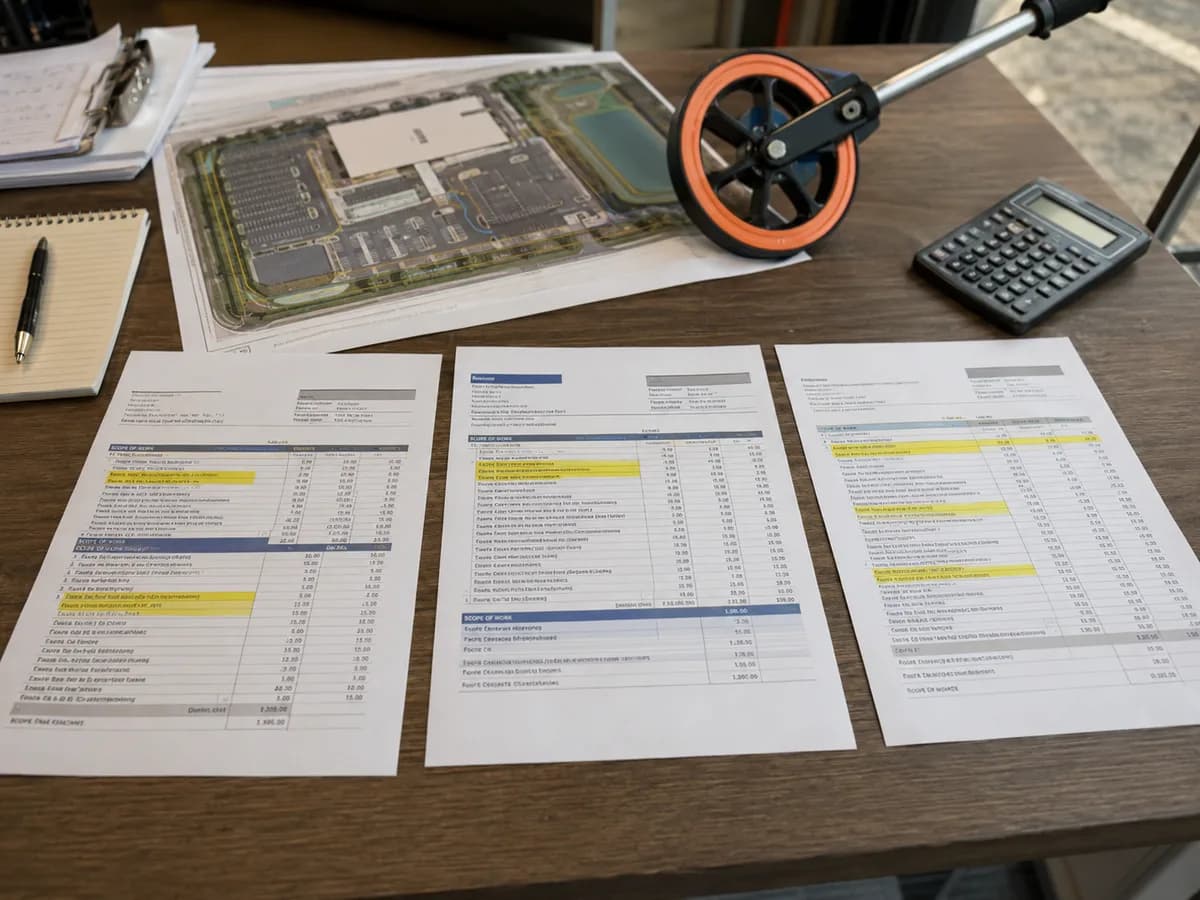
The apples-to-apples problem
Example: Contractor A bids $84,000 and includes milling, 3 inches of compacted asphalt, striping, and traffic control. Contractor B bids $67,000 and includes a 2-inch overlay, no striping, and no base repair. Contractor C bids $92,000 and includes full-depth replacement in failed areas and overlay elsewhere. These are not three prices for the same work — they are three different scopes.
Run the numbers and the "cheap" bid gets more interesting. Assume all three cover 42,000 square feet. Contractor A works out to about $0.67 per inch of asphalt per square foot. Contractor B works out to $0.80 per inch — 20 percent more per inch of asphalt while delivering less pavement, no striping, and no base repair. The lowest total price can be the most expensive material in the comparison.
Step 1: Match the work area
Start by confirming the same area is included: total square footage, work limits, site map, drive lanes, parking stalls, entrances, aprons, private roads, and excluded areas. If one bid includes 42,000 square feet and another includes 35,000 square feet, the total price comparison is misleading.
Step 2: Identify the paving method
Each bid should state whether the work is new paving, overlay, mill and overlay, full removal and replacement, full-depth patching plus overlay, or partial replacement. A 2-inch overlay is not the same project as full removal and replacement.
Step 3: Compare asphalt thickness
Look for proposed thickness, whether it's compacted, whether it's the same thickness in heavy traffic areas as in stalls, and lift count. Thickness is a major cost driver — a thin overlay may be cheaper, but it may not solve the same problem as replacement. Confirm every bid states compacted thickness. When a proposal lists area and tons, enter each lift in the Asphalt Tonnage Calculator to document the assumptions and compare the quoted material quantity.
Step 4: Compare base preparation
Base work may be included, excluded, or only included as an allowance. Check for grading, compaction, aggregate base, soft spot repair, proof rolling, a base repair allowance, a unit price for extra base work, and a change order process. If base repair is excluded, the bid may increase after demolition.
Step 5: Compare drainage assumptions
Drainage can change the real scope. Check whether each bid addresses visible problems — ponding, sunken areas near drains, settlement over trenches — the same way. If one contractor includes drainage correction and another excludes it, the pricing is not comparable. The full list of drainage items a proposal should address is in the Asphalt Paving Proposal Checklist.
Step 6: Compare striping and markings
Parking lots usually need striping after paving, and it's a common place where a low bid quietly drops scope. Confirm each bid includes the same markings, or clearly excludes striping so it can be priced separately with Parking Lot Striping Contractors.
Step 7: Compare access and traffic control
For occupied properties, compare phasing, barricades, notices, work hours, weekend or night work, flagging, emergency access, and reopening time. A bid without access planning may be cheaper but more disruptive.
When price per square foot helps
Price per square foot is useful only after scope is normalized — it's less useful when bids differ in thickness, milling depth, base work, striping, phasing, traffic control, disposal, or drainage. When thickness differs, divide again by inches of asphalt, as in the example above. Price per inch per square foot exposes thin bids fast.
Frequently asked questions
Why are asphalt paving bids so different?
They often include different scopes. Thickness, base prep, milling, striping, drainage, and traffic control can all change the price.
Is price per square foot a good way to compare paving bids?
Only after you confirm the bids include the same work. When thickness differs, compare price per inch of asphalt per square foot instead.
What should I compare first?
Compare work area and paving method first. Then compare thickness, base preparation, drainage, striping, and exclusions.
Should I ask contractors to revise bids?
Yes. If scopes are not equal, ask for clarifications or revised pricing so the bids can be compared fairly.
What is the most common hidden cost?
Base repair and drainage correction are common sources of added cost.
Before you hire: The Pavement Directory does not guarantee contractor performance, pricing, licensing, insurance, or availability. Business information may be submitted by contractors or gathered from public sources and should be independently verified before hiring. Always confirm licensing, insurance, references, scope of work, and written contract terms.
For property owners
Looking for a pavement contractor?
Use The Pavement Directory to search asphalt, concrete, sealcoating, striping, ADA access, and pavement maintenance contractors by service and location. Always verify license, insurance, references, and written scope before hiring.
Search contractorsFor contractors
Are you a pavement contractor?
Contractors can add or claim a company profile to help property owners find pavement professionals by service, location, and specialty.