

What this guide covers
This is a field guide for identifying raveling, judging how far it has progressed, telling it apart from other pavement failures, and understanding which repairs actually apply. It is written for property owners and managers who are looking at a deteriorating surface and trying to decide what to do about it.
The idea that matters most: the visible surface symptom does not by itself determine the repair scope. Two lots that look identical from ten feet away can need completely different work, because what decides the repair is the condition of the pavement below the surface.
Ready to have it looked at? Browse asphalt repair contractors by location and service, or use the pavement condition rating tool to organize what you are seeing before you call anyone.
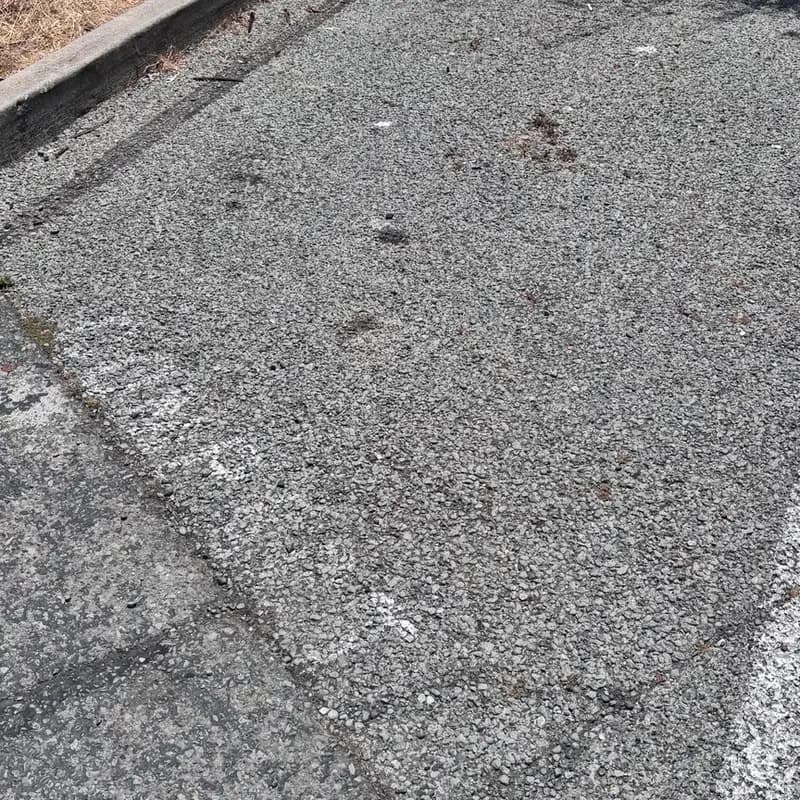
What raveling looks like on a real property
Raveling rarely announces itself. A lot can look intact from across the parking field while the surface is quietly coming apart underfoot. The usual first clue is not the pavement at all: it is the loose stone collecting where water and traffic push it, along curb lines, in gutters, and at the low corners of the lot.
Walk it and look for a combination of these signs rather than any single one:
- Loose aggregate on the surface, and accumulating along curbs, gutters, and drain inlets.
- A surface texture that has become noticeably rougher and more open than it once was.
- Coarse aggregate standing proud of the surface, with the fines around it worn away.
- Small pits where individual stones have come out entirely.
- Material that comes away when you drag a shoe across the surface.
- Deterioration concentrated in wheel paths, where traffic works on the surface hardest.
- Irregular patches or streaks that are noticeably worse than the pavement around them, sometimes tracking a paving pass or a truckload of mix.
- Sweeping that brings up material which used to be locked into the mat.
Severity varies enormously. On one property raveling means a slightly opened texture that a preservation treatment could address. On another it means a surface so far gone that stone comes up by the handful. Those two properties need different conversations, which is why judging extent matters as much as identifying the distress.
Signs to photograph during a pavement walk. Photographs are what turn a vague complaint into something a contractor can price and a board can approve. Capture a close-up of the surface texture with something for scale, the amount of loose material collecting at curbs, the overall extent of the affected area, the transitions between sound and deteriorated pavement, any cracking inside the same area, drainage conditions and anywhere water stands, and any previous patches or repairs and how they are holding up. Date the photographs. A second set six months later is the clearest evidence of whether the condition is progressing.
What causes asphalt raveling
Raveling happens when the bond between the binder and the aggregate stops doing its job, so particles that were locked into the mat come free. Several different conditions can produce that outcome, and more than one is often at work on the same pavement. No single cause explains every case.
- Inadequate compaction. Asphalt gets its durability from being compacted to a target density while still hot. A mat left with too much air void space is more permeable, ages faster, and holds its aggregate less securely. Compaction problems set the conditions for raveling years before it appears.
- Mixture problems. A mix with too little binder does not have enough material to coat and hold the aggregate. Problems with aggregate quality, gradation, or cleanliness can interfere with how well the binder adheres.
- Segregation. When coarse and fine particles separate during production, transport, or placement, the pavement ends up with localized coarse areas that are low in binder and high in air voids. These show up later as patches of raveling in an otherwise sound mat, which is why irregular, isolated areas are worth noting during a walk.
- Binder aging and oxidation. Asphalt binder reacts with air and sunlight over time, becoming harder and more brittle. A brittle binder holds aggregate less well and cracks rather than flexing. This is the ordinary aging path for pavement, though not all aged pavement ravels.
- Moisture-related deterioration. Water can attack the bond between binder and aggregate. Where that mechanism is at work, the pavement loses strength from within. Persistent moisture and poor drainage make the problem worse and can accelerate raveling that started for another reason.
- Construction and placement problems. Placing mix that is too cool, paving in marginal weather, laying a thin lift late in the season, or working a mat after it has begun to set can all produce a surface that never developed proper durability.
- Long-term weather and traffic exposure. Freeze and thaw cycles, heat, sunlight, and repeated traffic all work on a surface. On pavement that is already vulnerable for one of the reasons above, this exposure is what turns a latent weakness into visible material loss.
One practical distinction is worth carrying into a contractor conversation. Raveling that appears within the first year or two of a new pavement points toward a construction or mixture problem and may be worth raising under warranty. Raveling that appears on pavement well into its service life more often reflects aging and exposure. The repair may look similar, but who pays for it may not.
Is raveling a structural failure?
Not necessarily. Raveling is classified as a surface distress. It describes material being lost from the top of the pavement downward, and by itself it says nothing about whether the layers below are still sound.
That is genuinely good news in many cases, because a pavement with a worn surface and an intact structure has more options and cheaper ones. But the qualification matters: a surface distress can coexist with structural problems, and it can also be an early visible symptom of a mixture or moisture problem that runs deeper than the top few millimeters.
So the question to answer is not whether raveling is structural. It is whether this pavement has structural problems in addition to the raveling. Look for these alongside the material loss:
- Interconnected cracking in a pattern resembling alligator hide, which indicates fatigue failure.
- Rutting or depressions in wheel paths, which indicate permanent deformation.
- Areas that sink, feel soft, or move under a loaded vehicle.
- Water or fines pumping up through cracks under traffic.
- Potholes, which mean material loss has already gone below the surface.
- Patches that have repeatedly failed in the same location.
- Ponding water, which points to a grade or drainage problem no surface treatment corrects.
If any of those are present alongside the raveling, treating the surface alone is likely to be inadequate, and a treatment placed over them will fail with the pavement beneath it. The pavement condition rating tool helps organize these observations into something you can hand to a contractor or a board, and what causes alligator cracking in asphalt covers the most important of the accompanying distresses in detail.
How bad is it? A screening guide for property owners
Before reading the table below, one caution about severity. Pavement engineering does not have a single agreed severity scale for raveling. The FHWA Long-Term Pavement Performance distress manual records raveling by the area affected and assigns it no severity levels at all. Condition-survey methods based on ASTM D6433, the standard behind Pavement Condition Index surveys, do use low, medium, and high severity ratings.
So the categories below are a practical screening aid for a property owner walking a lot, and nothing more. They are not an engineering classification, and no contractor should present them as one.
| Observable condition | What it may indicate | Typical next step to investigate |
|---|---|---|
| Light change in surface texture, small aggregate loss, little loose material | Early surface deterioration | Inspection and a preservation review while options are still cheap |
| Noticeable loose aggregate, rough or pitted surface, texture visibly opened | Progressive material loss | Evaluate surface treatment or localized repair, after confirming the structure is sound |
| Heavy material loss, deep pitting, widespread areas, other distress present | Advanced deterioration, possibly more than surface deep | Evaluate patching, milling and overlay, or reconstruction |
This table is a screening tool, not a pavement design or engineering diagnosis. Extent matters as much as appearance: raveling across most of a property is a different problem from the same texture in one isolated bay, even though a single photograph of each would look the same.
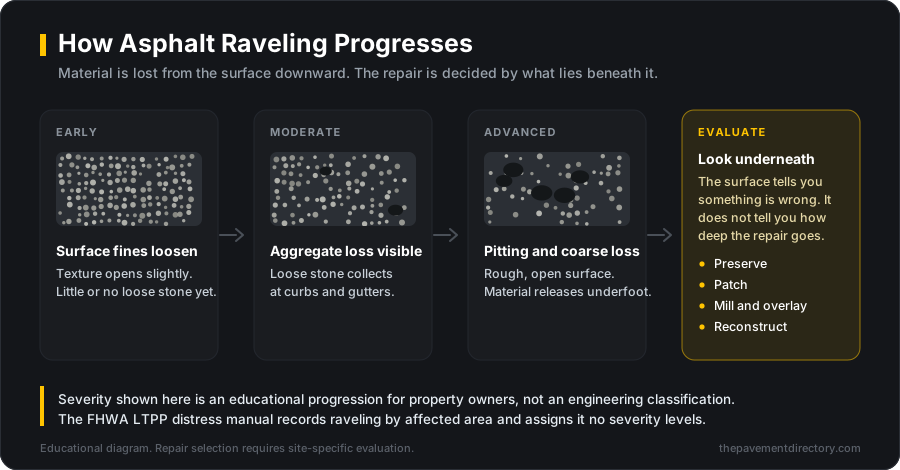
Raveling compared with other asphalt problems
Several pavement conditions get called raveling in casual conversation, and one in particular gets confused with it in technical conversation. Being precise here changes what gets proposed.
| Distress | What you typically see | Main difference from raveling |
|---|---|---|
| Raveling | Loose aggregate and progressive surface material loss | The surface wears away from the top downward |
| Stripping (moisture damage) | Loss of bond between binder and aggregate caused by water | A mechanism rather than an appearance, and it typically works from within the layer upward |
| Alligator cracking | Interconnected cracking in a hide-like pattern | A fatigue cracking pattern, not simple aggregate loss |
| Rutting | Depressions along wheel paths | Permanent deformation, with material moved rather than lost |
| Pothole | A localized bowl of missing pavement | Concentrated and deeper loss, often involving layers below the surface |
| Oxidation and weathering | A gray, aged, dried-out looking surface | Aging of the binder, which often accompanies raveling but is not the same as losing aggregate |
| Polished aggregate | A smooth, slick surface where stone has worn shiny | The aggregate is still in place and worn smooth, rather than dislodged |
The raveling and stripping distinction is the one that matters most, because it changes the diagnosis. Stripping describes moisture breaking the adhesion between binder and aggregate, weakening the mix from inside the layer. Raveling describes material coming off the surface. Stripping can be one of the mechanisms that produces visible raveling, which is exactly why the two get conflated, but plenty of raveling has nothing to do with moisture. Treat any confident claim that a raveled surface is definitely stripping as something to be supported with evidence, not accepted on sight. See the pavement glossary for how the site defines each of these terms.
Can sealcoating fix raveling asphalt?
Sealcoating is not a structural repair and should not be treated as a universal fix for raveling. It is the treatment most often proposed for a deteriorating lot, because it is the cheapest and the most visible improvement per dollar, and that is precisely why it deserves scrutiny here.
The honest version is conditional. Where the surface is only lightly weathered, still sound, and holding its aggregate, sealcoating is a legitimate preservation measure and can slow the oxidation that leads toward raveling. Where material is actively coming loose, the picture changes:
- A coating adds no thickness of structural value and cannot rebuild pavement that is no longer there.
- Sealer needs a sound surface to bond to. Applying it over loose aggregate can mean bonding it to particles that are already on their way off the pavement.
- Filling the pits and texture of a badly raveled surface is not what sealer is designed to do, and the result is often a thin, uneven film that wears through quickly.
- Cracking, potholes, base failure, and deformation all need to be addressed separately and first. Sealer over them changes the color and nothing else.
- A freshly sealed lot can look considerably better than its actual condition, which is a real risk when the coating is being used to support a sale, a lease, or a budget decision.
None of this makes sealcoating a bad treatment. It makes it a treatment with a window, like every other surface treatment. The useful question to put to a contractor is not whether they can seal the lot, but whether this pavement is still a candidate for sealing and what they observed that supports the answer. When is sealcoating a waste of money covers the conditions where the answer is no, and when is sealcoating worth it covers the conditions where it earns its cost.
Can a rejuvenator, slurry seal, or micro surfacing correct it?
These are the preservation treatments that come up once sealcoating has been ruled out, and each has a narrower application than its marketing suggests.
Asphalt rejuvenators are products intended to restore some properties of an aged binder rather than to add material. Whether one is appropriate depends on how far the deterioration has gone, whether the surface is still intact enough to treat, the specific product and its specifications, and the condition of the pavement underneath. A rejuvenator does not replace aggregate that has already left the pavement, and it should not be presented as reversing raveling in a surface that is actively shedding stone.
Slurry seal places a genuinely new thin wearing surface of fine aggregate and emulsion over the existing pavement. That makes it a more substantial answer to a worn, open-textured surface than any coating, because it adds material rather than covering what is left. It suits pavement that is structurally sound and needs its surface renewed, and preparation matters: loose material has to be removed and repairs completed before the treatment goes down. It adds no structural strength. See the slurry seal guide for which pavement qualifies.
Micro surfacing is a polymer-modified relative of slurry seal that sets chemically, reopens to traffic faster, and can be placed thick enough to fill wheel ruts. It is the usual choice where a long closure is impossible or where rutting accompanies the surface wear. It costs more per square foot. Micro surfacing contractors are listed separately because the equipment and mix control differ.
The common thread: none of these three adds structural capacity, all of them require the pavement underneath to be sound, and all of them require the loose material to be dealt with first. If a proposal offers any of them as the answer to a lot with interconnected cracking, ponding water, or areas that move under load, the proposal is treating a symptom.
How asphalt raveling is repaired
Repair is severity-dependent and condition-dependent. These are the directions a contractor may propose, from lightest to heaviest:
- Surface preservation for early deterioration. Where the surface is only beginning to open up and the structure is sound, a preservation treatment can extend service life and slow further loss. This is the cheapest window and the one most often missed, because early raveling does not look urgent.
- Localized repair and patching. Where deterioration is confined to identifiable areas, those areas can be removed and replaced while the surrounding pavement is left alone. This suits segregated areas, isolated bays, and spots where a specific defect is producing the loss. See the asphalt patching guide for how patch types differ.
- Milling and resurfacing. Where surface deterioration is widespread but the pavement structure is still serviceable, the deteriorated surface can be milled off and a new asphalt surface placed. Milling matters here: it removes the compromised material rather than paving over it, and it keeps surface elevations correct at curbs, drains, and door thresholds.
- Full-depth repair. Where the problem extends below the surface layer, repair has to go deeper, removing and rebuilding the affected pavement through its full thickness and sometimes into the base.
- Reconstruction. Where deterioration is severe and accompanied by broad structural problems, removing and rebuilding the pavement section may be the only approach that does not simply reset a countdown.
Notice that the same visible symptom appears at every level of this list. That is the point of the article. The surface symptom does not determine the repair scope. What determines it is the extent of the raveling and the condition of everything beneath it, which is why a proposal that jumps straight from a photograph to a price without describing what was investigated is not giving you much.
Patch, resurface, or replace?
This is the decision most owners are actually trying to make. There are no absolute rules here, because the right answer depends on quantities, budget cycles, and how long the property needs the pavement to last. But the conditions that point in each direction are reasonably consistent.
| Direction | Conditions pointing toward it | Cautions |
|---|---|---|
| Patching | Deterioration is localized, the surrounding pavement remains serviceable, the failure can be clearly isolated, or deeper repair is needed only in limited areas | Patching a surface that is deteriorating everywhere buys little and can look worse than doing nothing |
| Resurfacing | Deterioration is widespread at the surface, the underlying pavement is suitable, grade and drainage allow added thickness, and localized failures are corrected first | An overlay placed over unrepaired failures reflects them back through, usually within a season or two |
| Reconstruction | Substantial structural distress, widespread base failure, severe cracking or deformation accompanying the raveling | The most expensive option and the one most worth a second opinion before committing |
One sequencing point is worth more than the table. Localized failures get repaired before a surface treatment or overlay goes on, not after, and repairs need time to settle. Reversing that order wastes the treatment. Asphalt paving vs overlay covers the resurfacing decision in more depth, and a pavement consultant is worth considering when proposals disagree with each other or the project is large enough that being wrong is expensive.
What to look for during a site walk
Walk the property before you call anyone. You do not need to diagnose it, and you should not try to. You need to be able to describe it accurately and notice whether it is changing. Work through these questions:
- Is loose aggregate accumulating along curbs, gutters, and drain inlets?
- Is the deterioration isolated to a few areas, or spread across the property?
- Does it follow wheel paths, which points toward traffic working on a vulnerable surface?
- Are some paving passes or areas noticeably worse than others, which points toward segregation or a placement problem?
- Are cracks present within the raveled area, and what pattern do they form?
- Does the pavement move, flex, or feel soft under a loaded vehicle?
- Are potholes developing, meaning loss has already gone below the surface?
- Does water pond nearby after rain, or drain away?
- Are previous patches holding, or failing again in the same places?
- Is the surface merely faded and gray, or is material actually being lost?
- Did the raveling appear soon after the pavement was placed?
- Has the condition visibly progressed since you last looked, and how long ago was that?
The last two questions carry the most weight. Raveling that showed up shortly after construction points at the construction. Raveling that is progressing quickly is a different budget conversation from raveling that has looked the same for three years. Signs your parking lot needs maintenance covers the broader walk, and parking lot drainage problems covers what to do about standing water.
What belongs in a raveling repair proposal
A line reading "repair raveling asphalt" is not a scope. It cannot be compared against a competing bid, it cannot be held to, and it gives you no way to tell whether two contractors are proposing the same work. A proposal worth evaluating identifies:
- The exact limits of the repair areas, located on a plan or sketch rather than described in words.
- Approximate square footage for each area and each treatment type.
- The observed condition that led to the recommendation.
- The proposed repair method, and why that method rather than a lighter or heavier one.
- Removal or milling depth, where milling is involved.
- What the contractor assumes about the base, and what happens if that assumption proves wrong.
- Asphalt thickness where new material is being placed.
- Surface preparation, including removal of loose material before any treatment.
- Materials and the treatment system proposed.
- Compaction requirements where repair paving is involved.
- Drainage assumptions, and any utility or drain structure adjustments.
- Traffic control and phasing, so the property stays usable.
- Striping restoration, with stall counts and any accessible parking markings.
- Cleanup and removal of loose material from the site.
- Exclusions, stated plainly.
- The process for hidden conditions and change orders.
- Warranty terms, including what is covered and what voids them.
The hidden-conditions clause deserves attention on a raveling project specifically. Raveling is a surface symptom, so there is a real chance that removing the surface reveals something worse. A proposal that has thought about that will say what happens next and how it will be priced. One that has not will hand you a change order.
Questions to ask an asphalt contractor
These questions are designed to separate a contractor who has evaluated your pavement from one who is quoting a standard treatment. The reason each one matters is as useful as the question itself.
- What do you believe is causing the raveling here? A contractor who cannot offer a view has not looked closely, and cause affects whether the repair holds.
- Is the damage limited to the surface? This is the question that determines the entire scope, so it should be answered explicitly rather than assumed.
- Do you see any signs of deeper pavement or base failure? It invites the contractor to name what they looked for, which tells you how thorough the inspection was.
- How widespread is the affected area, and how did you measure it? Extent drives cost more than severity does, and a measured answer beats an impression.
- Would a surface treatment actually address this condition? Asked directly, it makes a contractor commit to a position you can hold them to.
- Why are you recommending this method rather than a lighter or heavier one? The comparison reveals whether alternatives were considered at all.
- What preparation is included before any treatment goes down? Preparation is the line item most often thin in a low bid, and the one that most affects whether the work lasts.
- Will loose material be removed before treatment, and how? Treatments bonded to loose aggregate fail early, so this is a direct durability question.
- What repairs must be completed first, and how long do they cure? Sequencing errors waste the treatment, and rushed cure times are a common corner to cut.
- How will drainage problems be handled? Water left standing shortens the life of whatever is placed, so a proposal silent on drainage has a gap in it.
- What conditions are excluded, and what happens if you find something worse? On a surface distress, discovering something worse is a genuine possibility rather than a formality.
- What warranty applies, and what would void it? A warranty that excludes the most likely failure mode is not offering much.
When to bring in an asphalt repair contractor
Any pavement showing material loss is worth having looked at, but some conditions move it up the list. Get an evaluation when:
- Material loss is visibly progressing between one look and the next.
- Loose aggregate is extensive rather than confined to a corner.
- Potholes are starting to develop within the raveled areas.
- Failures are localized but significant enough to affect how the property is used.
- Deeper cracking accompanies the raveling.
- Traffic appears to be accelerating the deterioration.
- You are considering sealcoating without knowing whether the pavement is still a candidate for it.
- You are budgeting for resurfacing or patching and need measured quantities rather than an impression.
That last case is the most common reason a property manager ends up here, and it is the one where an evaluation pays for itself. A number built from measured areas and an inspection survives a board meeting. A number built from a walk-past does not.
You can compare contractors that repair deteriorated asphalt by location and service, look at asphalt paving contractors if the direction is resurfacing or reconstruction, or start with parking lot maintenance contractors if the property needs an ongoing plan rather than a single project. Whichever direction you take, confirm licensing where it applies, insurance, relevant project experience, a written scope, repair depth, exclusions, and warranty terms before signing anything.
Frequently asked questions
What is asphalt raveling?
Asphalt raveling is the progressive wearing away of a pavement surface as aggregate particles work loose and the binder holding them deteriorates. It typically starts with the loss of fine particles and can progress to coarse aggregate loss, leaving a rough, pitted surface and loose stone along curbs.
What causes asphalt to ravel?
Causes vary and often overlap. They include inadequate compaction, mixture problems such as insufficient binder, segregation during production or placement, binder aging and oxidation, moisture-related deterioration, construction and placement defects, and long-term weather and traffic exposure. No single cause explains every case.
Can sealcoating fix raveling asphalt?
Not reliably, and not as a general rule. Sealcoating adds no structural value and needs a sound surface to bond to. On lightly weathered pavement that is still holding its aggregate it can be a legitimate preservation measure. On pavement that is actively shedding material it tends to produce a thin, uneven film that wears through, while making the lot look better than its condition.
Is raveling the same as asphalt stripping?
No, though they are related and often confused. Stripping describes moisture breaking the bond between binder and aggregate, weakening the mix from within the layer. Raveling describes material being lost from the surface. Stripping can be one mechanism that produces visible raveling, but much raveling has other causes entirely.
Can raveling lead to potholes?
It can contribute. As material is lost the surface becomes rougher and more permeable, which lets water reach lower layers and gives traffic more to work against. A pothole is a more localized and deeper loss of pavement that may involve failure below the surface, so it is a distinct distress rather than simply advanced raveling.
Should raveling asphalt be patched or resurfaced?
It depends on extent. Patching suits deterioration that is localized and clearly isolated within otherwise serviceable pavement. Resurfacing is considered when surface deterioration is widespread but the pavement structure is still suitable, and it requires localized failures to be repaired first. Widespread structural distress points toward reconstruction instead.
Is asphalt raveling a sign of base failure?
Not by itself. Raveling is a surface distress and can occur over a perfectly sound structure. It becomes a base concern when it appears alongside interconnected cracking, rutting, soft or moving areas, pumping, or repeatedly failing patches. Those accompanying signs, rather than the raveling, indicate a structural problem.
Can new asphalt ravel?
Yes. Raveling on recently placed pavement usually points toward a construction or mixture issue such as inadequate compaction, segregation, insufficient binder, or placement in unsuitable conditions, rather than toward aging. If raveling appears within the first year or two, it is worth documenting and raising with the contractor and reviewing against any warranty.
How quickly should raveling be repaired?
There is no universal timeline, because it depends on severity, how fast the condition is progressing, traffic, drainage, and the condition of the pavement underneath. The useful measure is direction of travel: raveling that has looked the same for several years is a planning item, while raveling that is visibly progressing or producing potholes should be evaluated promptly, since the cost of options rises as deterioration continues.
Before you hire: The Pavement Directory does not guarantee contractor performance, pricing, licensing, insurance, or availability. Business information may be submitted by contractors or gathered from public sources and should be independently verified before hiring. Always confirm licensing, insurance, references, scope of work, and written contract terms.
For property owners
Looking for a pavement contractor?
Use The Pavement Directory to search asphalt, concrete, sealcoating, striping, ADA access, and pavement maintenance contractors by service and location. Always verify license, insurance, references, and written scope before hiring.
Find asphalt repair contractorsFor contractors
Are you a pavement contractor?
Contractors can add or claim a company profile to help property owners find pavement professionals by service, location, and specialty.