The Pavement Directory

State pavement directory

Pavement Contractors in North Carolina

Few states change as much across their width as North Carolina. A lot in Wilmington sits on sandy coastal soil with a high water table and takes the direct force of tropical systems. The same building in Charlotte sits on Piedmont clay that holds water and cracks pavement from below. In Boone or Asheville, it faces freeze-thaw at elevation and a shorter construction season. All three are North Carolina, and none of them share a maintenance plan.

This page lists pavement contractors serving North Carolina cities and covers what actually varies: subgrade behavior by region, hurricane rainfall and inland flooding, the state's contractor licensing thresholds, and the stormwater rules that apply differently in coastal counties and nutrient-sensitive watersheds.

Listings
25
Cities
2
Services
13
Search North Carolina

Before you hire: The Pavement Directory does not guarantee contractor performance, pricing, licensing, insurance, or availability. Business information may be submitted by contractors or gathered from public sources and should be independently verified before hiring. Always confirm licensing, insurance, references, scope of work, and written contract terms.

25 contractors in North Carolina

Filter by service
All American Asphalt logo

Hendersonville, North Carolina

Asphalt PavingSealcoatingStriping & Pavement MarkingsCommercial

All American Asphalt Sealcoating provides asphalt paving, sealcoating, striping, patching, and pavement consulting and assessment services, along with snow and leaf removal. The company is based in Hendersonville, North Carolina, and describes its service area as the South Eastern United States. It is described as a third-generation family paving business, though a specific founding year is not stated on the site.

(828) 891-8990Website on file
American Asphalt logo

Greensboro, North Carolina

Asphalt PavingSealcoatingCrack SealingCommercial & Residential

American Asphalt provides asphalt paving, repair, sealcoating, striping, and sport court construction for both commercial and residential properties. Headquartered in Greensboro, NC, the company reports over 15 years of experience serving the Triad area of North Central North Carolina and Southern Virginia. Offerings include driveway and parking lot paving, crack sealing, maintenance programs, and pickleball/tennis/basketball court construction.

(336) 362-3495Website on file
Armor Asphalt logo

Charlotte, North Carolina

Asphalt PavingSealcoatingCrack SealingCommercial & Residential

Armor Asphalt is a family-owned paving contractor based in Charlotte, NC, offering asphalt paving, driveway installation, repair, sealcoating, parking lot paving and repair, and concrete flatwork such as sidewalks and patios. The company serves both residential and commercial clients across Charlotte and surrounding areas including Concord, Gastonia, Huntersville, Matthews, Indian Trail, and Cornelius, NC. It has received Angi Super Service Awards and is a Google Guaranteed provider.

(704) 207-4808Website on file
Asphalt & More, Inc. logo

Mt Holly, North Carolina

Asphalt PavingSealcoatingStriping & Pavement MarkingsCommercial

Paving contractor in Mt Holly, NC offering Asphalt Paving, Sealcoating, Parking Lot Striping, and Parking Lot Maintenance.

(980) 282-8473Website on file
Associated Asphalt Greensboro logo

Greensboro, North Carolina

Asphalt PavingCommercial & Residential

Based in Greensboro, North Carolina, Associated Asphalt Greensboro is a commercial and residential pavement contractor. The listing covers asphalt paving. The listing reports 78 years in business.

(336) 294-0025Website on file
Blalock Paving, Inc. logo

Raleigh, North Carolina

Asphalt PavingSealcoatingCrack SealingCommercial & Residential

Blalock Paving, Inc. is a paving contractor based in Raleigh, North Carolina, operating since 1968. It provides asphalt and concrete paving, sealcoating, and pavement striping for both commercial and residential properties throughout the Triangle area, including Cary, Durham, Chapel Hill, and other Wake County communities. The company states it is fully licensed and insured and offers a one-year workmanship guarantee on its paving projects.

(919) 782-5740Website on file
C & C Paving logo

Winston-Salem, North Carolina

Asphalt PavingSealcoatingConcrete SiteworkCommercial & Residential

C & C Paving provides asphalt paving, resurfacing, patching, sealcoating, and striping services for residential, commercial, and public properties in the Winston-Salem, NC area. The company works with homeowners, HOAs, apartment complexes, shopping centers, schools, hospitals, and other property types, and has been operating for more than 16 years. They offer free estimates and describe themselves as a full-service asphalt paving and maintenance contractor.

(336) 768-3635Website on file
Carolina Asphalt logo

Charlotte, North Carolina

Asphalt PavingSealcoatingCrack SealingCommercial

Carolina Asphalt is a commercial paving contractor offering asphalt and concrete paving, pavement maintenance, sealcoating, striping, crack sealing, drainage, sports construction, and snow removal services. The company reports over four decades of paving experience and serves businesses across Charlotte and Raleigh, North Carolina, and Columbia, South Carolina. Its work spans parking lots, sports courts, and other commercial properties.

(704) 850-6342Website on file
Asphalt PavingSealcoatingStriping & Pavement MarkingsCommercial & Residential

Paving contractor in Franklin, NC offering Asphalt Paving, Asphalt Repair, Sealcoating, and Parking Lot Striping.

(828) 342-8314Website on file
Cavalier Sealcoating logo

West Jefferson, North Carolina

Asphalt PavingSealcoatingCommercial & Residential

The company offers brush-applied sealcoating designed to protect asphalt against UV rays, oil, and water damage. Services include pavement marking and layout design with ADA compliance, asphalt overlay and resurfacing, crack filling, patching and repair, and parking lot maintenance. The company operates as a family-owned business serving commercial and industrial customers across North Carolina, South Carolina, and Virginia.

(336) 246-7000Website on file
Crocker Asphalt Services logo

Charlotte, North Carolina

Asphalt PavingSealcoatingCrack SealingCommercial & Residential

Crocker Asphalt Services performs asphalt paving, replacement, sealcoating, crack filling, pothole repair, mill and pave, and line striping for parking lots and driveways. The company serves commercial properties such as HOAs and businesses as well as residential customers throughout the greater Charlotte, North Carolina region, including Concord, Gastonia, Huntersville, Matthews, Monroe, and areas of South Carolina like Fort Mill and Rock Hill. Customer reviews reference completed parking lot repaving, driveway replacement, and community maintenance projects.

(704) 661-6134Website on file

Kings Mountain, North Carolina

Asphalt PavingCommercial & Residential

Paving contractor in Kings Mountain, NC offering Asphalt Paving.

(704) 692-3108
Furlough's Contracting logo

Plymouth, North Carolina

Asphalt PavingCommercial & Residential

Paving contractor in Plymouth, NC offering Asphalt Paving.

(252) 325-5975Website on file
Harrison Construction Co logo

Hayesville, North Carolina

Asphalt PavingCommercial & Residential

Harrison Construction Co operates sales yards, plants, and quarries in East Tennessee and Western North Carolina. The company supplies crushed stone, ready mix concrete, and asphalt to construction and development projects. Services include paving and milling for roads, highways, airports, and commercial developments, as well as delivery and installation for residential and commercial projects.

(828) 389-9657Website on file
Highland Paving logo

Leland, North Carolina

Asphalt PavingCommercial & Residential

The company operates hot mix asphalt plants in Fayetteville, Lillington, Leland, and Sanford. Highland Paving holds an Unlimited Unclassified license in North Carolina and provides services including land clearing and earthwork, water/sewer/storm drain installation, curb and gutter work, grading, and paving. The company supplies its own hot mix asphalt products that comply with city, county, and NCDOT regulations and handles projects ranging from highway construction to commercial sites to small parking lots.

(910) 485-5790Website on file

Bryson City, North Carolina

Asphalt PavingDrainage & GradingCommercial

Paving contractor in Bryson City, NC offering Asphalt Paving, Commercial Paving, Drainage and Sitework.

(828) 488-6298

Greensboro, North Carolina

Asphalt PavingConcrete SiteworkAsphalt MaintenanceCommercial & Residential

Paving contractor in Greensboro, NC offering Asphalt Paving, Concrete Repair, Parking Lot Maintenance.

(336) 399-6571
Pro Contracting Services logo

Aberdeen, North Carolina

Asphalt PavingCrack SealingCommercial & Residential

The company offers asphalt maintenance services including patching, crack filling, seal coating, line striping, pothole repair, and sidewalk grinding. They also provide pressure washing services for house siding, commercial buildings, decks, patios, and soft washing. Additional services include concrete repair, gutter cleaning, dryer vent cleaning, and root removal.

(910) 944-0950Website on file
Raleigh Paving logo

Apex, North Carolina

Asphalt PavingSealcoatingCrack SealingCommercial

Raleigh Paving is a family-owned paving contractor based near Apex, North Carolina, operating since 1925. The company provides asphalt paving, milling, repair, sealcoating, striping, and concrete flatwork for commercial and industrial clients. It also offers specialty services such as ADA-compliant paving, storm drain repair, grading, and athletic surfacing across cities including Raleigh, Cary, Durham, and Greensboro.

(919) 859-3626Website on file

Carthage, North Carolina

Asphalt PavingCommercial

Paving contractor in Carthage, NC offering Asphalt Paving.

(910) 947-5376
Smith Sealcoating & Striping logo

Kings Mountain, North Carolina

Asphalt PavingSealcoatingCrack SealingCommercial

The company offers sealcoating to protect asphalt surfaces, parking lot striping for traffic flow and safety, crack filling, and parking lot maintenance. They serve homeowners, business owners, and property managers in Shelby, Kings Mountain, Gastonia, Hickory, and Charlotte. Business hours are Monday through Friday, 8:00 am to 5:00 pm, and closed on weekends.

(704) 600-5172Website on file
Southeastern Asphalt logo

East Flat Rock, North Carolina

Asphalt PavingCommercial & Residential

The company has been in business for 24 years and states it uses the latest technology for paving and milling operations. Services include building new roads and paving driveways. The company also plans to build an asphalt production facility.

(828) 693-0230Website on file

What makes pavement work different in North Carolina?

North Carolina runs three distinct pavement environments across one state, and the regulatory picture shifts almost as much as the geology.

  • North Carolina requires a general contractor license from the state licensing board for projects at or above a statutory threshold, with a Highway classification that fits much paving and site work.
  • Piedmont clay drains poorly and loses strength when wet; Coastal Plain sand drains fast but sits near a high water table. The right design differs fundamentally.
  • Hurricane rainfall causes serious inland flooding in North Carolina, not just coastal surge — properties well away from the ocean have seen base washout.
  • Coastal counties apply additional development and stormwater rules through the state's coastal management program that inland counties do not.
  • Mountain properties in the west have a genuinely shorter construction season and real freeze-thaw damage.

Pavement Conditions by Region in North Carolina

North Carolina does not have one climate or one soil profile, and pavement that performs well in one part of the state can fail early a few hours away. These are the divisions that matter most when scoping paving, repair, or maintenance work.

Piedmont

Charlotte · Raleigh · Durham · Greensboro · Winston-Salem

Environmental stress

  • Heavy rainfall on sites with real grade
  • Hot, humid summers with strong UV
  • Occasional ice events rather than sustained freezing
  • Rapid development putting new traffic on older pavement

Subgrade conditions

  • Red clay residual soils over weathered rock
  • Micaceous soils that lose strength when saturated
  • Variable fill on quickly developed parcels

Common distress

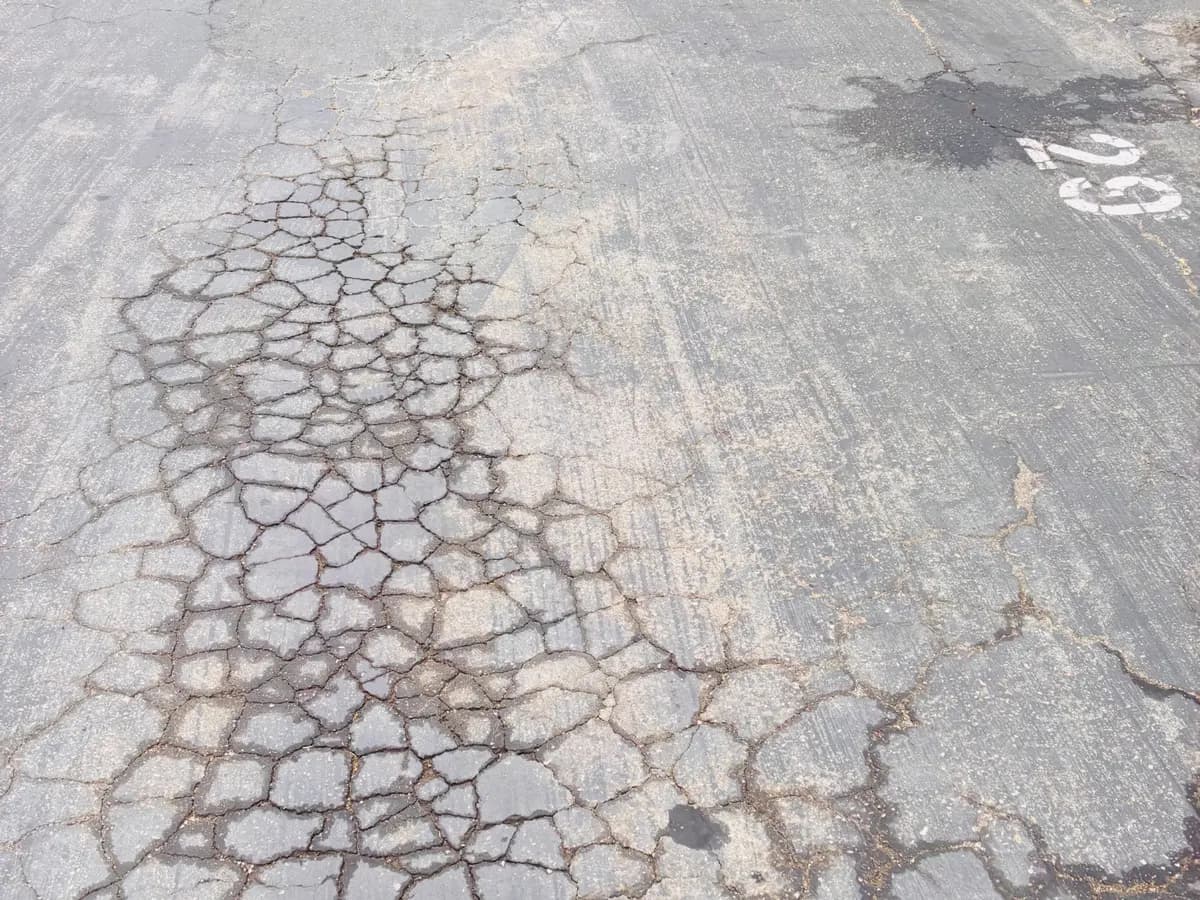
  • Alligator cracking where clay subgrade stays wet
  • Erosion at pavement edges on sloped sites
  • Rutting at distribution and retail delivery areas

What it means for the work

  • Drainage correction usually precedes surface work
  • Nutrient-sensitive watershed rules apply in parts of the region
  • Sloped sites need a designed flow path, not just a grade away from the building

Coastal Plain and Sandhills

Fayetteville · Rocky Mount · Greenville · Lumberton

Environmental stress

  • Heavy tropical rainfall and inland flooding
  • Hot, humid summers
  • Agricultural and military truck traffic

Subgrade conditions

  • Sandy soils that drain quickly but provide limited cohesion
  • Flat terrain with poor natural fall to an outlet
  • High water table in the lower Coastal Plain

Common distress

  • Base saturation during prolonged wet periods
  • Flood-related washout well inland from the coast
  • Edge break-up where sandy shoulders offer no support

What it means for the work

  • Flat sites need designed positive drainage, not minimal slope
  • Sandy subgrade needs confinement and edge support
  • Military installation work carries its own requirements and standards

Coastal counties and the Outer Banks

Wilmington · Jacksonville · New Bern · Nags Head

Environmental stress

  • Direct hurricane and storm surge exposure
  • High groundwater and tidal influence
  • Salt air along the immediate coast
  • Blowing sand in the barrier island communities

Subgrade conditions

  • Sand with a high water table
  • Organic and marsh-adjacent soils on many parcels
  • Fill over former wetland in developed areas

Common distress

  • Storm washout and edge undermining
  • Settlement around inlets and structures
  • Sand accumulation blocking drainage

What it means for the work

  • Coastal management review can apply on top of local permitting
  • Post-storm assessment should look beneath the surface
  • Seasonal occupancy peaks limit acceptable work windows

Mountains and western North Carolina

Asheville · Boone · Hendersonville · Waynesville

Environmental stress

  • Real freeze-thaw cycling and winter snow at elevation
  • Very heavy rainfall in parts of the mountain region
  • Steep terrain concentrating runoff

Subgrade conditions

  • Rocky residual soils over bedrock
  • Shallow rock and steep grades on many parcels
  • Colluvial soils on slopes with stability considerations

Common distress

  • Freeze-thaw potholing in late winter
  • Erosion and undermining at pavement edges
  • Cracking at transitions between rock and soil subgrade

What it means for the work

  • Crack sealing before winter has real value here, unlike the coast
  • Slope stability warrants attention on hillside parcels
  • The construction season is shorter and books out earlier

Common Pavement Problems in North Carolina

Piedmont clay saturation

Alligator cracking in the lower areas of a lot, pavement that feels soft after wet weather, and repairs that fail in the same locations year after year.

Likely causes

  • Clay subgrade holding water rather than draining it
  • Grading with no positive fall to an outlet
  • Base material with too many fines to drain

When to get it looked at: Repeat failure in the same areas is a drainage problem, not a surface one. Ask whether the base was dry when the last repair went in.

Inland flood damage

After a tropical system, pavement edges undermine and sections drop at properties nowhere near the coast, sometimes with little visible surface damage.

Likely causes

  • Extreme rainfall producing riverine and flash flooding well inland
  • Floodwater moving through and beneath the pavement structure
  • Drainage systems overwhelmed and blocked with debris

When to get it looked at: After a flood, have edges, structures, and any area that moves under load evaluated before returning heavy traffic. Surface appearance is a poor guide to what happened below.

Sandy subgrade edge failure

Pavement breaking away along the perimeter of Coastal Plain and Sandhills lots, especially where vehicles run partly off the edge.

Likely causes

  • Sandy soils offering little cohesion or edge support
  • No shoulder, curb, or confinement at the pavement edge
  • Water washing material out from beneath the edge

When to get it looked at: Edge failure that keeps recurring means the edge condition itself needs to change — confinement or a shoulder — rather than another strip of patching.

Mountain freeze-thaw damage

Potholes and crack deterioration developing through late winter in Asheville, Boone, and the western counties, in lots that carried the same traffic all season.

Likely causes

  • Water entering unsealed cracks and freezing repeatedly
  • Meltwater trapped above still-frozen subgrade
  • Snow and ice operations abrading the surface

Distribution and delivery rutting

Wheel-path depressions and shoving at dock aprons and turning areas around Piedmont distribution facilities and large retail properties.

Likely causes

  • Slow, heavy, channelized truck loading
  • High summer pavement temperatures reducing mix stiffness
  • Sections built for lighter traffic than the site now carries

Paving and Maintenance Calendar for North Carolina

Treat this as a planning aid, not a rule. Whether a given treatment can actually be placed on a given day depends on product requirements, surface and nighttime temperatures, the rain forecast, humidity, plant availability, the project specification, and the contractor’s means and methods.

Winter

Work often suited to this window

  • Crack sealing during cool, dry stretches
  • Assessments and budgeting
  • Repairs during mild spells in the east

Scheduling risks

  • Ice events shut down properties briefly without sustained freezing
  • Mountain properties are effectively out of season
  • Winter rain keeps Piedmont clay subgrade wet

Inspect for: Note where water stands after winter rain and how long it takes to clear.

Regional exception: Western North Carolina experiences genuine freeze-thaw; the coastal counties rarely do.

Spring

Work often suited to this window

  • Paving, overlays, and reconstruction
  • Drainage corrections ahead of hurricane season
  • Striping and accessibility work

Scheduling risks

  • Pollen season affects coating and marking adhesion
  • Severe storms interrupt work
  • Demand peaks and lead times stretch

Inspect for: Separate winter surface damage from base failure before pricing repair work.

Summer and hurricane season

Work often suited to this window

  • Sealcoating and surface treatments in dry stretches
  • Paving with attention to placement temperature
  • Post-storm assessment and repair

Scheduling risks

  • Afternoon storms interrupt placement regularly
  • Named storms suspend work and disrupt supply, including inland
  • Coastal properties face seasonal occupancy constraints

Inspect for: Check drainage after every significant rainfall and walk truck areas during the hottest hours.

Regional exception: Inland properties should not assume hurricane risk is a coastal-only concern — North Carolina's worst storm flooding has been well inland.

Fall

Work often suited to this window

  • Crack sealing before mountain and Piedmont winter
  • Final paving in favorable conditions
  • Drainage cleaning and leaf debris removal

Scheduling risks

  • Mountain night temperatures close the window early
  • Late-season tropical systems remain possible

Inspect for: Confirm cracks are sealed and inlets are clear before winter rain and mountain freeze-up.

Contractor Licensing and Verification in North Carolina

Statewide licensing
State-level licensing applies
Administering body
North Carolina Licensing Board for General Contractors
Classifications that can apply to pavement work
Highway · Building · Public Utilities

North Carolina requires a general contractor license for projects at or above a statutory dollar threshold, issued by the North Carolina Licensing Board for General Contractors. Licenses are issued in classifications, and the Highway classification is the one that typically covers grading, paving, and related site work. Building and Public Utilities classifications cover different scopes.

Verify both the license and the classification through the board's licensee search. A contractor holding a Building classification is not thereby qualified under the board's framework for a highway or paving scope, and the distinction matters more here than in states without classifications. The search also shows license limitation — the dollar value of work the license permits — which is worth checking against your project size.

Because the requirement is tied to project value, a small repair may fall below the threshold while a full reconstruction of the same lot does not. If your project is near the line, ask the contractor how they are licensed for it.

Confirm the entity through the Secretary of State, verify insurance directly with the carrier, and check whether the local jurisdiction requires additional permits — in North Carolina, local land disturbance permitting is frequently the practical gating item on a project of any size.

What a contractor license does not prove

A North Carolina license and classification confirm scope eligibility and a dollar limitation. Neither establishes that the contractor has built pavement that survives your region's specific subgrade.

  • That the proposed scope is the right fix for what is actually failing
  • That the price is fair for the local market
  • That drainage has been designed or corrected
  • That the pavement section and thickness suit the traffic the property carries
  • That the specified materials are appropriate for the site
  • That the crew will show up when promised
  • That workmanship will hold up past the first winter or summer
  • That the company is financially stable enough to honor a warranty

Ask for a certificate of insurance sent directly from the carrier or agent rather than a copy forwarded by the contractor, confirm the general liability and workers’ compensation coverage is active on the dates of your work, and ask to be named as certificate holder so you are notified if the policy lapses.

Licensing requirements can turn on project value, scope of work, property location, and whether the job is public or private. City and county rules may add registration, permitting, or bonding requirements beyond anything required at the state level. Verify current requirements with the agency directly before contracting.

Last reviewed:

Stormwater and Environmental Considerations

North Carolina administers construction stormwater and sedimentation control through the Department of Environmental Quality. Projects disturbing enough ground generally require an approved erosion and sedimentation control plan along with construction stormwater permit coverage, and the state's sedimentation program is actively enforced.

The post-construction picture varies more by location here than in most states. Nutrient-sensitive watershed rules apply in parts of the Piedmont, water supply watershed rules apply elsewhere, and the twenty coastal counties fall under the state's coastal area management program, which adds development standards and permitting that inland counties do not face. Which set applies is a function of where the property sits.

Local governments layer their own land disturbance permitting, detention, and buffer requirements on top of that. For a paving project of any size, local approval timing is usually what governs the schedule rather than the state permit.

What tends to drive requirements here

  • Disturbed area, which drives erosion control plan approval and stormwater coverage
  • Whether the property is in a nutrient-sensitive or water supply watershed
  • Coastal area management requirements in the twenty coastal counties
  • Local land disturbance permitting and detention requirements
  • Riparian buffer rules where a project is near a stream
  • Floodplain status, particularly for inland properties with flood history

Watershed-specific and coastal requirements in North Carolina differ substantially by location, and local rules can exceed state minimums. Confirm with the local authority and DEQ before design.

Last reviewed:

Pavement Terms You May Encounter in North Carolina

TermWhat it means on a North Carolina project
SuperpaveThe mix design system used to match binder grade and aggregate structure to expected traffic and temperature. North Carolina suppliers use this vocabulary when discussing mixes for truck areas.
Aggregate base course (ABC)The compacted crushed stone base layer used across North Carolina. On Piedmont clay its thickness and drainage quality usually matter more than the asphalt above it.
Geotextile separation fabricFabric between subgrade and base that keeps clay from pumping into the stone. On wet Piedmont clay it can make a substantial difference to pavement life.
Riparian bufferA protected vegetated strip along a stream. In several North Carolina watersheds these are regulated, and they can constrain what a project may do near the low side of a property.
Full-depth reclamation (FDR)Pulverizing existing asphalt and base together, treating the blend, and repaving over it. Useful on larger lots and private roads where the base has failed.
Chip seal / surface treatmentAn asphalt binder application covered with aggregate, common on rural roads and large private roads. It is a surface treatment, not a structural repair.

State transportation specifications can provide useful regional terminology and material references, but they do not automatically govern private parking-lot or driveway projects unless incorporated into the contract or required by the applicable jurisdiction.

More definitions are in the pavement glossary.

Common Pavement Projects in North Carolina

Distribution and manufacturing facilities

Piedmont corridor development concentrates truck loading at docks and turning areas on clay subgrade that gives up strength when it is wet.

Military installations and adjacent properties

Fayetteville, Jacksonville, and Goldsboro-area facilities carry heavy equipment loading, often on sandy subgrade with limited edge support.

Coastal resort and rental properties

Storm exposure, sand accumulation, and seasonal occupancy mean the damage and the acceptable work window fall in different parts of the year.

University and hospital campuses

Research Triangle and other campuses need continuous access, and the practical construction window compresses into breaks.

Mountain hospitality and resort properties

Freeze-thaw damage, snow operations, and a short construction season shift the emphasis toward crack sealing and durable markings.

Questions to Ask a Paving Contractor in North Carolina

North Carolina pavement FAQs

Does North Carolina require a license for paving contractors?

North Carolina requires a general contractor license for projects at or above a statutory dollar threshold, issued by the North Carolina Licensing Board for General Contractors in classifications. The Highway classification is the one that typically covers grading, paving, and related site work. The board's licensee search shows both the classification and the license limitation — the dollar value of work permitted — and both are worth checking against your project before signing.

How does pavement differ between the Piedmont and the Coastal Plain?

Almost entirely. Piedmont red clay drains poorly, so the problem is water sitting in the pavement structure and softening the subgrade, producing alligator cracking in low areas. Coastal Plain sand drains quickly but offers little cohesion, so the problem is edge failure and lack of support, made worse by a high water table in the lower Coastal Plain and by very flat terrain with no natural fall. The right design and the right maintenance program differ fundamentally between them.

Do hurricanes only affect coastal North Carolina pavement?

No, and that assumption has cost inland property owners real money. North Carolina's most damaging storm flooding has occurred well inland, driven by extreme rainfall producing riverine and flash flooding rather than by surge. Floodwater moving through and beneath pavement washes out base material and undermines edges while the surface can still look intact. Any property with flood history should have edges and structures evaluated after a major event, regardless of distance from the coast.

What are nutrient-sensitive watershed rules and do they affect my project?

Parts of North Carolina's Piedmont drain to watersheds where the state applies additional nutrient management requirements, and other areas fall under water supply watershed protections. Whether they affect a paving project depends on the property's location and the scope, particularly whether impervious area is changing. Because which rules apply is entirely a function of where the property sits, it is worth confirming during design rather than during permitting.

Why does the edge of my Coastal Plain parking lot keep breaking away?

Sandy subgrade provides very little cohesion, so pavement edges without a curb, shoulder, or other confinement have nothing holding them. Vehicles running partly off the edge break it down, and water washes material out from beneath. Patching the edge repeatedly does not change the condition that caused it — the edge itself usually needs confinement, a proper shoulder, or a widened section for the traffic that actually uses it.

Is the paving season shorter in western North Carolina?

Yes. Asheville, Boone, and the western counties experience genuine winter conditions and freeze-thaw cycling, which closes the reliable window for asphalt placement and surface treatments earlier than in the Piedmont and considerably earlier than on the coast. Mountain properties also see real value from fall crack sealing, which does comparatively little for a Wilmington lot. Booking mountain work earlier in the year is a practical necessity, not a preference.

What is a land disturbance permit and does my project need one?

It is the local approval governing grading and soil disturbance, issued by the city or county alongside the state's erosion and sedimentation control requirements. In North Carolina it is frequently the practical gating item on a paving project of any size, and the approval timeline can be longer than the construction. Ask early who is responsible for obtaining it and whether that time is reflected in the contractor's schedule.

Browse cities in North Carolina

Browse services in North Carolina

Related reading for North Carolina property owners

North Carolina Agencies and Reference Links

This page summarizes publicly available information for general education. It is not legal, engineering, or code-compliance advice, and requirements change. Confirm anything that affects your project with the agency with jurisdiction over the property.

Regulatory content last reviewed:

For contractors

Are you a pavement contractor in North Carolina?

Get listed where property managers, owners, and facility teams search by state, city, and service.