
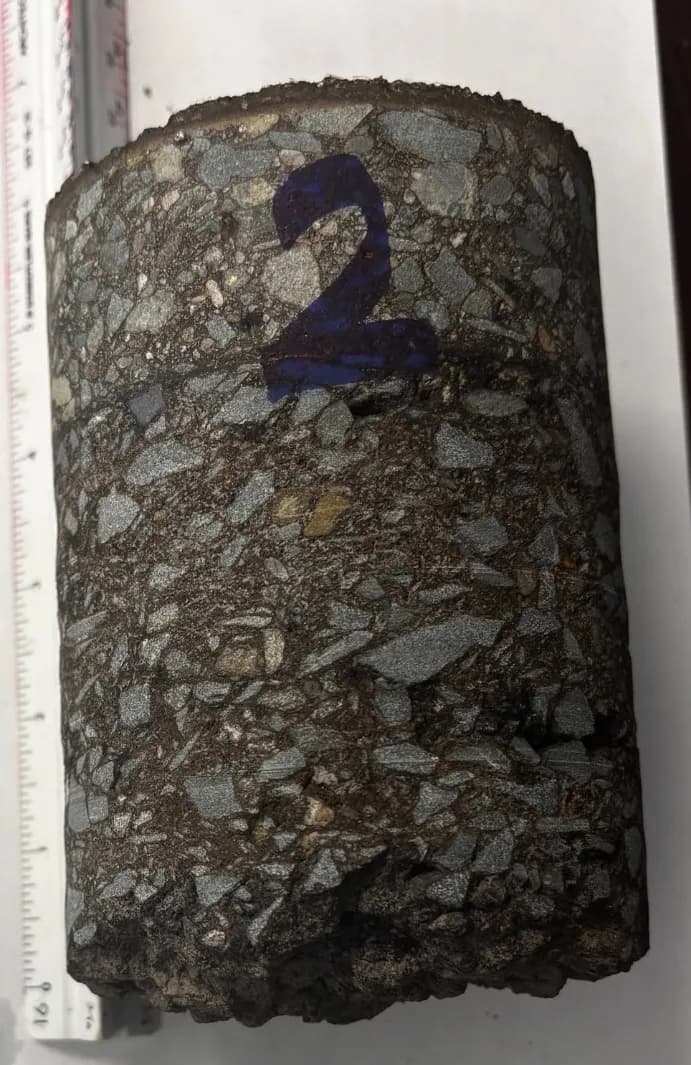
Direct answer
A commercial pavement condition assessment commonly includes a site inspection, distress identification, photographs, condition mapping, repair recommendations, approximate quantities, priority rankings, and budget guidance. More advanced assignments may include Pavement Condition Index scoring, coring, deflection testing, elevation surveys, drainage analysis, laboratory testing, engineering design, or construction-phase services.
The right provider depends on whether the owner needs a basic maintenance proposal, an independent capital plan, an engineered repair design, or a forensic investigation.
Quick summary
- Not every pavement assessment provides the same level of detail.
- Contractor inspections are useful for straightforward repair pricing.
- Independent consultants are useful when scope objectivity matters.
- Engineering or testing may be appropriate for repeated failures or major reconstruction.
- A useful report should locate conditions, not merely describe them.
- Recommendations should distinguish maintenance, repair, rehabilitation, and replacement.
- Assumptions and exclusions should be explicit.
What is a pavement condition assessment?
A pavement condition assessment is a structured review of the visible condition and serviceability of a paved property. It may cover:
- Asphalt parking lots
- Private roads
- Drive lanes
- Loading areas
- Industrial yards
- Concrete sidewalks and flatwork
- Curbs and gutters
- Drainage structures
- Striping and markings
- Accessible parking areas
- Utility trenches
- Building approaches
The purpose is to convert site conditions into an actionable plan.
What does a commercial pavement assessment include?
| Assessment component | Typical purpose |
|---|---|
| Site inventory | Divides the property into logical pavement sections |
| Asphalt distress review | Documents cracking, potholes, rutting, raveling and failed areas |
| Concrete review | Identifies displacement, cracking, spalling and trip hazards |
| Drainage observations | Records ponding, settlement and damaged drainage areas |
| Striping observations | Notes faded, missing or conflicting markings |
| Accessibility observations | Flags visible conditions that may require qualified review |
| Photographs | Creates a dated visual record |
| Condition map | Locates deficiencies by area |
| Repair quantities | Supports budgeting and contractor pricing |
| Priority ranking | Separates immediate, near-term and long-term work |
| Treatment recommendations | Identifies maintenance, repair, overlay or reconstruction candidates |
| Budget framework | Supports annual and multi-year capital planning |
The proposal should identify which of these deliverables are included.
Levels of pavement assessment
Contractor site walk
A contractor inspects the property and recommends work the company can perform.
Best for:
- Obtaining a repair proposal
- Pricing obvious patching or coating work
- Planning a straightforward maintenance project
- Identifying immediate field concerns
Limitations:
- Recommendations may focus on the contractor's service offering
- A formal condition rating may not be included
- Alternative treatment strategies may be limited
- The contractor may not provide an independent bid document
Independent pavement consultant assessment
A consultant evaluates the property for planning or procurement rather than immediately selling construction work.
Best for:
- Large commercial sites
- Multi-property portfolios
- HOA reserve planning
- Conflicting contractor recommendations
- Phased rehabilitation programs
- Preparing a neutral scope for competitive bidding
Potential deliverables:
- Condition maps
- Priority rankings
- Repair quantities
- Treatment alternatives
- Multi-year budgets
- Bid scopes
- Proposal comparisons
- Construction observation
Engineering assessment
A civil, pavement, or geotechnical engineer may be appropriate where design or structural analysis is needed.
Potential uses:
- Repeated pavement failures
- Heavy truck or industrial traffic
- New pavement design
- Major reconstruction
- Drainage redesign
- Subgrade problems
- Pavement-section recommendations
- Public-works or institutional requirements
Forensic investigation
A forensic investigation seeks the cause of a failure rather than merely documenting symptoms.
Potential components:
- Historical record review
- Coring
- Test pits
- Density testing
- Material testing
- Drainage investigation
- Deflection testing
- Subgrade evaluation
- Construction-document review
Common pavement conditions assessed
Cracking
- Longitudinal cracks
- Transverse cracks
- Block cracking
- Reflective cracking
- Edge cracking
- Alligator cracking
- Utility-trench cracking
Crack type and pattern help determine whether crack treatment, patching, overlay, or reconstruction is appropriate.
Surface deterioration
- Raveling
- Oxidation
- Loose aggregate
- Delamination
- Oil damage
- Surface wear
Surface treatments may help only when the pavement remains structurally suitable.
Deformation and settlement
- Rutting
- Depressions
- Shoving
- Settlement
- Heaving
- Failed trench patches
These conditions may indicate problems below the visible surface.
Drainage conditions
- Standing water
- Water trapped at curbs
- Settlement around drain inlets
- Roof-drain discharge
- Irrigation overspray
- Failed trench drains
- Erosion at pavement edges
Drainage should be addressed before recommending a surface-only treatment.
What should the final report contain?
A useful commercial report may include:
- Executive summary
- Property and pavement inventory
- Inspection date and weather
- Site map
- Area-by-area observations
- Condition photographs
- Distress map
- Condition rating or prioritization
- Immediate operational or safety concerns
- Maintenance recommendations
- Repair and replacement alternatives
- Approximate quantities
- Budget ranges
- Phased work plan
- Assumptions and limitations
- Recommended further investigation
- Contractor procurement guidance
The report should explain how recommendations were developed.
Pavement Condition Index (PCI) and other condition ratings
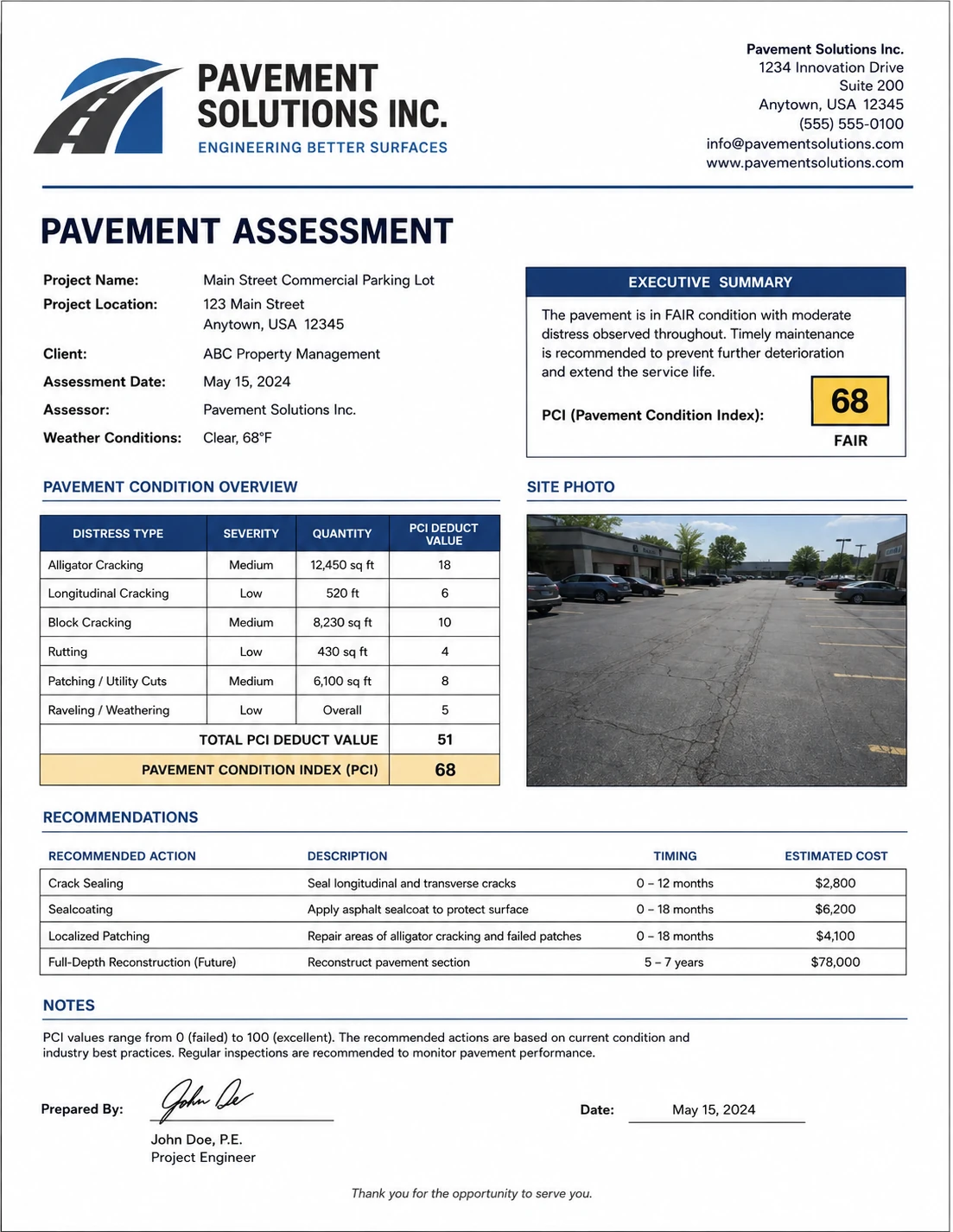
A condition rating turns observed distress into a number, which is what makes one pavement section comparable with another and with itself a year later.
Pavement Condition Index, usually shortened to PCI, is the most widely referenced approach. A formal PCI survey evaluates distress type, severity, and quantity across defined sample units using an established inspection methodology, and produces a score on a 0-to-100 scale.
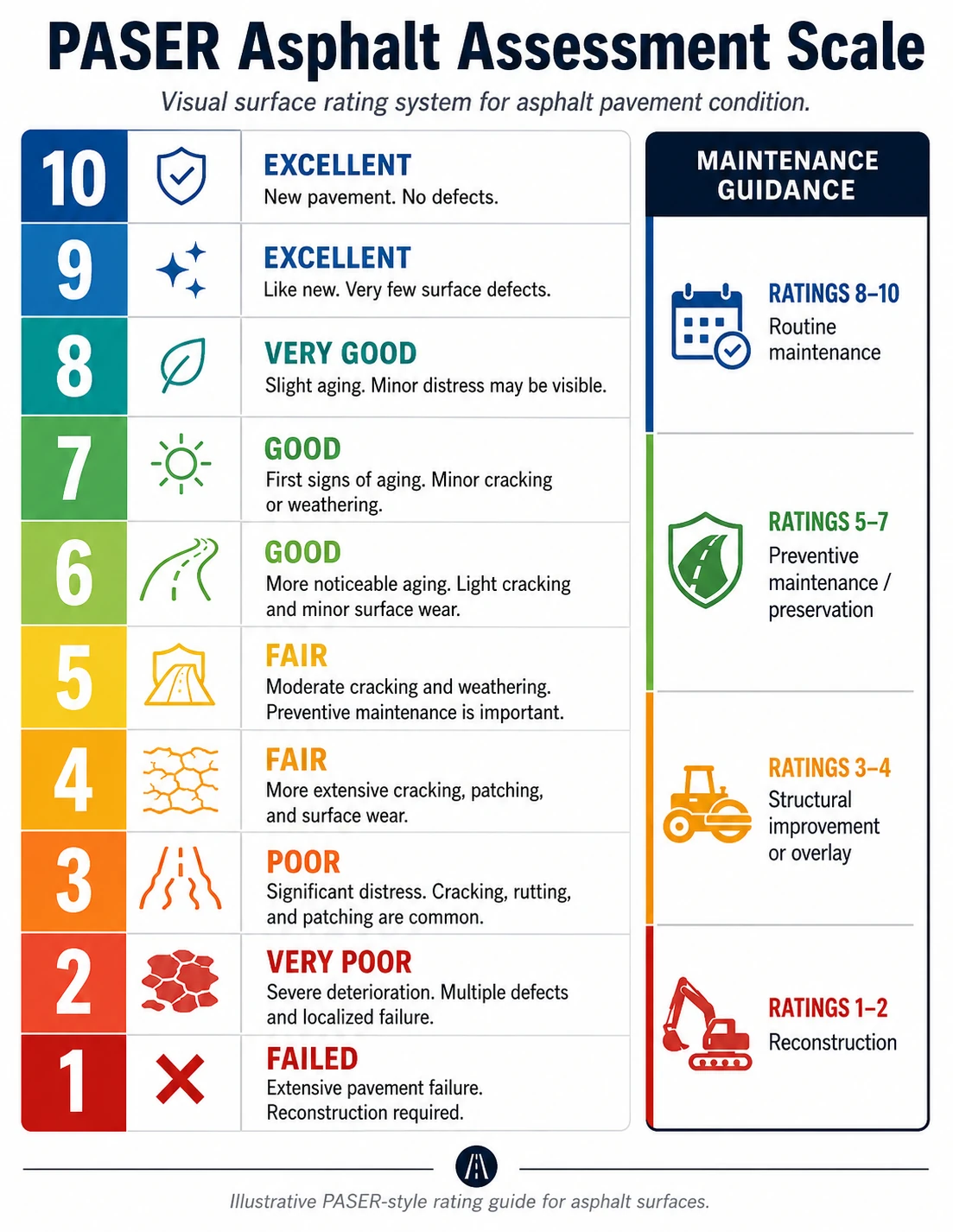
PASER, short for Pavement Surface Evaluation and Rating, is the other system an owner is likely to meet. Developed by the University of Wisconsin-Madison Transportation Information Center, it rates surface condition on a 1-to-10 scale from a visual inspection alone, with no coring or deflection testing behind it. That makes it fast and cheap enough to run across an entire road network, which is why municipalities use it heavily, and it is increasingly borrowed for private lots and community roads.
The trade-off is what a surface rating cannot see. PASER describes the condition of the top of the pavement, not the strength of the structure underneath it, so a lot can rate reasonably well on the surface while the base below it is already failing. A rating of either kind is a starting point for prioritizing work, never the whole diagnosis.
What a condition rating is genuinely useful for:
- Comparing pavement sections against each other on one property
- Comparing whole properties across a portfolio
- Tracking deterioration between inspections
- Ranking work when the budget will not cover everything
- Communicating condition consistently between staff, boards, and contractors
- Supporting a multi-year pavement-management program
The distinction that matters when reading a proposal: a walk-through impression expressed as a number is not a PCI survey. A formal PCI rating requires the defined procedure and trained inspection behind it. Both can be useful, and they should not be described interchangeably.
For most single commercial properties, a clearly reasoned condition narrative with mapped locations and quantities supports the decision just as well. Formal rating earns its cost when sections and properties have to be ranked against each other consistently over time. The directory's free Visual Pavement Condition Screen is a starting point for an owner's own walk-through, not a substitute for either.
How repairs get prioritized
Documenting conditions is the easy half. The value of an assessment is in what comes next: deciding what happens first when the budget will not cover everything at once.
A defensible prioritization considers more than severity:
| Factor | The question it answers |
|---|---|
| Safety and liability | Does this create a hazard to vehicles or pedestrians now? |
| Rate of deterioration | Is this getting worse quickly, slowly, or not at all? |
| Water intrusion | Is this letting water into the pavement structure? |
| Structural condition | Is this a surface defect or a failure of the pavement section? |
| Operational impact | Does this interfere with access, deliveries, or tenant use? |
| Maintenance opportunity | Is there a closing window where a cheap treatment still works? |
| Remaining serviceability | How much useful life does this area still have? |
| Cost and efficiency | Can this be combined with other work in one mobilization? |
Two examples show why severity alone is a poor ranking tool.
A small, isolated area of failed pavement at a main entrance can outrank a large area of faded, oxidized surface, because one is a hazard on the busiest pavement on the property and the other is cosmetic.
Conversely, deferring inexpensive crack sealing across a large, stable, otherwise sound lot rarely appears urgent in any single year, and is one of the most reliable ways to convert a maintenance budget into a rehabilitation budget over time.
The assessment should make these trade-offs visible rather than presenting one undifferentiated list of everything wrong with the property.
Immediate repair versus preventive maintenance
This is the single most useful division an assessment can draw, because the two categories are funded differently, scheduled differently, and justified differently.
Immediate repair addresses pavement that has already failed:
- Potholes and areas of lost material
- Failed pavement and unstable patches
- Severe depressions and settlement
- Significant trip hazards in pedestrian areas
- Drainage failures actively damaging the pavement
Preventive maintenance protects pavement that has not:
- Crack sealing on stable, sound pavement
- Sealcoating where the surface is still intact
- Slurry seal or other preservation treatments where the surface has worn but the structure is sound
- Restriping on a planned cycle
Preventive maintenance only works when there is something left to preserve. Applied over structural failure it produces a better-looking property and no change in its condition, and the money spent is gone. That is why an assessment that does not separate these two categories leaves the most important question unanswered — and why a proposal recommending a surface treatment across a lot with widespread alligator cracking or rutting should be questioned before it is priced.
Turning the assessment into a maintenance plan
Once conditions are documented and located, the property can be divided into treatment groups. This is what converts a report into a plan:
| Area | Condition | Action | Horizon |
|---|---|---|---|
| North parking field | Good | Monitor and re-inspect | Routine |
| West drive aisle | Aging but stable | Crack seal, then preservation | Near term |
| Main entrance | Localized failure | Full-depth repair | Immediate |
| Rear service lane | Widespread surface deterioration | Evaluate resurfacing | Capital |
| Dumpster approach | Structural failure, repeat repairs | Rebuild the section for the load | Capital |
Two things make this more useful than a single condition label for the whole property.
It stops the two most expensive errors at once: replacing pavement that only needed maintenance, and applying maintenance to pavement that had already failed.
And it produces a budget that can be phased. Immediate work is funded this year, near-term work is scheduled, and capital work is forecast far enough ahead that it does not arrive as an emergency. How to create a parking lot maintenance plan covers building the recurring schedule around that structure.
Contractor assessment vs independent assessment
| Contractor assessment | Independent consultant assessment |
|---|---|
| Often free or included in estimating | Usually fee-based |
| Focused on producing a construction proposal | Focused on planning or defining a neutral scope |
| Useful for routine work | Useful for large, disputed, or phased projects |
| May emphasize the contractor's services | Can compare multiple treatment approaches |
| May provide limited documentation | Can provide maps, quantities, priorities and budgets |
| Usually does not include engineering | Can coordinate engineering or testing where needed |
Neither approach is automatically better. The correct choice depends on the decision and risk.
How an assessment improves bid comparison
One of the most practical returns on an assessment has nothing to do with the pavement. It is that contractors end up pricing the same work.
Without a defined scope, three proposals for one property routinely look like this:
- Contractor A prices an overlay across the entire lot with light patching.
- Contractor B prices repairs to the failed areas, plus sealcoating and restriping.
- Contractor C prices full reconstruction of the worst sections and leaves the rest alone.
Those are three different projects. Comparing the totals tells the owner almost nothing, and the lowest number frequently belongs to the narrowest scope.
With an assessment in hand, contractors can be asked to price defined quantities instead:
- 8,000 SF of full-depth repair at marked locations
- 4,200 LF of crack sealing
- 60,000 SF of preservation treatment
- Designated concrete repairs, by location
- Restriping to the existing layout, with stall counts
Now the proposals differ on unit price and approach rather than on what is being built, and the comparison is meaningful. The Three-Bid Decoder helps line up proposals that were written to different scopes in the first place.
Accessible parking in a pavement assessment
ADA access belongs in any serious commercial pavement assessment or HOA site review. Surface work, concrete repairs, drainage corrections, and restriping can all change accessible conditions, which means a paving project can quietly move a lot out of compliance even when nothing was wrong before.
A practical accessible-parking review during an assessment covers:
- Accessible stall and access aisle layout
- Van-accessible designation
- Signs, mounting height, and sign condition
- Pavement markings and their legibility
- Visible slope and drainage concerns in stalls and aisles
- Cracks, holes, and abrupt level changes on the route
- The route from parking to the building entrance
- Curb ramps and transitions
Paint does not fix slope
Restriping can make a parking area look compliant without correcting the surface beneath it. Ponding, cross slope, settlement, overlay thickness, and poor transitions all affect usability even when the symbol and lines are fresh. Blue paint can look correct while slopes, signs, routes, and surface conditions remain problematic.
Before an overlay or a restripe, document how the existing surface drains, where the accessible route begins, and whether concrete or asphalt work will change elevations.
Record the visible condition, not a verdict
Create a dated record with wide and close photographs, the location of each concern, any complaints received, temporary actions taken, contractor recommendations, and the next review date.
Avoid recording that an area is compliant or non-compliant. An assessment records visible condition and escalates measurement questions to a qualified professional. Seek a Certified Access Specialist, accessibility consultant, engineer, or qualified design professional when slope, dimensions, route configuration, technical compliance, or a complaint requires formal evaluation. A property-manager assessment helps identify the need for that review; it does not replace it.
Before approving paving or concrete work
- Clarify who owns accessibility review in the contractor scope of work.
- Document existing stalls, aisles, signs, ramps, and routes first.
- Ask how grade and drainage will change.
- Confirm whether restriping repeats the current layout or corrects it.
- Save measurements, photographs, approvals, and final as-built conditions.
Resurfacing and restriping are generally treated as alterations that trigger current accessible parking standards — see Does Resurfacing Trigger ADA Compliance? before a scope is priced.
Assessments during acquisition and capital planning
An assessment commissioned for a transaction answers a different question from one commissioned for maintenance. The maintenance question is what to do next; the transaction question is what the condition means for price, timing, and the capital plan after close.
Deferred pavement maintenance can distort acquisition assumptions, net operating income projections, tenant experience, accessibility risk, and capital planning. Surface condition affects reserves, lender comfort, tenant renewals, buyer credits, operating interruption, and the timing of future capital calls — which is why pavement belongs in the investment memo rather than in a post-close surprise.
Three questions tend to matter at this stage:
- Is this a pricing issue? Visible distress may indicate near-term capital needs that should be reflected in diligence, a credit, or a post-close budget.
- What does deferral cost? Maintenance pushed too far becomes a larger reconstruction expense and a drag on operating assumptions.
- What should be funded first? Repairs, overlays, accessibility upgrades, concrete flatwork, striping, and phasing need to be sorted into an owner-ready sequence rather than a single lump.
An assessment is useful during acquisition diligence, annual business planning, refinance preparation, and hold-or-sell capital planning. It is a condition and planning document, not an appraisal, a property condition assessment under an ASTM standard, an engineering report, or a legal opinion — if the transaction requires any of those, commission them separately.
The NOI impact calculator translates deferral into operating and capital terms, and the paving budget estimator turns the findings into a planning range.
Pavement assessment versus reserve study
An HOA reserve study and a pavement assessment overlap, and boards sometimes assume one replaces the other.
A reserve study looks across every capital asset a community owns — roofs, pools, fencing, pavement — and answers a funding question: how much should be set aside each year, and when will each asset need replacing. Pavement appears in it as one line, usually with a remaining-life estimate and a replacement cost.
A pavement assessment goes down instead of across. It divides the pavement itself into sections, documents current condition in each, distinguishes maintenance from repair from replacement, quantifies the work, and sequences it.
The two are complementary rather than interchangeable. An assessment gives the reserve study a defensible basis for its pavement line, and it gives the board something the reserve study cannot: a plan for the years between now and replacement. The HOA Reserve Estimator is a rough starting point for the funding side of that conversation.
When should a property be assessed?
Consider an assessment:
- Before annual budget preparation
- Before a reserve-study update
- Before requesting major paving proposals
- When bids recommend conflicting scopes
- Before acquisition or disposition
- When repairs repeatedly fail
- Before a large overlay
- When drainage problems are widespread
- When accessible parking areas are being altered
- When managing multiple properties under one capital plan
- When the owner needs objective repair priorities
How often should pavement be assessed?
There is no universal interval, and any provider offering one is describing their service rather than your property. Frequency should follow pavement age, condition, traffic, climate, drainage, maintenance history, and the owner's budget cycle.
What matters more than the interval is that someone is watching. A formal assessment every few years, combined with simple documented walk-throughs in between, is more useful than a detailed report that is filed and never revisited.
The single most valuable thing routine observation produces is change. Knowing that a rut is two inches deep is useful. Knowing it was one inch deep last spring is what separates a stable defect from an active failure, and no one-time inspection can supply it. Dated photographs of the same locations, taken after rain, cost nothing and answer a question a site visit cannot. The Parking Lot Maintenance Checklist is a reasonable structure for those interim walks.
Assessments for HOAs and multi-site portfolios
HOAs and community associations
Community pavement projects frequently exceed what an annual operating budget can absorb, so the planning horizon has to be longer than one year. A useful HOA assessment sorts work into four buckets the board can actually budget against:
- Immediate — severe potholes, major trip hazards, rapidly failing areas, active drainage problems
- Near term — localized patching, crack treatment, concrete repairs, failing utility trenches
- Preventive maintenance — crack sealing, sealcoating, slurry seal, and other preservation where the pavement still qualifies
- Long-term capital — resurfacing, phased replacement, private road reconstruction
A community with private streets, parking areas, and pedestrian concrete will usually end up with more than one treatment across the same property in the same plan. That is the correct outcome, not a sign of an inconsistent recommendation.
Multi-site portfolios
Owners and managers responsible for many properties need consistency more than they need depth on any one site. If each property is inspected differently, the portfolio cannot be ranked.
A portfolio-level record should carry the same fields for every site:
- Property and pavement section
- Condition and approximate area
- Immediate repairs and estimated cost
- Maintenance needs
- Projected rehabilitation and year
- Priority relative to the rest of the portfolio
- Notes and inspection date
That turns twenty properties into one prioritized capital plan, rather than twenty separate conversations competing for the same budget on whoever escalates loudest.
Should the assessment include cost estimates?
It usually should, with one distinction stated clearly.
Planning-level budgets are what make an assessment actionable. They let an owner size immediate funding needs, set an annual maintenance budget, forecast capital reserves, and phase a project across fiscal years.
But a planning estimate and a contractor proposal are different instruments, and a report should never blur them. A planning estimate is built from measured quantities and unit costs drawn from recent projects and market ranges. A proposal is a price a specific contractor will stand behind, based on their crews, their schedule, their access to the site, and their read of the risk.
Real bids diverge from planning estimates for reasons that have nothing to do with the estimate being wrong: site access, phasing requirements, traffic control, material prices, disposal, mobilization, and how busy the market is that season. The directory's cost guides — including asphalt resurfacing cost and asphalt paving cost — publish planning ranges on exactly that basis.
An assessment that reduces total spending usually does so by redirecting it rather than shrinking it. A property where 10% of the pavement needs deep repair, 50% needs only maintenance, and 40% needs nothing this year is a very different budget from one priced as a single uniform treatment — in both directions.
What may not be included
Unless specifically contracted, an assessment may not include:
- Survey-grade elevations
- Subsurface investigation
- Core sampling
- Laboratory testing
- Engineering design
- Drainage calculations
- Accessibility certification
- Legal review
- Permit documents
- Contractor bidding
- Construction inspection
- Guaranteed repair pricing
- Warranty administration
Questions to ask an assessment provider
- What decisions will the report support?
- Is the provider independent from the contractor bidding the work?
- What pavement areas and site elements are included?
- Will the property be divided into condition sections?
- Will the report include a map?
- Will repair quantities be measured?
- Will treatments be prioritized?
- Will budget ranges be provided?
- Is a formal condition score included?
- Are drainage and concrete included?
- Are accessibility observations included?
- What testing is excluded?
- Can the provider prepare bid scopes?
- Can the provider review contractor proposals?
- What qualifications and similar projects can the provider show?
Frequently asked questions
What is a pavement assessment?
It is a documented review of pavement and related site conditions used to identify deficiencies, recommend treatments, establish priorities, and support budgeting.
What does a commercial pavement assessment include?
Depending on scope, it may include inspection, photographs, mapping, distress identification, condition ratings, quantities, treatment recommendations, priorities, and budget guidance.
Who performs pavement assessments?
Providers may include pavement consultants, civil engineers, pavement-management firms, qualified contractors, reserve-study professionals, and specialized testing or inspection firms.
Is a contractor's free assessment enough?
It may be enough for a straightforward repair proposal. An independent assessment is more useful when the owner needs neutral planning, a competitive bid scope, or analysis of conflicting recommendations.
What is a Pavement Condition Index?
PCI is a structured condition-rating method based on observed pavement distress. A formal PCI survey requires defined procedures and trained inspection. Not every pavement assessment includes PCI.
How often should a commercial parking lot be assessed?
The appropriate interval depends on age, condition, climate, traffic, drainage, prior repairs, and capital-planning needs. Properties should at least be observed routinely and documented before major budget or rehabilitation decisions.
How are pavement repairs prioritized?
A defensible ranking weighs safety and liability, how fast the condition is deteriorating, whether water is entering the pavement structure, whether the defect is structural or cosmetic, operational impact on the property, remaining serviceable life, and whether a closing maintenance window makes cheap treatment possible now. Severity alone is a poor ranking tool.
Can a pavement assessment help compare contractor bids?
Yes, and this is one of its most practical returns. Defining repair quantities and treatment areas before contractors bid means proposals differ on unit price and approach rather than on what is being built, which makes the totals comparable for the first time.
How much does a pavement condition assessment cost?
Pricing depends on property size, the number of pavement sections, whether mapping is included, report detail, any testing or coring, the condition-rating methodology, travel, and whether budgeting or design services are part of the scope. Request a scope-specific proposal rather than a per-square-foot rate.
Should pavement be assessed before buying a commercial property?
Yes, where pavement is a material part of the site. Deferred maintenance can affect pricing, credits, reserve assumptions, and the first years of the capital plan, and it is far cheaper to learn about it during diligence than after close. A pavement assessment for a transaction is a condition and planning document; it is not an appraisal, an ASTM property condition assessment, or an engineering report.
Does a pavement assessment include ADA compliance review?
Not automatically. A general assessment may note visible accessible-parking conditions such as ponding, surface deterioration, faded markings, or apparent slope concerns, but formal accessibility review requires separate qualified evaluation. Confirm what is and is not included before assuming the report covers it.
Is a reserve study the same as a pavement assessment?
No. A reserve study looks across all of a community's capital assets to answer a funding question, with pavement as one line item. A pavement assessment goes into the pavement itself — section by section condition, quantities, treatment recommendations, and sequencing. An assessment gives a reserve study a defensible basis for its pavement number.
Before you hire: The Pavement Directory does not guarantee contractor performance, pricing, licensing, insurance, or availability. Business information may be submitted by contractors or gathered from public sources and should be independently verified before hiring. Always confirm licensing, insurance, references, scope of work, and written contract terms.
For property owners
Looking for a pavement contractor?
Use The Pavement Directory to search asphalt, concrete, sealcoating, striping, ADA access, and pavement maintenance contractors by service and location. Always verify license, insurance, references, and written scope before hiring.
Search contractorsFor contractors
Are you a pavement contractor?
Contractors can add or claim a company profile to help property owners find pavement professionals by service, location, and specialty.