
Direct answer
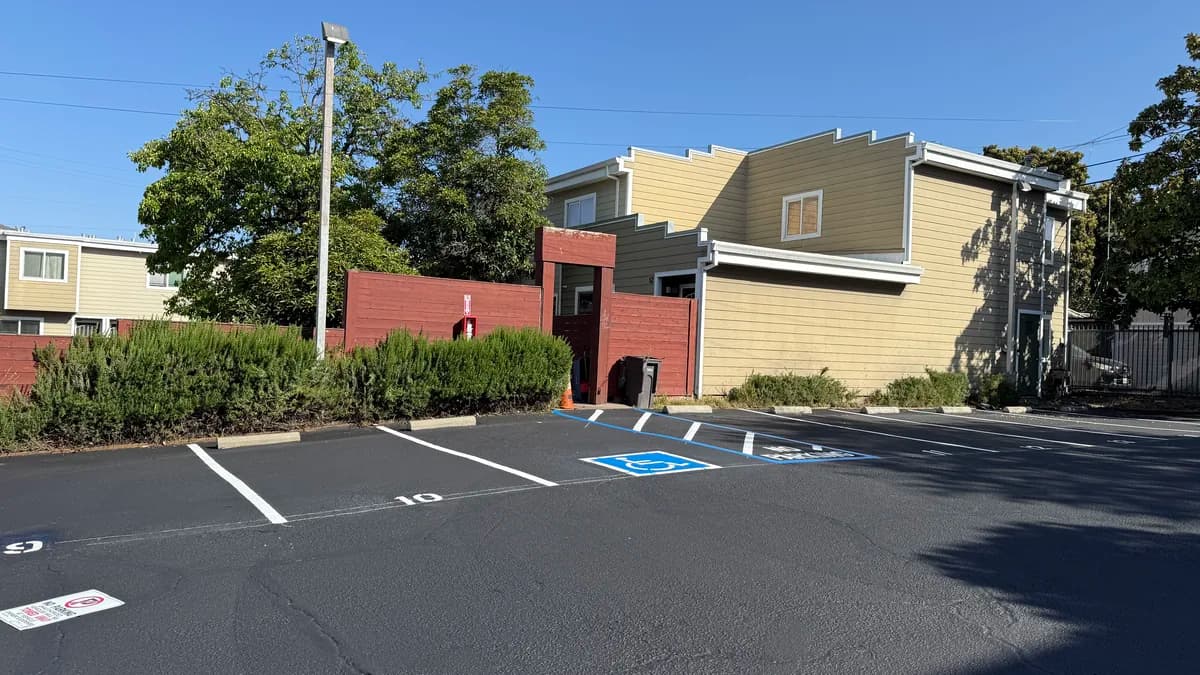
ADA handicap parking painting generally includes marking accessible parking spaces and access aisles, applying the International Symbol of Accessibility where required by the project or local standard, and installing or replacing identification signs. Before painting, the contractor should confirm the intended layout, identify obsolete markings, review the surface condition, and clearly state whether layout verification or accessibility consulting is included.
A striping contractor can paint the markings shown in an approved layout. The contractor should not automatically be treated as the professional responsible for certifying that the entire property complies with federal, state, and local accessibility requirements.
Quick summary
- Accessible parking work is not limited to blue paint and a wheelchair stencil.
- Parking spaces, access aisles, signs, slopes, routes, and surface conditions can all affect the finished result.
- Old markings may need removal rather than simply being painted over.
- Striping cannot correct excessive pavement slope or an inaccessible route.
- The proposal should state who is responsible for layout and dimensions.
- State and local requirements may be more specific than the federal minimums.
- Site-specific review may require a consultant, design professional, inspector, or local authority.
ADA handicap parking painting explained
ADA handicap parking painting is the name property owners most often use for the pavement-marking work that makes an accessible parking space visible and usable. Contractors usually call the same work ADA striping, accessible parking striping, or handicap striping. All of them describe the same core scope: painting the stall boundary, marking the access aisle beside it, applying the required symbols, and installing or replacing the sign that identifies the space.
The wording matters when comparing proposals, because a request to paint the handicap spots can mean four different projects.
| What the owner asks for | What the work usually involves |
|---|---|
| Repaint the faded handicap spaces | Repainting stall lines, aisle hatching and symbols on the layout that already exists |
| Paint new handicap spaces | Laying out stalls and aisles that do not exist yet, then painting them and setting signs |
| Fix our handicap parking | Layout review, removal of obsolete lines, repainting, signs and often concrete or asphalt work |
| Make the lot ADA compliant | An accessibility review by a qualified professional, followed by whatever construction that review identifies |
Only the first two are painting scopes. The last two involve layout, slope, and code decisions a paint crew is not necessarily contracted or qualified to make. Identifying which one applies, in writing, is the most useful thing an owner can do before requesting prices.
What actually gets painted in an accessible stall
- The stall boundary lines that define the parking space
- The access aisle beside the stall, marked so it is not mistaken for a parking space
- Diagonal hatch lines within the access aisle
- The International Symbol of Accessibility where the project or local standard calls for it
- "NO PARKING" lettering in the access aisle where required
- Curb paint or edge markings where the jurisdiction requires them
Signs are a separate line item. A painted symbol on the pavement does not replace the identification sign an accessible space generally requires.
Handicap parking or accessible parking?
Both terms remain in everyday use. Federal materials and current design standards generally use accessible parking, while handicap parking is still the phrase most owners and tenants use day to day. Striping contractors answer to either. Use whichever term the people reading the proposal will understand, then make sure the written scope describes the actual markings, dimensions, and signs rather than relying on the label to carry the meaning.
What ADA parking lot striping may include
A project may include some or all of the following:
- Accessible parking stall boundary lines
- Access aisle boundary lines and hatch markings
- International Symbol of Accessibility pavement markings
- Van-accessible designation signs
- Accessible parking identification signs
- "No Parking" pavement text where required
- Curb painting or markings required by the jurisdiction
- Removal or obscuring of obsolete parking lines
- Reconfiguration of standard parking stalls
- Crosswalks and pedestrian-route markings
- Wheel-stop relocation
- Sign-post installation or replacement
- Restriping after paving or sealcoating
- Traffic control while the paint dries
The federal ADA standards require accessible parking spaces and access aisles to meet dimensional, slope, surface, signage, and route-related criteria. Access aisles must be marked to discourage parking, and accessible spaces generally require identification signs. State and local standards may add paint colors, wording, curb markings, towing signs, or other details.
ADA striping is more than painting
A newly painted space can still have serious accessibility problems.
Striping does not correct:
- Excessive running slope or cross slope
- A raised lip between the access aisle and sidewalk
- A curb ramp projecting into an access aisle
- Broken, displaced, or spalled concrete
- An obstructed accessible route
- Standing water in the stall or access aisle
- Incorrect vertical clearance for a van route
- Missing or improperly mounted signs
- A route that passes through unsafe or blocked areas
- An insufficient number of accessible spaces
- A layout that does not connect to an accessible entrance
The current federal standard generally limits slopes within accessible parking spaces and access aisles to 1:48, approximately 2.08 percent, in all directions. That cannot be verified with paint alone.
Restripe the existing layout or redesign it?
Before work begins, determine whether the project is:
- Maintenance restriping: Repainting a layout that has already been reviewed and is intended to remain unchanged.
- Layout correction: Moving lines, signs, access aisles, or stalls to correct known issues.
- Post-construction striping: Establishing markings after paving, concrete work, grading, or an accessibility upgrade.
- New design: Creating a layout for a new or substantially altered parking facility.
A contractor asked only to "repaint the existing ADA stalls" may reasonably assume that the owner is providing the layout. If the owner expects the contractor to determine the correct stall count, location, dimensions, route, and signage, that responsibility should be written into the scope.
Restriping to meet the requirements
Painting is where accessible parking requirements become visible, but the requirements themselves — how many spaces a facility needs, how wide stalls and aisles have to be, the slope limit, sign height — sit outside the paint scope. The ADA parking requirements guide covers that baseline. What follows is what those requirements mean for the striping work itself.
What the federal standard does not specify
The federal ADA standard does not prescribe one nationwide paint color for accessible parking pavement markings. It also does not establish every local requirement for:
- Blue borders
- Blue backgrounds
- NO PARKING lettering
- State-specific symbols
- Tow-away signs
- Curb colors
- Sign wording beyond the federal requirements
- Permit or inspection procedures
Check state building codes, local ordinances, adopted accessibility standards, and the specific project requirements before paint or stencils are ordered.
Before restriping after paving or sealcoating
Paving and sealcoating often erase or obscure the old layout. Before final striping:
- Confirm the intended space count.
- Confirm the location of accessible entrances.
- Identify the accessible route.
- Review stall and aisle slopes.
- Determine whether old curb ramps and signs remain suitable.
- Remove conflicting markings.
- Establish control points from an approved plan or verified layout.
- Coordinate sign installation and concrete work.
- Confirm cure time for the asphalt or coating.
- Keep traffic off the area until the markings are ready.
Reproducing an old layout after resurfacing may repeat the same deficiencies it had before.
Who is responsible for the layout
The contract should identify who is responsible for:
- Counting required accessible spaces
- Selecting the location
- Confirming dimensions
- Reviewing slopes
- Identifying the accessible route
- Preparing a striping plan
- Verifying state and local details
- Obtaining permits or approvals
- Certifying or inspecting the completed work
A striping contractor should not be expected to assume unstated design liability simply because the work involves accessible parking markings.
Surface preparation before painting
Paint performance depends on the condition of the pavement.
Typical preparation may include:
- Sweeping and blowing loose debris
- Removing dirt, sand, and vegetation
- Scraping loose or flaking paint
- Treating oil-contaminated areas when feasible
- Grinding, blasting, or obscuring conflicting markings
- Allowing new asphalt or sealcoat to cure
- Repairing failed asphalt before painting
- Replacing damaged concrete or wheel stops
- Marking layout control points before production striping
Painting over dirt, loose paint, fresh uncured coating, or conflicting lines can produce poor adhesion and an unclear layout.
Keeping the access aisle clear
The access aisle beside an accessible stall is marked with diagonal hatching in a contrasting colour, and its function is to stay empty. It is the space a wheelchair user or a side-mounted vehicle lift deploys into.
That makes one common layout fault more serious than it looks: if vehicles route through the striped aisle because it doubles as a drive lane, this is not a design quirk. It obstructs the aisle in use and creates a genuine hazard for someone deploying a ramp. Where an aisle has been absorbed into circulation, the fix is a layout change, not fresh paint.
Where California is more prescriptive
California Building Code Chapter 11B is considerably more specific about markings and signage than the federal standard, and a lot that satisfies the federal requirements can still fail a California inspection.
On top of the federal basics, CBC 11B calls for:
| Element | California requirement |
|---|---|
| Stall symbol | A 36 inch by 36 inch accessibility symbol painted on the stall surface |
| Access aisle | Bordered in blue, with "NO PARKING" in 12 inch letters inside the aisle |
| Signage | Reflectorized, with at least 70 square inches of reflective area |
| Sign mounting | 80 inches where the sign is in a pedestrian circulation path, which describes most parking lots |
| Fine notice | Signs must carry "Minimum Fine $250" text |
| Tow-away notice | Posted at each entrance to the lot, with the enforcing agency and phone number, at least 17 by 22 inches |
Most sign suppliers default to the federal 60 inch mounting height. On a California project, specify the height and the required text explicitly rather than assuming a standard sign package will comply. For the wider California picture, including the Unruh Act exposure that makes these details expensive, see California ADA Parking Requirements.
A restripe resets the obligation
This is the part that surprises owners most often. A fresh stripe layout is generally treated as an alteration, and an alteration triggers current accessible parking standards.
Restriping to the old faded pattern does not preserve an older configuration. It creates a new layout, and the new layout owes today's count, dimensions, access aisle, and signage requirements. If a lot was striped years ago with narrow stalls and no van-accessible aisle, the restripe is the moment that has to change — not a later project.
Plan the compliant layout before the crew arrives, and price it with the striping rather than after it. Does Resurfacing Trigger ADA Compliance? covers which scopes cross that line.
Fading is a maintenance schedule, not a cosmetic issue
Open-deck and sun-exposed markings fade faster than most maintenance calendars assume. Accessible stalls, access aisles, and symbols are worth restriping on a shorter cycle than general parking — commonly every 18 to 24 months depending on exposure and traffic.
A faded accessible marking is not just untidy. It is a visible, photographable condition, and in states with statutory damages attached to accessibility violations it is the kind of condition that gets documented from the drive aisle.
Who performs accessible parking work?
Different professionals handle different portions of the project.
Parking lot striping contractor
Best suited for:
- Layout based on an approved plan
- Pavement markings
- Stencils
- Curb painting
- Sign and post installation
- Old-line removal
- Restriping after paving or sealcoating
Asphalt contractor
May be needed for:
- Slope corrections
- Full-depth asphalt repair
- Milling
- Overlay transitions
- Drain adjustments
- Depressions and ponding
- Rebuilding the accessible parking area
Concrete contractor
May be needed for:
- Curb ramps
- Landings
- Sidewalk transitions
- Broken concrete
- Detectable warnings
- Path-of-travel repairs
Accessibility consultant, inspector, architect, or engineer
May be needed for:
- Site-specific accessibility review
- Layout design
- Elevation and slope evaluation
- Applicable-code analysis
- Construction documents
- Disputed or high-risk conditions
What should the contractor proposal include?
A useful proposal should identify:
- Number of accessible and van-accessible spaces included
- Work area and layout source
- Stall and access-aisle markings
- Symbols, lettering, and hatch markings
- Paint type and number of coats
- Surface preparation
- Old-line removal or obscuring
- Signs, posts, and mounting method
- Wheel-stop work
- Curb markings
- Traffic control
- Drying and reopening time
- Work-hour restrictions
- Layout exclusions
- Slope and accessibility-review exclusions
- Warranty or touch-up terms
Avoid a proposal that says only "paint ADA stalls." That is too vague to compare or administer.
Common ADA striping mistakes
- Painting over an obsolete layout
- Assuming the stencil makes the stall compliant
- Failing to mark the full access aisle
- Leaving ghost lines that create two competing layouts
- Installing signs without verifying mounting height
- Ignoring drainage and ponding
- Treating access aisles as regular parking space
- Locating wheel stops where vehicle overhang blocks the route
- Repainting after paving without checking grades
- Using "ADA compliant" as a blanket guarantee
- Failing to identify the party responsible for design
Common field conflicts
These are the situations where the paint is correct and the parking still is not.
Correct paint, incorrect slope
The markings are right, but the space or aisle exceeds the allowable slope.
Correct space, blocked route
The stall and aisle are usable, but a curb, wheel stop, signpost, planter, or parked-vehicle overhang blocks the route.
Correct layout, missing signs
Pavement markings are present, but identification signs are missing, mounted too low, obscured, or fail to identify van spaces.
New overlay, old drainage problem
The accessible area ponds water because the paving scope maintained or worsened a low point.
Conflicting old lines
The new accessible layout stays visually confusing because obsolete stall lines were never removed.
Questions to ask before hiring
- Are you repainting an existing layout or creating a new one?
- Who is responsible for confirming the layout?
- Are old conflicting lines being removed?
- How many accessible and van-accessible spaces are included?
- Are access aisles and pavement symbols included?
- Are signs and posts included?
- Will slopes be measured?
- Is the accessible route included in the review?
- Are asphalt or concrete corrections included?
- What paint system and number of coats will be used?
- How long must the area remain closed?
- What accessibility-related items are excluded?
Frequently asked questions
What is ADA handicap parking painting?
ADA handicap parking painting, also called ADA striping, is the pavement-marking portion of an accessible parking layout. It commonly includes stall lines, access aisles, hatch markings, symbols, and related markings. Signs, slopes, routes, and physical improvements are separate but connected issues.
How are handicap parking spaces marked?
An accessible space is marked with painted boundary lines, an adjoining access aisle marked so it is not mistaken for parking, and the International Symbol of Accessibility where the project or local standard calls for it. Access aisles are commonly hatched with diagonal lines, and some jurisdictions require NO PARKING lettering inside the aisle. The pavement markings are paired with an identification sign mounted so it remains visible when a vehicle occupies the space.
Who paints handicap parking spaces?
Parking lot striping contractors and pavement maintenance contractors commonly paint accessible parking spaces. Asphalt and concrete contractors may be needed when the surface or grades require correction.
Can a striping contractor make a parking lot ADA compliant?
A striping contractor can complete the markings and related items included in the contract. Full compliance can depend on stall count, dimensions, slopes, signs, routes, curb ramps, entrances, and jurisdiction-specific requirements.
Do handicap parking spaces have to be painted blue?
The federal standards do not prescribe one universal pavement-marking color. Blue is the common convention, and some state or local laws require it along with specific wording, symbols, or curb markings. Confirm the requirement for the jurisdiction before the paint is ordered.
How wide is a handicap parking space?
Under the federal 2010 ADA Standards, a car-accessible space is at least 96 inches wide and its access aisle at least 60 inches wide. A van-accessible space is at least 132 inches wide with a 60-inch aisle, or at least 96 inches wide with a 96-inch aisle. Width is measured from the centerline of the painted markings where a space adjoins another marked space or aisle. State standards may be more restrictive.
How many handicap parking spaces are required?
The federal minimum is calculated separately for each parking facility, beginning with one accessible space for a facility of 1 through 25 total spaces and increasing as the count grows. At least one of every six required accessible spaces, or fraction of six, must be van accessible. Medical, rehabilitation, and residential facilities follow separate rules, so confirm the facility type before applying the basic table.
Do handicap parking spaces need a sign?
Accessible spaces generally require an identification sign displaying the International Symbol of Accessibility, with van spaces additionally designated van accessible. Under the federal standard that sign is mounted at least 60 inches above the ground, measured to the bottom of the sign. Limited exceptions exist for very small parking facilities and assigned residential parking, and state or local rules may still apply.
Does the wheelchair symbol replace the required sign?
No. Pavement symbols and identification signs serve different purposes, and the symbol painted on the stall does not satisfy the sign requirement. Federal standards generally require signs, subject to limited exceptions.
Can two accessible spaces share one access aisle?
Yes, qualifying spaces can share a single access aisle. Angled van parking is the exception worth checking, since it carries a passenger-side aisle requirement.
Can existing accessible spaces simply be repainted?
They can be repainted when maintenance is appropriate, but repainting does not verify that the existing layout, slopes, signage, and accessible route satisfy current requirements.
How often should accessible parking markings be restriped?
More often than general parking. Sun-exposed and open-deck markings commonly need attention every 18 to 24 months, against longer cycles for standard stalls. Accessible markings are the ones most likely to be photographed as evidence, so they are worth keeping legible on a shorter schedule.
Are California striping requirements different from the federal standard?
Yes, and materially so. California Building Code Chapter 11B specifies a 36 by 36 inch stall symbol, blue access aisle borders with "NO PARKING" in 12 inch letters, reflectorized signage, an 80 inch mounting height in pedestrian circulation paths, minimum-fine text, and a tow-away notice at each lot entrance. A lot meeting only the federal requirements can still fail a California inspection.
Should ADA striping be completed after sealcoating?
Yes, final striping is generally performed after the sealcoat has cured sufficiently for the selected paint and site conditions. Follow the coating and paint manufacturers' requirements.
Before you hire: The Pavement Directory does not provide legal or compliance advice. ADA and accessibility requirements vary by site, jurisdiction, and project scope. Contractors may perform striping, grading, concrete, or asphalt corrections, while CASp inspectors or accessibility consultants may be needed for compliance review. Consult qualified professionals when compliance is material.
For property owners
Looking for a pavement contractor?
Use The Pavement Directory to search asphalt, concrete, sealcoating, striping, ADA access, and pavement maintenance contractors by service and location. Always verify license, insurance, references, and written scope before hiring.
Search contractorsFor contractors
Are you a pavement contractor?
Contractors can add or claim a company profile to help property owners find pavement professionals by service, location, and specialty.