The Pavement Directory

State pavement directory

Pavement Contractors in Washington

The Cascade crest splits Washington into two pavement problems that share almost nothing. West of the mountains, the enemy is water: months of rain, saturated subgrade, moss on shaded pavement, and a construction season limited by drying rather than by cold. East of the crest, it is temperature: hot dry summers, cold winters, real freeze-thaw, and a shorter paving window for entirely different reasons.

This page lists pavement contractors serving Washington cities and covers the state-level context that matters: contractor registration through Labor and Industries, the state's unusually well-developed stormwater framework, and the practical scheduling and drainage decisions that follow from which side of the mountains a property sits on.

Listings
16
City
1
Services
14
Search Washington

Before you hire: The Pavement Directory does not guarantee contractor performance, pricing, licensing, insurance, or availability. Business information may be submitted by contractors or gathered from public sources and should be independently verified before hiring. Always confirm licensing, insurance, references, scope of work, and written contract terms.

16 contractors in Washington

Filter by service

Walla Walla, Washington

Asphalt PavingSealcoatingCrack SealingCommercial & Residential
Business Info Reviewed

A & B Asphalt is a reputable asphalt company based in Walla Walla, WA, specializing in providing professional asphalt paving services to residential and commercial clients. With a focus on quality workmanship and customer satisfaction, A & B Asphalt offers a range of asphalt solutions, including driveway paving, parking lot construction, and asphalt repairs.

(509) 525-9445
Black Top Solutions logo

Yelm, Washington

Asphalt PavingSealcoatingCrack SealingCommercial & Residential
Business Info Reviewed

The company offers asphalt paving, parking lot construction, seal coating, striping, and asphalt repair services. They provide residential driveway and walkway installation as well as complete road and parking lot construction. Services include preventative and restorative asphalt maintenance and ADA upgrades.

(360) 791-9722Website on file
Asphalt PavingSealcoatingParking Lot StripingCommercial & Residential
Business Info Reviewed

Paving contractor in Burien, WA offering Asphalt Paving, Sealcoating, Parking Lot Striping For over 20 years, Superior Asphalt Maintenance has provided the highest level of asphalt contracting services in asphalt paving, sealing, striping, curbing, and repairs to all of Western Washington. We have worked with both commercial and residential clients throughout the years.

(206) 246-3237Website on file
Transblue logo

Lynnwood, Washington

Asphalt PavingParking Lot MaintenanceSnow RemovalCommercial
Business Info Reviewed

Facility service solutions. Transblue helps operations professionals like you streamline facility management and maintenance by providing expert services and innovative solutions—so you can focus on expanding your business. Offering pavement maintenace and snow removal to companies such as Costco.

(425) 658-0098Website on file
Asphalt Patch Systems Inc logo

Puyallup, Washington

Asphalt PavingConcrete RepairCommercial & Residential

The company offers asphalt services including driveways, roadways, patching, repairs, parking lots, new pavement, crack filling, and milling. Concrete services include ADA ramps, driveways, sidewalks, vertical curb, flat work, road panels, curb and gutter, and demo and prep. Additional services include saw cutting, site prep, grinding, trucking, concrete delivery, hydro excavation, trenching, and bin disposal. The company maintains relationships with utility providers and commercial property owners throughout the region.

(253) 535-2590Website on file
Black Diamond Asphalt Paving LLC logo

Spokane Valley, Washington

Asphalt PavingSealcoatingCommercial & Residential

Black Diamond Asphalt Paving LLC is a family-owned paving company based in Spokane Valley, WA, offering new asphalt installation, repairs, resurfacing, and sealcoating for driveways, patios, private roads, and parking lots. Founded in 2014, the company serves residential and commercial customers across Spokane, Stevens, and Lincoln Counties in Washington, as well as Kootenai and Bonner Counties in Idaho. It also provides grading and trucking/hauling services to support paving projects.

(509) 202-4342Website on file
Central Paving, LLC logo

Ellensburg, Washington

Asphalt PavingCommercial & Residential

Central Paving was founded in 2009 as Central Sealcoat by the Grear brothers in Ellensburg, Washington. The company serves commercial, industrial, residential, and public works projects across central Washington. Central Paving is fully licensed, bonded, and insured in Washington State.

(509) 929-1044Website on file
Central Washington Asphalt, Inc. logo

Moses Lake, Washington

Asphalt PavingCommercial & Residential

Central Washington Asphalt is a family-owned and operated paving contractor headquartered in Moses Lake, Washington, in operation since 1982. The company performs asphalt paving and chip seal (BST) work ranging from WSDOT highway projects to subdivisions and private driveways. It is affiliated with a Spokane-area operation, Shamrock Paving, and a sister concrete readymix company, AAA Concrete. Central Washington Asphalt is associated with industry groups including NAPA, WAPA, and AGC.

(509) 765-5757Website on file
Asphalt PavingCommercial & Residential

The family-owned company has operated since 1988 and serves the greater Puget Sound, Central, Eastern, and Southwest Washington regions. Services include residential and commercial paving, sealcoating, striping, patch and repair work, grading with crushed rock and gravel, overlays, water berms, resurfacing, speed bumps, and ramps. The company operates offices in Edgewood and Ocean Shores, Washington.

(253) 952-3905Website on file
Lakeridge Paving Co LLC logo

Covington, Washington

Asphalt PavingCommercial

The company offers asphalt paving for driveways, parking lots, and site development projects. Services include residential paving, commercial paving, site development, and asphalt grinding. The website states the company has over fifty years of experience and received Best of Kent Awards in 2013 and 2014.

(253) 631-8290Website on file
Oasis Asphalt Paving logo

Seattle, Washington

Asphalt PavingSealcoatingCrack SealingCommercial & Residential

Oasis Asphalt Paving provides asphalt paving, patching, sealcoating, striping, and parking lot installation and repair for residential and commercial properties in Seattle, Washington. The company also serves nearby communities including Bellevue, Redmond, Kirkland, Everett, Tacoma, and Renton. It states it is licensed and insured and offers a 3-year warranty on new installations.

(206) 203-1791Website on file
Patriot Sealcoat Inc. logo

Battle Ground, Washington

Asphalt PavingSealcoatingCommercial & Residential

The company has been in operation for more than 30 years serving educational, municipal, and industrial/commercial markets throughout Illinois, Wisconsin, and Indiana. Services include paving, sealcoating, concrete work, drainage, new construction, and pavement management using environmentally friendly products. The company states it backs all work with a guarantee and provides warranty service.

(360) 723-5117Website on file
Seal Coat Solutions logo

Pasco, Washington

Asphalt PavingConcrete RepairCommercial

Paving contractor in Pasco, WA offering Asphalt Paving, Concrete Repair, Commercial Paving.

(509) 544-9685Website on file
Stateline Paving & Maintenance, LLC logo

Spokane Valley, Washington

Asphalt PavingSealcoatingCrack SealingCommercial & Residential

Stateline Paving & Maintenance, LLC is a locally owned asphalt contractor based in Spokane Valley, Washington, serving both residential and commercial clients throughout the greater Spokane and North Idaho region. Their work includes asphalt resurfacing, removal and replacement, milling, paving and patching, seal coating, and crack sealing, along with excavation, speed bump installation, and winter pothole repair. The company also offers snow removal services and works on parking lots, roads, private drives, and driveways for both commercial/industrial and residential properties.

(509) 255-9322Website on file
Valley Asphalt Solutions logo

Everett, Washington

Asphalt PavingSealcoatingCrack SealingCommercial & Residential

Valley Asphalt Solutions is an asphalt paving contractor based in Everett, Washington, offering services such as driveway and parking lot paving, patching, repair, sealcoating, striping, and slurry coating. The company works with both residential and commercial clients, serving Everett and surrounding areas including Marysville, Mukilteo, Lynnwood, Bothell, Snohomish, and Lake Stevens. The site states the business is licensed and insured, though specific license numbers, founding year, and years in operation are not disclosed.

(425) 546-0558Website on file

What makes pavement work different in Washington?

Washington runs two separate pavement climates, and the state's stormwater requirements are among the more consequential in the country for parking lot work.

  • Contractors must be registered with Washington's Department of Labor and Industries, with a bond and liability insurance on file — registration status is easy to verify and worth checking every time.
  • Western Washington's problem is water in and under the pavement, not cold; base drainage and moss control matter more than freeze protection.
  • Eastern Washington genuinely freezes and thaws, so crack sealing before winter carries real value there and comparatively little in Seattle.
  • Ecology's stormwater manuals drive local requirements across much of the state, and projects that create or replace impervious surface can trigger treatment or flow control obligations.
  • Permeable pavement is used more widely in Washington than in most states, but it is a designed system with maintenance obligations rather than a drop-in substitute for asphalt.

Pavement Conditions by Region in Washington

Washington does not have one climate or one soil profile, and pavement that performs well in one part of the state can fail early a few hours away. These are the divisions that matter most when scoping paving, repair, or maintenance work.

Puget Sound lowlands

Seattle · Tacoma · Everett · Bellevue · Olympia

Environmental stress

  • Extended wet season with persistent saturation
  • Mild temperatures with limited freeze-thaw
  • Heavy shading from evergreens keeping pavement damp
  • Dense commercial, port, and distribution traffic

Subgrade conditions

  • Glacial till that can be dense but drains poorly
  • Silty soils that soften when saturated
  • Fill over former tideflats in industrial areas

Common distress

  • Base saturation producing alligator cracking
  • Moss and organic growth on shaded pavement
  • Rutting at port and distribution truck routes

What it means for the work

  • Drainage correction usually precedes any surface work
  • Dry working windows are the scheduling constraint, not temperature
  • Local stormwater review is more developed here than in most of the country

Southwest Washington and the coast

Vancouver · Longview · Aberdeen · Port Angeles

Environmental stress

  • Very high annual rainfall, especially on the coast and Olympic Peninsula
  • Persistent damp and limited drying
  • Wind and salt exposure at the coast

Subgrade conditions

  • Saturated fine-grained and organic soils
  • Steep hillside sites with concentrated runoff
  • Timber-country subgrades on rural properties

Common distress

  • Base failure where water has no outlet
  • Moss and algae on shaded, damp pavement
  • Erosion and undermining at unprotected edges

What it means for the work

  • Genuinely dry working windows are scarce — schedule with slack
  • Log truck and timber traffic loads rural pavement heavily
  • Vegetation management is a pavement maintenance task here

Cascade mountains and passes

Leavenworth · Snoqualmie Pass area · Cle Elum

Environmental stress

  • Heavy snowfall and sustained plowing
  • Repeated freeze-thaw cycling
  • Deicing chemical and abrasive use

Subgrade conditions

  • Coarse granular glacial and alluvial soils
  • Shallow rock on many parcels
  • Steep grades with concentrated meltwater

Common distress

  • Spring potholing after thaw
  • Plow gouging at curbs and transitions
  • Markings worn off within a single winter

What it means for the work

  • The construction season is compressed into the snow-free months
  • Snow storage and meltwater routing belong in the site plan
  • Durable marking materials are worth the premium here

Eastern Washington and the Columbia Basin

Spokane · Yakima · Kennewick · Wenatchee · Moses Lake

Environmental stress

  • Hot, dry summers with strong UV
  • Cold winters with genuine freeze-thaw cycling
  • Wide day-to-night temperature swings
  • Wind and blowing dust

Subgrade conditions

  • Loess soils that are stable when dry and weak when saturated
  • Basalt bedrock at varying depth
  • Irrigated agricultural ground with changing subgrade moisture

Common distress

  • Freeze-thaw potholing and spring break-up
  • Surface oxidation from summer UV
  • Rutting and edge break-up under agricultural equipment

What it means for the work

  • Crack sealing before winter has real value here, unlike the west side
  • Irrigation-driven subgrade moisture change is a design factor
  • Harvest-season loading concentrates in a few weeks a year

Common Pavement Problems in Washington

Saturated base in western Washington

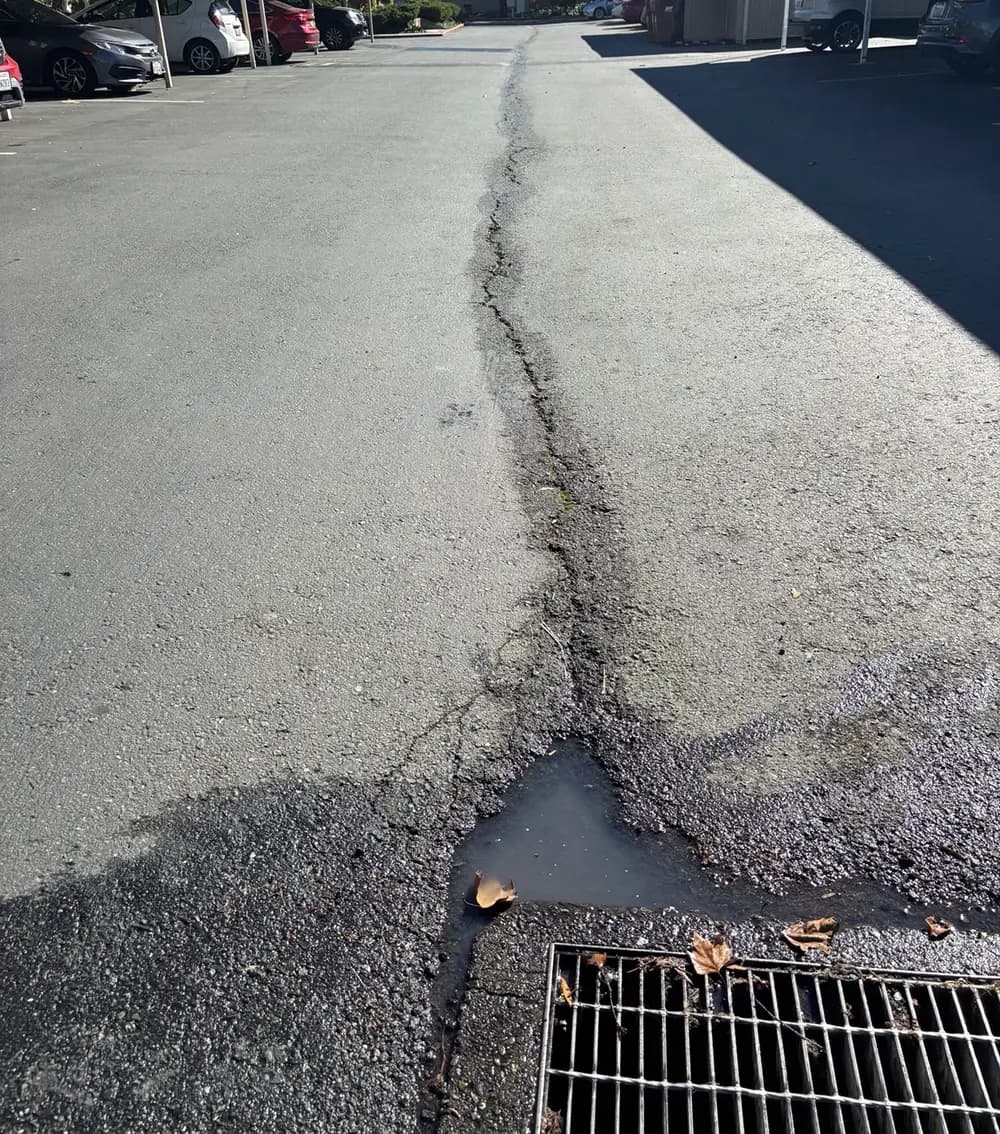
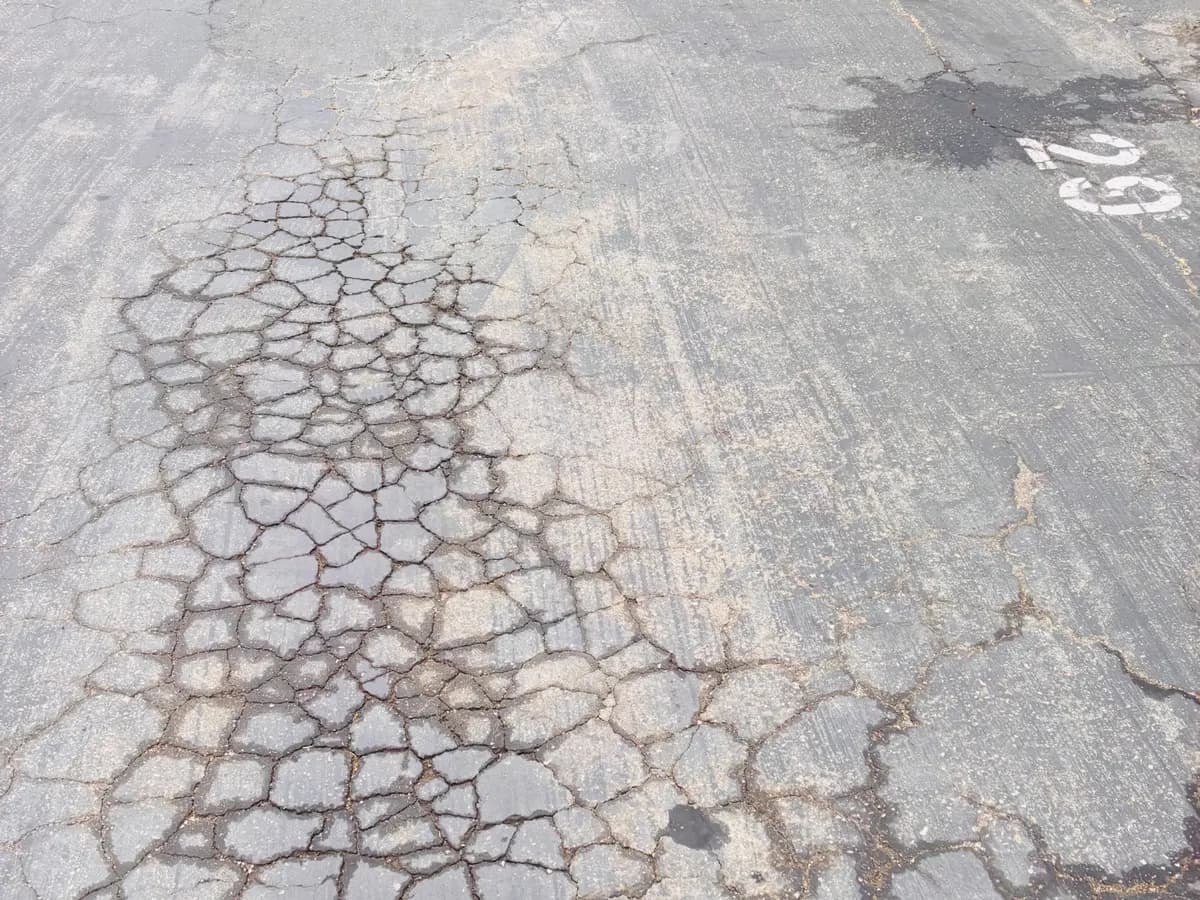
Spongy areas, rapid pothole formation, and alligator cracking that appears through the wet season in a lot whose traffic has not changed.

Likely causes

  • Months of rainfall with little drying between events
  • Base material with too many fines to drain
  • Blocked inlets, clogged drainage courses, or no outlet at all

When to get it looked at: If failures return to the same areas each winter, the base is holding water. Confirm the base is actually dry before agreeing to another overlay over it.

Moss and organic growth

Green growth spreading across shaded pavement, especially along north-facing edges and under tree canopy, holding moisture against the surface and making it slick.

Likely causes

  • Persistent shade combined with a long wet season
  • Overhanging vegetation limiting drying
  • Surface texture and cracks providing a foothold

When to get it looked at: Moss is mostly a maintenance and slip-safety issue, but where it is growing out of cracks it is a sign water is sitting in the pavement structure — that part is worth a closer look.

Eastern Washington freeze-thaw damage

Potholes and edge break-up forming over a few weeks in late winter and early spring around Spokane, Yakima, and the Columbia Basin.

Likely causes

  • Water entering unsealed cracks and freezing repeatedly
  • Meltwater trapped above still-frozen subgrade
  • Loess soils losing strength when saturated

When to get it looked at: Damage that repeats in the same areas every spring points to drainage or base material rather than to the winter itself.

Failing or neglected permeable pavement

Permeable pavement that no longer drains — water ponding on a surface designed to let it through — usually because the void structure has filled with fines.

Likely causes

  • Sediment, landscape debris, and fines clogging the surface over time
  • Missed vacuum sweeping and maintenance obligations
  • Adjacent unstabilized areas washing sediment onto the surface

When to get it looked at: If permeable pavement was installed to satisfy a stormwater requirement, its failure may be a compliance problem as well as a maintenance one. Find out what the original approval obligated you to do.

Port and distribution corridor rutting

Deep wheel paths and shoving at container terminals, distribution centers, and their approach routes around Puget Sound and along I-5.

Likely causes

  • Very heavy, slow, channelized truck loading
  • Subgrade over fill with limited bearing capacity
  • A section built for lighter traffic than the site now carries

Paving and Maintenance Calendar for Washington

Treat this as a planning aid, not a rule. Whether a given treatment can actually be placed on a given day depends on product requirements, surface and nighttime temperatures, the rain forecast, humidity, plant availability, the project specification, and the contractor’s means and methods.

Wet season (late fall through early spring)

Work often suited to this window

  • Emergency and safety repairs
  • Drainage clearing between storms
  • Assessments, budgeting, and booking the coming season

Scheduling risks

  • Persistent rain closes paving and coating windows for long stretches
  • Saturated subgrade makes structural repairs unreliable
  • Cool damp conditions extend cure times for coatings and markings

Inspect for: Walk the property during rain and record where water stands, where it runs, and which inlets back up.

Regional exception: Eastern Washington is in a freeze-thaw winter rather than a rain-driven one; crack sealing matters more there before this period begins.

Late spring

Work often suited to this window

  • Structural repairs once subgrade dries out
  • Drainage corrections identified over the winter
  • Early-season paving as conditions allow

Scheduling risks

  • Late rain can interrupt work already mobilized
  • Demand climbs sharply and lead times lengthen
  • Mountain sites may still be in snow

Inspect for: Map what the wet season damaged and separate surface distress from base failure before pricing repairs.

Dry season

Work often suited to this window

  • Paving, overlays, and reconstruction
  • Sealcoating and surface treatments
  • Striping, accessibility work, and permeable pavement maintenance

Scheduling risks

  • This is a genuinely short reliable window on the west side and it books out
  • Wildfire smoke and heat events can affect crews and schedules in eastern Washington
  • School and campus work competes for the same weeks

Inspect for: Look for rutting and structural distress in truck areas while pavement is warm, and confirm permeable surfaces still infiltrate.

Pre-wet-season preparation

Work often suited to this window

  • Crack sealing before the rain arrives
  • Inlet, swale, and drainage course cleaning
  • Final paving as temperatures and drying allow

Scheduling risks

  • The transition to sustained rain can arrive earlier than planned
  • Crack sealing demand peaks and crews book out

Inspect for: Confirm cracks are sealed and drainage is clear before the wet season begins — this is the highest-leverage week of the year on the west side.

Contractor Licensing and Verification in Washington

Statewide licensing
State-level licensing applies
Administering body
Washington State Department of Labor and Industries (L&I)
Classifications that can apply to pavement work
General contractor registration · Specialty contractor registration

Washington requires construction contractors to be registered with the Department of Labor and Industries, as either a general or specialty contractor, with a surety bond and liability insurance on file. Registration is straightforward to verify through L&I's Verify a Contractor tool, which shows registration status, bond and insurance information, the registration history, and whether there are lawsuits recorded against the bond.

That verification tool is genuinely informative and takes under a minute. Check the registration status, confirm the bond and insurance are current, and look at how long the registration has been in place — a very recent registration for a company claiming decades of experience is worth asking about.

L&I also enforces prevailing wage on public works, and public projects carry additional requirements including responsible bidder criteria. Those rules apply to school, city, and other public properties rather than to a private commercial lot.

Confirm the business entity through the Secretary of State, verify insurance directly with the carrier for your project dates, and check whether the city requires its own permits for the work — larger site projects in Washington frequently do because of stormwater review.

What a contractor license does not prove

L&I registration establishes bonding and insurance, not competence with saturated subgrade, permeable systems, or the stormwater review your project may need.

  • That the proposed scope is the right fix for what is actually failing
  • That the price is fair for the local market
  • That drainage has been designed or corrected
  • That the pavement section and thickness suit the traffic the property carries
  • That the specified materials are appropriate for the site
  • That the crew will show up when promised
  • That workmanship will hold up past the first winter or summer
  • That the company is financially stable enough to honor a warranty

Ask for a certificate of insurance sent directly from the carrier or agent rather than a copy forwarded by the contractor, confirm the general liability and workers’ compensation coverage is active on the dates of your work, and ask to be named as certificate holder so you are notified if the policy lapses.

Licensing requirements can turn on project value, scope of work, property location, and whether the job is public or private. City and county rules may add registration, permitting, or bonding requirements beyond anything required at the state level. Verify current requirements with the agency directly before contracting.

Last reviewed:

Stormwater and Environmental Considerations

Washington's Department of Ecology administers construction stormwater permitting and publishes the stormwater management manuals that most local jurisdictions adopt or mirror. Construction that disturbs enough ground generally requires coverage under the construction stormwater general permit, along with erosion and sediment controls and a site-specific plan.

The part that most affects parking lots is post-construction. Projects that create or replace impervious surface can trigger runoff treatment and flow control requirements under the applicable manual, and the thresholds and the way replaced surface is counted are set by the local jurisdiction implementing the manual. A full lot reconstruction and a mill-and-overlay of the same lot can land on opposite sides of that line, which is why the question is worth asking during design rather than after.

Permeable pavement, bioretention, and other low impact development approaches are used more widely in Washington than in most states, often to satisfy those requirements. They come with maintenance obligations — vacuum sweeping for permeable surfaces, for instance — and those obligations may have been recorded as conditions of the original approval.

What tends to drive requirements here

  • Disturbed area, which drives construction stormwater general permit coverage
  • New plus replaced impervious surface, which drives treatment and flow control requirements
  • Which Ecology manual and which local implementation apply to your jurisdiction
  • Existing low impact development facilities on site and their maintenance obligations
  • Proximity to Puget Sound, salmon-bearing streams, and other sensitive receiving waters
  • Critical areas ordinances, wetland buffers, and steep slope regulations

Thresholds and calculations are implemented locally and differ between Washington jurisdictions. Confirm with the city or county before design, and check whether prior approvals imposed ongoing maintenance conditions on your site.

Last reviewed:

Pavement Terms You May Encounter in Washington

TermWhat it means on a Washington project
Hot mix asphalt (HMA)The standard plant-produced asphalt mixture. Washington specifications reference HMA by class and binder grade, and local suppliers use the same vocabulary.
Crushed surfacing base course (CSBC)The crushed rock base layer beneath the asphalt, referenced by that name on Washington plans and proposals. On saturated west-side sites, how well it drains matters as much as how thick it is.
Permeable pavementPavement designed to let water pass through into a storage layer below. In Washington it is often installed to satisfy a stormwater requirement, which means it carries recorded maintenance obligations, not just a maintenance recommendation.
Bioretention / rain gardenEngineered landscaped areas that treat and infiltrate runoff. Common alongside Washington parking lots, and easily damaged by construction traffic or by sediment during repaving.
Flow controlManaging the rate and duration of runoff leaving a site, not just its volume. It is a distinctly Washington emphasis, driven by stream protection, and it affects what a large lot project has to include.
Chip seal / bituminous surface treatment (BST)An asphalt binder application covered with aggregate, common on eastern Washington county roads and large private roads. It is a surface treatment, not a structural repair.

State transportation specifications can provide useful regional terminology and material references, but they do not automatically govern private parking-lot or driveway projects unless incorporated into the contract or required by the applicable jurisdiction.

More definitions are in the pavement glossary.

Common Pavement Projects in Washington

Port and distribution facilities

Seattle, Tacoma, and I-5 corridor freight sites carry very heavy channelized loads, often on fill with limited bearing capacity, making base design the controlling decision.

Technology and office campuses

Eastside campuses combine appearance expectations with extensive low impact development features that constrain how and when pavement work can be done.

Agricultural and food processing facilities

Yakima and Columbia Basin operations concentrate heavy seasonal truck and equipment loads, with irrigation changing subgrade moisture around the pavement.

Multifamily and HOA communities

Shaded private drives stay damp for months, so moss, drainage, and base moisture drive the maintenance program more than traffic does.

Mountain and pass-area commercial properties

Snow operations, plow damage, and a short construction season shift priorities toward durable markings and meltwater routing.

Questions to Ask a Paving Contractor in Washington

Washington pavement FAQs

Why does pavement fail so quickly in western Washington?

Not because of cold — western Washington sees relatively little freeze-thaw. The problem is sustained moisture. Months of rain with little drying keep the base layer saturated, and a saturated base has far less strength, so ordinary traffic starts producing alligator cracking and potholes. That is why drainage correction and base moisture usually matter more here than surface specification, and why resurfacing over a wet base tends to fail within a season or two.

How is pavement maintenance different in eastern Washington?

Eastern Washington has hot dry summers and genuinely cold winters with real freeze-thaw cycling, which western Washington largely lacks. That flips the priorities: crack sealing before winter has substantial value around Spokane, Yakima, and the Columbia Basin because it keeps water out of a structure that will freeze, while on the west side the same effort is aimed at keeping a persistently wet structure from staying wet. Summer UV also ages east-side pavement faster.

Does Washington require paving contractors to be registered?

Yes. Contractors must be registered with the Department of Labor and Industries as either general or specialty contractors, with a surety bond and liability insurance on file. L&I's Verify a Contractor tool shows registration status, bond and insurance details, registration history, and any lawsuits against the bond. It takes under a minute and is worth doing on every proposal, not just unfamiliar ones.

Will repaving my parking lot trigger stormwater requirements in Washington?

It can. Washington's stormwater framework ties treatment and flow control requirements to how much impervious surface a project creates or replaces, and the thresholds and counting rules are implemented by the local jurisdiction using Ecology's manuals. A full reconstruction and a mill-and-overlay of the same lot can fall on opposite sides of that line. Ask the city or county during design rather than discovering it when permits are pulled.

Why is moss growing on my parking lot, and does it matter?

Persistent shade plus a long wet season gives moss what it needs, and evergreen canopy over Washington parking lots supplies both. Mostly it is a maintenance and slip-safety issue rather than a structural one. But moss growing out of cracks indicates water is sitting in the pavement structure, and that part is worth looking into. Trimming back overhanging vegetation to let pavement dry does more good than repeated removal alone.

Do I have to maintain permeable pavement, and what happens if I don't?

Yes, and it is more consequential in Washington than most places. Permeable pavement works by letting water through its void structure, and those voids gradually fill with fines and organic debris unless the surface is vacuum swept on a schedule. Once it stops infiltrating, it is a normal impervious surface that happens to be more expensive. If it was installed to satisfy a stormwater requirement, the maintenance may have been a recorded condition of the approval — worth checking what your site's original permit obligated.

When is the paving season in Washington?

West of the Cascades, the reliable window is the dry summer stretch, and it is genuinely short — scheduling, not price, is often the binding constraint. East of the Cascades the season is limited at the other end by winter cold rather than by rain. Mountain and pass properties have the shortest window of all. On any given day, product requirements, surface temperature, and whether the pavement can be dry are what actually govern.

Browse cities in Washington

Browse services in Washington

State and local licensing rules vary, and Washington appears in the national comparison of commercial and residential paving-contractor requirements. Review the national paving-contractor licensing comparison, then verify current requirements with the applicable licensing authority.

Related reading for Washington property owners

Washington Agencies and Reference Links

This page summarizes publicly available information for general education. It is not legal, engineering, or code-compliance advice, and requirements change. Confirm anything that affects your project with the agency with jurisdiction over the property.

Regulatory content last reviewed:

For contractors

Are you a pavement contractor in Washington?

Get listed where property managers, owners, and facility teams search by state, city, and service.