

What this guide covers
A maintenance plan is just a condition assessment plus a schedule and a budget: know where the lot stands, put the core services on their cycles, and set aside a reserve for repairs.
This guide lays out how to build that plan step by step. A maintenance contractor can do it with you — browse parking lot maintenance contractors or see how to choose a parking lot maintenance contractor — and the maintenance cost guide covers the budgeting side.
For a hands-on inspection list, use the parking lot maintenance checklist.
Related contractor categories
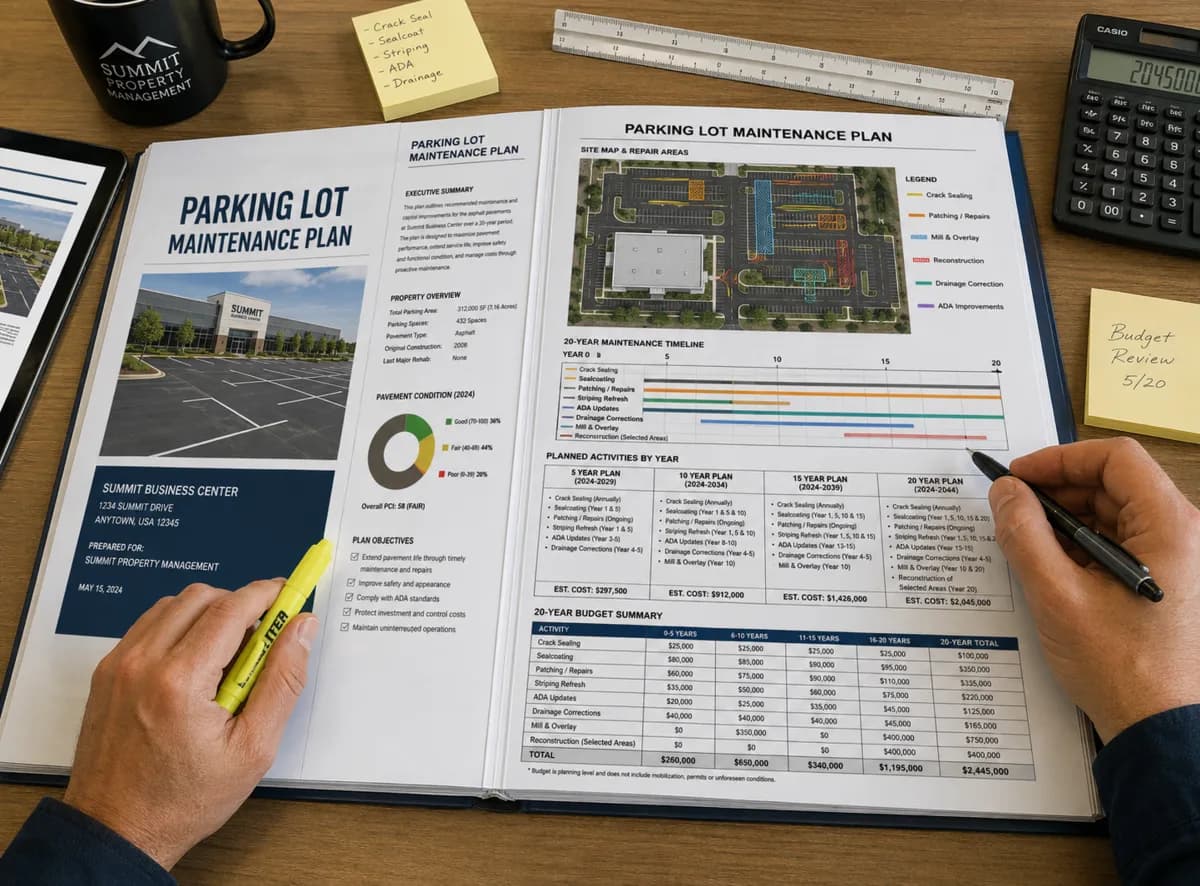
Step 1 — Assess current condition
A plan starts with knowing where the lot stands. Walk it (or have a contractor inspect it) and note cracking, potholes, raveling, faded striping, ponding, drainage issues, and any failed sections. This baseline tells you what needs attention now versus what can be scheduled. See signs your parking lot needs maintenance for what to look for.
Step 2 — Set the service cycles
Most of a plan is putting the core services on their natural cycles and sequencing them correctly.
| Service | Typical cycle | Purpose |
|---|---|---|
| Crack sealing | Annually | Keep water out before it spreads |
| Sealcoating | Every 2–4 years | Protect and renew the surface |
| Restriping | With the sealcoat | Restore markings and ADA lines |
| Repairs / patching | As needed | Fix failures before they grow |
| Inspection | Annually | Reassess and adjust the plan |
Step 3 — Prioritize and budget
Not everything happens at once. Prioritize keeping water out — crack sealing and fixing drainage — because water causes most failures. Handle active failures (potholes, badly broken areas) before they spread. Then schedule surface work (sealcoat, stripe) on its cycle. Set aside a small annual reserve for unexpected repairs so a surprise doesn't blow the budget.
Step 4 — Reassess every year
A plan is a living document. Each year, re-inspect and adjust: maybe the sealcoat can wait another season, maybe a new area needs repair. Condition-based adjustment beats a rigid calendar and keeps spending matched to what the lot actually needs. Over time, a consistent plan defers the big cost — resurfacing — for years.
Building a multi-year plan for a portfolio? The resource center for property managers links the budgeting tools, bid checklists, and ADA guides that usually come next.
Frequently asked questions
What goes into a parking lot maintenance plan?
A condition assessment, service cycles for crack sealing (annual), sealcoating (every 2–4 years), and restriping, a repair reserve, and an annual reassessment to adjust the plan.
How often should each maintenance service be done?
As a starting point: crack sealing roughly annually, sealcoating every 2 to 4 years, restriping with the sealcoat, and repairs as needed. Adjust to the lot's actual condition and climate.
What should I prioritize in a maintenance plan?
Keeping water out — crack sealing and fixing drainage — plus repairing active failures before they spread. Surface work like sealcoating follows on its cycle.
Why have a multi-year plan instead of fixing things as they break?
Because reactive repairs are more expensive and let failures spread. A consistent plan keeps water out and the surface sound, deferring the far larger cost of resurfacing for years.
Before you hire: The Pavement Directory does not guarantee contractor performance, pricing, licensing, insurance, or availability. Business information may be submitted by contractors or gathered from public sources and should be independently verified before hiring. Always confirm licensing, insurance, references, scope of work, and written contract terms.
For property owners
Looking for a pavement contractor?
Use The Pavement Directory to search asphalt, concrete, sealcoating, striping, ADA access, and pavement maintenance contractors by service and location. Always verify license, insurance, references, and written scope before hiring.
Search contractorsFor contractors
Are you a pavement contractor?
Contractors can add or claim a company profile to help property owners find pavement professionals by service, location, and specialty.