

What this guide covers
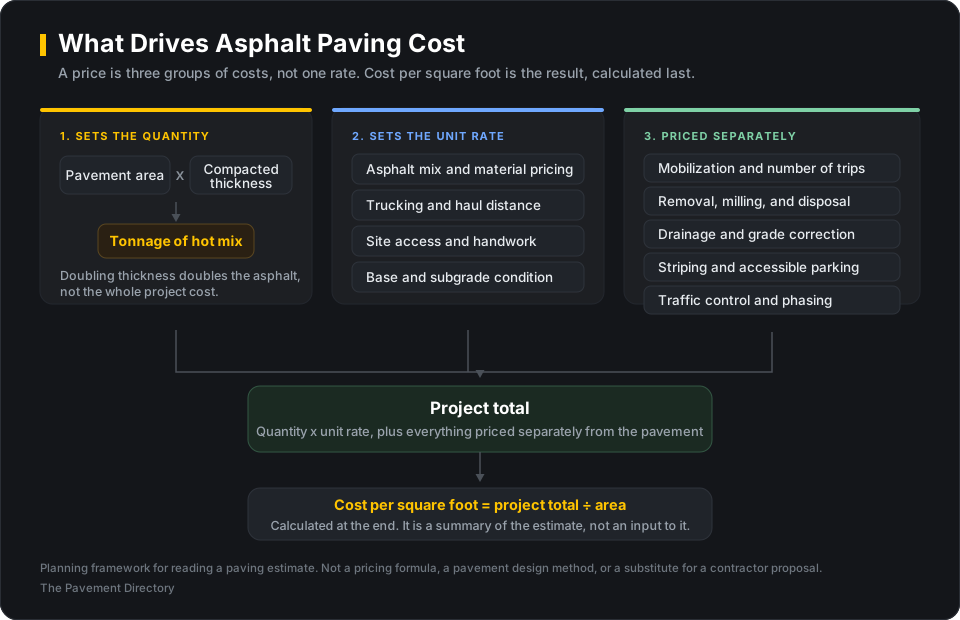
Asphalt paving is quoted per square foot, but the unit price is not a constant. It moves with project size, compacted thickness, base condition, how much removal is involved, and how much of the site has to stay open while the work happens.
Start with a budget, not a bid. Use the Paving Project Budget Estimator to turn your square footage and scope into a low, mid, and high planning range, then use the Asphalt Tonnage Calculator when you need the material quantity behind that number.
A budget only becomes a price after a contractor walks the site. When proposals arrive, use How to Compare Asphalt Paving Bids to confirm you are comparing equivalent scope, and browse asphalt paving contractors to build the bid list.
Estimate the project
Run the Paving Project Budget Estimator
Turn the ranges in this guide into numbers for your property. Estimates are for planning only, so confirm final scope and pricing with contractor proposals.
Project inputs
Budget scenario
Complete the inputs
Asphalt paving cost at a glance
The table below is the fastest answer to "what should this cost?" It gives 2026 national planning ranges per square foot by project type, plus the variable most likely to move a specific project inside or outside the range.
Read them as brackets for a budget conversation, not as a price book. Two projects with identical square footage can land at opposite ends of the same row because one needs base repair and phased night work and the other does not.
| Project type | Planning range (per ft²) | Biggest variables |
|---|---|---|
| New asphalt driveway (residential) | $4.00 to $8.00 | Size, thickness, base condition, access, mobilization minimum |
| Driveway overlay (resurface) | $2.50 to $6.00 | Condition of the existing pavement, garage and curb transitions |
| Driveway removal and replacement | $8.00 to $15.00 | Demolition, haul-off, base repair, small-job unit cost |
| Commercial parking lot, new asphalt | $3.50 to $8.00 | Area, pavement section, staging, truck traffic areas |
| Parking lot overlay (resurface) | $2.00 to $5.00 | Milling, failed areas repaired first, drainage, tie-ins |
| Mill and overlay | $4.00 to $9.00 | Milling depth, disposal, transitions, utility adjustments |
| Full-depth removal and replacement (commercial) | $7.00 to $14.00 | Demolition, haul-off, aggregate base, restriping |
| Heavy-duty truck and loading areas | Site-specific | Pavement section, base design, subgrade, traffic loading |
These are planning ranges, not contractor quotes. They reflect 2026 national figures reviewed across public agency unit-price data, the BLS producer price index for asphalt paving mixture, and multiple national cost guides. Regional markets, site conditions, and scope can put a real project outside any of these rows. There is no defensible universal price for heavy-duty pavement, because the pavement section is designed for the traffic it carries.
Asphalt paving cost per square foot
Asphalt paving cost per square foot generally falls between about $2.00 and $15.00 in 2026, depending on whether the work is an overlay over sound pavement, new asphalt on a prepared base, or a full removal and replacement. The spread is wide because the per-square-foot figure is an output of the job, not an input to it.
Square-foot pricing is useful for getting from an area you can measure to a budget you can defend in a meeting. It is not how the work is priced. A contractor builds a number from tonnage, crew days, trucking, equipment moves, disposal, and subcontracted items, then divides by area at the end.
That is why unit cost falls as projects get larger. Mobilizing the paver, roller, and crew costs roughly the same either way. On a 1,000 square foot driveway that setup is spread across 1,000 square feet; on a 100,000 square foot lot it is spread across a hundred times the area. It is the main reason a homeowner's per-foot number looks nothing like a property manager's.
The first-pass arithmetic is simple: area in square feet × planning cost per square foot = preliminary budget. A 12,000 square foot parking lot overlay at a $3.00 mid-range planning rate is roughly $36,000 before base repair, striping, and contingency.
That is a bracket to plan around, not a price to hold anyone to. It carries no site inspection, no measurement of the failed areas, no drainage assessment, and no local market data. A contractor proposal replaces it.
Asphalt driveway paving cost
A new residential asphalt driveway commonly runs about $4.00 to $8.00 per square foot in 2026, putting a typical 600 to 800 square foot driveway near $2,400 to $6,400 before removal of an existing surface.
Driveways sit at the high end of per-foot pricing because a driveway needs the same truck, paver, roller, and crew as a much larger job. Most contractors carry a practical minimum job size for that reason. If the crew is on site for two hours, you are paying for a mobilization more than for asphalt.
- Dimensions and shape: long, simple runs pave efficiently; irregular or curved driveways involve more handwork.
- Base condition: a gravel driveway paved for the first time may need grading, added aggregate base, and compaction first.
- Removal: tearing out failed asphalt or concrete adds demolition, hauling, and disposal, which is why replacement runs roughly $8.00 to $15.00 per square foot.
- Access: overhead wires, low branches, narrow gates, and steep grades can force smaller equipment or handwork.
- Thickness: a driveway carrying only cars is a different section than one taking an RV or a delivery truck.
- Edges and transitions: garage thresholds, sidewalks, curb cuts, and aprons all have to tie in at the right elevation.
- Drainage: water has to leave the driveway and stay out of the garage, which sometimes means regrading rather than repaving.
If you know the dimensions, the Asphalt Driveway Cost Calculator turns them into a budget. If the driveway is failing rather than just tired, the driveway replacement cost guide covers the removal side.
Commercial parking lot paving cost
New asphalt on a commercial parking lot commonly runs about $3.50 to $8.00 per square foot in 2026, and an overlay over sound pavement about $2.00 to $5.00. A 40,000 square foot lot overlay therefore brackets around $80,000 to $200,000 before base repair, striping, and contingency.
Commercial paving prices differently because the property keeps operating while the work happens. The asphalt is often the least complicated part. What moves the number is everything arranged around it: keeping tenants trading, fire lanes open, and residents parked somewhere, then bringing the crew back for the sections that could not be closed at the same time.
- Area and economies of scale: a large, open lot is the cheapest asphalt per square foot anyone buys, because the paver runs continuously.
- Drive lanes versus stalls: aisles, entrances, and dumpster approaches take concentrated traffic and are often built heavier than stalls.
- Truck traffic and loading areas: delivery routes, trash truck paths, and docks are where thin pavement fails first, and pricing them like stall areas is a common source of a low bid.
- Fire lanes and emergency access: usually cannot close at the same time as the rest of the site, which forces phasing.
- Staging and phasing: each additional mobilization adds equipment moves, setup, and crew time.
- Business and resident access: retail, apartment, and medical properties constrain when work can happen, and night or weekend work carries a premium.
- Tenant and resident notices: someone has to plan, distribute, and enforce the closure schedule, and the proposal should say who.
- Striping and layout: repaving erases the layout, so restriping happens whether or not it sits inside the paving line item.
- Accessible parking areas: paving disturbs accessible stalls, aisles, ramps, and signage, and putting them back correctly is its own scope.
- Traffic control: cones, barricades, signage, and flaggers on active sites are a line item, not an overhead.
- Drainage structures: catch basins, area drains, and trench drains have to be adjusted to the new surface elevation.
- Utility adjustments: manholes, water valves, and cleanouts need to meet finish grade.
Almost no parking lot needs the same treatment everywhere, so the budget goes further when the lot is split into zones with different scopes rather than priced one way.
To build a bid list, browse asphalt paving contractors and see commercial asphalt paving contractors for what matters in a contractor working on occupied properties. For what follows the project, see how to create a parking lot maintenance plan.
Asphalt overlay cost
An overlay places a new wearing surface over existing pavement. Plan on roughly $2.00 to $5.00 per square foot for a parking lot, $2.50 to $6.00 for a driveway, and $4.00 to $9.00 for mill and overlay once milling and disposal are added.
Overlay is not automatically a cost-saving option. It adds surface life and ride quality but little structural capacity, and it does not repair what is happening underneath. If the base or subgrade is failing, the overlay fails with it, often within a season or two.
For the full breakdown — what milling adds, worked examples at three sizes, what gets billed separately, and where these figures come from — see asphalt overlay cost. For the condition side of the decision, see Asphalt Paving vs Asphalt Overlay.
Full removal and replacement cost
Full-depth removal and replacement commonly runs about $7.00 to $14.00 per square foot on commercial work and $8.00 to $15.00 on smaller residential jobs. It costs more than an overlay because it is a different project: the old pavement leaves the site, the base gets fixed, and the pavement is rebuilt from the subgrade up.
It is also frequently the right answer. Pavement that has failed structurally cannot be resurfaced back to health, and overlaying it buys a short-lived surface over the same problem.
- Sawcutting where the new work meets pavement that stays, so the joint is clean and vertical.
- Demolition of the existing asphalt, and of concrete where curb or gutter is involved.
- Hauling and disposal of the removed material, priced by tonnage and haul distance.
- Grading and subgrade preparation, including removal of soft or unsuitable material.
- Base repair and imported aggregate base where the existing base is inadequate.
- Compaction of subgrade and base, which is what the pavement's life actually depends on.
- New asphalt placed in one or more lifts to the specified compacted thickness.
- Restoration: striping, markings, signage, wheel stops, and any concrete work disturbed by the project.
The wide range on this scope reflects one thing above all: nobody knows what is under the pavement until the pavement is off. A proposal that handles unsuitable subgrade with a stated unit price is worth more than one that assumes the problem away.
New pavement construction on prepared subgrade
New pavement construction is asphalt placed where there was none before: a lot expansion, a new access drive, an overflow parking area, or a new site. The asphalt portion prices like replacement paving, but the work that comes before it varies more than in any other project type.
No single design fits these projects, so treat any per-square-foot figure as the paving portion only. Getting raw ground ready to be paved can cost as much as the pavement itself.
- Clearing, stripping, and earthwork to reach the design subgrade elevation.
- Cut and fill balance, and whether soil has to be exported or imported.
- Subgrade stabilization where native soils will not support pavement as-is.
- Aggregate base depth, which is set by the soil and the traffic, not by a rule of thumb.
- Drainage design: inlets, piping, outfalls, and in many jurisdictions stormwater treatment.
- Curb, gutter, and sidewalk where the layout requires them.
- Permitting, engineering, geotechnical investigation, and inspection.
- Striping, signage, lighting, and accessible route construction.
At this scale a pavement design from a qualified engineer is worth more than any cost range, because the design sets the quantities the price is built from. Pavement consulting and assessment is the category to look at when the question is what to build rather than what it costs.
The 10 factors that change asphalt paving cost most
Two proposals for the same property can differ by tens of thousands of dollars without either contractor doing anything wrong. The gap almost always traces back to one or more of these ten factors, so reading a bid means finding where each one landed.
- Project size. Mobilization, equipment moves, setup, and crew minimums spread across more area on large jobs, so unit cost falls as area rises. Below a contractor's practical minimum, the job prices as a mobilization with some asphalt attached.
- Asphalt thickness. Thickness is specified compacted, after rolling, not as placed. It sets tonnage, and tonnage is usually the largest material line in the estimate. A proposal quoting loose thickness delivers less finished pavement than one quoting the same number compacted. See Asphalt Paving Thickness for Parking Lots.
- Existing pavement removal. Leaving it in place, milling part of it off, and removing it entirely price very differently. Milling and full removal both add machine time, trucking, and disposal tonnage.
- Base and subgrade condition. Soft areas, unsuitable material, poor compaction, and trapped water can cost as much to correct as the asphalt above them. This is the most common hidden condition, and the most common reason a low bid grows during construction.
- Asphalt mix and material pricing. Hot mix commonly runs about $90 to $160 per ton at the plant in 2026 depending on region and mix, with polymer-modified mixes higher. Plant price is not installed price. The Asphalt Cost Calculator handles the delivered-material side.
- Trucking and haul distance. Asphalt has to arrive hot enough to compact, so plant distance, traffic, and truck cycle times matter. A site far from a plant, or one that can only take one truck at a time, costs more to pave. The asphalt plant finder shows what supply looks like nearby.
- Site access. Tight entrances, low clearances, weight-restricted approaches, and areas the paver cannot reach convert machine work into handwork, which is slower and harder to compact consistently.
- Drainage and grade corrections. Low spots, ponding, catch basins, trench drains, utility covers, and slope corrections are separate work from paving. Resurfacing without addressing them reproduces the same standing water on a new surface.
- Striping, accessibility, and restoration. Paving erases the layout, so striping, markings, accessible stalls and aisles, signage, and wheel stops all have to go back. Paving does not by itself make a site accessible or compliant; accessibility corrections are their own scope with their own price.
- Traffic control, phasing, and work hours. Occupied properties drive cost through scheduling. Night and weekend work, multiple mobilizations, phasing, maintained tenant access, and preserved emergency access all add crew time to the same quantity of pavement.
How asphalt thickness changes cost
Thickness changes cost because it changes tonnage, and tonnage is what the plant invoices. Compacted hot mix weighs roughly 145 pounds per cubic foot, or about 110 pounds per square yard per compacted inch.
The table applies that to a 20,000 square foot parking lot. Only the asphalt quantity is shown, at an illustrative material price, so the effect of thickness is not buried inside a full installed rate.
| Compacted thickness | Approximate tons | Material at $125/ton | Change vs. 2 in |
|---|---|---|---|
| 2 in | ~121 tons | ~$15,100 | baseline |
| 2.5 in | ~151 tons | ~$18,900 | +25% |
| 3 in | ~181 tons | ~$22,700 | +50% |
| 4 in | ~242 tons | ~$30,300 | +100% |
Illustrative only. Tonnage assumes 145 lb/ft³ compacted density; actual mix density varies. The material price shown is a placeholder for arithmetic, not a market quote, and material is only one part of an installed price.
Thickness also changes the work. Thicker sections may need more than one lift, which means more passes and sometimes a second day. On a mill and overlay, milling depth has to match the new surface thickness so the finished elevation lands where it started, and transitions at gutters, garage slabs, and adjacent pavement get harder as added thickness grows.
None of that means thicker is better. Thickness is a design decision based on traffic, soil, and base, and buying pavement your site does not need is as wasteful as underbuilding it. See Asphalt Paving Thickness for Parking Lots for how the section gets decided, and the Asphalt Tonnage Calculator to convert area and thickness into tons.
Estimate your asphalt paving cost
A useful paving cost estimate needs two things: a quantity and a set of scope assumptions. A calculator that supplies one without the other produces a confident number that means very little.
The estimator embedded near the top of this guide is the Paving Project Budget Estimator, the right starting point for the dollar question. Enter the project area and known scope assumptions to create a preliminary budget, then compare that estimate with contractor-specific proposals. Its default unit rates are planning figures you can overwrite, so put in a local number if you have one.
The other calculators answer narrower questions. Pick by what you already know:
| What you know | Use this tool | What it gives you |
|---|---|---|
| Project area and a rough scope | Paving Project Budget Estimator | A low, mid, and high installed budget with base repair and contingency |
| Driveway dimensions | Asphalt Driveway Cost Calculator | A residential driveway budget range |
| Area and compacted thickness | Asphalt Tonnage Calculator | Tons of hot mix required |
| Tonnage and a plant price | Asphalt Cost Calculator | Delivered material cost and effective price per ton |
| Nothing measured yet | Parking Lot Square Footage Calculator | The area every other tool needs first |
| Whether to repair or replace | Repair vs. Replace Calculator | Cost per year of useful life for each option |
Open any of them directly: Paving Project Budget Estimator, Asphalt Driveway Cost Calculator, Asphalt Tonnage Calculator, Asphalt Cost Calculator, Parking Lot Square Footage Calculator, and Repair vs. Replace Calculator.
The tonnage calculator is the deeper technical path, not the budget path. Tons tell you what the material weighs, not what the project costs: labor, equipment, milling, aggregate base, mobilization, traffic control, disposal, striping, overhead, and profit all sit outside that number.
Every calculator output here is a planning estimate. None is a quote, and none has seen your site.
Asphalt paving cost examples
Worked examples make the arithmetic visible so you can substitute your own numbers. Every assumption is stated, and each example leaves real scope outside the number on purpose, because that is what a preliminary budget does. None of these is a quote.
- Example 1, residential driveway. A 700 square foot asphalt driveway, existing gravel, straightforward access. At a $6.00 per square foot planning midpoint, the preliminary budget is 700 × $6.00 = $4,200. Excluded and uncertain: any imported aggregate base beyond routine grading, drainage correction at the garage apron, and the contractor's job minimum, which on a driveway this size may set the price on its own.
- Example 2, commercial parking lot overlay. A 45,000 square foot retail lot, overlay over pavement that is sound across most of the site. At a $3.00 per square foot planning midpoint, that is 45,000 × $3.00 = $135,000. Excluded: full-depth repair of the failed areas (budget these separately by the square footage that actually fails), restriping and accessible stall restoration, drainage structure adjustment, and any premium for night or phased work to keep the center trading.
- Example 3, overlay compared with replacement on the same lot. On a 30,000 square foot lot, an overlay at a $3.00 midpoint brackets around $90,000 and a full-depth replacement at a $10.00 midpoint around $300,000. The gap is real but it is not the whole comparison: if the base is failing, the overlay buys a few years and the replacement is still coming, so the honest measure is cost per year of service. The Repair vs. Replace Calculator runs that math.
All three share the same shape: a stated area, a stated planning rate, one line of arithmetic, and an explicit list of what is not in the number. A contractor proposal should be at least that transparent, with real quantities in place of the planning rate.
Asphalt overlay vs replacement cost
Overlay generally costs less up front. Whether it costs less over the life of the pavement depends entirely on what is under the surface. The table compares how the two scopes behave rather than promising a fixed price difference.
| Factor | Overlay | Full replacement |
|---|---|---|
| Existing asphalt removal | None, or partial milling | Full or substantial removal |
| Access to the base | Limited; base is largely unknown | Full access; base can be inspected and rebuilt |
| Typical initial cost | Generally lower | Generally higher |
| Suitability over structural failure | Usually not appropriate | Can address deeper failures |
| Effect on surface grade | Raises the surface unless milled first | Greater control over finished elevation |
| Drainage correction | Limited; mostly follows existing grade | Greater ability to correct slope and low spots |
| Project duration and disruption | Often shorter | Often longer, with more phasing |
| Typical planning range (per ft²) | $2.00 to $5.00, or $4.00 to $9.00 milled | $7.00 to $15.00 depending on scale |
Planning ranges only. The right choice is set by pavement condition, not by the price gap: an overlay placed over a failing base is the more expensive option once it is replaced early.
Working the overlay side of that comparison in detail? See asphalt overlay cost.
What is usually included in an asphalt paving price?
A total is only meaningful next to a scope. A useful proposal lets you answer every item below without calling the contractor. Anything it does not state, it does not include.
- Exact work limits, ideally on a marked-up site plan or aerial
- Square footage of each area, by scope
- Asphalt thickness, stated as compacted rather than loose
- Milling or removal depth where applicable
- Disposal of removed material, and who pays the tipping fees
- Base preparation: grading, compaction, and the treatment of soft areas
- Aggregate base: depth and whether it is new material or reworked existing
- Tack coat between lifts and at joints where applicable
- Asphalt mix or specification where the property has a standard
- Compaction requirements, and any testing
- Transitions and tie-ins at gutters, garages, sidewalks, and adjacent pavement
- Utility adjustments: manholes, valve boxes, cleanouts, and drainage structures
- Drainage assumptions, and whether existing low spots are being corrected
- Striping, markings, signage, wheel stops, and accessible stall restoration
- Traffic control, barricades, signage, and flagging
- Cleanup and haul-off of debris
- Schedule, number of mobilizations, and work hours
- Exclusions, stated explicitly
- Warranty terms, duration, and what voids them
Use the Asphalt Paving Proposal Checklist as the working version of this list while you read the documents. It is the same content in a form you can mark up.
Why asphalt paving bids can be thousands of dollars apart
Compare scope first, total price second. Most large bid gaps are not markup differences. They are two contractors solving different problems on the same property, and the cheaper solution is often the smaller one.
When bids diverge sharply, the difference is nearly always in one of these places:
- Scope quantities: one contractor measured 38,000 square feet and the other measured 44,000.
- Thickness: two inches compacted versus three is a fifty percent difference in the largest material line.
- Base work: one bid repairs the failed areas full depth, the other paves over them.
- Milling: one mills the perimeter to preserve grade, the other overlays to the curb and buries the reveal.
- Hauling and disposal: included as a quantity in one bid, excluded or assumed in the other.
- Number of mobilizations: a single-phase price and a four-phase price are not the same project.
- Asphalt mix: a standard mix and a polymer-modified or heavy-duty mix carry different plant prices.
- Striping and accessibility restoration: in the base bid in one proposal, an allowance or exclusion in another.
- Traffic control: priced as a line item, or quietly assumed to be the property's responsibility.
- Exclusions: unsuitable subgrade, utility adjustment, and drainage work are common ones.
- Warranty: a one-year workmanship warranty and a multi-year warranty carry different risk pricing.
- Contractor structure: crew size, owned versus rented equipment, self-performed versus subcontracted work, and overhead all show up in the number.
Normalize the bids to a common scope before comparing totals. How to Compare Asphalt Paving Bids walks through that line by line, and Questions to Ask an Asphalt Paving Contractor covers what to ask when a line is missing.
What a cheap asphalt paving bid may leave out
A low bid is not automatically a bad bid. A contractor already working nearby, owning rather than renting equipment, self-performing work others subcontract, or simply wanting the job can be both cheaper and better.
The same number can also come from a smaller scope. These are the places to look before deciding which one you are holding:
- Thinner asphalt than the other bids, or a thickness stated loose rather than compacted
- Little or no base repair, with failed areas simply paved over
- Removal omitted where the other proposals included it
- Striping and markings excluded, or reduced to an allowance
- No traffic control, phasing, or notice plan on an occupied property
- Unclear or unstated quantities, so the scope cannot be verified
- Vague thickness language such as "standard" or "industry typical"
- Drainage corrections left out, with existing low spots simply resurfaced
- Utility and drainage structure adjustments excluded
- A short or heavily conditioned warranty
The test is completeness, not price. A cheap bid that states its scope fully is easy to evaluate; one that states almost nothing is not a bargain, it is an unknown. Cheap Asphalt Paving Bid Red Flags covers the patterns worth a second look.
How to budget for a commercial parking lot paving project
Property managers, HOA boards, and facility teams usually need a number long before they need a contractor, often for a budget cycle or a reserve study. This process produces one that survives scrutiny.
- Measure the pavement area. Aerial measurement is close enough for budgeting, and the Parking Lot Square Footage Calculator handles irregular lots. Every later step depends on this number.
- Separate the site into scope zones. Divide it into areas likely to need overlay, full-depth replacement, patching only, and heavy-duty treatment such as truck routes and dumpster approaches.
- Identify the ancillary work. Striping and layout, accessible parking corrections, drainage structures, concrete curb and sidewalk, and utility adjustments do not scale with pavement area and have to be budgeted separately.
- Build a low, mid, and high budget. Apply a planning range to each zone rather than a single number, then total them. The Paving Project Budget Estimator does this and adds a base repair allowance.
- Request comparable written scopes. Give every bidder the same zone map and quantities. Bids priced against different scopes cannot be normalized afterward.
- Carry contingency for unknown conditions. Removal and base work carry real uncertainty until the pavement is off, and a stated unit price for unsuitable subgrade beats an optimistic assumption.
- Phase the project if the budget requires it. Doing the failing zones now and the sound zones later usually beats a thin treatment everywhere. Expect a phasing premium: each mobilization is priced again.
A paving project should start a maintenance program rather than end one. See how to create a parking lot maintenance plan, the parking lot maintenance cost guide, and resources for property managers for the reserve and board-reporting side.
When cost per square foot is misleading
Per-square-foot pricing describes a job where the pavement is the dominant cost and the site does not fight back. The further a project gets from that, the less the unit price means. A national average misleads badly in these cases:
- Very small projects, where mobilization is most of the price and area barely matters
- Complicated phasing, where the same square footage is paved across several separate mobilizations
- Heavy base failure, where subgrade correction outweighs the pavement above it
- Unusually thick pavement sections built for truck or industrial loading
- Isolated patches, which carry setup cost for a small quantity of asphalt
- Narrow or restricted access, which forces small equipment and slower placement
- Large amounts of handwork around islands, structures, and tight corners
- Long haul distances from the nearest plant, which add trucking and constrain the paving day
- Extensive drainage or utility work that is priced by structure, not by area
- Projects where accessible route or concrete work is a significant share of the scope
In all of these the unit cost is a result you calculate afterward, not a rate you can look up beforehand. A national average is a sanity check on a proposal. It is not a price book, and it never predicts the number for one property.
Questions to ask before approving a paving price
These twelve questions surface the scope decisions behind most of the price difference between proposals. Ask every bidder, and compare the answers before the totals.
| Question | Why it matters |
|---|---|
| What exact square footage is included? | Quantities set the price. Two bids measuring different areas cannot be compared as totals. |
| What paving method is proposed? | Overlay, mill and overlay, and full-depth replacement are different projects with different lives. |
| What is the compacted asphalt thickness? | Compacted thickness sets tonnage. A number quoted loose delivers less finished pavement. |
| What removal or milling is included? | Removal adds machine time, trucking, and disposal tonnage that an overlay bid does not carry. |
| What base preparation is included? | Base work is where a low bid usually differs from a complete one. |
| What happens if unstable base is discovered? | A stated unit price for unsuitable subgrade is the difference between a change order and an argument. |
| Is striping included? | Paving erases the layout, so restriping happens either way. The question is whose budget it is in. |
| Are drainage and utility adjustments included? | Structures and covers must meet the new surface elevation, and this is a common exclusion. |
| What traffic control and phasing are included? | On an occupied property, scheduling is a major cost driver and a major disruption risk. |
| What is specifically excluded? | Exclusions are where two similar-looking bids actually differ. |
| What warranty applies, and what voids it? | Warranty duration and conditions carry real cost and real value. |
| Is the price tied to a validity period or material escalation clause? | Asphalt tracks energy prices, so an old quote may not hold. Know the terms before you plan around the number. |
Where these cost ranges come from
This guide states planning ranges rather than averages, and it is worth being explicit about where they come from, because cost pages go stale quickly and a number without a method is not verifiable.
The ranges were last reviewed in August 2026 against several kinds of evidence rather than a single source. The U.S. Bureau of Labor Statistics producer price index for asphalt paving mixture and block manufacturing stood at 440.7 in July 2026, up from 419.7 in December 2025, indicating upward pressure on material cost through the year. Published state DOT asphalt price indices, used for contract price adjustments rather than as retail quotes, sit in the $700 to $900 per ton range for binder in the states that publish them. Public agency bid data such as the Caltrans contract cost database supplies real unit prices from competitively bid work. National consumer and commercial cost guides were reviewed together, not individually, to bracket installed pricing.
Two distinctions are preserved throughout. Material price is not installed price: a plant quote per ton covers hot mix at the plant, while an installed price covers labor, equipment, base, trucking, mobilization, disposal, restoration, overhead, and profit. And public agency unit prices are not private commercial prices: agency work carries specifications, testing, and wage requirements a retail parking lot project does not.
No national figure predicts the price of an individual project, and this guide does not publish location-specific prices, because a defensible local number requires local evidence. Treat everything here as a bracket for planning and let contractor proposals set the price.
Frequently asked questions
How much does asphalt paving cost per square foot?
As a 2026 national planning range, asphalt paving runs roughly $2.00 to $5.00 per square foot for an overlay over sound pavement, $3.50 to $8.00 for new asphalt on a commercial lot, $4.00 to $8.00 for a new residential driveway, and $7.00 to $15.00 for full removal and replacement. Small projects sit at or above the top of their range because mobilization is close to fixed.
How much does it cost to pave a parking lot?
Using 2026 planning ranges, a parking lot overlay brackets around $2.00 to $5.00 per square foot and new asphalt around $3.50 to $8.00, so a 40,000 square foot lot overlay plans at roughly $80,000 to $200,000 before base repair, striping, and contingency. Base condition, phasing, drainage, and accessible parking restoration move that substantially.
How much does it cost to pave an asphalt driveway?
A new residential asphalt driveway commonly runs about $4.00 to $8.00 per square foot in 2026, putting a typical 600 to 800 square foot driveway near $2,400 to $6,400. Replacing a failed driveway runs higher, roughly $8.00 to $15.00 per square foot, because removal, disposal, and base repair are added on top of the paving.
Is an asphalt overlay cheaper than replacing asphalt?
An asphalt overlay generally has a lower initial cost than full removal and replacement because less demolition and reconstruction are required, but it is only suitable when the existing pavement structure can support it. Over a failing base, an overlay reflects the old cracking through quickly and the replacement still has to happen, so the cheaper option becomes the more expensive one.
How does asphalt thickness affect paving cost?
Thickness sets tonnage, usually the largest material line in a paving estimate: going from 2 inches to 3 inches compacted is about 50 percent more asphalt for the same area. Thickness is specified compacted, after rolling, so a proposal quoting loose thickness delivers less finished pavement.
Why do asphalt paving prices vary so much?
Because the same property can be paved several different ways. Bids diverge on measured quantities, compacted thickness, base repair, whether old pavement is removed or overlaid, mix type, mobilizations, striping, traffic control, exclusions, and warranty. Normalize the scopes before comparing totals.
How much does asphalt cost per ton?
Hot mix asphalt commonly runs about $90 to $160 per ton at the plant in 2026 depending on region and mix type, with polymer-modified mixes higher. State DOT published price indices are a different figure again: they are used for contract price adjustments, not as retail quotes. Plant price is only one input into an installed paving price.
Does asphalt paving cost include base preparation?
Only if the proposal says so. Base and subgrade work is one of the most common scope differences between two bids on the same property, and it is where a low number usually comes from. Ask what base preparation is included and what the unit price is if unsuitable material is found after demolition.
Is it cheaper to pave a larger area?
Per square foot, generally yes. Mobilization, equipment moves, setup, and crew minimums are close to fixed, so they spread across more area on a large project. That is why a small driveway and a large parking lot do not carry the same unit cost even with identical pavement sections.
How can I estimate asphalt paving cost before getting bids?
Measure the pavement area, split it into zones by likely scope, apply a planning range to each, and add ancillary work such as striping, accessible parking corrections, and drainage separately. The Paving Project Budget Estimator does this and produces a low, mid, and high range. Treat it as a planning bracket, then price the work from written proposals.
Before you hire: Costs vary by region, project size, access, materials, labor, traffic control, disposal, site conditions, and scope. Use written proposals and contractor-specific pricing before making decisions.
For property owners
Looking for a pavement contractor?
Use The Pavement Directory to search asphalt, concrete, sealcoating, striping, ADA access, and pavement maintenance contractors by service and location. Always verify license, insurance, references, and written scope before hiring.
Find asphalt paving contractorsFor contractors
Are you a pavement contractor?
Contractors can add or claim a company profile to help property owners find pavement professionals by service, location, and specialty.