

What this guide covers
This guide explains what infrared repair actually does on site, which defects it suits, where it is the wrong method, how it compares with cold patch, skin patching, and sawcut full-depth patching, and what a proposal has to say before it can be compared against a competing bid.
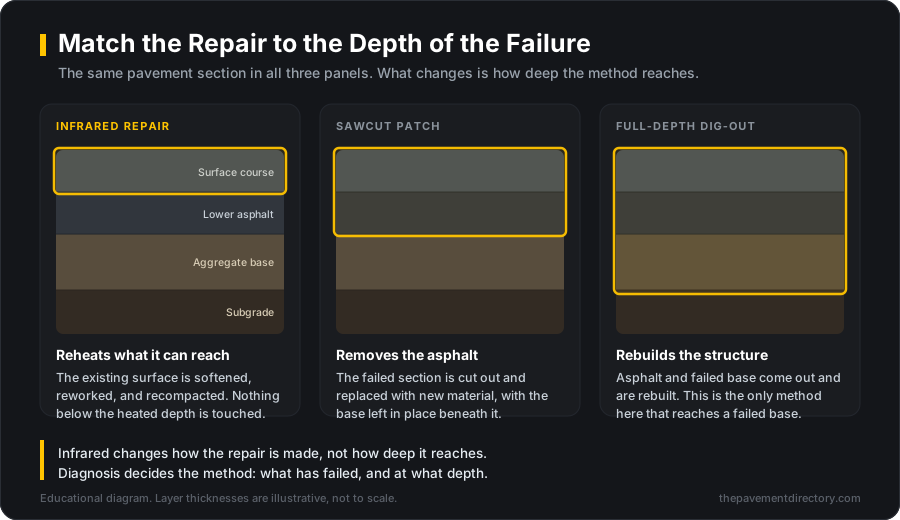
The claim the article is built on: infrared changes how a repair is made, not how deep it reaches. Every method on the table works to some depth. The pavement decides which depth is required, so the useful question is never "is infrared good" but "how deep has this pavement failed, and does the proposed method get there."
Ready to have it looked at? Compare asphalt repair contractors by location and service, and ask specifically whether infrared is performed in-house alongside conventional patching.
What infrared asphalt repair actually is
Infrared repair is a heat-based method for reworking asphalt that is already in the ground. A heating unit is positioned over the pavement and transfers heat down into the surface until the asphalt softens enough to be raked, loosened, and reshaped. The crew works the softened material, adds new hot-mix asphalt or a rejuvenating agent where the specification calls for it, brings the area back to grade, and compacts it.
What separates it from conventional patching is what happens at the edges. A sawcut patch creates a defined vertical joint between old pavement and new. An infrared repair heats the pavement surrounding the defect as well, so the reworked material and the existing pavement are blended and compacted together rather than butted against each other.
Three things are worth being precise about before any of the rest of this makes sense:
- It reuses the existing asphalt. The material in the repair is mostly the material that was already there, reheated and reworked, with new mix added as needed rather than as a matter of course.
- It works to a limited depth. Heat has to travel down through the pavement, and the deeper it goes the longer it takes and the greater the risk of scorching the surface. Manufacturers and contractors commonly describe an effective working depth of roughly one and a half to two and a half inches. Treat that as a claim about a specific machine, not a standard, and ask what depth the equipment on your property actually reaches.
- It does not excavate. Nothing below the heated depth is removed, inspected, or rebuilt. If the base under the defect is saturated, poorly compacted, or failed, an infrared repair passes over it without touching it.
None of that makes infrared a lesser method. It makes it a method with a working range, in exactly the way sealcoating, slurry seal, and skin patching each have one. The failures happen when a method is used outside its range, which on an infrared repair means using it over a problem that lives below the depth the heat reaches.
What happens on site, step by step
Procedures vary by equipment, defect, weather, and contractor. A typical repair runs roughly like this:
- The area is swept and cleaned so debris and standing water are not worked into the repair.
- The heating unit is positioned over the defect and the surrounding pavement.
- The pavement is heated until it is workable, usually over several minutes rather than seconds.
- The heated material is scarified and raked loose.
- Material that is too deteriorated to reuse is removed rather than blended back in.
- New hot-mix asphalt, and a rejuvenating agent where specified, are added and mixed through.
- The repair interface is treated according to the contractor's system.
- The material is raked to the correct elevation and profile so water still drains.
- The area is compacted, typically with a roller or plate compactor sized to the repair.
- The repair is allowed to cool before traffic returns.
Two of those steps carry most of the quality. Removing unsuitable material is what separates a repair from a reshuffle, because reheating badly deteriorated asphalt does not restore it. Compaction is what determines density, and a repair left short of density will ravel, hold water, and fail early no matter how neatly it was blended at the edges.
Both are also the steps most easily skipped on a fast-moving crew, and neither is visible in a photograph of the finished repair. That is why the questions further down this page are worth asking before the work rather than after it.
The question that decides whether infrared is right
Almost every argument about infrared repair is really an argument about depth. The pavement in a parking lot is a stack: a surface course, usually a lower asphalt course beneath it, an aggregate base under that, and subgrade soil under all of it. Distress can originate in any of those layers, and it can look identical from standing height regardless of where it started.
Infrared works in the top of that stack. A sawcut patch works through the asphalt. A full-depth dig-out reaches the base and subgrade. Those are three different depths of repair, and the pavement decides which one is required, not the equipment on the truck.
So the question to settle first is not which method is better. It is: what has failed here, and how deep does it go? A contractor who can answer that with reference to what they observed is worth more than one who leads with a method.
What infrared asphalt repair is good at
Infrared suits localized defects where the existing pavement can still be reheated and reworked, and where the trouble sits within the depth the heat reaches. These are the situations it comes up for most often, and what has to be true for each.
| Defect | Why infrared fits | What has to be true |
|---|---|---|
| Potholes | The surrounding pavement is heated in, so the repair is not a plug sitting in a hole | The loss is within the heated depth and the base beneath it is sound |
| Rough utility cut or trench surface | The transition between the reinstated cut and the original pavement can be reworked as one surface | The trench below has been properly backfilled and compacted and is no longer settling |
| Open or deteriorated seams and joints | The material either side of the joint is reworked together rather than sealed over | The joint is deteriorating at the surface, not moving because of something below it |
| Shallow depressions and birdbaths | The surface can be heated, brought back to grade, and recompacted in place | The low spot is a surface profile problem, not ongoing settlement |
| Failing skin patches and rough previous repairs | The patch and the pavement around it can be reworked into one surface | The original defect that prompted the patch is not still active underneath |
| Isolated surface deterioration | The defect can be treated without sawcutting a wider area than the problem | The surrounding pavement remains serviceable and the cause has been identified |
Read the third column as the real content of the table. In every row, the same condition appears in different words: the problem has to live at the surface, and whatever is beneath it has to be sound and stable. Where that holds, infrared is a legitimate and often efficient repair. Where it does not, none of the advantages in the middle column apply.
Where infrared repair is the wrong method
The failures below are not edge cases. They are the conditions most often present when an owner is unhappy with an infrared repair a year later, and every one of them is diagnosable before the work.
- Failed base or subgrade. If the aggregate base or the soil beneath it is unstable, saturated, or has lost bearing capacity, heating the surface changes nothing about it. The repair will move, settle, or break up along with the material under it. This needs excavation and rebuilding.
- Widespread alligator cracking. Interconnected fatigue cracking indicates a pavement flexing more than its structure can take. Reworking the top of that pavement does not add structure. See what causes alligator cracking in asphalt for how to tell fatigue cracking from surface distress.
- Rutting whose source has not been identified. Ruts can come from deformation within the asphalt, from the base, or from both. Reheating and regrading a rut caused by base deformation resets the appearance and none of the cause.
- Drainage problems. Standing water, saturated base, failed or badly set drainage structures, and grades that never drained correctly are separate problems with separate fixes. Correcting a low spot without correcting why water arrives there and stays lets the depression come back. Parking lot drainage problems covers what to look for.
- Deterioration across large areas. Infrared is a localized repair. Once a meaningful share of a lot is failing, milling and resurfacing, full-depth repair of the worst areas, or reconstruction usually costs less over a few years than a long list of spot repairs.
- Pavement too far gone to rework. Asphalt that is severely oxidized, badly raveled, or thin from previous milling may not have enough sound material or usable binder left to reheat into a durable repair. See asphalt raveling on judging how far surface deterioration has gone.
There is one honest caveat to attach to this list. An infrared repair placed over a base problem is not always a mistake being made in bad faith. It is sometimes a deliberate short-term measure on a property that is scheduled for reconstruction and needs to be safe and usable until then. That is a reasonable decision, but it should be a stated one, priced and warranted as a temporary measure rather than sold as a repair.
The joint is the real argument for infrared
Conventional patches usually fail first at the edge. The joint between old pavement and new is where compaction is hardest to achieve, where water finds its way in, and where the two materials move against each other through temperature cycles. Watch any failing patch over a few seasons and the deterioration typically starts as a hairline at the perimeter and works inward.
Infrared repair addresses that specific weakness. Because the surrounding pavement is heated and worked together with the repair material, the finished area has a blended transition rather than a butted cold joint. On a repair of the right type, in the right pavement, that is a genuine durability advantage and the strongest thing that can be said for the method.
Two qualifications keep it honest:
- A blended joint improves the perimeter. It does not improve the pavement beneath the repair, which is where the more consequential failures start.
- The advantage depends on the crew reaching a workable temperature across the whole area, including the heated margin. An under-heated edge is a cold joint that has been disguised rather than eliminated.
So the joint argument is real, and it is narrower than it is usually presented. It is a reason to prefer infrared for a defect that is genuinely a surface defect. It is not a reason to prefer infrared for a defect that is not.
Infrared compared with the other repair methods
The methods below are the realistic alternatives for a localized defect. The column that matters most is the last one, because knowing how a method usually fails tells you what has to be true for it to hold.
| Method | What it does to the existing pavement | Where it fits | How it usually fails |
|---|---|---|---|
| Cold patch | Leaves it in place and fills the void with cold mix | Emergency and winter stopgap until a permanent repair | Ravels out under traffic and water, often within weeks or months |
| Skin patch | Covers a shallow defect with a thin asphalt layer | Shallow surface defects over sound pavement | Delaminates or cracks through when the trouble was deeper than assumed |
| Infrared repair | Reheats and reworks it, blending in new material | Localized surface defects within the heated depth, over a sound base | Settles or breaks up when the base beneath it was the actual problem |
| Sawcut partial-depth patch | Cuts out and removes the asphalt layer | Asphalt-layer failure where the base is confirmed sound | Fails at the cold joint, or repeats when the base was not sound after all |
| Full-depth dig-out | Removes asphalt and failed base and rebuilds both | Structural failure, repeat potholes, base or subgrade problems | Settles when the rebuilt base was not compacted in proper lifts |
Notice that three of the five failure modes are the same failure: the repair was shallower than the problem. That is the single most common way money gets wasted on pavement repair, and it is a diagnostic failure rather than a workmanship one.
Cold patch deserves one specific caution, because it is the method most often confused with a permanent repair. It exists to make a hazard safe until a proper repair can be scheduled, and pricing it against infrared or a dig-out is comparing a stopgap with a repair. The asphalt patching guide covers how the patch types differ in more detail.
There is no national standard for infrared spot repair
This is worth knowing before you compare proposals, because it explains why two infrared bids can describe genuinely different work.
The federal manual of practice for pothole repair, published by FHWA and built on Strategic Highway Research Program work, documents four techniques: throw-and-roll, semi-permanent repair, spray injection, and edge sealing. Infrared spot repair is not among them. That is not a verdict against the method. It means there is no equivalent national procedure, acceptance criterion, or performance benchmark for it that a proposal can be measured against.
State specifications for heat-based work do exist, but they mostly cover a different operation: heater scarification and hot in-place recycling, where a machine train heats, scarifies, adds a recycling agent, and recompacts a whole roadway surface. New York State DOT's specification for that work is instructive anyway, because of how carefully it bounds the process. The equipment is specified to reprocess only the upper layers of the existing asphalt. The scarification depth is set in the contract documents rather than left to the crew. The recycling agent application rate is calculated from cores taken out of the actual pavement. And the crew is directed not to overheat the pavement and soften material below the depth being reworked.
That is what a written heat-based repair specification looks like: a stated depth, a stated material rate, and an explicit boundary at the bottom of the work. Almost no infrared parking lot proposal contains any of the three.
The practical consequence is simple. With no standard to point at, the proposal has to do the work: what depth, what preparation, what material, what compaction, and what happens if the crew finds something worse once the surface is open. A bid that says only "infrared asphalt repair" and gives a price is not describing a method, it is describing a piece of equipment.
Reused material, new material, and rejuvenator
The material question is where infrared repairs quietly diverge in quality, and it rarely appears in a proposal at all.
The asphalt being reheated is old. Its binder has oxidized over years of sun and air, which is part of why the defect formed. Heat makes that binder workable again for the length of the repair, but heat alone does not restore it. Three things can be done about that, and a good repair usually involves at least two:
- Remove what is not worth reusing. Severely deteriorated material, contaminated material, and anything saturated should come out rather than be raked back in. A repair made from bad material is a repair made from bad material regardless of how it was heated.
- Add new hot-mix asphalt. New mix replaces material that has been lost, restores the profile, and brings fresh binder and clean aggregate into the repair. Most repairs of any size need some.
- Add a rejuvenating agent where specified. Rejuvenators are products intended to restore properties of an aged binder. Where they are used, the amount matters, which is exactly why DOT hot in-place recycling specifications set the rate from tested cores rather than by eye.
There is a failure mode on the other side of this too. Asphalt can be overheated. Held too long or too hot, binder is damaged, and a repair that looked well blended on the day can go brittle and ravel out early. It is not a thing an owner can inspect after the fact, which is a reason to weigh a contractor's experience with the specific equipment more heavily than the equipment itself.
Weather, cooling, and reopening to traffic
Heat-based repair is weather-sensitive on both ends of the job. Cold pavement takes longer to bring up to a workable temperature, and cools faster once the heat is removed, which compresses the window the crew has to rake, grade, and compact the material properly. Wind does the same. Wet pavement has to be dried before heating, and a repair placed over trapped moisture starts with a defect built into it.
None of that makes cold-weather infrared work impossible, and its ability to work in shoulder seasons when a paving crew cannot get hot mix is one of its practical advantages. It does mean marginal conditions demand more from the crew, and it is fair to ask how a contractor adjusts.
Reopening to traffic is governed by cooling rather than by curing. The repair has to lose enough heat to hold its shape under load, and how long that takes depends on the repair thickness, the air and pavement temperature, and what is going to drive on it. Passenger cars and a loaded refuse truck are not the same test.
Ask for the reopening plan in writing for your property rather than accepting a general number, especially where a delivery bay, a fire lane, or an accessible route is closed. On an occupied commercial property, phasing usually matters more to the tenants than the repair method does.
What infrared asphalt repair costs
There is no useful national price for infrared repair, and any single number should be treated with suspicion. Pricing is driven less by the repair area than by what it takes to get a crew and equipment to your property and working.
What actually moves the number:
- Mobilization, which is charged whether the crew fixes two defects or twenty.
- The number of repair areas and the size of each.
- Depth of deterioration and how much material has to be removed.
- How much new hot-mix asphalt the repairs consume.
- Site access, including gates, grades, and overhead clearances.
- Traffic control, phasing, and whether the work runs at night or on a weekend.
- Travel distance, since infrared crews are not evenly distributed across markets.
- Whether striping, wheel stops, or markings have to be reinstated afterward.
- Commercial versus residential context, which changes access, scheduling, and liability.
The practical consequence is the same one that applies to all small repair work: batch it. A list of defects addressed in one mobilization costs far less per repair than the same defects addressed one service call at a time, which is the strongest argument for walking a property annually rather than reacting to complaints. The repair vs replace calculator is worth running before committing to a long repair list, because past a certain quantity, resurfacing is the cheaper answer.
What belongs in an infrared repair proposal
A line reading "infrared asphalt repair" with a price attached cannot be compared against a competing bid, held to, or enforced. A proposal worth evaluating identifies:
- Each repair location, marked on a plan or sketch rather than described in words.
- Approximate size of each repair area, and the total quantity.
- The observed condition that led to infrared being recommended for that specific area.
- The depth the repair is expected to address.
- Whether deteriorated material will be removed, and how much.
- Whether new hot-mix asphalt will be added, and roughly how much.
- Whether a rejuvenating agent is used, and at what rate.
- How the repair will be compacted, and with what equipment.
- What the contractor is assuming about the base, stated explicitly.
- What happens if deeper failure is found once the surface is open, and how it will be priced.
- Drainage and utility assumptions, including anything the repair is not correcting.
- Traffic control, work hours, and phasing.
- Expected reopening time for each area.
- Striping and marking restoration where repairs cross them.
- Cleanup and disposal of any removed material.
- Exclusions, stated plainly.
- Warranty terms, and specifically what voids them.
The hidden-conditions clause is the one to read twice on this kind of work. Infrared repair does not open the pavement up in the way a dig-out does, so there is a real possibility that the crew discovers the problem is deeper than the proposal assumed. A contractor who has thought about that will tell you what happens next. One who has not will hand you a change order on the day.
Questions to ask an infrared repair contractor
These are ordered roughly the way a site conversation goes. The reason each one matters is as useful as the question itself.
- Why is infrared the right method for these specific areas? A contractor who evaluated your pavement can answer per area. One quoting a standard treatment will answer about the method in general.
- Do you see any evidence of base failure here? This invites them to name what they looked for, which tells you how much inspection actually happened.
- What depth will this repair address? Infrared has a working range, and a contractor who cannot state it for their equipment is not describing a controlled process.
- Will any existing material be removed, or is all of it being reworked? Badly deteriorated material should come out, not be raked back into the repair.
- Will new hot-mix asphalt be added, and how much? Restoring profile and replacing lost material usually requires it.
- Is a rejuvenating agent used, and at what rate? Reheating an oxidized binder does not restore it, so the answer says something about how carefully the material side is being handled.
- How will the repair be compacted? Density decides service life more than the blended edge does.
- What happens if you find deeper failure once the surface is open? On a surface method, this is a live possibility rather than a formality.
- Are drainage problems included, excluded, or simply not addressed? Infrared corrects none of them, so it should be stated rather than left ambiguous.
- How long will each area be closed, and what can use it after that? Cooling time depends on thickness, weather, and the traffic that follows.
- Do you also perform conventional sawcut and full-depth patching? A contractor with more than one method can recommend based on the pavement rather than on the equipment they own.
- What does the warranty cover, and what voids it? Ask specifically about settlement, base failure, drainage, utility movement, and heavy traffic.
The second-to-last question does more work than the rest combined. A crew that only owns an infrared unit will find infrared solutions, in the same way a crew that only owns a sealcoat tank will find sealcoating ones. That is not dishonesty, it is the ordinary gravity of a business, and the way around it is to ask what else they would have proposed if they did not own the machine.
When to call an asphalt repair contractor
Get the pavement looked at when:
- Potholes keep returning in the same locations, which usually means the base has failed.
- Utility patches and trench cuts are settling below the surrounding surface.
- Seams and joints are opening up.
- Localized depressions are developing or holding water after rain.
- Previous repairs are failing early, or failing in the same way each time.
- Surface deterioration is spreading rather than staying put.
- You do not know whether the problem is superficial or structural, which is the most common reason to get an opinion and the best value one.
Compare asphalt repair contractors by location and service, and ask up front whether infrared is performed in-house. If the direction turns out to be resurfacing or reconstruction, asphalt paving contractors cover that work, parking lot maintenance contractors are the right call for an ongoing plan, and drainage and sitework contractors handle the water problems that no surface repair fixes. Where the proposals disagree with each other or the project is large enough that being wrong is expensive, a pavement consultant is worth the cost of an independent opinion.
Frequently asked questions
What is infrared asphalt repair?
Infrared asphalt repair uses heating equipment to soften existing pavement so it can be loosened, reworked, supplemented with new hot-mix asphalt where needed, and recompacted into the surrounding surface. It is used for localized defects that sit within the depth the equipment can heat, and it does not replace full-depth repair where the base has failed.
Is infrared asphalt repair permanent?
It can be long-lasting where the defect suits the method and the pavement underneath is sound. It should not be expected to permanently correct anything caused by an unstable base, continuing settlement, or a drainage problem, because the process never reaches those conditions. Durability comes down to the diagnosis, the material used, and compaction.
Can infrared asphalt repair fix potholes?
Some of them. A pothole confined to the depth the equipment heats, over a base that is still sound, is a reasonable candidate and benefits from the blended edge. A pothole caused by saturated or failed base material needs excavation and full-depth repair — and a pothole that has already returned after a previous patch is usually in that second category.
Is infrared repair better than sawcut patching?
Neither is universally better; they address different depths. Infrared is well suited to localized surface defects and produces a blended edge rather than a cold joint. Sawcut patching removes the failed asphalt and, in a full-depth repair, gives direct access to the base. If the failure extends below what infrared can heat, sawcut repair is the appropriate method.
Can infrared asphalt repair fix alligator cracking?
Not as a stand-alone solution where the cracking reflects structural failure. Alligator cracking is a fatigue pattern that develops as pavement flexes more than its structure can support, so reworking the top of the pavement leaves the cause untouched. The condition should be evaluated for full-depth patching, resurfacing after repair, or reconstruction.
Does infrared asphalt repair require new asphalt?
Usually some. New hot-mix asphalt replaces material that has been lost, restores the profile, and brings fresh binder and clean aggregate into a repair that is otherwise made of aged material. How much depends on the defect. A proposal should say whether new material is included rather than leaving it to be decided on the day.
Can infrared repair correct low spots and standing water?
It can adjust a shallow depression when the low spot is a surface profile problem. It cannot correct base settlement, drainage design, catch basin elevations, or grades that never drained properly. Where those are the cause, regrading the visible low spot lets the problem return, so the drainage question has to be answered first.
How long before traffic can drive on an infrared repair?
The repair has to cool enough to hold its shape under load, and the time depends on repair thickness, air and pavement temperature, and the type of traffic. Heavy trucks warrant more caution than passenger vehicles. Follow the contractor's site-specific instructions rather than a general figure, and get the reopening time per area in writing.
Is infrared repair cheaper than conventional patching?
Sometimes per repair, because it reuses existing material and avoids sawcutting and hauling, but small jobs are dominated by mobilization rather than by method. Comparing an infrared price against a full-depth price is usually comparing two different scopes: if one addresses the base and the other does not, the cheaper number is not the cheaper repair.
Can infrared repair be done in cold weather?
Yes, and working in shoulder seasons is one of its practical advantages, since the process reheats existing material rather than depending on hot mix arriving hot. Cold pavement takes longer to heat and cools faster once heating stops, which shortens the window for raking and compaction, so marginal conditions ask more of the crew.
Before you hire: The Pavement Directory does not guarantee contractor performance, pricing, licensing, insurance, or availability. Business information may be submitted by contractors or gathered from public sources and should be independently verified before hiring. Always confirm licensing, insurance, references, scope of work, and written contract terms.
For property owners
Looking for a pavement contractor?
Use The Pavement Directory to search asphalt, concrete, sealcoating, striping, ADA access, and pavement maintenance contractors by service and location. Always verify license, insurance, references, and written scope before hiring.
Find asphalt repair contractorsFor contractors
Are you a pavement contractor?
Contractors can add or claim a company profile to help property owners find pavement professionals by service, location, and specialty.