The Pavement Directory

State pavement directory

Pavement Contractors in New Jersey

New Jersey concentrates a lot of pavement stress into a small area. The port complex and the warehouse corridor along the Turnpike move an enormous volume of freight over lots that are frequently built to the property line with no room to stage a project. Along the shore, storm flooding and a high water table attack the base from below. And the whole state cycles through freeze-thaw with heavy salt use every winter.

This page lists pavement contractors serving New Jersey cities and covers what determines a project here: port and warehouse loading, constrained construction on dense sites, coastal flood exposure, and New Jersey's contractor registration and public works requirements.

Listings
27
Cities
0
Services
13
Search New Jersey

Before you hire: The Pavement Directory does not guarantee contractor performance, pricing, licensing, insurance, or availability. Business information may be submitted by contractors or gathered from public sources and should be independently verified before hiring. Always confirm licensing, insurance, references, scope of work, and written contract terms.

27 contractors in New Jersey

Filter by service

Dover, New Jersey

Asphalt PavingCommercial & Residential

Paving contractor in Dover, NJ offering Asphalt Paving.

(862) 944-2053
Asphalt PavingCommercial & Residential

Established in 1903, Earle American has operated as a provider of premium paving solutions. The company is located in Collingswood Heights, New Jersey.

(201) 991-9200Website on file
Asphalt PavingConcrete SiteworkSnow RemovalCommercial & Residential

The company offers concrete services including sidewalks, walkways, and stamped concrete for residential and commercial projects. Construction and hardscape services include pavers, retaining walls, steps, repointing, patching, and driveways. Landscape services encompass maintenance, mowing, trimming, fertilization, weed control, planting, design, seasonal clean-ups, mulching, and sod installation. Home improvement services include kitchen and bathroom remodels, basement finishing, and room additions.

(973) 594-0600Website on file
Bob's Asphalt Sealcoating logo

Cherry Hill, New Jersey

Asphalt PavingSealcoatingCommercial & Residential

Paving contractor in Cherry Hill, NJ offering Asphalt Paving, Sealcoating.

(856) 425-4975Website on file
Bonk's Trucking and Grading logo

Barnegat, New Jersey

Asphalt PavingSealcoatingDrainage & GradingCommercial & Residential

Paving contractor in Barnegat, NJ offering Asphalt Paving, Sealcoating, Residential Driveway, and Drainage and Sitework.

(609) 693-5964Website on file

Township Of Washington, New Jersey

Asphalt PavingCommercial & Residential

Paving contractor in Township Of Washington, NJ offering Asphalt Paving.

(201) 666-0707
Jag & Son Construction LLC logo

Kearny, New Jersey

Asphalt PavingSealcoatingResidential

The company has operated since 1999 as a family-owned business. Services include new asphalt installation, seal coating, masonry work, and driveway construction. The business describes itself as offering premium construction services with tailored work to maximize pavement investment.

(201) 991-4105Website on file
Asphalt PavingSealcoatingCommercial & Residential

JP Paving and Hardscaping is a New Jersey-based contractor offering asphalt driveway installation, recaps, and hardscaping services such as walkways, patios, retaining walls, and driveway hardscaping. The company also performs sealing and restoration of brick, travertine, limestone, marble, and granite pavers. It states it is ICPI certified and works with brands including Techo Bloc, serving both residential and commercial customers with roots as a family paving business spanning multiple generations.

(855) 757-7284Website on file
JPG Asphalt logo

Denville, New Jersey

Asphalt PavingResidential

Paving contractor in Denville, NJ offering Asphalt Paving, Residential Driveway.

(973) 862-2792Website on file
Kuebler Paving Inc. logo

Paramus, New Jersey

Asphalt PavingCommercial & Residential

Paving contractor in Paramus, NJ offering Asphalt Paving.

(201) 444-5537Website on file
McFarlane Asphalt logo

Ramsey, New Jersey

Asphalt PavingCommercial & Residential

McFarlane Asphalt offers asphalt and concrete paving services including sealcoating, resurfacing, repair, milling, overlay, curbing, and drainage work. The company also provides driveway and sidewalk services such as paving, repaving, repair, sealcoating, and heated driveway installation. Commercial services include parking lot construction, maintenance, sealcoating, repair, paving, and striping.

(201) 327-5258Website on file
NVN PAVING logo

Fair Lawn, New Jersey

Asphalt PavingSealcoatingStriping & Pavement MarkingsCommercial & Residential

NVN Paving offers asphalt paving, concrete services, parking lot paving and striping, driveway paving, sealcoating, crack repair, catch basin repair, and emergency repair services. The company serves Bergen, Passaic, Somerset, and Morris Counties in New Jersey. They provide both new installations and maintenance services for residential and commercial properties.

(201) 304-7345Website on file
Roca and Associates Construction LLC logo

City Of Orange, New Jersey

Asphalt PavingCommercial & Residential

The company specializes in asphalt paving, concrete work, and masonry services for residential and commercial properties. They serve all 22 towns in Essex County, with particular focus on Orange, Newark, and Montclair. The company states it has been in operation since 2010 and is licensed and insured.

(973) 592-9369Website on file
Roger's Paving Construction Inc. logo

Hillsborough Township, New Jersey

Asphalt PavingCommercial & Residential

The company serves residential and commercial customers in Hillsborough Township and surrounding areas. Services include concrete installation and repair, asphalt paving, asphalt milling, excavating, and site work. The company states it offers free estimates and works on projects of various sizes.

(908) 215-4131Website on file
Seal Team Sealcoating logo

Marmora, New Jersey

SealcoatingCommercial & Residential

Seal Team Sealcoating provides asphalt sealcoating services to customers throughout Southern New Jersey. The company has operated since 2010 and uses SealMaster Ultra PPM asphalt emulsion sealer in its work. Specific details on the property types served and additional pavement services are not stated on the site.

(609) 350-9928Website on file
SealPro Inc. logo

Mahwah, New Jersey

Asphalt PavingConcrete SiteworkCommercial

The company offers asphalt paving, resurfacing, sealcoating, brick pavers, concrete work, and drainage solutions for residential customers, as well as parking lot paving, milling, line striping, and emergency pothole service for commercial clients. SealPro operates two specialized divisions to serve projects of different sizes. The company states it is fully insured and licensed in NJ and NY.

(201) 739-0590Website on file
South Shore Sealcoating, LLC logo

Vineland, New Jersey

Asphalt PavingSealcoatingStriping & Pavement MarkingsCommercial & Residential

South Shore Sealcoating has been operating for over 20 years in South Jersey. The company serves both commercial and residential customers with sealcoating, asphalt repair, line striping, concrete services, asphalt paving and milling, general construction, and Christmas light installation. The business is based in Vineland, New Jersey.

(609) 675-6752Website on file
Stanley Paving logo

Burlington, New Jersey

Asphalt PavingSnow RemovalCommercial

Stanley Paving provides asphalt paving and maintenance services including parking lot paving, driveway paving, asphalt repair, sealcoating, crack sealing, line striping, and asphalt milling. The company serves commercial and residential customers in New Jersey and Pennsylvania. Services are designed for driveways, parking lots, roadways, and other pavement applications.

(609) 806-5584Website on file
Asphalt PavingSealcoatingCommercial & Residential

The company operates as a third-generation asphalt contractor serving Northern New Jersey. They offer asphalt paving, sealcoating, parking lot paving, and asphalt crack repair services across Warren, Sussex, Hunterdon, and Morris Counties. The business is fully licensed and insured, and accepts Visa, MasterCard, and American Express.

(866) 782-8726Website on file
T&T Construction Inc. logo

Clifton, New Jersey

Asphalt PavingCommercial & Residential

Paving contractor in Clifton, NJ offering Asphalt Paving.

(973) 340-7430Website on file
The Seal Coat Man logo

Howell Township, New Jersey

SealcoatingResidential

The Seal Coat Man provides brush-applied driveway sealcoating services to homeowners in Monmouth and Ocean Counties, New Jersey, including Howell, Jackson, Wall, Freehold, Brick, and Point Pleasant. The company has operated since 2005 and uses a coal-tar based sealer product. It states it applies sealcoating by brush rather than spraying and has received recognition through Angie's List Super Service Awards for multiple years.

(732) 364-4478Website on file
Tilcon New York Inc. | North Bergen logo

North Bergen, New Jersey

Asphalt PavingCommercial & Residential

The company produces hot mix asphalt, aggregates, and provides paving and construction services. Materials are transported throughout the region by truck and barge through an extensive network of 20+ operating locations. The company was established in 1981 and employs over 700 team members.

(201) 854-2815Website on file
United Paving Contractors logo

Deptford Township, New Jersey

Asphalt PavingCommercial

The company provides asphalt paving services for driveways and parking lots across multiple counties in South Jersey. United Paving Contractors states it has trained professionals on staff and maintains a full line of equipment to handle projects from conception to completion. The company serves corporate, government, residential, and property management clients.

(856) 302-5212Website on file

What makes pavement work different in New Jersey?

New Jersey pavement carries port-scale loading on constrained sites, then spends every winter with salt and freeze-thaw working on it.

  • New Jersey requires Home Improvement Contractor registration through the Division of Consumer Affairs for residential work, and separate public works contractor registration with the Department of Labor for public projects.
  • Port Newark–Elizabeth and the Turnpike warehouse corridor impose container and drayage loading that ordinary commercial pavement sections cannot carry.
  • Dense sites mean staging, phasing, and access frequently drive cost and schedule more than the paving itself does.
  • Shore and back-bay properties face a high water table and periodic flooding that damages the pavement structure beneath an intact-looking surface.
  • New Jersey's stormwater rules are among the more demanding in the country, and projects that create or disturb impervious area can trigger substantive requirements.

Pavement Conditions by Region in New Jersey

New Jersey does not have one climate or one soil profile, and pavement that performs well in one part of the state can fail early a few hours away. These are the divisions that matter most when scoping paving, repair, or maintenance work.

Port district and northeastern New Jersey

Newark · Elizabeth · Jersey City · Bayonne · Kearny

Environmental stress

  • Extremely heavy container and drayage truck traffic
  • Frequent freeze-thaw cycling with heavy salt use
  • Coastal and tidal flooding in low-lying areas

Subgrade conditions

  • Historic fill over former meadowlands and marsh
  • Soft, compressible soils with limited bearing capacity
  • Dense utility congestion beneath existing pavement

Common distress

  • Severe rutting and shoving under container chassis loading
  • Settlement over compressible fill
  • Utility cut settlement and patch failure

What it means for the work

  • Container loading is a heavy-duty design problem, not a standard commercial one
  • Concrete is common for the heaviest areas for good reason
  • Site access and staging often govern the schedule

Turnpike warehouse corridor and central New Jersey

Edison · Piscataway · New Brunswick · Cranbury · Trenton

Environmental stress

  • Very heavy distribution and freight traffic
  • Frequent freeze-thaw cycling
  • Heavy seasonal rainfall

Subgrade conditions

  • Coastal plain sands and clays with variable drainage
  • Fill on rapidly developed industrial parcels
  • Locally poor drainage on flat sites

Common distress

  • Rutting at dock aprons and truck courts
  • Alligator cracking where drainage is inadequate
  • Freeze-thaw potholing in late winter

What it means for the work

  • Truck courts need a heavier section than the parking field
  • Stormwater review is a real gating item on large sites
  • Phasing around 24-hour operations is standard practice

Jersey Shore and coastal counties

Atlantic City · Toms River · Asbury Park · Cape May

Environmental stress

  • Coastal flooding and storm surge exposure
  • High water table and tidal influence in back-bay areas
  • Salt air and blowing sand
  • Extreme seasonal swings in occupancy

Subgrade conditions

  • Sandy soils with a high water table
  • Organic and marsh-adjacent soils in back-bay areas
  • Fill over former wetland on many parcels

Common distress

  • Base saturation and flood-related washout
  • Settlement around inlets and structures
  • Sand accumulation blocking drainage

What it means for the work

  • Work windows are constrained by the summer season
  • Post-flood assessment should look beneath the surface
  • Coastal permitting can add review that inland projects do not face

Northwestern New Jersey and the Highlands

Morristown · Sparta · Hackettstown · Phillipsburg

Environmental stress

  • Colder winters with deeper frost than the coast
  • Rolling to steep terrain concentrating runoff
  • Heavier snowfall than the shore counties

Subgrade conditions

  • Glacial tills over bedrock
  • Shallow rock on many hillside parcels
  • Frost-susceptible soils in low-lying areas

Common distress

  • Frost heave and spring break-up damage
  • Erosion at pavement edges on slopes
  • Plow gouging at curbs and transitions

What it means for the work

  • Highlands water protection rules apply in parts of this region
  • Crack sealing before winter has more value here than at the shore
  • Rock excavation can dominate hillside project cost

Common Pavement Problems in New Jersey

Container and drayage rutting

Deep wheel paths, shoving, and structural break-up in container yards, truck courts, and drayage routes around the port and along the Turnpike corridor.

Likely causes

  • Loaded container chassis imposing very high, concentrated, slow-moving loads
  • Sections designed for ordinary commercial traffic
  • Soft fill subgrade with limited bearing capacity

When to get it looked at: Rutting in a container or drayage area is a structural question about the section and the subgrade. Milling and filling it repeats the failure on a predictable schedule.

Settlement over meadowlands fill

Broad, gradual settlement and pavement pulling away from structures on sites built over former marsh and meadowlands fill in northeastern New Jersey.

Likely causes

  • Compressible organic soils consolidating under fill and pavement
  • Fill of variable quality placed decades ago
  • Buildings on piles staying put while pavement around them settles

When to get it looked at: Where pavement is separating from a pile-supported building, repairs should be designed to tolerate continued movement rather than to make it flat once.

Coastal flood damage

After a coastal storm, pavement edges undermine, sections drop under load, and material is washed out from beneath, often with the surface looking largely intact.

Likely causes

  • Floodwater moving through and beneath the pavement structure
  • Prolonged inundation softening the subgrade
  • Debris blocking drainage during the peak of the event

When to get it looked at: After a flood, have edges, structures, and any area that moves under load evaluated before reopening heavy traffic. Surface appearance is a poor guide to what happened below.

Freeze-thaw and salt deterioration

Spring potholing plus concrete curbs, walks, and aprons scaling and spalling faster than the adjacent asphalt shows wear.

Likely causes

  • Water in unsealed cracks freezing repeatedly through the winter
  • Chloride deicers driving freeze-thaw within the concrete surface
  • Concrete without adequate air entrainment for the climate

Utility cut settlement

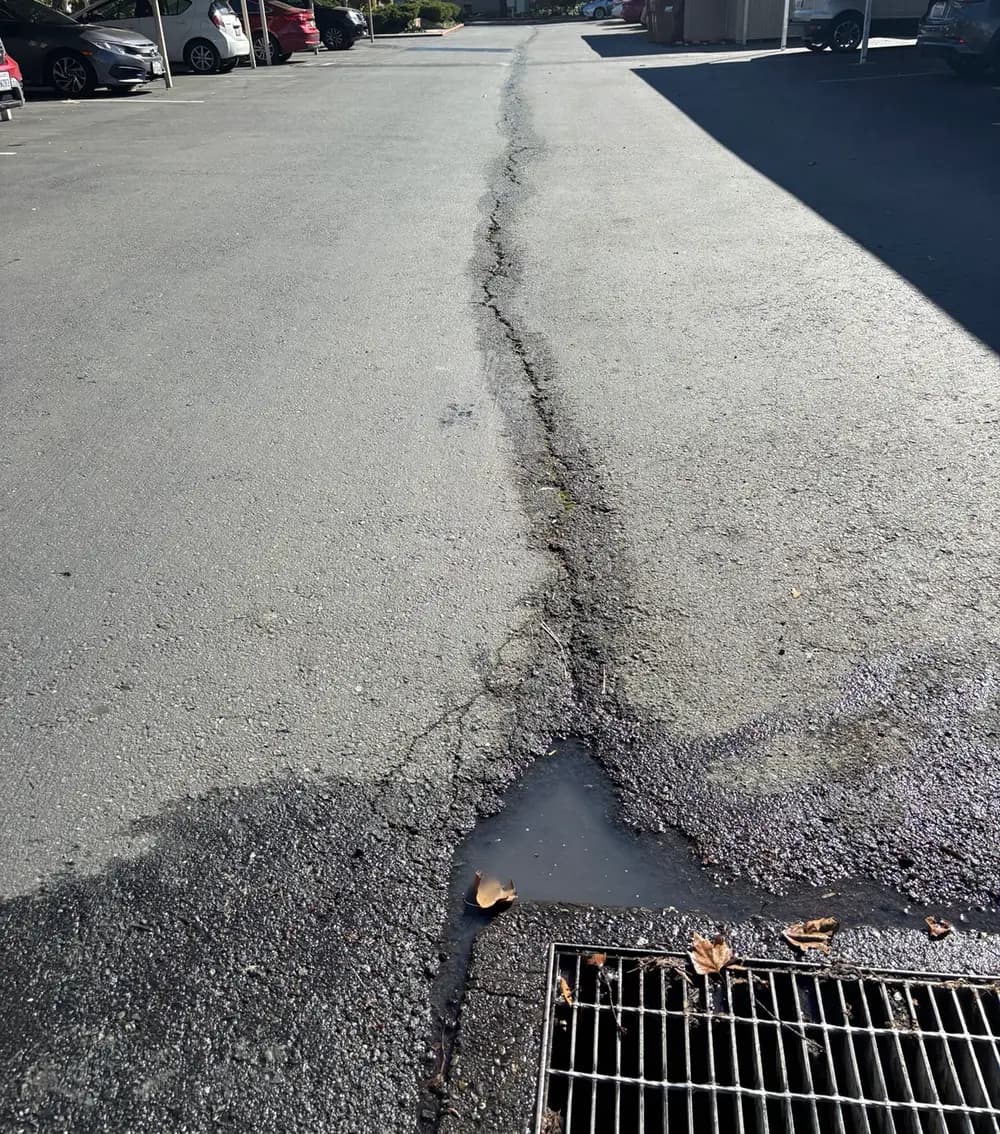
Depressions and cracking rings around utility trenches and structures on dense urban and older commercial pavement.

Likely causes

  • Trench backfill not compacted to match the surrounding subgrade
  • Water migrating along the trench line and freezing
  • Repeated cuts in the same area over decades

Paving and Maintenance Calendar for New Jersey

Treat this as a planning aid, not a rule. Whether a given treatment can actually be placed on a given day depends on product requirements, surface and nighttime temperatures, the rain forecast, humidity, plant availability, the project specification, and the contractor’s means and methods.

Winter

Work often suited to this window

  • Snow and ice management
  • Emergency pothole and safety repairs
  • Assessments, budgeting, and booking the coming season

Scheduling risks

  • Paving and coatings are out of season
  • Coastal storms can flood low-lying properties outside hurricane season
  • Northwestern counties see substantially more snow than the shore

Inspect for: Note where snow is stored, where meltwater refreezes, and where plows catch edges.

Spring

Work often suited to this window

  • Repairs to winter damage
  • Sweeping accumulated salt and sand
  • Drainage corrections and early paving as conditions allow

Scheduling risks

  • Subgrade may still be thaw-weakened in the northwest
  • Shore properties race to finish before the summer season
  • Demand peaks immediately and lead times stretch

Inspect for: Map winter damage and get shore work scoped before the season makes the property unavailable.

Regional exception: Shore properties have a hard deadline: work generally has to be complete before the summer season starts.

Summer

Work often suited to this window

  • Paving, overlays, and reconstruction inland
  • Sealcoating and surface treatments
  • Night work at warehouse and port-adjacent facilities

Scheduling risks

  • Shore properties are largely unavailable during the season
  • Thunderstorms interrupt placement and coating cure
  • Peak demand statewide stretches lead times

Inspect for: Walk truck courts and container areas during the hottest weeks looking for rutting and shoving.

Fall (pre-freeze)

Work often suited to this window

  • Crack sealing — the highest-return routine work in this climate
  • Shore work resuming after the season ends
  • Drainage clearing before winter and coastal storm season

Scheduling risks

  • Late-season coastal storms can flood low-lying sites
  • Night temperatures close the window earlier in the northwest
  • Crack sealing crews book out through the fall

Inspect for: Confirm cracks are sealed and every inlet is clear before winter, and check shore drainage before storm season.

Contractor Licensing and Verification in New Jersey

Statewide licensing
Depends on scope and project value
Administering body
New Jersey Division of Consumer Affairs (Home Improvement Contractor registration) and Department of Labor (public works contractor registration)

New Jersey requires Home Improvement Contractors to register with the Division of Consumer Affairs, carry commercial general liability insurance at a statutory minimum, and display the registration number on contracts and advertising. That framework covers residential work — a driveway at a private home falls within it; a commercial parking lot generally does not.

Separately, contractors performing public works in New Jersey must be registered with the Department of Labor and Workforce Development under the Public Works Contractor Registration Act, and prevailing wage applies. If your property is a school, municipality, county, or authority, that registration is a legal prerequisite and is verifiable through the department.

For private commercial paving there is no statewide licensing requirement, so verification leans on the entity and insurance. Confirm the entity through the Division of Revenue business search and match it to the contract and the certificate of insurance. New Jersey's Home Improvement Contractor insurance minimum is a useful reference point but does not apply to commercial work.

Many New Jersey municipalities require their own permits for site work, and in a state this densely governed, local approval timing is often what drives the schedule.

What a contractor license does not prove

Home Improvement Contractor registration is a residential consumer protection measure, and public works registration applies only to public projects. Neither establishes competence on a port-adjacent or heavily loaded commercial site.

  • That the proposed scope is the right fix for what is actually failing
  • That the price is fair for the local market
  • That drainage has been designed or corrected
  • That the pavement section and thickness suit the traffic the property carries
  • That the specified materials are appropriate for the site
  • That the crew will show up when promised
  • That workmanship will hold up past the first winter or summer
  • That the company is financially stable enough to honor a warranty

Ask for a certificate of insurance sent directly from the carrier or agent rather than a copy forwarded by the contractor, confirm the general liability and workers’ compensation coverage is active on the dates of your work, and ask to be named as certificate holder so you are notified if the policy lapses.

Licensing requirements can turn on project value, scope of work, property location, and whether the job is public or private. City and county rules may add registration, permitting, or bonding requirements beyond anything required at the state level. Verify current requirements with the agency directly before contracting.

Last reviewed:

Stormwater and Environmental Considerations

New Jersey administers stormwater management through the Department of Environmental Protection, and the state's stormwater rules are among the more demanding in the country. Major development — defined in part by how much impervious surface a project creates or disturbs — triggers requirements for groundwater recharge, runoff quantity control, and water quality treatment, and green infrastructure is the default approach under the current rules.

For a parking lot, the practical consequence is that a full reconstruction can land in a different regulatory category than a mill-and-overlay of the same lot. Because the thresholds turn on disturbed and created impervious area, it is worth establishing early which category your project falls into rather than discovering it during permitting.

Additional layers apply by location: coastal areas fall under the state's coastal permitting program, parts of the northwest fall under Highlands water protection, freshwater wetlands are regulated statewide, and flood hazard area rules apply along waterways. New Jersey also has a substantial number of contaminated sites, and disturbing soil on a site with environmental history has its own implications worth confirming before work begins.

What tends to drive requirements here

  • Disturbed and newly created impervious area, which drive major development thresholds
  • Groundwater recharge, runoff quantity, and water quality treatment requirements
  • Coastal permitting for shore and back-bay properties
  • Highlands water protection in parts of northwestern New Jersey
  • Flood hazard area rules along waterways
  • Environmental history of the site, which can constrain soil disturbance

New Jersey layers state stormwater, coastal, Highlands, wetlands, and flood hazard programs with municipal requirements. Confirm what applies to your parcel before design.

Last reviewed:

Pavement Terms You May Encounter in New Jersey

TermWhat it means on a New Jersey project
SuperpaveThe mix design system used to match binder grade and aggregate structure to expected traffic and temperature. New Jersey suppliers use this vocabulary, and it matters for port and warehouse loading.
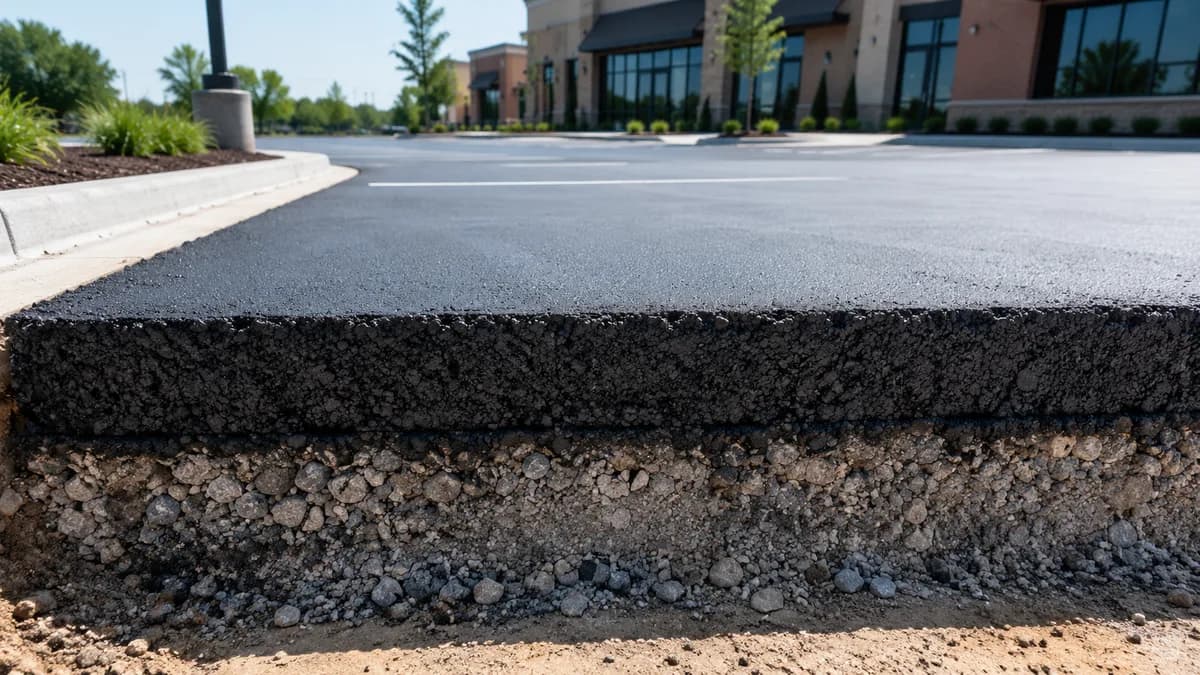
Dense-graded aggregate base (DGA)The compacted crushed stone base commonly specified in New Jersey. Its thickness and compaction usually determine pavement life more than the asphalt above it.
Heavy-duty pavement sectionA thicker, stronger design intended for container, chassis, or sustained truck loading. On a port-adjacent site this is a different design problem than a standard commercial lot.
Green infrastructureBioretention, permeable pavement, and similar practices that manage stormwater on site. Under New Jersey's stormwater rules these are the default approach for major development.
Groundwater rechargeA stormwater requirement to return a portion of runoff to the ground rather than discharging it. New Jersey's emphasis on recharge affects what a large lot project has to include.
Air-entrained concreteConcrete with microscopic air voids that give freezing water somewhere to expand. Standard for exterior concrete here and a real factor in whether a walk or curb scales under salt.

State transportation specifications can provide useful regional terminology and material references, but they do not automatically govern private parking-lot or driveway projects unless incorporated into the contract or required by the applicable jurisdiction.

More definitions are in the pavement glossary.

Common Pavement Projects in New Jersey

Port and drayage facilities

Container chassis loading around Newark and Elizabeth requires heavy-duty design, and the soft meadowlands fill beneath many of those sites makes subgrade the controlling variable.

Warehouse and distribution facilities

Turnpike corridor truck courts concentrate slow, heavy loading, and stormwater review on large sites is usually the gating approval.

Shore hospitality and rental properties

Flood exposure and a hard summer-season deadline mean the damage and the acceptable work window fall in opposite parts of the year.

Dense retail and mixed-use properties

Sites built to the property line leave no staging area, so phasing and access frequently drive cost more than the paving does.

Corporate campuses and office parks

Large lots with extensive green infrastructure require work that protects bioretention areas and permeable surfaces during construction.

Questions to Ask a Paving Contractor in New Jersey

New Jersey pavement FAQs

Why does pavement fail so fast at New Jersey port and warehouse sites?

Loaded container chassis and drayage trucks impose very high, concentrated, slow-moving loads — a fundamentally different problem from parked cars or even ordinary delivery traffic. Many of those sites also sit on historic fill over former marsh with limited bearing capacity. When heavy-duty loading meets a section designed for standard commercial traffic on soft subgrade, rutting and structural failure follow quickly. Milling and filling it addresses the symptom rather than the section.

Does New Jersey require a license for paving contractors?

It depends on the work. New Jersey requires Home Improvement Contractor registration through the Division of Consumer Affairs for residential work, with a statutory insurance minimum and the registration number displayed on contracts. Public works projects require separate contractor registration with the Department of Labor along with prevailing wage. For private commercial paving there is no statewide licensing requirement, so verification relies on the entity, insurance, and references.

What is 'major development' under New Jersey stormwater rules?

It is the regulatory threshold that determines whether a project must meet the state's stormwater requirements for groundwater recharge, runoff quantity control, and water quality treatment, and it turns in part on how much impervious surface the project creates or disturbs. For a parking lot, a full reconstruction can fall into a different category than a mill-and-overlay of the same lot. Establishing which category your project is in should happen during design, not during permitting.

What should I check on a shore property after coastal flooding?

Look beneath the surface. Floodwater moving through and under pavement washes out base material and undermines edges while the surface can still look intact. Check pavement edges, areas around inlets and structures, and anywhere that moves or sounds hollow under load. Have undermined areas evaluated before returning heavy traffic. Because shore properties also have a hard summer-season deadline, getting this scoped in the off-season matters.

Why do New Jersey projects cost more on constrained sites?

Because access and staging are real work. On a site built to the property line with no lay-down area, material has to be delivered in smaller loads on a tighter schedule, work has to be phased so the property keeps operating, and some of it may need to happen at night. That can add substantially to a project without changing a square foot of pavement. It is worth asking a contractor to explain how they plan to phase the work, because that explanation is often where the price difference between bids lives.

Does green infrastructure change how my parking lot gets maintained?

Yes. Bioretention areas and permeable pavement are engineered systems with maintenance obligations, not landscaping. Permeable surfaces need periodic vacuum sweeping or they stop infiltrating and become ordinary impervious pavement. Bioretention areas can be destroyed by construction traffic or by sediment washed in during repaving. If these features were installed to satisfy a stormwater approval, their maintenance may have been a recorded condition — worth confirming what your site's approval required.

Is northwestern New Jersey different from the rest of the state?

Meaningfully so. The Highlands and northwestern counties see colder winters, deeper frost, and more snow than the shore, which makes frost heave and fall crack sealing more consequential there. Parts of the region also fall under Highlands water protection, which adds review that a central New Jersey project would not face. A maintenance plan and a permitting assumption built for a Middlesex County site will not transfer to Sussex or Warren County.

Browse services in New Jersey

Related reading for New Jersey property owners

New Jersey Agencies and Reference Links

This page summarizes publicly available information for general education. It is not legal, engineering, or code-compliance advice, and requirements change. Confirm anything that affects your project with the agency with jurisdiction over the property.

Regulatory content last reviewed:

For contractors

Are you a pavement contractor in New Jersey?

Get listed where property managers, owners, and facility teams search by state, city, and service.