

What this guide covers
Common starting benchmarks: parking stalls at 3 inches of asphalt over 6 inches of base, drive lanes at 4 inches over 8 inches, truck routes and loading areas at 5 to 6 inches or more, residential driveways at 2 to 3 inches over 4 to 6 inches, and overlays at 1.5 to 2 inches over stable existing pavement.
This guide is part of the asphalt paving hiring hub — start with How to Choose an Asphalt Paving Contractor for the full picture. This article covers thickness and pavement section decisions; for bid comparison, see How to Compare Asphalt Paving Bids.
Once a qualified professional has identified the pavement section, enter each compacted lift in the Asphalt Tonnage Calculator to estimate material and truckloads, then browse asphalt paving contractors by location and specialty. For what the section costs to build, see asphalt paving cost.
Related contractor categories
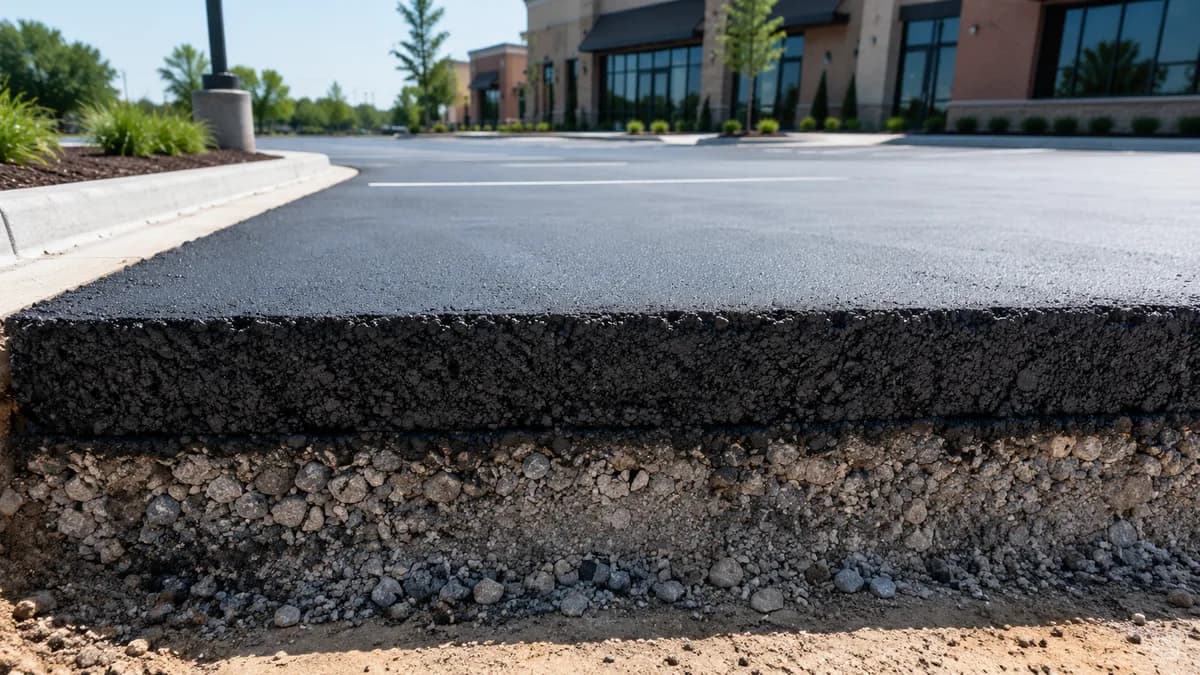
Why asphalt thickness matters
Asphalt thickness affects pavement cost, strength, and service life. If the asphalt section is too light for the traffic, the pavement may crack, rut, shove, or break apart early. Thickness alone does not solve every problem — a thick asphalt layer over weak base or poor drainage can still fail.
The pavement should be viewed as a system: subgrade, aggregate base, asphalt layer, drainage, traffic load, and maintenance all work together.
Typical thickness benchmarks
Treat these as the numbers to measure a proposal against, not a substitute for design. Soft soils, wet climates, and heavy traffic push all of them up, and local standards or an engineered section override all of them.
| Area type | Typical compacted asphalt | Typical aggregate base | Notes |
|---|---|---|---|
| Parking stalls (passenger vehicles) | 3 inches | 6 inches | Light loads, but base and drainage still matter |
| Drive lanes | 4 inches | 8 inches | Concentrated, repeated traffic |
| Truck routes, trash routes, fire lanes | 5 to 6 inches or more | 8 to 12 inches | Often warrants engineered design |
| Loading docks and industrial yards | 6 inches or more | 12 inches or more | Point loads and turning; engineering advised |
| Residential driveways | 2 to 3 inches | 4 to 6 inches | More for RVs, trailers, work trucks |
| Overlay on stable pavement | 1.5 to 2 inches | Existing pavement | Depends entirely on existing condition |
Passenger vehicle areas vs. heavy vehicle areas
Parking stalls and light-duty areas usually carry lower loads than drive lanes or service areas and may not need the same pavement section as truck paths — though poor base or drainage can still cause failure even in light-duty areas.
Some areas receive heavier loading: fire lanes, trash enclosure routes, loading docks, delivery truck paths, bus areas, industrial yards, main drive lanes, and turning areas. A single fully loaded trash truck stresses pavement more than thousands of passenger cars, which is why trash routes fail first in so many lots built to a single uniform section.
New paving, overlay, and replacement thickness
New paving is installed over prepared base, so asphalt thickness should be selected with the base, soil, traffic, and drainage in mind — is the base new or existing, has it been compacted, is drainage acceptable, and are heavy trucks expected?
Most overlays are 1.5 to 2 inches compacted; thinner lifts are hard to compact properly and wear faster. Overlay thickness may be limited by curb height, drain elevation, utility covers, door thresholds, sidewalk transitions, ADA slopes, existing cracking, and existing drainage — the existing pavement must be stable enough to support the new layer. For the full decision, see Asphalt Paving vs Asphalt Overlay.
Full replacement gives the contractor more control because existing failed asphalt can be removed, but the base still matters — if it's soft, wet, or unstable, replacing the asphalt alone may not be enough. The proposal should state whether base repair is included, excluded, or handled by change order.
Compacted vs. loose thickness
Ask whether the proposal lists compacted thickness. Compacted thickness is the finished asphalt thickness after rolling; loose asphalt thickness is the thickness before compaction, and asphalt compacts roughly 20 to 25 percent under rolling. That means 3 inches placed loose finishes at roughly 2.25 to 2.4 inches — two bids both saying "3 inches" can deliver meaningfully different pavement. For owners comparing bids, compacted thickness is the number that matters.
Thickness, drainage, and ADA areas
Water weakens pavement systems. Saturated base leads to cracking, pumping, settlement, potholes, and rutting regardless of how much asphalt sits on top. If a parking lot holds water, thickness alone will not solve the problem, and drainage correction should be scoped with Drainage and Sitework Contractors before or alongside paving.
ADA parking areas require attention to slope, access aisles, accessible routes, and transitions — thickness is not the only issue. Accessible stalls and aisles are limited to roughly 2 percent slope in any direction, so even a small grade change from added thickness can create a compliance problem. Related category: ADA Parking Contractors.
Common mistakes
Avoid these when reviewing thickness in a proposal or comparing bids:
- Comparing bids without checking asphalt thickness
- Assuming thicker asphalt fixes bad base
- Treating truck paths like parking stalls
- Ignoring drainage
- Accepting vague "standard thickness" wording
- Confusing loose thickness with compacted thickness
- Overlaying failed pavement without repair
- Ignoring ADA grade impacts
Frequently asked questions
What is the standard asphalt thickness for a parking lot?
Common starting benchmarks are 3 inches compacted asphalt over 6 inches of base in parking stalls and 4 inches over 8 inches in drive lanes. Truck routes need more. Soil, drainage, climate, and local standards can change all of these numbers.
Is thicker asphalt always better?
No. Thickness helps only if the base, drainage, and pavement design are appropriate.
Should drive lanes be thicker than parking stalls?
Usually, yes. Drive lanes carry concentrated, repeated traffic, and heavy vehicle paths like trash routes need the most.
What is compacted asphalt thickness?
Compacted thickness is the finished asphalt thickness after rolling. Asphalt compacts roughly 20 to 25 percent, so 3 inches loose finishes near 2.25 to 2.4 inches.
Can asphalt thickness fix drainage problems?
No. Drainage problems may require grading, drain work, or sitework in addition to paving.
Before you hire: The Pavement Directory does not provide legal or compliance advice. ADA and accessibility requirements vary by site, jurisdiction, and project scope. Contractors may perform striping, grading, concrete, or asphalt corrections, while CASp inspectors or accessibility consultants may be needed for compliance review. Consult qualified professionals when compliance is material.
For property owners
Looking for a pavement contractor?
Use The Pavement Directory to search asphalt, concrete, sealcoating, striping, ADA access, and pavement maintenance contractors by service and location. Always verify license, insurance, references, and written scope before hiring.
Search contractorsFor contractors
Are you a pavement contractor?
Contractors can add or claim a company profile to help property owners find pavement professionals by service, location, and specialty.