The Pavement Directory

State pavement directory

Pavement Contractors in Minnesota

Minnesota pavement has to survive a temperature range that few other states impose — deep subzero cold that shrinks asphalt until it cracks, followed by a spring in which the subgrade loses much of its strength for several weeks. Add plow blades, deicing chemicals, and a construction season that closes early, and the maintenance calendar here is not a preference. It is a constraint.

This page lists pavement contractors serving Minnesota cities and covers the state-specific mechanics behind the damage: low-temperature cracking, frost depth and spring thaw, chloride effects on concrete, and how the season shapes what can realistically be scheduled and when.

Listings
24
City
1
Services
13
Search Minnesota

Before you hire: The Pavement Directory does not guarantee contractor performance, pricing, licensing, insurance, or availability. Business information may be submitted by contractors or gathered from public sources and should be independently verified before hiring. Always confirm licensing, insurance, references, scope of work, and written contract terms.

24 contractors in Minnesota

Filter by service
1-800-ASPHALT logo

Princeton, Minnesota

Asphalt PavingSealcoatingStriping & Pavement MarkingsCommercial

This company provides asphalt paving, sealcoating, striping, and repair services along with concrete work such as driveways, patios, sidewalks, and curbs. It serves both residential and commercial customers, including work like parking lot maintenance, catch basin installation, and sport court construction. The business operates across numerous Minnesota communities, including Princeton, St. Cloud, Anoka, and the greater Twin Cities metro area.

(800) 277-4258Website on file
Asphalt PavingCommercial & Residential

Locally owned and operated, Ace Asphalt is a full-service paving and maintenance contractor serving the Twin Cities metro area. The company offers driveway paving and repairs, parking lot installation and maintenance, asphalt milling and resurfacing, and snow and ice removal services. Services are provided for residential properties, business parks, schools, churches, and other organizations.

(952) 938-6137Website on file
ACI Asphalt & Concrete, LLC. logo

Maple Grove, Minnesota

Asphalt PavingSealcoatingConcrete SiteworkCommercial

ACI Asphalt & Concrete, LLC is a commercial pavement contractor serving Maple Grove, Minnesota, Roberts, Wisconsin, and surrounding areas. The company offers asphalt paving and resurfacing, asphalt patching and repair, sealcoating and crack filling, parking lot paving and striping, concrete design and repair, drainage solutions, and polyjacking services. The company serves industrial, multifamily, retail, office, and hospitality sectors.

(763) 424-9191Website on file
Advanced Asphalt Inc. logo

Lino Lakes, Minnesota

Asphalt PavingCommercial & Residential

Advanced Asphalt Inc. has provided residential and commercial paving services since 1999 and is based in Lino Lakes, Minnesota. The company offers driveway and parking lot removal and replacement, milling and overlaying, parking lot patching, class 5 driveways, asphalt millings, and repair of previous construction problems including drainage issues. The owner, Alex Hamernick, started the company with over 10 years of prior paving experience.

(651) 307-0114Website on file
Asphalt PavingDrainage & GradingCommercial & Residential

Paving contractor in Brainerd, MN offering Asphalt Paving, Drainage and Sitework.

(218) 829-1768Website on file
Asphalt PavingCommercial & Residential

The company has been in business since 1986 and completes hundreds of asphalt paving jobs per season. They serve government municipalities and businesses throughout Minnesota and surrounding states. The company offers on-site estimates and is a member of several industry associations including NAPA, ISSA, and the Minnesota Asphalt Pavement Association.

(320) 363-8500Website on file
Dunsmore Asphalt logo

Chanhassen, Minnesota

Asphalt PavingCommercial & Residential

The company has been delivering asphalt services to the southwest Twin Cities area of Minnesota since 1988. Residential services include removals, replacements, patches, seal coating, repairs, overlays, additions, parking pads, aprons, and sport courts. Commercial services include asphalt repair, additions, overlays, and new construction.

(952) 474-5670Website on file
Duramax Asphalt logo

Spring Lake Park, Minnesota

Asphalt PavingConcrete SiteworkCommercial & Residential

Paving contractor in Spring Lake Park, MN offering Asphalt Paving, Concrete Repair.

(763) 600-8337Website on file

Oakdale, Minnesota

Asphalt PavingConcrete SiteworkCommercial & Residential

Paving contractor in Oakdale, MN offering Asphalt Paving, Concrete Repair.

(651) 494-4663
Imperial Seal, LLC logo

Lakeville, Minnesota

Asphalt PavingSealcoatingResidential

Imperial Seal is a family-owned asphalt maintenance company serving the Twin Cities region. The company offers residential driveway sealcoating and repair, commercial parking lot sealcoating, hot rubber crack sealing, cut-out patching, overlay pothole patching, and line striping services. The business is led by brothers Mike and Joseph with operational support from their mother Deb.

(952) 454-5874Website on file
Interstate Companies logo

Forest Lake, Minnesota

Asphalt PavingConcrete SiteworkDrainage & GradingCommercial

Interstate Companies provides commercial property services in Minnesota, including asphalt paving, concrete work, pavement repair and maintenance, excavation, and snow and ice management. It serves corporate, industrial, logistics, healthcare, and retail properties. The company states it has 26 years of industry experience, owns more than 600 pieces of equipment, and serviced over 90 million square feet of property in 2024-2025.

(651) 765-0765Website on file
J&W Asphalt logo

Burnsville, Minnesota

Asphalt PavingCommercial & Residential

J&W Asphalt is a family-owned business founded in 1976 that offers residential asphalt services including driveways, asphalt repair, settlement repair, and apron repair. The company also provides commercial services such as parking lot paving, pathways and trails, sealcoating, and services for HOAs, property managers, and builders. The company states it adheres to Minnesota Asphalt Paving Association standards and utilizes advanced recycling techniques.

(952) 894-9078Website on file
Knife River Corporation logo

St Cloud, Minnesota

Asphalt PavingCommercial & Residential

Knife River operates in 15 states and provides construction materials and services for projects of any size. The company offers aggregates, asphalt, ready-mix concrete, construction services, and prestress products. Knife River also performs heavy-civil construction work and has completed projects including bridge replacements, airport terminal construction, and commercial building work.

(320) 252-4322Website on file
Asphalt PavingDrainage & GradingCommercial & Residential

Paving contractor in New Ulm, MN offering Asphalt Paving, Drainage and Sitework.

(507) 354-4171Website on file
Modern Roadways Company logo

New Hope, Minnesota

Asphalt PavingCommercial & Residential

The company specializes in road construction projects including secondary roads, highways, international roads, and bridges. Services include advanced lighting systems, modern sidewalks, road safety elements, barriers, signage, and construction of public and private facilities such as parks, sports tracks, and parking lots. The company states it works according to quality and safety standards and serves both government and private sector clients.

(763) 545-1777Website on file
Concrete SiteworkCommercial & Residential

Patrick Miller Construction is a family-owned contractor based in the Minneapolis, Minnesota area, operating since 2005. The company serves residential, commercial, and government clients with services including roofing, siding, window replacement, decks, garages, and concrete work. It holds Minnesota contractor license BC576168 and also operates an affiliated roll-off dumpster and junk hauling service.

(763) 786-1684Website on file
Paul A. Swartz Asphalt Paving logo

Alexandria, Minnesota

Asphalt PavingSealcoatingCrack SealingCommercial

The company specializes in driveway, parking lot, patching, sealcoating, crack filling, pavement marking, and overlay services. They accept projects of all sizes and offer free on-the-spot estimates on residential jobs. The company states it has over 30 years of experience in the asphalt paving and sealcoating industry and offers a customer satisfaction guarantee.

(320) 808-8326Website on file
Richfield Blacktop & Concrete logo

Richfield, Minnesota

Asphalt PavingConcrete SiteworkCommercial & Residential

The company offers asphalt driveway paving, concrete driveway paving, concrete projects, concrete steps and stoops, and concrete garage floor construction. They provide a 5-Year Craftsmanship Warranty that includes free repairs for five years on new asphalt pavement installations. Their services are designed for Minnesota weather conditions.

(612) 866-8073Website on file
RyGuy Asphalt logo

Jordan, Minnesota

Asphalt PavingCommercial & Residential

The company offers paving installation and replacement for all paving projects, asphalt repairs, sealcoating, and crack filling services. They serve residential driveways and commercial parking lots, and perform mill, sawcut, and dig-out patching work. The website lists customer reviews from Home Advisor with 5.0 ratings from customers in Jordan, Shakopee, and Lakeville, Minnesota.

(952) 412-1639Website on file
Superior Asphalt logo

Edina, Minnesota

SealcoatingCommercial & Residential

Superior Asphalt is a company based in Edina, Minnesota, that provides sealcoating services. The website text available does not describe additional services, project types, or the specific properties served in detail.

(952) 942-8547Website on file

Vadnais Heights, Minnesota

Asphalt PavingSealcoatingCommercial & Residential

Paving contractor in Vadnais Heights, MN offering Asphalt Paving, Sealcoating.

(651) 483-4546

What makes pavement work different in Minnesota?

Minnesota pavement fails from cold contraction in winter and lost subgrade strength in spring — two separate problems with two different fixes.

  • Regularly spaced transverse cracks across a Minnesota lot are usually low-temperature thermal cracking, not a traffic or workmanship failure.
  • Spring thaw temporarily weakens the subgrade statewide; this is the reason for seasonal load restrictions on public roads and a real consideration for heavy deliveries on private sites.
  • Deicing chemicals attack concrete surfaces, joints, and reinforcement more aggressively than they attack asphalt, so concrete aprons and sidewalks often deteriorate first.
  • Crack sealing before freeze-up is the highest-value routine maintenance in this climate, because open cracks feed water into a structure that then freezes.
  • Minnesota licenses residential building contractors through the Department of Labor and Industry; commercial paving is generally outside that requirement, which shifts verification onto insurance and references.

Pavement Conditions by Region in Minnesota

Minnesota does not have one climate or one soil profile, and pavement that performs well in one part of the state can fail early a few hours away. These are the divisions that matter most when scoping paving, repair, or maintenance work.

Twin Cities metro

Minneapolis · St. Paul · Bloomington · Plymouth · Eagan

Environmental stress

  • Repeated freeze-thaw cycling through late winter and early spring
  • Heavy plowing and chemical deicing on commercial properties
  • Dense commercial and distribution traffic

Subgrade conditions

  • Glacial tills and mixed soils varying block to block
  • Frost-susceptible silts in some areas
  • Older urban fill and utility corridors under existing lots

Common distress

  • Spring potholing where meltwater sat in cracks
  • Concrete surface scaling and joint deterioration from chlorides
  • Rutting on delivery routes and dock approaches

What it means for the work

  • The metro has the deepest contractor market and the tightest scheduling competition
  • Snow storage location determines where spring meltwater damage concentrates
  • Phasing around occupied retail and office properties is standard practice

Southern Minnesota

Rochester · Mankato · Owatonna · Worthington

Environmental stress

  • Somewhat milder winters than the north, with more freeze-thaw cycles
  • Heavy agricultural equipment and grain truck traffic
  • Intense summer thunderstorms

Subgrade conditions

  • Deep, fertile loams and silty soils
  • Karst features in the southeastern bluff country
  • Agricultural drainage patterns affecting adjacent sites

Common distress

  • Edge break-up from heavy equipment turning off pavement
  • Localized settlement in karst areas of the southeast
  • Freeze-thaw cracking and potholing

What it means for the work

  • Harvest-season loading is a design consideration on farm-adjacent sites
  • Sinkhole-prone southeastern areas warrant investigation of recurring depressions
  • Shoulder and edge support prevents a common failure mode here

Northern Minnesota and the Iron Range

Duluth · Hibbing · Bemidji · International Falls

Environmental stress

  • The state's most extreme cold and deepest frost penetration
  • Very heavy snowfall, including lake-effect snow near Lake Superior
  • Sustained plowing and sanding operations

Subgrade conditions

  • Shallow bedrock in parts of the Iron Range and North Shore
  • Frost-susceptible soils with deep seasonal frost
  • Peat and organic soils in low-lying and bog areas

Common distress

  • Severe low-temperature thermal cracking
  • Frost heave and spring break-up damage
  • Plow gouging on transitions, curbs, and raised features

What it means for the work

  • The construction season is shortest here — book early
  • Mining and timber loading are real design loads on industrial sites
  • Durable marking materials matter where plows run all winter

Western Minnesota and the Red River Valley

Moorhead · Willmar · Alexandria · Fergus Falls

Environmental stress

  • Open, windswept terrain with drifting snow
  • Spring flooding in the Red River Valley
  • Wide temperature swings between seasons

Subgrade conditions

  • Heavy lacustrine clays in the Red River Valley with high shrink-swell potential
  • Flat terrain with poor natural drainage
  • Agricultural ground with variable moisture

Common distress

  • Cracking driven by clay movement in addition to freeze-thaw
  • Prolonged saturation and base weakening after spring flooding
  • Drifted snow concentrating meltwater in specific areas

What it means for the work

  • Flat sites need designed positive drainage, not minimal slope
  • Valley clays add a moisture-movement problem on top of the frost problem
  • Snow fencing and drift management affect where meltwater ends up

Common Pavement Problems in Minnesota

Low-temperature thermal cracking

Straight cracks running across the pavement at fairly regular intervals, with no connection to wheel paths. They appear or widen during the coldest stretches and are widest in midwinter.

Likely causes

  • Asphalt contracting in extreme cold until it cracks in tension
  • Binder grade not selected for the site's low-temperature extreme
  • Aged, oxidized binder that can no longer relax stress

When to get it looked at: Regularly spaced transverse cracking is normally a sealing priority rather than a structural alarm — but once those cracks start branching and the edges break down, water has been getting in and the question changes.

Spring thaw weakening

Potholes and edge failures appearing over a few weeks in March and April, in areas that carried the same traffic all winter without trouble.

Likely causes

  • Meltwater trapped in the base above still-frozen subgrade
  • Frost-susceptible soils losing strength when saturated
  • Heavy deliveries during the weakest weeks of the year

When to get it looked at: If the same areas fail every spring, drainage or base material is the cause. Repaving without correcting that repeats the cycle on a schedule.

Deicing chemical damage to concrete

Concrete sidewalks, aprons, and dumpster pads develop surface scaling, flaking, and spalling at joints, often long before the adjacent asphalt shows serious wear.

Likely causes

  • Chloride deicers driving repeated freeze-thaw within the concrete surface
  • Chloride reaching reinforcement and causing corrosion and spalling
  • Concrete placed without adequate air entrainment or cure for this climate

When to get it looked at: Scaling that exposes coarse aggregate over large areas, or spalling that reveals reinforcement, is past the point where a surface treatment helps — get the extent evaluated before another winter.

Snowplow damage

Gouges, chipped edges, and scraped markings concentrated at curbs, transitions, drainage structures, and anything that stands proud of the surface.

Likely causes

  • Plow blades catching raised features and uneven transitions
  • Repeated passes along the same lines through a long winter
  • Markings and thin surface treatments with limited abrasion resistance

Meltwater concentration at snow storage areas

Localized pavement failure, staining, and sediment accumulation in and downhill of the areas where plowed snow is piled every winter.

Likely causes

  • Large volumes of meltwater and accumulated sand and chloride released in one place
  • Snow piles placed over pavement that drains poorly
  • Sediment from plowed snow blocking nearby inlets

When to get it looked at: If snow storage location has never been discussed with your snow contractor, that conversation is cheaper than the pavement repair it prevents.

Paving and Maintenance Calendar for Minnesota

Treat this as a planning aid, not a rule. Whether a given treatment can actually be placed on a given day depends on product requirements, surface and nighttime temperatures, the rain forecast, humidity, plant availability, the project specification, and the contractor’s means and methods.

Winter

Work often suited to this window

  • Snow and ice management
  • Emergency pothole and safety repairs
  • Assessment review, budgeting, and booking the coming season

Scheduling risks

  • Paving and surface treatments are out of season
  • Cold-patch repairs are temporary by design

Inspect for: Note where snow is being stored and where plows are catching edges — both determine where spring damage appears.

Spring thaw

Work often suited to this window

  • Damage assessment once the surface is clear
  • Pothole repair and safety work
  • Sweeping accumulated winter sand and chloride

Scheduling risks

  • Subgrade is at its weakest, so structural work now is less reliable
  • Load restrictions affect hauling and material delivery
  • Spring flooding can delay access in the Red River Valley

Inspect for: Map the winter's damage and identify which failures repeat annually — those are drainage or base problems, not weather.

Regional exception: Northern Minnesota thaws weeks later than the metro; a schedule built on Twin Cities timing will not fit Duluth or International Falls.

Construction season

Work often suited to this window

  • Paving, overlays, and reconstruction
  • Sealcoating and surface treatments
  • Striping, accessibility work, and drainage corrections

Scheduling risks

  • This is peak demand statewide and the window is genuinely short
  • Summer thunderstorms interrupt placement and sealcoat cure
  • School and campus work competes for the same few weeks

Inspect for: Look for rutting and structural distress in delivery and truck areas while the pavement is warm and weaknesses show.

Fall (pre-freeze)

Work often suited to this window

  • Crack sealing — the highest-value routine work in this climate
  • Final paving as temperatures allow
  • Drainage clearing and snow-operation planning

Scheduling risks

  • Night temperatures fall quickly and close the window earlier than expected
  • An early hard freeze can end the season with little warning
  • Crack sealing demand peaks and crews book out

Inspect for: Confirm cracks are sealed and drainage is clear before freeze-up; every open crack is a place water will freeze and pry.

Contractor Licensing and Verification in Minnesota

Statewide licensing
Depends on scope and project value
Administering body
Minnesota Department of Labor and Industry

Minnesota licenses residential building contractors and residential remodelers through the Department of Labor and Industry, and that licensing is verifiable through the department's online lookup. Commercial paving and parking lot work generally sits outside that residential licensing framework, so on a commercial property there may be no state license number to check at all.

That makes the other verification steps carry more weight. Confirm the exact entity name through the Secretary of State's business search and check that it matches the contract and the insurance certificate. Ask for a certificate of insurance sent directly from the carrier or agent, covering general liability and workers' compensation for the dates of your project.

Public projects in Minnesota carry their own bonding, prevailing wage, and responsible contractor requirements, which differ substantially from private commercial work. If your property is a school, city, or other public facility, those rules — not the residential licensing framework — are what apply.

Some Minnesota cities require their own contractor registration or permits for work within their jurisdiction. Ask the city with jurisdiction over your property rather than assuming a statewide answer.

What a contractor license does not prove

For a commercial parking lot, there is often no state paving license to verify, so references from comparable Minnesota winters and a clear written scope do more work than a license check would elsewhere.

  • That the proposed scope is the right fix for what is actually failing
  • That the price is fair for the local market
  • That drainage has been designed or corrected
  • That the pavement section and thickness suit the traffic the property carries
  • That the specified materials are appropriate for the site
  • That the crew will show up when promised
  • That workmanship will hold up past the first winter or summer
  • That the company is financially stable enough to honor a warranty

Ask for a certificate of insurance sent directly from the carrier or agent rather than a copy forwarded by the contractor, confirm the general liability and workers’ compensation coverage is active on the dates of your work, and ask to be named as certificate holder so you are notified if the policy lapses.

Licensing requirements can turn on project value, scope of work, property location, and whether the job is public or private. City and county rules may add registration, permitting, or bonding requirements beyond anything required at the state level. Verify current requirements with the agency directly before contracting.

Last reviewed:

Stormwater and Environmental Considerations

Minnesota administers construction stormwater permitting through the Minnesota Pollution Control Agency. Construction activity that disturbs enough ground generally requires coverage under the state's construction stormwater permit, along with a stormwater pollution prevention plan and erosion and sediment controls during the work.

Minnesota's post-construction requirements have a distinct local character because of the state's lakes and its chloride problem. Many watershed districts and municipalities apply their own volume-control, infiltration, or treatment requirements when a project creates or reconstructs impervious surface, and watershed district review is a step that catches property owners by surprise more often than the state permit does.

Chloride from winter deicing is a recognized water quality concern statewide, and Minnesota has invested significantly in training around applying less salt while maintaining safety. For a property owner, that is worth knowing in two ways: over-application damages your own concrete, and reducing it is increasingly expected practice rather than an optional efficiency.

What tends to drive requirements here

  • Disturbed area, which drives construction stormwater permit coverage
  • Watershed district review, which applies in much of the metro and elsewhere
  • Volume control and infiltration requirements tied to new or reconstructed impervious surface
  • Proximity to lakes, wetlands, and impaired waters
  • Chloride management and snow storage practices as an ongoing water quality issue
  • Erosion control stabilization before freeze-up, ahead of spring melt

Watershed district and municipal requirements in Minnesota frequently exceed state minimums and differ from one district to the next. Confirm with both the city and the watershed district before design.

Last reviewed:

Pavement Terms You May Encounter in Minnesota

TermWhat it means on a Minnesota project
PG binder grade (e.g. PG 58-34)The performance grade of the asphalt binder. The second number is the low-temperature limit, and in Minnesota that number is what governs resistance to thermal cracking. It is a fair question to ask which grade a proposal includes.
Spring load restrictionsSeasonal axle load limits imposed while subgrade is thaw-weakened. They apply to public roads, but the same weakness affects private lots receiving heavy deliveries in April.
Frost-free / non-frost-susceptible baseGranular base with few fines, chosen so freezing water cannot build ice lenses that heave the surface. In a deep-frost state this often does more for pavement life than adding asphalt thickness.
Air-entrained concreteConcrete with microscopic air voids that give freezing water somewhere to expand. It is a standard requirement for exterior concrete in Minnesota and a real factor in whether a sidewalk or apron scales.
Full-depth reclamation (FDR)Pulverizing the existing asphalt and base together and repaving over the treated blend. Used on Minnesota lots and roads where the base has failed and full removal is impractical.
Fog seal and seal coatThin surface treatments used to slow oxidation. In Minnesota roadway usage a seal coat often means a chip-and-binder application, which is not the same as sealcoating a parking lot — confirm which one a proposal means.

State transportation specifications can provide useful regional terminology and material references, but they do not automatically govern private parking-lot or driveway projects unless incorporated into the contract or required by the applicable jurisdiction.

More definitions are in the pavement glossary.

Common Pavement Projects in Minnesota

Distribution and cold-storage facilities

Truck aprons and dock approaches carry concentrated loads and see the most plowing, so they combine structural stress with the worst of the winter abrasion.

Healthcare and clinic campuses

Rochester and metro medical campuses need continuous access and safe walking surfaces, which makes concrete deterioration and trip hazards a higher priority than surface appearance.

Agricultural and grain facilities

Southern and western Minnesota facilities take extremely heavy loading concentrated into harvest weeks, usually on pavement edges that lack support.

Apartment and townhome communities

Private drives with narrow geometry get plowed hard all winter, and snow storage location determines where the pavement fails first.

Mining and timber industrial sites

Iron Range and northern industrial properties carry loads far beyond commercial design assumptions in the state's harshest frost environment.

Questions to Ask a Paving Contractor in Minnesota

Minnesota pavement FAQs

When does spring thaw affect paving in Minnesota?

Roughly from the time the surface starts thawing until the frost is fully out of the ground — typically several weeks in spring, later in northern Minnesota than in the Twin Cities. During that period meltwater is trapped in the base above still-frozen soil, the subgrade loses much of its strength, and both pavement damage and unreliable repair work are more likely. It is the reason for seasonal load restrictions on public roads, and it is why structural repairs are usually scheduled after the frost is out rather than during break-up.

Why does my Minnesota parking lot have evenly spaced cracks across it?

That pattern is characteristic of low-temperature thermal cracking. In extreme cold, asphalt contracts until it cracks in tension, and because the stress relieves at each crack, the cracks tend to appear at fairly regular spacing across the pavement rather than following traffic. It is not a workmanship failure or a base failure. The important thing is keeping those cracks sealed, because once water gets in and freezes, an orderly crack pattern turns into potholes.

How do deicing chemicals affect concrete in Minnesota?

Chloride deicers increase the number of freeze-thaw cycles the concrete surface experiences and drive water deeper into it, which produces scaling and flaking. Where chloride reaches embedded reinforcement, it causes corrosion that expands and spalls the concrete from within. That is why sidewalks, aprons, and dumpster pads often deteriorate faster than the asphalt beside them. Air-entrained concrete, proper cure, and moderating salt application all matter.

When is the best time to seal cracks in Minnesota?

Fall, before freeze-up, is generally the highest-value window in this climate. Cracks are open enough to fill, temperatures are still workable, and sealing them keeps water out of the pavement structure through the winter when freezing does the most damage. Spring sealing is also done, but by then the winter's water has already been in the structure. The exact timing depends on the product's temperature requirements and the moisture in the cracks.

Does Minnesota require a license for commercial paving contractors?

Minnesota licenses residential building contractors and remodelers through the Department of Labor and Industry, but commercial paving and parking lot work generally falls outside that requirement, so there may be no state license to check on a commercial project. Verification here relies more on confirming the business entity, verifying insurance directly with the carrier, checking whether the city requires its own registration, and getting references from comparable Minnesota properties.

How short is the paving season in Minnesota?

The reliable window for asphalt placement and surface treatments runs roughly from late spring through early fall, and it is shorter in northern Minnesota than in the metro. Because that window is narrow and demand concentrates in it, scheduling is often the practical constraint on a project. Fall crack sealing extends a little later, but night temperatures start closing options quickly, and an early hard freeze can end the season with little warning.

Where should plowed snow be stored on a commercial property?

Somewhere that meltwater — carrying the winter's accumulated sand and chloride — can drain away without sitting on pavement or overwhelming an inlet. Snow piles concentrate a large volume of water, sediment, and salt in one place, and the pavement under and downhill of a habitual pile often fails first. It is worth agreeing on storage locations with your snow contractor before the season rather than discovering the effect in April.

Browse cities in Minnesota

Browse services in Minnesota

Related reading for Minnesota property owners

Crack Sealing

Property-owner guide

Updated July 11, 2026

When Should You Seal Asphalt Cracks?

When to seal cracks in asphalt — which cracks to seal, the best time of year, why sealing early matters, and how crack sealing fits a maintenance schedule.
Read guide
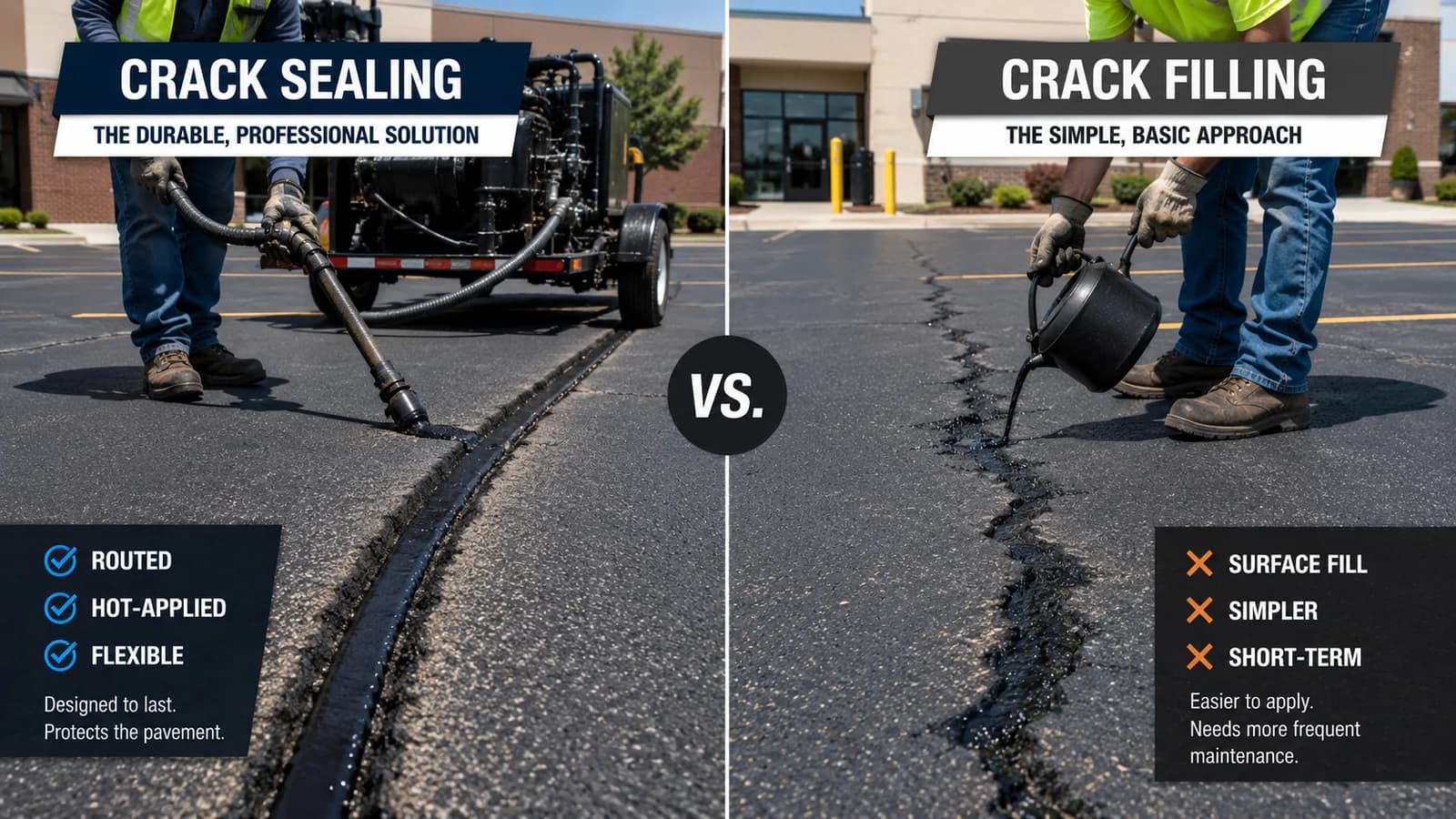
Side-by-side comparison: a crew member sealing a routed crack with hot-applied rubberized sealant from a melter unit, next to a worker pouring cold crack filler over an unrouted crack.
Crack Sealing

Property-owner guide

Updated July 6, 2026

Crack Sealing vs. Crack Filling: What Is the Difference?

The difference between crack sealing and crack filling, which method fits which type of crack, and how each fits into pavement maintenance.
Read guide
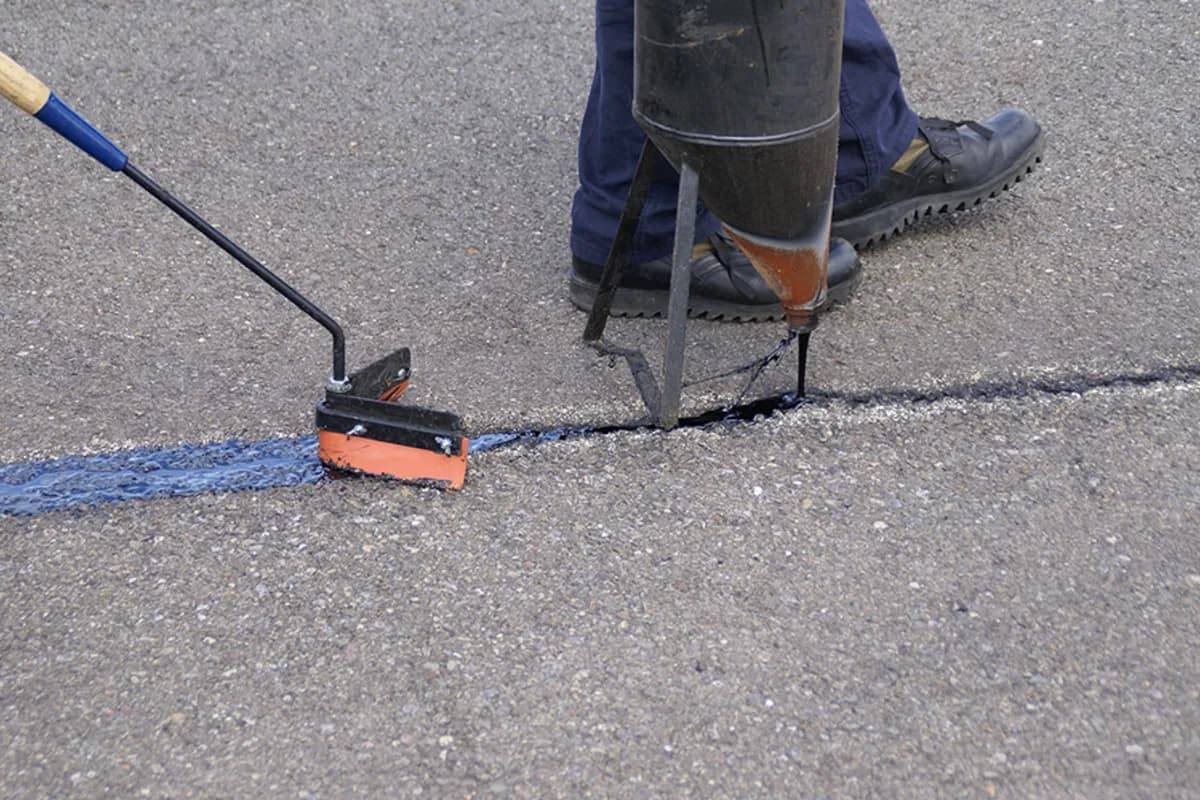
Close-up of a worker applying hot rubberized crack sealant into a pavement crack with a wand and squeegee applicator.
Contractor Hiring Guides

Property-owner guide

Updated July 11, 2026

How to Choose a Crack Sealing Contractor

How to choose a crack sealing contractor: the right material and prep, honest measurement, which cracks to skip, and how it fits a maintenance plan.

Read guide
Six close-up examples of cracked concrete labeled with their causes — shrinkage, temperature swings, heavy loads, water and drainage, soil movement, and age and wear — above a row of signs that a crack is worth investigating.
Concrete Repair

Property-owner guide

Updated July 11, 2026

Why Concrete Cracks (and When to Worry)

Why concrete cracks — shrinkage, settlement, freeze-thaw, roots, and loads — the difference between cosmetic and structural, and when to repair.

Read guide
Water pooling in a low spot of a parking lot due to poor drainage.
Drainage & Sitework

Property-owner guide

Updated July 12, 2026

How Drainage Affects Pavement Life

Why drainage is the biggest factor in how long pavement lasts, how water damages asphalt from the base up, and why fixing it protects every repair.

Read guide
Parking Lot Maintenance

Property-owner guide

Updated July 11, 2026

How to Create a Parking Lot Maintenance Plan

How to build a parking lot maintenance plan: inspecting condition, setting service cycles, prioritizing repairs, and budgeting over multiple years.

Read guide

Minnesota Agencies and Reference Links

This page summarizes publicly available information for general education. It is not legal, engineering, or code-compliance advice, and requirements change. Confirm anything that affects your project with the agency with jurisdiction over the property.

Regulatory content last reviewed:

For contractors

Are you a pavement contractor in Minnesota?

Get listed where property managers, owners, and facility teams search by state, city, and service.