

What this guide covers
The terms "crack sealing" and "crack filling" are often used interchangeably in casual conversation, but they describe different methods with different expected performance — worth clarifying before you accept a bid using either term.
Related contractor categories
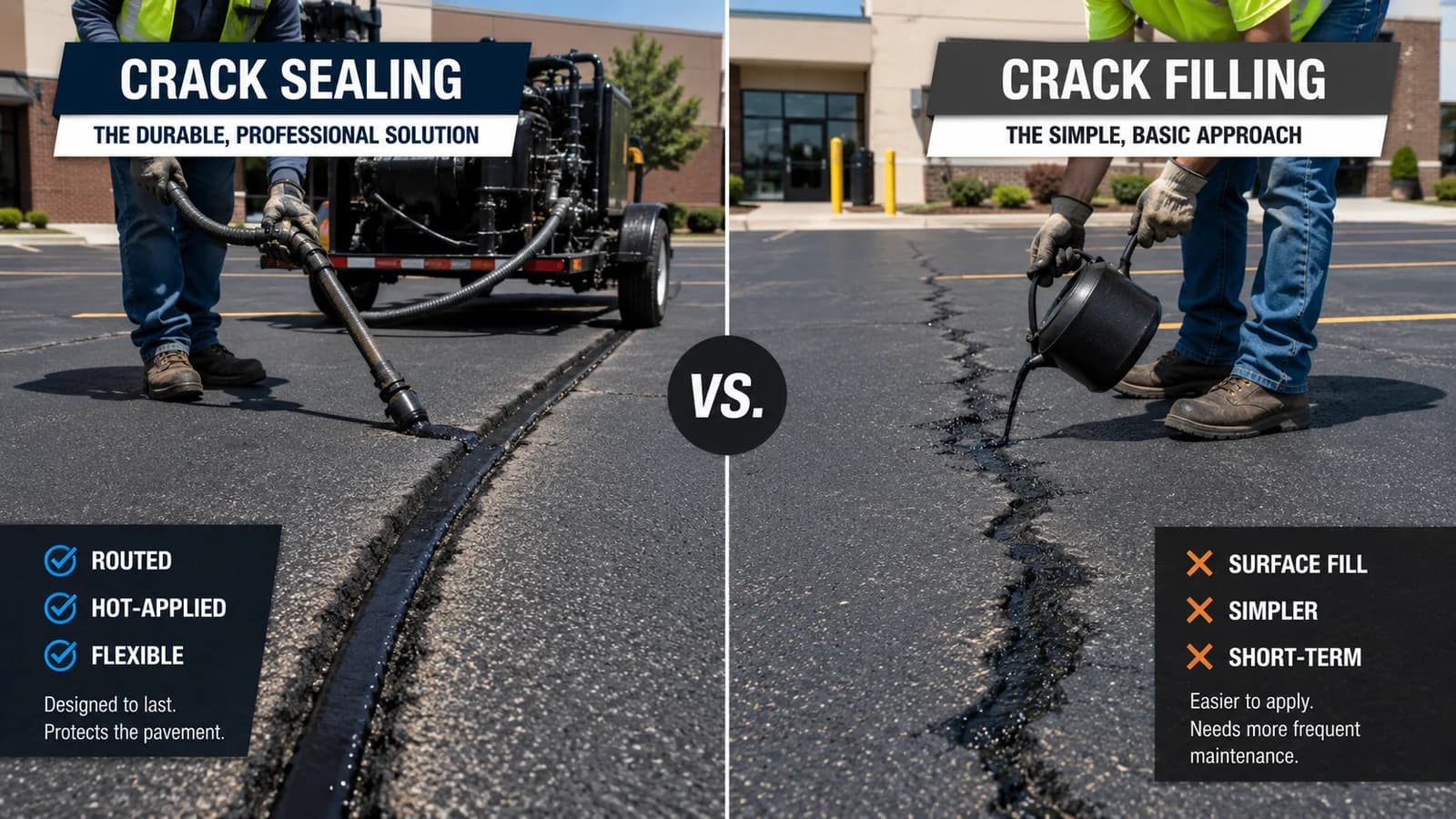
What crack sealing involves
Crack sealing typically starts with routing — mechanically widening and cleaning the crack to create a reservoir — followed by a hot-pour rubberized sealant that bonds to the crack walls and flexes with pavement expansion and contraction from temperature changes. This method is designed for active, working cracks that continue to move seasonally.
What crack filling involves
Crack filling is generally a lower-cost treatment, often applied without routing, using a less flexible material suited to smaller or non-working cracks. It can be a reasonable option for hairline cracks that aren't actively widening, but it tends to perform worse on cracks subject to ongoing movement.
Which cracks are candidates for which method
Narrow, isolated, actively moving cracks are generally good candidates for sealing. Very fine, stable hairline cracks may be reasonable candidates for filling. Wider cracks, interconnected alligator cracking, or areas with base failure usually need patching or repair rather than either sealant method alone.
| Crack type | Recommended method | Why |
|---|---|---|
| Active, working linear crack | Crack sealing (routed) | Flexible sealant moves with seasonal expansion |
| Fine, stable hairline crack | Crack filling | Lower cost, adequate for minimal movement |
| Wide crack or alligator pattern | Patch or repair | Sealant alone won't address base-level failure |
How this fits into a broader maintenance plan
Crack sealing or filling should happen before sealcoating, and sealcoating should cure before restriping. Getting this sequence right protects the investment in each subsequent step.
Frequently asked questions
What is the difference between crack sealing and crack filling?
Crack sealing typically involves routing the crack and applying a flexible, hot-pour rubberized sealant designed to move with pavement expansion, while crack filling is often a lower-cost surface treatment without routing. Ask which method a contractor is proposing.
Which cracks are worth sealing versus patching?
Narrow, isolated cracks are generally good candidates for sealing. Wider cracks, alligator cracking, or areas with base failure usually need patching or repair rather than sealant alone.
Should cracks be filled before sealcoating?
Yes. Cracks should generally be routed and sealed before sealcoating is applied, not after, so water intrusion is addressed before the protective coat goes down.
Is crack filling a waste of money?
Not necessarily — it can be a reasonable, lower-cost option for small, stable hairline cracks. It performs worse than routed crack sealing on cracks that are actively widening with seasonal movement.
Before you hire: The Pavement Directory does not guarantee contractor performance, pricing, licensing, insurance, or availability. Business information may be submitted by contractors or gathered from public sources and should be independently verified before hiring. Always confirm licensing, insurance, references, scope of work, and written contract terms.
For property owners
Looking for a pavement contractor?
Use The Pavement Directory to search asphalt, concrete, sealcoating, striping, ADA access, and pavement maintenance contractors by service and location. Always verify license, insurance, references, and written scope before hiring.
Search contractorsFor contractors
Are you a pavement contractor?
Contractors can add or claim a company profile to help property owners find pavement professionals by service, location, and specialty.