
Pennsylvania pavement guide
Pavement Conditions in Pennsylvania: Regions, Soils, and Common Problems
In Pennsylvania, grade decides where the water goes, winter decides what the water does, and in the coal regions the ground itself is a variable.
- 4 regions
- 5 common problems
- 6 local terms
Jump to section
Regional differences
Pavement Conditions by Region in Pennsylvania
Pennsylvania does not have one climate or one soil profile, and pavement that performs well in one part of the state can fail early a few hours away. These are the divisions that matter most when scoping paving, repair, or maintenance work.
Philadelphia and southeastern Pennsylvania
Philadelphia · Allentown · Reading · West Chester · Bethlehem
Environmental stress
- Frequent freeze-thaw cycling with heavy salt use
- Very heavy warehouse and distribution truck traffic in the Lehigh Valley corridor
- Dense urban constraints on older properties
Subgrade conditions
- Clay and silt soils over weathered rock
- Historic urban fill of variable quality
- Karst limestone in parts of the Lehigh Valley and Chester County
Common distress
- Utility cut settlement on older urban pavement
- Rutting at distribution dock and yard areas
- Localized sinkhole-related settlement in karst areas
What it means for the work
- Karst areas warrant investigation before major reconstruction
- Warehouse loading calls for a heavier section at truck areas
- Urban access and staging can drive the schedule more than the paving does
Central Pennsylvania and the ridge and valley
Harrisburg · State College · Lancaster · Altoona
Environmental stress
- Cold winters with frequent freeze-thaw and deep frost
- Steep terrain concentrating runoff
- Heavy interstate freight and agricultural traffic
Subgrade conditions
- Residual soils over limestone and shale
- Karst features with sinkhole potential in the limestone valleys
- Shallow rock on ridge and hillside parcels
Common distress
- Erosion and undermining at pavement edges on slopes
- Localized settlement over karst
- Freeze-thaw potholing in late winter
What it means for the work
- Concentrated runoff needs a designed flow path
- Recurring depressions in limestone country deserve investigation
- Rock excavation can dominate site work cost
Northeastern Pennsylvania and the anthracite region
Scranton · Wilkes-Barre · Hazleton · Stroudsburg
Environmental stress
- Heavy snowfall and long winters with deep frost
- Steep terrain and narrow valley sites
- Growing warehouse and distribution traffic
Subgrade conditions
- Abandoned anthracite mine workings beneath parts of the region
- Mine spoil and fill on redeveloped parcels
- Frost-susceptible soils with deep seasonal frost
Common distress
- Subsidence-related settlement over mine workings
- Severe spring break-up damage
- Plow gouging at curbs and transitions
What it means for the work
- Mine subsidence history is worth checking before major reconstruction
- The construction season is shorter than in the southeast
- Redeveloped mine land can have highly variable subgrade
Western Pennsylvania and the Allegheny Plateau
Pittsburgh · Erie · Johnstown · Washington
Environmental stress
- Frequent freeze-thaw with lake-effect snow near Erie
- Very steep terrain with slope stability concerns
- Heavy industrial and energy-sector truck traffic
Subgrade conditions
- Colluvial soils on slopes with landslide potential
- Abandoned bituminous mine workings in parts of the region
- Clay shale that weakens substantially when wet
Common distress
- Slope movement cracking and dropping pavement
- Subsidence settlement over mine workings
- Erosion at pavement edges on steep sites
What it means for the work
- Landslide-prone slopes around Pittsburgh warrant geotechnical input
- Marcellus-related heavy truck traffic is a real design load in some areas
- Water management on slopes is the controlling design question
Field conditions
Common Pavement Problems in Pennsylvania
Slope erosion and edge undermining
Water cutting channels along the low side of a lot, working under the pavement edge, and dropping the perimeter — on sites where the grade concentrates flow rather than spreading it.
Likely causes
- Real grade concentrating runoff into a single path
- Intense rainfall exceeding what the edge condition can handle
- Unprotected edges with no shoulder or confinement
When to get it looked at: Once erosion reaches under the pavement edge it is undermining the structure, not just moving soil. That needs a designed flow path rather than more fill.
Mine subsidence settlement
Settlement, tilting, or cracking that does not correspond to drainage or traffic patterns, in areas of the anthracite and bituminous regions with abandoned underground workings.
Likely causes
- Collapse or compression of abandoned mine workings
- Subsidence occurring decades after mining ended
- Groundwater changes affecting void stability
When to get it looked at: In known mining areas, unexplained settlement should be investigated before a major reconstruction, and it may have insurance implications worth understanding first.
Karst sinkhole settlement
A localized depression that deepens over time, sometimes with circular cracking, in the limestone valleys of central and southeastern Pennsylvania.
Likely causes
- Dissolution of underlying limestone creating voids
- Soil raveling downward into those voids
- Concentrated stormwater infiltration accelerating the process
When to get it looked at: A depression that keeps growing after each repair is a geotechnical question. Directing concentrated stormwater into a karst area can make it worse.
Freeze-thaw and salt deterioration
Spring potholing across the pavement plus concrete curbs, walks, and steps scaling and spalling faster than the asphalt around them.
Likely causes
- Water in unsealed cracks freezing repeatedly through the winter
- Chloride deicers driving freeze-thaw within the concrete surface
- Concrete without adequate air entrainment for the climate
Warehouse and industrial rutting
Deep wheel paths and shoving at dock aprons, truck courts, and turning areas around Lehigh Valley, Harrisburg, and northeastern Pennsylvania distribution facilities.
Likely causes
- Slow, heavy, channelized truck loading
- Yard areas built to the same section as the parking field
- Subgrade losing strength when saturated under that loading
Property types
Common Pavement Projects in Pennsylvania
Warehouse and distribution facilities
Lehigh Valley, Harrisburg, and northeastern Pennsylvania freight development concentrates truck loading on yard pavement that is rarely designed for the actual loads.
Colleges and university campuses
Hillside campuses combine pedestrian safety on concrete surfaces, snow operations, and a construction window compressed into summer break.
Healthcare campuses
Continuous access requirements and pedestrian trip-hazard exposure make concrete condition a higher priority than asphalt appearance.
Energy sector facilities
Marcellus-region access roads and yards carry very heavy truck traffic on sloped ground where drainage and edge support decide how long the pavement lasts.
Apartment and townhome communities
Sloped private drives concentrate runoff and get plowed hard, so erosion at edges and salt damage to walks drive the recurring cost.
Plain English
Pavement Terms You May Encounter in Pennsylvania
| Term | What it means on a Pennsylvania project |
|---|---|
| Superpave | The mix design system used to match binder grade and aggregate structure to expected traffic and temperature. Pennsylvania suppliers use this vocabulary when discussing mixes for truck areas. |
| 2A aggregate base | The dense-graded crushed aggregate base commonly specified in Pennsylvania. Its compaction and drainage quality usually determine pavement life more than the asphalt above it. |
| Anti-skid material | The abrasive applied for winter traction alongside or instead of salt. It accumulates on pavement and in inlets and needs to be swept in spring before it blocks drainage. |
| Air-entrained concrete | Concrete with microscopic air voids that give freezing water somewhere to expand. Standard for exterior concrete here and a real factor in whether a walk or step scales under salt. |
| Underdrain | A perforated pipe in stone giving water trapped in the pavement structure a path out. On sloped Pennsylvania sites there is often somewhere for it to discharge, which makes it practical. |
| Full-depth reclamation (FDR) | Pulverizing existing asphalt and base together, treating the blend, and repaving over it. Useful on larger lots and private roads where the base has failed. |
State transportation specifications can provide useful regional terminology and material references, but they do not automatically govern private parking-lot or driveway projects unless incorporated into the contract or required by the applicable jurisdiction.
More definitions are in the pavement glossary.
Before you sign
Questions to Ask a Paving Contractor in Pennsylvania
- How is runoff on this slope being handled, and is a designed flow path part of this scope?
- Has anything been done to check whether abandoned mine workings underlie this property?
- If we have a recurring depression, has a karst cause been ruled out?
- Who submits the erosion and sedimentation control plan to the county conservation district, and how long does review take?
- How will disturbed slopes be stabilized between work days during thunderstorm season?
- Is the concrete deterioration on our walks and steps from salt, and does that change repair versus replacement?
- Are the truck court and dock areas being built to a heavier section than the parking field?
- Does this municipality require its own contractor registration or permit?
- What is the crack sealing plan, and how late in the fall can it be done here?
Pennsylvania pavement condition FAQs
Could mine subsidence be causing settlement on my property?
In parts of the anthracite region around Scranton, Wilkes-Barre, and Hazleton, and in the bituminous region of western Pennsylvania, abandoned underground workings can collapse or compress decades after mining ended. That produces settlement, tilting, or cracking that does not correspond to drainage or traffic. If your property is in a known mining area and you are seeing unexplained movement, investigate before committing to a major reconstruction — there may also be insurance implications worth understanding first.
Why does my sloped Pennsylvania lot keep eroding at the edge?
Most Pennsylvania sites have real grade, so runoff concentrates into a path rather than spreading out. Where that path runs along a pavement edge with no shoulder or confinement, it cuts a channel and works its way underneath, undermining the structure while the surface still looks fine. Adding fill does not change the flow. The durable answer is a designed flow path — a swale, a pipe, or a properly detailed edge — that takes water somewhere on purpose.
What causes a growing depression in a Lehigh Valley or Lancaster County lot?
The limestone valleys of central and southeastern Pennsylvania are karst terrain, where dissolution creates subsurface voids and soil gradually ravels down into them. That produces a localized depression that deepens again after each repair. Directing concentrated stormwater into a karst area can accelerate it. A depression that keeps returning is a geotechnical question rather than a paving one, and repeatedly filling it can obscure something worth understanding.
Why do concrete steps and walks fail before the asphalt in Pennsylvania?
Chloride deicers increase the freeze-thaw cycling that a concrete surface experiences and draw water deeper into it, producing scaling and flaking, and where chloride reaches reinforcement it causes corrosion that spalls the concrete from within. Asphalt has no reinforcement and responds differently to the same exposure. On a property with pedestrian traffic, deteriorating concrete is also a trip-hazard exposure, which makes it a higher priority than surface appearance.
Related reading for Pennsylvania property owners
Property-owner guide
Updated July 12, 2026
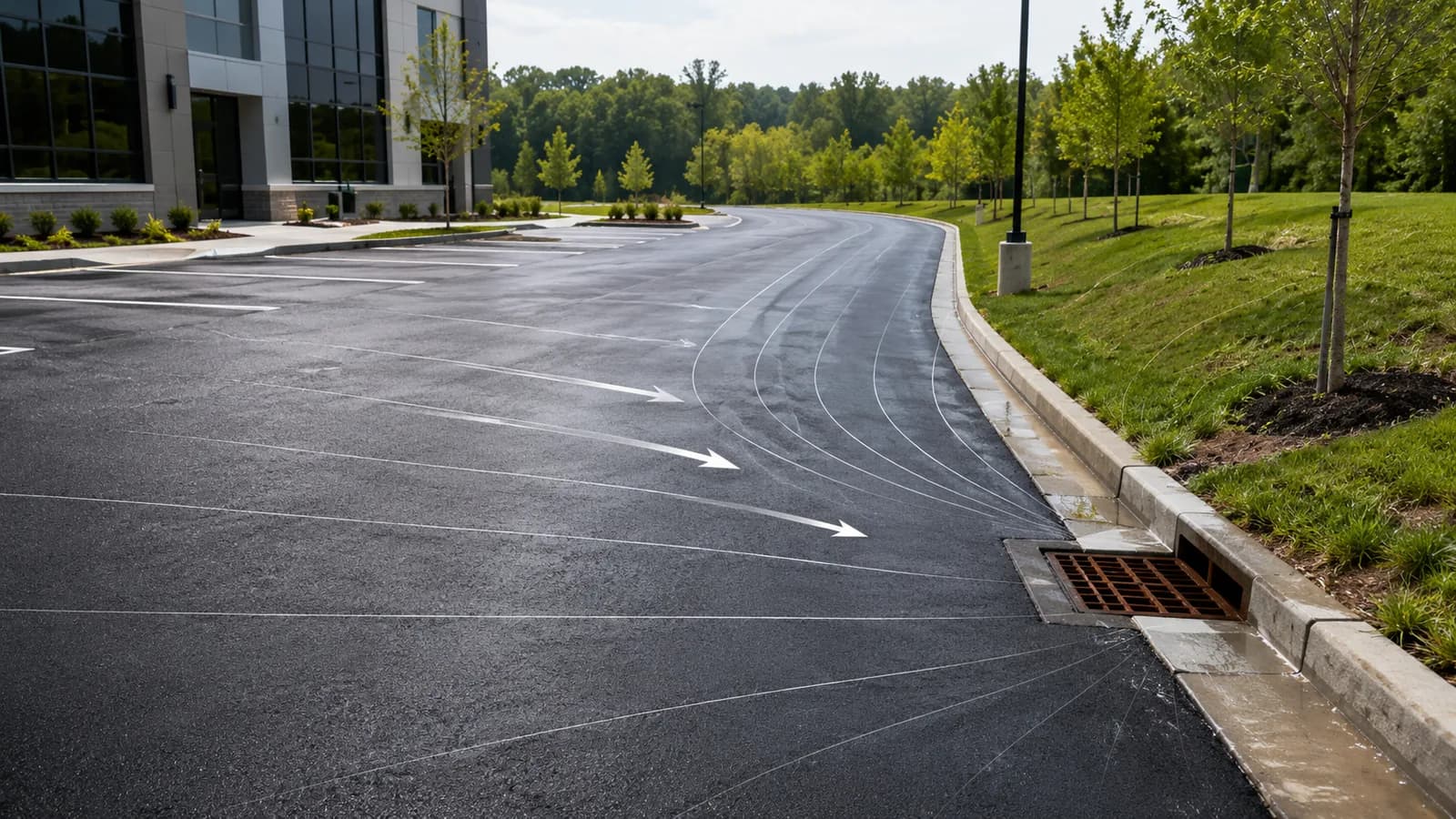
Grading and Slope Basics for Pavement
Grading and slope basics for pavement: what positive drainage means, why slope matters, common grading problems, and where engineering comes in.
Property-owner guide
Updated July 12, 2026
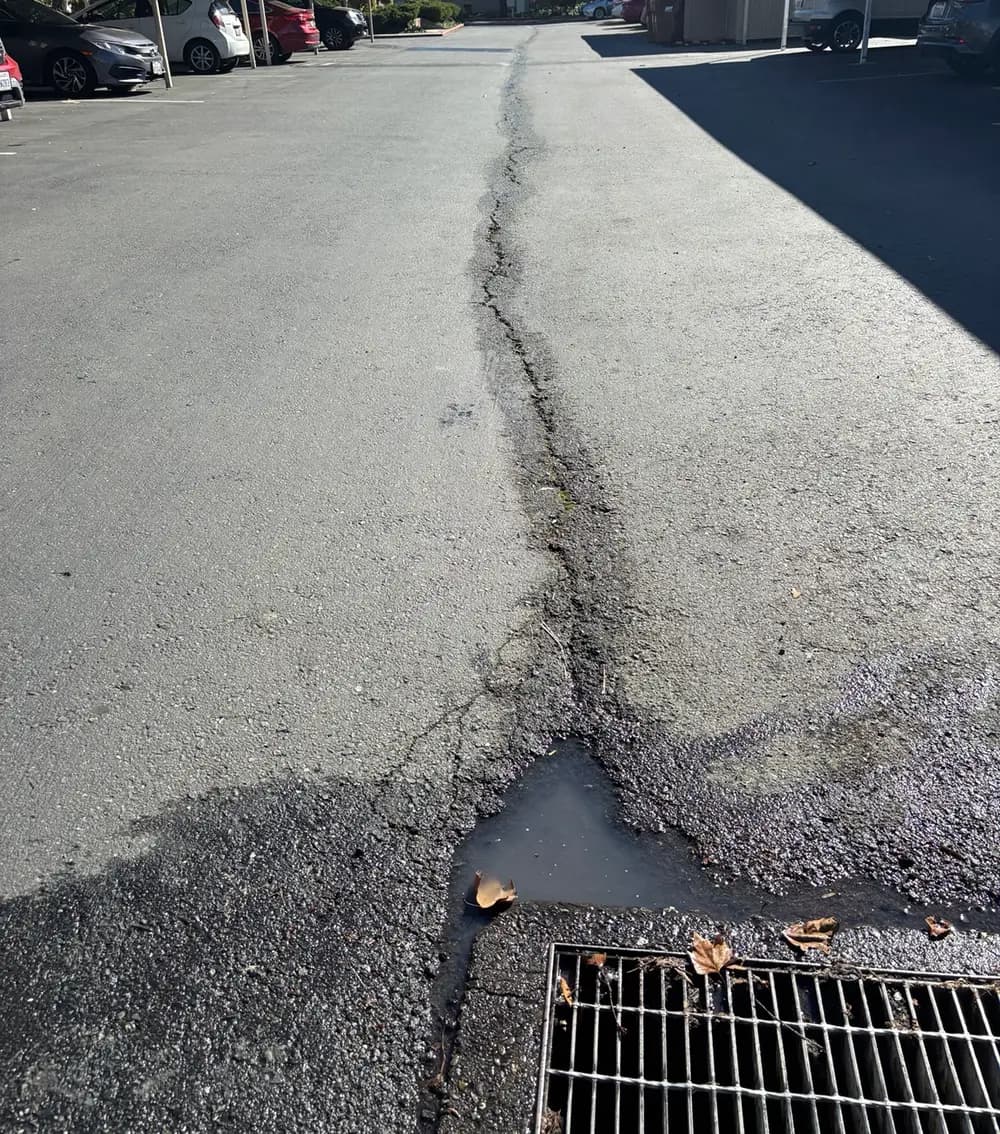
How Drainage Affects Pavement Life
Why drainage is the biggest factor in how long pavement lasts, how water damages asphalt from the base up, and why fixing it protects every repair.
Property-owner guide
Updated July 11, 2026
When Should You Seal Asphalt Cracks?
When to seal cracks in asphalt — which cracks to seal, the best time of year, why sealing early matters, and how crack sealing fits a maintenance schedule.
Property-owner guide
Updated July 11, 2026
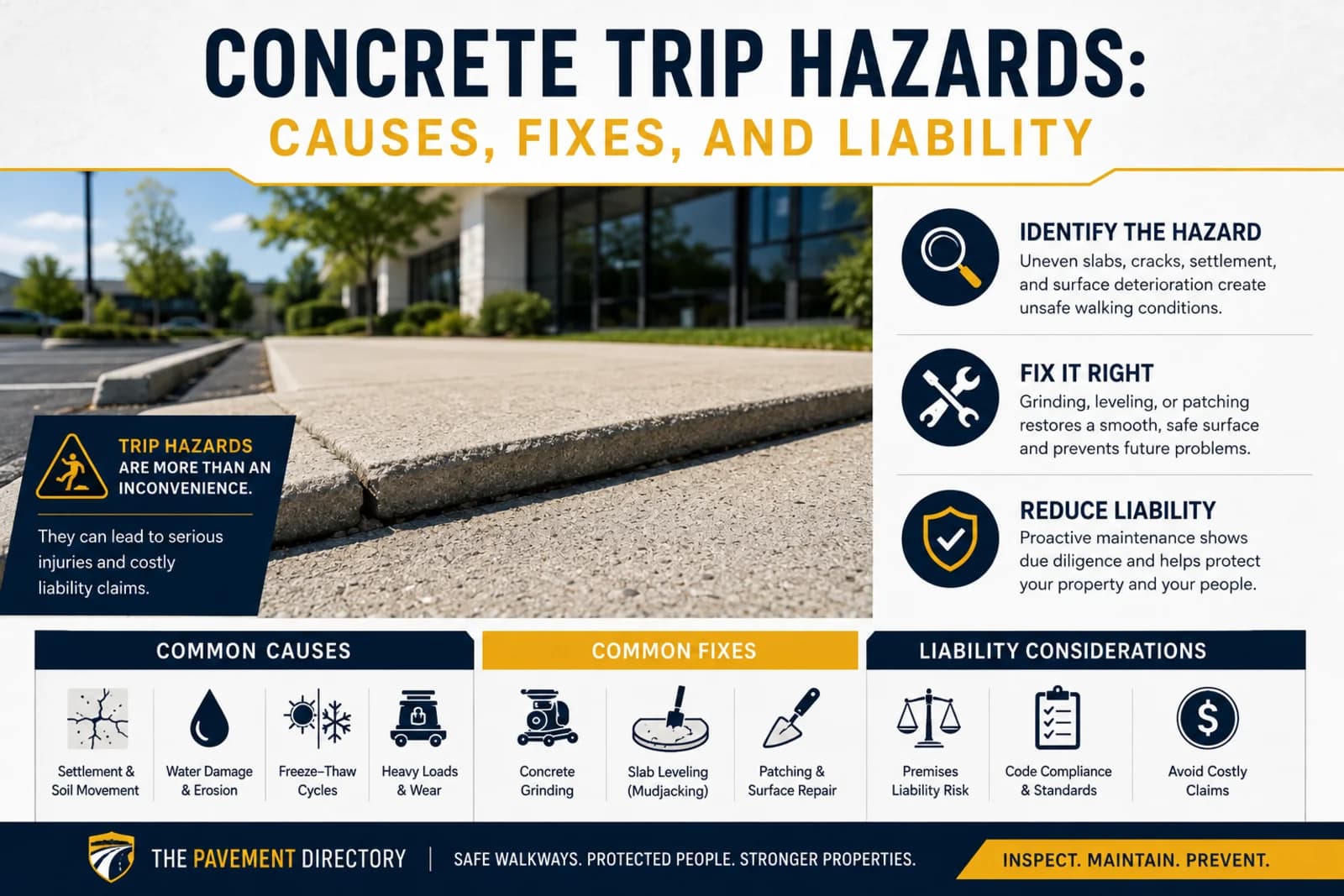
Concrete Trip Hazards: Causes, Fixes, and Liability
What causes concrete trip hazards on sidewalks, how they are fixed by grinding, cutting, slab lifting, or replacement, and the ADA and liability stakes.
Property-owner guide
Updated July 6, 2026
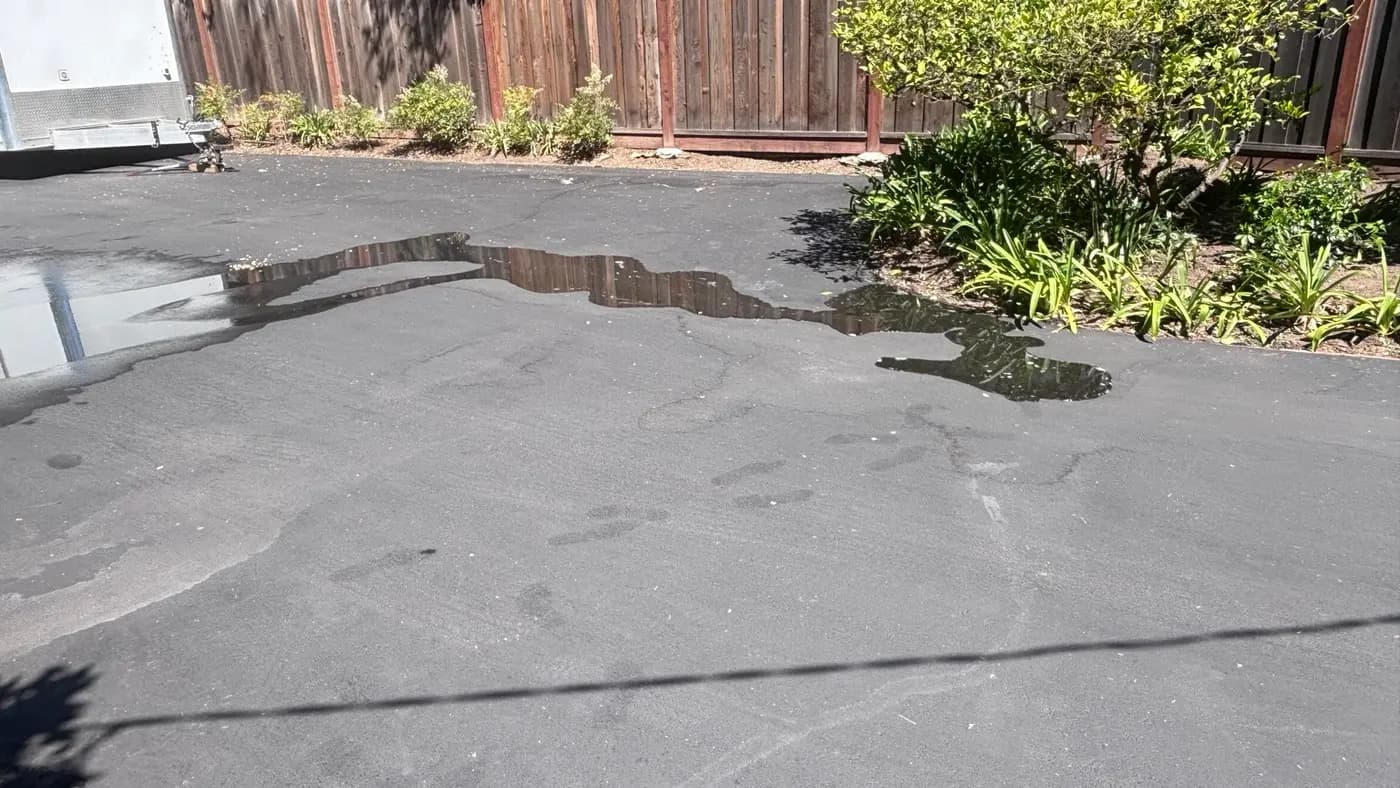
Parking Lot Drainage Problems: What Property Owners Should Know
Common causes of parking lot drainage problems, why they accelerate pavement damage, and what property owners should ask contractors before a fix.
Before you hire: The Pavement Directory does not guarantee contractor performance, pricing, licensing, insurance, or availability. Business information may be submitted by contractors or gathered from public sources and should be independently verified before hiring. Always confirm licensing, insurance, references, scope of work, and written contract terms.
For contractors
Ready to compare Pennsylvania contractors?
Browse listings by city and service, then use what you have read here to check the scope, the credentials, and the timing before you sign.