
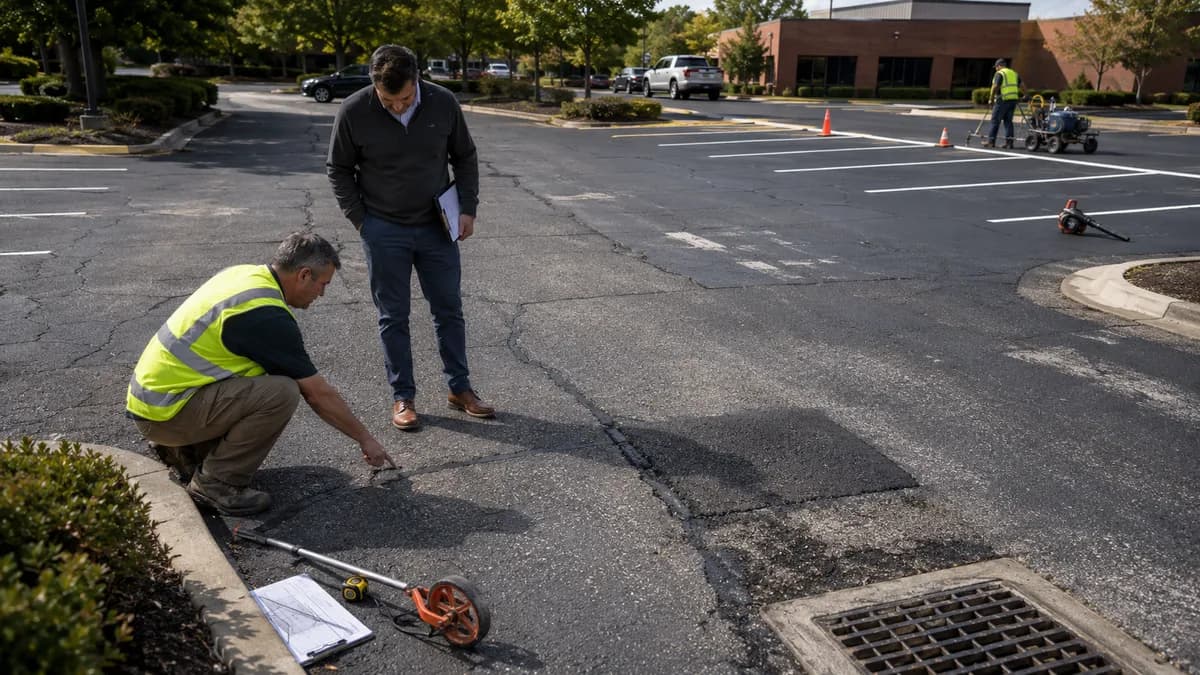
Direct answer
Inspect a commercial parking lot routinely and document its condition at least before major budgeting or rehabilitation decisions. Address active potholes, failed drainage areas, trip hazards, and other operational concerns promptly. Seal suitable cracks before water intrusion accelerates deterioration. Repair structurally failed areas before applying sealcoat or an overlay. Plan milling, overlay, or reconstruction when preventive maintenance no longer matches the pavement condition.
Quick summary
- Inspect after severe weather and before annual budgeting.
- Keep drains, gutters, and discharge paths clear.
- Treat isolated cracks differently from alligator cracking.
- Use full-depth repairs where the base or full pavement section has failed.
- Do not use sealcoat as a structural repair.
- Coordinate paving, striping, accessibility, concrete, and drainage work.
- Maintain a map and history of repairs.
- Budget by urgency and pavement section, not just by total square footage.
Recommended inspection schedule
A commercial property can use the following framework.
| Frequency | Recommended activity |
|---|---|
| Monthly or during routine property walks | Observe potholes, ponding, loose material, damaged drains, trip hazards and failed markings |
| After major storms or freeze-thaw events | Check drainage paths, saturated areas, new potholes and edge erosion |
| Seasonally | Review cracking, vegetation, oxidation and surface deterioration |
| Annually | Update the condition map, repair priorities, quantities and capital plan |
| Before sealcoating or overlay | Confirm that structural repairs and drainage work are complete |
| Before budget approval | Obtain current quantities, priorities and contractor or consultant input |
The exact frequency should reflect climate, traffic, pavement age, liability exposure, and property use.
Conditions to inspect
Linear cracks
Look for:
- Longitudinal cracks
- Transverse cracks
- Construction joints
- Reflective cracks
- Edge cracks
- Utility-trench cracks
Suitable cracks may be candidates for cleaning and sealing. Open cracks that contain vegetation, debris, or moisture need preparation before treatment.
Alligator cracking
Alligator cracking is a connected pattern of small polygons commonly associated with structural failure. Crack sealer does not rebuild failed base or asphalt.
Typical responses may include:
- Monitoring a low-severity area
- Full-depth patching
- Base repair
- Drainage correction
- Reconstruction
- Further investigation
Potholes
Potholes should be evaluated for:
- Depth
- Loose material
- Water infiltration
- Traffic hazard
- Base condition
- Nearby cracking
- Drainage source
Temporary repairs may restore short-term service, but permanent repair generally requires removal of failed material and proper rebuilding.
Rutting and depressions
Rutting can result from asphalt instability, inadequate compaction, heavy traffic, weak base, or subgrade deformation. Depressions can collect water and accelerate damage.
Surface filling without identifying the cause may provide only temporary improvement.
Raveling and oxidation
Raveling is loss of surface aggregate. Oxidation can make asphalt appear gray and brittle. Surface treatments may help selected pavements, but severe raveling or structural failure requires more than coating.
Edge failure
Inspect unsupported edges, shoulders, landscape interfaces, drainage channels, and truck-turning areas. Edge repair may require:
- Shoulder support
- Drainage improvement
- Widening
- Full-depth repair
- Traffic-control changes
Utility trenches
Utility cuts frequently crack or settle along their edges. Record:
- Trench limits
- Settlement
- Cracking
- Drainage effects
- Repeated repair history
- Utility ownership
Maintenance treatment hierarchy
Use treatments based on condition rather than habit.
1. Monitor and document
Appropriate where a condition is stable, low severity, and not an immediate operational concern.
Document:
- Location
- Date
- Dimensions
- Photograph
- Condition change
- Planned review date
2. Crack treatment
Appropriate for selected cracks where the adjacent pavement remains serviceable.
A complete scope may include:
- Routing where specified
- Cleaning
- Drying
- Hot-applied or approved sealant
- Overband limits
- Traffic protection
Crack treatment is not appropriate for every crack.
3. Localized full-depth repair
Appropriate for isolated structural failures.
A strong proposal should define:
- Repair area
- Sawcut limits
- Removal depth
- Base evaluation
- Base replacement allowance
- Tack coat
- Asphalt thickness
- Lift placement
- Compaction
- Edge sealing if specified
- Disposal
4. Drainage correction
Address water before applying surface treatments.
Potential work includes:
- Drain cleaning
- Inlet repair
- Trench-drain repair
- Grade correction
- Low-spot repair
- Roof-drain redirection
- Irrigation correction
- Edge drainage
- Subsurface drainage evaluation
5. Sealcoating
Sealcoating may be appropriate where the asphalt remains structurally serviceable and the selected coating is compatible with local rules, climate, surface condition, and owner objectives.
Before coating:
- Complete asphalt repairs
- Treat suitable cracks
- Address oil spots
- Clean the pavement
- Confirm weather
- Plan phasing and traffic control
- Coordinate striping
Sealcoat does not repair failed base, rutting, alligator cracking, or severe depressions.
6. Mill and overlay
An overlay may restore surface condition and add structural value where the existing pavement can support it. Milling helps manage grades, transitions, surface defects, and tie-ins.
Before overlay, evaluate:
- Structural failures
- Crack reflection
- Drainage
- Curb reveal
- Door and gate transitions
- Utility elevations
- Accessible parking slopes
- Existing pavement thickness
7. Reconstruction
Reconstruction may be appropriate where failures are widespread, base conditions are poor, grades require major correction, or overlays would not provide acceptable performance.
Crack sealing guidelines
A crack-sealing program should distinguish crack types.
Potentially suitable:
- Working transverse cracks
- Longitudinal joints
- Isolated open cracks
- Selected reflective cracks
Generally unsuitable as a stand-alone treatment:
- Alligator cracking
- Wide failed joints with broken edges
- Potholes
- Depressions
- Rutted pavement
- Loose, severely raveled asphalt
- Wet or contaminated cracks
Ask contractors to define crack-width limits and preparation.
Asphalt repair guidelines
For permanent repair, avoid vague scope such as "patch bad areas."
Require:
- Marked limits
- Measured quantities
- Repair depth
- Sawcutting
- Disposal
- Base work
- Asphalt mix
- Compacted thickness
- Number of lifts
- Tack coat
- Compaction method
- Drain and utility adjustments
- Traffic-control plan
- Change-order process for hidden conditions
Sealcoating guidelines
Do not set one universal application interval. Timing depends on:
- Pavement age
- Surface condition
- Climate
- Ultraviolet exposure
- Traffic
- Prior products
- Local environmental restrictions
- Manufacturer requirements
- Owner expectations
Evaluate the actual pavement before approving coating.
Drainage maintenance
Include drainage in routine property operations.
- Clear debris from drain inlets
- Remove sediment from gutters
- Observe flow during rain
- Photograph persistent ponding
- Repair failed asphalt around inlets
- Check irrigation overspray
- Track roof-drain discharge
- Stabilize eroding edges
- Correct low spots before overlays
- Review drainage where base failures recur
Striping and accessibility observations
Maintain faded or missing markings, but do not assume restriping verifies accessibility.
Observe:
- Accessible stalls and aisles
- Identification signs
- Fire lanes
- Crosswalks
- Loading zones
- Directional arrows
- Curb markings
- Wheel-stop movement
- Conflicting ghost lines
- Surface slope and ponding
- Route obstructions
Use qualified review where accessibility compliance is at issue.
Budgeting by urgency
Immediate
- Potholes affecting traffic
- Loose material
- Severe trip hazards
- Failed drain grates
- Barricade needs
- Dangerous depressions
- Unstable concrete
Near term
- Open cracks
- Isolated structural repairs
- Drainage corrections
- Failed utility patches
- Faded critical markings
Preventive
- Crack treatment
- Selected sealcoating
- Routine striping
- Drain maintenance
- Edge stabilization
Capital
- Large-scale patching
- Milling and overlay
- Reconstruction
- Major drainage changes
- Accessible parking reconstruction
Maintenance-record system
Maintain a simple record containing:
- Site map
- Pavement sections
- Inspection dates
- Photographs
- Repair limits
- Contractor scopes
- Materials used
- Warranty information
- Costs
- Condition changes
- Planned future work
This history helps determine which repairs performed well and which failures returned.
Contractor proposal checklist
Ask for:
- Quantities
- Thicknesses
- Preparation
- Materials
- Repair locations
- Phasing
- Traffic control
- Cure or reopening time
- Striping
- Drainage assumptions
- Accessibility exclusions
- Permits
- Disposal
- Warranty
- Change-order procedures
Frequently asked questions
How often should an asphalt parking lot be inspected?
Observe it during routine property walks and after severe weather. Complete a documented assessment before major budgeting, maintenance, or rehabilitation decisions.
How often should a parking lot be sealcoated?
There is no responsible universal interval. Evaluate the pavement condition, prior products, climate, traffic, local restrictions, and manufacturer requirements.
Does crack sealing stop all pavement cracking?
No. Crack sealing can reduce water intrusion at suitable cracks. It does not repair alligator cracking, failed base, rutting, or widespread structural deterioration.
Should potholes be repaired before sealcoating?
Yes. Failed pavement should be repaired before applying a surface coating.
What is the difference between preventive and corrective maintenance?
Preventive maintenance slows deterioration in pavement that remains serviceable. Corrective maintenance repairs existing failures, such as potholes, failed patches, depressions, or drainage damage.
When is an overlay appropriate?
An overlay may be appropriate where the existing pavement and base can support it, grades and drainage can be maintained, and structural failures are repaired first.
Before you hire: The Pavement Directory does not guarantee contractor performance, pricing, licensing, insurance, or availability. Business information may be submitted by contractors or gathered from public sources and should be independently verified before hiring. Always confirm licensing, insurance, references, scope of work, and written contract terms.
For property owners
Looking for a pavement contractor?
Use The Pavement Directory to search asphalt, concrete, sealcoating, striping, ADA access, and pavement maintenance contractors by service and location. Always verify license, insurance, references, and written scope before hiring.
Search contractorsFor contractors
Are you a pavement contractor?
Contractors can add or claim a company profile to help property owners find pavement professionals by service, location, and specialty.