

What this guide covers
Resurfacing is usually the cheapest way to get a new asphalt surface, and it is only a good value when the pavement underneath can support one. This guide covers what the work costs, what moves the price, and how to tell whether an overlay is the right scope in the first place.
The distinction that matters most in a proposal: an overlay and a mill-and-overlay are different projects at different prices. Two bids for "resurfacing" the same lot can be a third apart and both be honest, because one includes milling and repairs and the other does not.
Start with a budget rather than a bid. Use the Paving Project Budget Estimator below to turn your square footage and scope into a planning range, then browse asphalt paving contractors to build the bid list.
Estimate the project
Run the Paving Project Budget Estimator
Turn the ranges in this guide into numbers for your property. Estimates are for planning only, so confirm final scope and pricing with contractor proposals.
Project inputs
Budget scenario
Complete the inputs
Asphalt resurfacing cost at a glance
These are 2026 national planning ranges per square foot. Read them as brackets for a budget conversation, not as a price book — two projects with identical square footage routinely land at opposite ends of the same row.
| Scope | Planning range (per ft²) | Biggest variables |
|---|---|---|
| Parking lot overlay (no milling) | $2.00 to $5.00 | Compacted thickness, failed areas repaired first, tie-ins |
| Driveway overlay (resurface) | $2.50 to $6.00 | Small-job mobilization, garage and curb transitions |
| Mill and overlay (commercial) | $4.00 to $9.00 | Milling depth and limits, disposal, utility adjustments |
| Full-depth removal and replacement (commercial) | $7.00 to $14.00 | Demolition, haul-off, aggregate base, restriping |
| Driveway removal and replacement | $8.00 to $15.00 | Demolition, haul-off, base repair, small-job unit cost |
| Full-depth repair before an overlay | Priced by the area, not the lot | Depth, access, base condition, quantity |
These are planning ranges, not contractor quotes. They align with the ranges published in the directory's asphalt paving cost guide, which reviews public agency unit-price data, the BLS producer price index for asphalt paving mixture, and multiple national cost guides. Regional markets, site conditions, and scope can put a real project outside any of these rows.
What resurfacing actually means
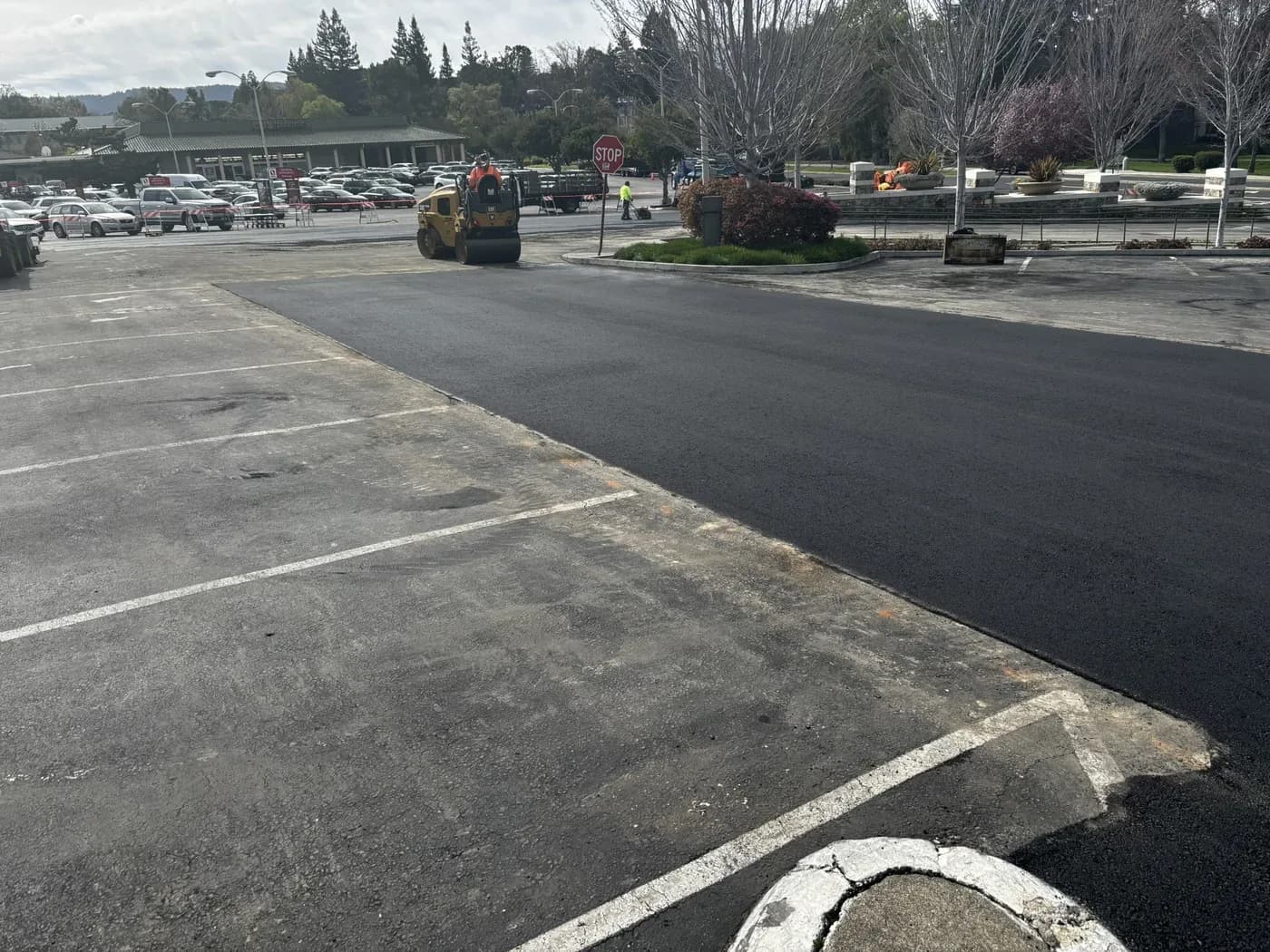
Resurfacing means placing a new layer of hot-mix asphalt over pavement that stays in place. The existing asphalt becomes the base for the new surface, which is exactly why the existing asphalt's condition governs whether the project makes sense.
Three scopes get called resurfacing in conversation, and they are not the same purchase:
- Overlay. New asphalt placed over the existing pavement, with edge grinding at transitions. The pavement surface ends up higher than it was.
- Mill and overlay. A defined depth of existing asphalt is ground off first, then the new layer goes on. Elevation can be held roughly where it was, and the deteriorated top of the old pavement leaves with the millings.
- Removal and replacement. The asphalt comes out entirely, the base is evaluated and repaired, and a new pavement section is built. This is not resurfacing, and it belongs on the table when the pavement cannot support an overlay.
When a proposal says "resurface parking lot" and gives a price, the first question is which of those three it is. The second is how much of the fourth item — repairing what has already failed — is included.
Working a square-foot range into a budget
Take a 40,000-square-foot commercial lot being considered for an overlay. At the planning range above:
40,000 ft² × $2.00 = $80,000. 40,000 ft² × $5.00 = $200,000.
That spread is not imprecision. It is the honest width of what "overlay this lot" can mean before anyone has looked at the pavement. A thin overlay on sound asphalt with clean edges sits near the bottom. A thicker section with milling at the perimeter, drain adjustments, 8,000 square feet of full-depth repair, and two construction phases sits above the top.
Narrow it by pricing the pieces separately rather than by guessing a better rate:
- Start with the base overlay at a planning rate for your project type.
- Add a separate allowance for full-depth repairs, measured in square feet rather than estimated as a percentage.
- Add milling, priced by area and depth, if elevations require it.
- Add drain and utility adjustments by count.
- Add striping by stall count, including accessible stalls and access aisles.
- Add traffic control and an amount per additional construction phase.
That produces a budget you can defend to a board or an owner, and a scope contractors can bid against consistently. Run the arithmetic in the Paving Project Budget Estimator, and get your square footage right first with the square footage calculator if the lot has been measured only roughly.
Why a driveway costs more per square foot than a parking lot
The unit price runs backwards from what people expect: the small project is more expensive per square foot than the large one. The reason is that most of the cost of a paving day arrives before any asphalt does.
A crew has to mobilize a paver, rollers, a skid steer, trucks, traffic-control equipment, and supervision whether the job is 3,000 square feet or 100,000. On a driveway, that fixed cost is spread across a few thousand square feet and dominates the total. On a large lot it disappears into the area.
Two practical consequences. Most contractors carry a minimum charge, below which a driveway is priced as a job rather than by the foot — so a very small driveway can cost more than its square footage suggests, and asking for a lower per-foot rate will not move it. And combining work matters: resurfacing a driveway at the same time as neighbors, or paving several small areas in one mobilization, genuinely lowers the unit cost in a way negotiation does not.
Milling: the largest single variable
Milling grinds a controlled depth of the existing asphalt off before the new layer goes down, and whether it is included is usually the biggest difference between two resurfacing bids.
It is not an upsell. An overlay raises the pavement, and on a built site there are fixed elevations it cannot rise past:
- Curb reveal. Every inch of overlay is an inch of curb height lost. Enough overlays and the curb stops containing water or protecting a landscape island.
- Doorways and thresholds. Pavement at a building entrance cannot rise into the door.
- Drains and catch basins. Inlets have to stay at or below the surface around them, or the lot ponds at exactly the point built to drain it.
- Concrete tie-ins. Sidewalks, gutters, aprons, and valley gutters do not move.
- Accessible parking. Slope in accessible stalls, access aisles, and the route to the entrance is regulated, and a new surface changes it.
- Adjacent pavement. The property line and the street tie-in have to meet flush.
Where those constraints bind, milling is the only way to place new asphalt without creating a problem the old pavement did not have. Where they do not, a straight overlay may be entirely appropriate and cheaper.
The distinction to insist on in writing is full-area milling versus edge milling. Edge milling grinds only the transitions — gutters, aprons, entrances, doorways, property limits. Full-area milling covers most or all of the lot. "Mill as needed" is not a scope. Ask for milling limits and depth.
Repairs before the overlay, and why skipping them costs more
An overlay is a new surface, not a new structure. It does not rebuild failed base, and it does not stop pavement that is moving. Areas that have already failed have to be repaired before the new layer goes over them, or they will fail again through it.
The areas that usually come out first:
- Alligator-cracked areas, which indicate load-related fatigue and lost support.
- Potholes, where material is already gone.
- Failed utility trenches and settled areas.
- Severe localized rutting, where deformation may originate below the surface.
- Patches that have failed and been redone more than once.
- Broken pavement around drains and catch basins.
- Failed truck lanes, dumpster routes, and loading areas.
These repairs raise the first invoice, and skipping them is the most reliable way to spend the money twice. A proposal that overlays a lot with visible structural failure and prices no repairs is not the cheaper bid; it is a different, worse project at a lower number.
A normal commercial resurfacing job therefore contains several scopes at once — full-depth repairs, milling, crack treatment, the overlay, and striping — and seeing all five on a proposal is a sign it was written after someone walked the property.
Reflective cracking, and what an overlay does not fix
Cracks in the old pavement tend to reappear in the new surface above them, a behavior called reflective cracking. The old pavement keeps moving — thermally, seasonally, or under load — and the new layer eventually telegraphs that movement to the top.
This is not an argument against overlays. It is an argument for knowing what is under one. An overlay over pavement that is stable and cracked mostly from age performs differently from an overlay over pavement that is cracking because it is failing.
The conditions that should stop an overlay and start a different conversation:
- Alligator cracking across a large share of the area rather than in isolated spots.
- Extensive base failure, pumping, or fines washing up through cracks.
- Deep or widespread rutting that originates below the asphalt.
- Severe settlement, or drainage that would need regrading to correct.
- Repairs in the same locations that keep failing.
- Existing elevations that cannot accept additional thickness even with milling.
Where several of those are present, removal and replacement at $7.00 to $14.00 per square foot may genuinely be the lower lifetime cost, even though the overlay quote is half of it. The cheapest project this year and the cheapest pavement over ten years are frequently not the same purchase.
Asphalt paving vs asphalt overlay works through that comparison in detail, and the repair vs. replace calculator puts numbers against it.
Thickness, and why it has to be compared first
Compacted asphalt thickness is the single largest driver of material cost, and it is the easiest thing to leave vague in a proposal.
More thickness means more tons, more trucks, more plant material, and more placement time. A lot resurfaced at two inches compacted uses roughly a third more asphalt than the same lot at one and a half.
Two rules for reading it:
- Insist on compacted thickness. Asphalt is placed loose and compacted down. "Two inches of asphalt" can describe either state, and the difference is real material.
- Never compare bids across different thicknesses. A bid at 1.5 inches compacted and a bid at 2 inches compacted are not the same job, and the cheaper one is not necessarily the worse value — but you cannot tell until both numbers are on the table.
Asphalt paving thickness for parking lots covers what thickness is appropriate for which traffic, and the asphalt tonnage calculator converts area and thickness into the tons a bid should reflect.
The costs that are not asphalt
A large share of a resurfacing invoice buys things other than the new surface. Each of these should be included or explicitly excluded rather than assumed:
- Drain and utility adjustments. Storm drains, manholes, valve boxes, cleanouts, and trench drains may have to be raised, lowered, or reset. Priced by count.
- Edge grinding and transitions. Grinding at aprons, sidewalks, gutters, entrances, and property limits so the new surface meets fixed concrete flush.
- Drainage correction. A new surface changes where water goes. Existing ponding rarely fixes itself and can get worse.
- Striping. Stalls, accessible stalls and access aisles, arrows, crosswalks, fire lanes, stop bars, loading zones, and stencils. Frequently a separate contract.
- Accessible parking work. Slope in accessible stalls and routes is regulated, and resurfacing is the moment it gets touched. A new surface does not make an existing layout compliant.
- Traffic control and phasing. Occupied properties cost more to pave than empty ones, and each phase adds mobilization, transitions, and lost production.
- Disposal. Millings and demolition have to go somewhere.
Phasing deserves particular attention on an occupied site. A lot that could be paved in a day may take four because a retail center, a medical property, or an apartment community cannot close all at once. That is not padding — it is the property's operating requirement showing up in the price.
Why two bids for the same lot look nothing alike
Three contractors can walk the same parking lot and return three proposals that are not comparable:
- Contractor A overlays the entire lot, patches lightly, and does not mill. Lowest number.
- Contractor B repairs the failed areas, mills the full area, overlays, adjusts drains, and restripes. Highest number.
- Contractor C recommends removal and replacement in the failed third and an overlay on the rest. Somewhere between, with a different risk profile.
Those are three different projects. Comparing the totals tells you almost nothing. Compare quantities, compacted thickness, repair scope and square footage, milling limits and depth, base work, drainage, striping, traffic control, and exclusions — in that order — and the totals start to mean something.
A low price is not itself a red flag. A low price attached to an undefined scope is. How to compare asphalt paving bids and the three-bid decoder are built for exactly this.
What a resurfacing proposal has to state
"Resurface parking lot — $X" is not something you can bid competitively. A usable proposal identifies:
- Total resurfacing area, with square footage.
- Compacted asphalt thickness, and the mix specified.
- Milling limits and milling depth, or a clear statement that no milling is included.
- Edge grinding at transitions.
- Full-depth repair areas, with quantities, and whether base repair is included.
- Crack treatment, as a separate line item.
- Tack coat.
- Drain and utility adjustments, by count.
- Transitions to concrete, adjacent pavement, and the street.
- Compaction and the paving sequence.
- Traffic control, phasing, and work-hour restrictions.
- Striping, with stall counts including accessible stalls and access aisles.
- Disposal and cleanup.
- Reopening times by area.
- Warranty terms, and what the warranty excludes.
- Exclusions, and the change-order procedure if bad base is found.
The last two carry more weight than owners expect. Base failure discovered mid-project is common on resurfacing work, and the time to agree on how it will be priced is before the milling machine finds it.
When to assess the property before pricing anything
Sometimes the right first purchase is not paving. Consider a pavement assessment before soliciting resurfacing bids when:
- Contractor recommendations differ substantially in scope, not just in price.
- Cracking is widespread and you cannot tell whether it is structural.
- Pavement condition varies a lot across a large property.
- The budget is large enough that being wrong is expensive.
- You need a multi-year capital plan rather than one project.
- Drainage problems are present anywhere on the site.
- Repairs in the same locations have failed more than once.
An assessment divides the property into maintenance, repair, resurfacing, and replacement areas before anyone bids. That usually reduces total spend — money stops going into pavement that did not need it, and stops being withheld from pavement that did — and it gives every contractor the same scope to price.
Frequently asked questions
How much does asphalt resurfacing cost per square foot?
As a 2026 national planning range, a commercial parking lot overlay runs about $2.00 to $5.00 per square foot and a residential driveway overlay about $2.50 to $6.00. Adding full-area milling moves a commercial project to roughly $4.00 to $9.00. Repairs, drainage work, utility adjustments, striping, and phasing are additional.
Is resurfacing cheaper than replacing asphalt?
Usually, and often by half. Resurfacing keeps the existing pavement in place and avoids demolition, haul-off, and base reconstruction. It is only the cheaper answer when the pavement underneath can support a new surface — an overlay over failing pavement gets paid for twice.
What is the difference between resurfacing and an overlay?
In practice the terms are used interchangeably for the same work: placing new hot-mix asphalt over existing pavement. What matters is whether milling is included. A straight overlay adds thickness on top; a mill and overlay grinds a defined depth off first so elevations can be held.
How much does it cost to resurface a parking lot?
A straightforward commercial overlay falls in a planning range of about $2.00 to $5.00 per square foot. That figure rises with full-area milling, extensive full-depth repair, drainage work, utility adjustments, accessible parking work, complex striping, multiple phases, or night work.
How much does it cost to resurface a driveway?
Roughly $2.50 to $6.00 per square foot as a planning range where the existing driveway is a suitable candidate. Small projects carry minimum mobilization charges, so a very small driveway can cost more than its square footage implies.
Does asphalt have to be milled before resurfacing?
Not always. Milling is needed when the pavement cannot rise — limited curb reveal, door thresholds, drain elevations, concrete tie-ins, accessible parking slopes — or when the deteriorated top of the old asphalt should be removed rather than covered. Where elevations allow it, a straight overlay can be appropriate and costs less.
Can you resurface over cracks?
Stable cracks can be treated before resurfacing, though they may still reflect through the new surface over time. Widespread alligator cracking is different: it indicates the pavement is failing under load, and covering it with an overlay does not restore the support that is missing.
Can you resurface asphalt with a bad base?
An overlay does not repair base. Localized bad base can be excavated and rebuilt as full-depth repair before the overlay goes on. Where base failure is widespread, removal and replacement is usually the more economical project despite the higher price.
Does resurfacing fix potholes?
Not on its own. A pothole is lost material, usually over failed base, and paving across it leaves the failure underneath. Potholes are repaired as part of the pre-overlay scope, and that repair should appear as its own line item.
How long does asphalt resurfacing last?
There is no reliable universal figure. Performance depends on the condition of the pavement underneath, whether structural failures were corrected first, compacted thickness, traffic, drainage, climate, and construction quality. The pavement below the overlay matters more than the overlay.
Why do resurfacing bids vary so much?
Because they are frequently different projects. One bid may include full-area milling, measured full-depth repairs, drain adjustments, and striping; another may be an overlay across the whole lot with light patching. Compare thickness, milling, repair quantities, and exclusions before comparing totals.
Can you sealcoat instead of resurfacing to save money?
Only if the pavement is a sealcoat candidate, which is a question about its condition rather than about the budget. Sealcoating is a surface coating: it adds no thickness, repairs no base, and corrects no rutting or structural cracking. A lot that needs resurfacing does not become a sealcoat candidate because resurfacing is expensive.
Before you hire: Costs vary by region, project size, access, materials, labor, traffic control, disposal, site conditions, and scope. Use written proposals and contractor-specific pricing before making decisions.
For property owners
Looking for a pavement contractor?
Use The Pavement Directory to search asphalt, concrete, sealcoating, striping, ADA access, and pavement maintenance contractors by service and location. Always verify license, insurance, references, and written scope before hiring.
Find asphalt paving contractorsFor contractors
Are you a pavement contractor?
Contractors can add or claim a company profile to help property owners find pavement professionals by service, location, and specialty.