The Pavement Directory

State pavement directory

Pavement Contractors in North Dakota

The eastern quarter of North Dakota is the floor of a lake that drained thousands of years ago. Glacial Lake Agassiz left the Red River Valley almost perfectly flat and covered in fine lacustrine clay, and that clay is the single most demanding subgrade condition in the state — highly plastic, very weak when wet, and prone to seasonal volume change on top of frost depths that reach several feet. Property owners in Fargo and Grand Forks are dealing with a fundamentally different problem than owners in Williston.

Because North Dakota ties contractor licensing to contract value, the license class a firm holds is a genuine data point rather than a formality: it tells you the size of work the state has licensed them to take on. That is worth checking alongside the things that actually determine outcomes here — whether a section was designed for the clay it sits on, whether the binder grade matches a climate with one of the widest annual temperature ranges in the country, and whether an entrance was built for the trucks that now use it.

Listings
4
City
1
Services
13
Search North Dakota

Before you hire: The Pavement Directory does not guarantee contractor performance, pricing, licensing, insurance, or availability. Business information may be submitted by contractors or gathered from public sources and should be independently verified before hiring. Always confirm licensing, insurance, references, scope of work, and written contract terms.

4 contractors in North Dakota

Filter by service
Advanced Striping logo

Fargo, North Dakota

Asphalt PavingSealcoatingConcrete SiteworkCommercial & Residential

Advanced Striping is a Fargo, North Dakota based contractor founded in 2009 offering parking lot striping, sealcoating, crack filling, pothole and pavement repair, concrete work, and sports court services. The company serves both residential and commercial clients throughout the Red River Valley region, including Fargo-Moorhead. It emphasizes using American-made equipment and materials and provides free estimates for asphalt maintenance and repair projects.

(701) 388-4426Website on file
Border States Paving Inc logo

Fargo, North Dakota

Asphalt PavingCommercial & Residential

Border States Paving is a Fargo, North Dakota construction firm founded in 1967 offering asphalt paving, earthmoving, underground utility, and base/site work. The company serves municipal, commercial, and highway clients, using equipment with Topcon machine control and intelligent compaction technology. Its project portfolio includes municipal streets, mainline highways, and large-scale site development work in the region.

(701) 237-4860Website on file
Asphalt PavingSealcoatingStriping & Pavement MarkingsCommercial

Hubert Oye and Sons is a Fargo, North Dakota contractor founded in 1950 that provides asphalt paving, patching, chip sealing, parking lot striping, and commercial snow removal and de-icing services. The company primarily serves commercial properties such as parking lots and business driveways in the Fargo-Moorhead area, offering maintenance solutions from new construction to seasonal upkeep. It has operated as a family business for multiple generations, currently run by the founder's son and family.

(701) 232-2782Website on file
Quality Asphalt Inc logo

Bismarck, North Dakota

Asphalt PavingSealcoatingStriping & Pavement MarkingsCommercial & Residential

Quality Asphalt, Inc. is a paving contractor based in Bismarck, North Dakota, serving the Bismarck/Mandan area since 1993. The company handles asphalt paving, patching, crack filling, seal coating, and striping for commercial, industrial, municipal, and residential properties. Additional services include utility cuts for water and sewer repair, along with gravel and snow hauling.

(701) 258-5355Website on file

What makes pavement work different in North Dakota?

North Dakota pairs Lake Agassiz clay and extreme cold in the east with Bakken-scale truck loading in the west, and licenses contractors by the value of work they can take on.

  • North Dakota licenses contractors through the Secretary of State in classes tied to contract value, so the class held tells you the scale of work a firm is licensed for — verify it against your project's size.
  • Red River Valley lacustrine clay is highly plastic, loses strength dramatically when wet, and moves seasonally, which makes subgrade treatment and drainage more consequential than surface thickness.
  • The state's annual temperature range is wide enough that low-temperature binder selection is a real decision rather than a regional default.
  • Bakken-area facilities carry truck loading far beyond ordinary commercial traffic, and entrances and turning radii fail well before the parking fields do.
  • The construction season is short and plant capacity is limited outside the main centers, so scheduling is often the binding constraint rather than price.

Pavement Conditions by Region in North Dakota

North Dakota does not have one climate or one soil profile, and pavement that performs well in one part of the state can fail early a few hours away. These are the divisions that matter most when scoping paving, repair, or maintenance work.

The Red River Valley

Fargo · Grand Forks · West Fargo · Wahpeton · Grafton

Environmental stress

  • The state's heaviest commercial traffic on its most difficult subgrade
  • Deep seasonal frost with a pronounced spring thaw
  • Spring flooding on extremely flat terrain with very little natural fall

Subgrade conditions

  • Fine lacustrine clay left by glacial Lake Agassiz, highly plastic and weak when wet
  • A high water table across broad flat areas
  • Very little natural grade available to move water off a site

Common distress

  • Pavement flexing under slow-moving vehicles where clay has lost strength
  • Seasonal movement and irregular cracking as the clay changes volume
  • Ponding on flat sites where no positive fall was established

What it means for the work

  • Subgrade treatment and clean granular depth matter far more here than asphalt thickness
  • Flat sites need designed positive drainage rather than a minimum slope satisfied on paper
  • This is the deepest contractor and supplier market in the state

The Drift Prairie and the Devils Lake basin

Devils Lake · Jamestown · Valley City · Rugby · Carrington

Environmental stress

  • Deep frost penetration and a short construction season
  • A closed basin around Devils Lake where water levels have changed substantially over decades
  • Wind with significant blowing and drifting snow

Subgrade conditions

  • Glacial till with a mix of fines, sand, and stones
  • Frost-susceptible silts in low areas and around sloughs
  • A high water table in areas with poor natural drainage outlets

Common distress

  • Frost heave producing seasonal ridges that partly recover by summer
  • Spring break-up potholing where water reached the base over winter
  • Base saturation where a site has no working outlet for water

What it means for the work

  • Many sites here have no gravity outlet, so where water is supposed to go is a design question rather than a detail
  • Frost-susceptible material at transitions is a recurring source of heaving
  • Local plant capacity is limited and schedules fill early

The Missouri Coteau and south-central North Dakota

Bismarck · Mandan · Minot · Dickinson · Garrison

Environmental stress

  • A very wide annual temperature range from severe cold to high summer heat
  • Wind exposure with drifting snow across open sites
  • Growing commercial traffic in the Bismarck-Mandan and Minot areas

Subgrade conditions

  • Glacial till over shale, with clays of variable plasticity
  • Shale-derived soils with meaningful shrink-swell potential in places
  • River terrace deposits along the Missouri with better bearing

Common distress

  • Thermal cracking from cold contraction at regular spacing
  • Seasonal movement where shale-derived clay underlies a lot
  • Freeze-thaw potholing along crack lines opened over winter

What it means for the work

  • Binder selection for the actual low-temperature extreme matters more here than in most of the country
  • Terrace gravel and shale-derived clay can occur on the same site and need different assumptions
  • Where snow drifts and where its meltwater goes belongs in the site layout

The Williston Basin and the Bakken

Williston · Watford City · Tioga · Stanley · New Town

Environmental stress

  • Very heavy oilfield truck traffic on sites built for far lighter use
  • Severe cold with deep frost and a compressed construction season
  • Rapid growth putting new loading on comparatively new pavement

Subgrade conditions

  • Shale-derived clays with significant shrink-swell potential
  • Sodium sulfate and alkali soils in some areas, which can affect concrete durability
  • Badlands terrain nearby with slumping and unstable slopes

Common distress

  • Severe rutting and edge break-up on truck routes and at facility entrances
  • Irregular cracking over swelling clay unrelated to traffic patterns
  • Rapid deterioration where a section was built for a lighter traffic assumption

What it means for the work

  • Oilfield loading is a heavy design load and should drive the section at entrances and turning areas
  • Sulfate exposure in soil is worth testing before specifying concrete rather than assuming
  • Contractor availability tracks energy sector activity and can tighten sharply during busy periods

Common Pavement Problems in North Dakota

Lacustrine clay strength loss

Pavement that visibly flexes under a slow-moving vehicle and cracks in an alligator pattern across broad areas of a Red River Valley lot, worst during wet periods and after the spring thaw.

Likely causes

  • Highly plastic lake clay losing most of its strength when it takes on water
  • A section built with too little clean granular material above the clay
  • Flat grading and a high water table leaving water no route away from the structure
  • Subgrade placed without treatment, separation fabric, or moisture conditioning

When to get it looked at: If a lot flexes underfoot or under a slow vehicle, resurfacing over it will fail. The question is how much granular material sits above the clay and whether water can get out, and that is a design question.

Seasonal clay movement

Irregular cracks that follow no traffic pattern, open during dry stretches, and partly close after wet weather, with repairs in the same locations failing repeatedly.

Likely causes

  • Plastic clays changing volume with moisture across the seasons
  • Moisture change from drainage patterns, downspouts, irrigation, or leaks
  • Vegetation drawing moisture unevenly from beneath the pavement
  • Subgrade placed without treatment on a soil with a high plasticity index

When to get it looked at: If the same crack has been repaired twice and moved again, the soil is the driver. Surface work does not stop a clay from changing volume with moisture.

Low-temperature thermal cracking

Straight transverse cracks running across the pavement at fairly even spacing, unrelated to where traffic goes, appearing across the state in the coldest stretches.

Likely causes

  • Severe cold contracting the asphalt until it cracks in tension
  • A binder grade whose low-temperature rating does not match the site's actual winter extreme
  • Aged, oxidized binder that can no longer relax stress
  • A very wide annual temperature range cycling the pavement

When to get it looked at: Evenly spaced transverse cracks are a sealing matter while they stay tight. Left open through a North Dakota winter they become the entry point for the water that drives spring break-up.

Spring break-up on a thaw-weakened base

Potholes and edge failures appearing over a few weeks in spring in areas that carried the same traffic all winter without a problem.

Likely causes

  • The surface thawing before the ground below, trapping meltwater in the base
  • Frost-susceptible material losing strength when saturated
  • Loaded delivery and service traffic arriving during the weakest weeks of the year
  • Drainage that cannot move meltwater off flat ground fast enough

When to get it looked at: Damage repeating in the same locations every spring is telling you about drainage or base material rather than about the winter, and annual patching treats it indefinitely.

Oilfield truck loading damage

Entrances, turning radii, and yard areas at Bakken-area facilities breaking up rapidly while the adjacent parking areas remain intact.

Likely causes

  • Loaded tankers, water trucks, and rig equipment imposing axle loads far beyond the design assumption
  • Traffic type changing after the lot was built with no corresponding section change
  • Unpaved shoulders giving way under wide turns
  • Swelling clay beneath a section that was already marginal for the loading

When to get it looked at: Damage concentrated where trucks turn, queue, or stop is a section and loading question rather than a maintenance one, and those areas usually need a heavier design than the parking field.

Paving and Maintenance Calendar for North Dakota

Treat this as a planning aid, not a rule. Whether a given treatment can actually be placed on a given day depends on product requirements, surface and nighttime temperatures, the rain forecast, humidity, plant availability, the project specification, and the contractor’s means and methods.

Winter

Work often suited to this window

  • Snow and ice operations, including managing drift and stockpile locations
  • Emergency safety repairs only
  • Assessment, budgeting, and securing next season's crew and plant commitments

Scheduling risks

  • Paving and surface treatments are out of season across the state for this whole period
  • Material and equipment mobilization is constrained
  • Contractor schedules for the coming season fill during these months

Inspect for: Note where snow drifts form and where plowed snow is stockpiled, then trace where its meltwater will run — on flat valley sites that is precisely where spring damage will concentrate.

Spring thaw

Work often suited to this window

  • Damage assessment as the surface becomes visible
  • Pothole and safety repairs
  • Confirming scope, pricing, and material orders for the construction season

Scheduling risks

  • Subgrade strength is at its annual low, so structural work placed now is unreliable
  • Seasonal load restrictions affect hauling and material delivery
  • Flooding on the Red River Valley floor can restrict site access entirely

Inspect for: Map where the pavement broke up and compare with last year; repeat locations point to drainage, granular depth, or clay movement rather than to the winter.

Construction season

Work often suited to this window

  • Paving, reclamation, and full-depth structural repair
  • Drainage corrections, structure resetting, and grading
  • Sealcoating, striping, and accessible route upgrades

Scheduling risks

  • The window is short and books out early, and a missed slot can mean waiting a year
  • Plant capacity is limited outside Fargo, Bismarck, and Minot
  • Energy sector activity in the west can tighten crew availability sharply

Inspect for: Walk truck entrances, turning areas, and yard approaches in the heat of the day, when rutting and shoving are visible rather than inferred from a cool-morning walk.

Regional exception: Bakken-area facilities compete directly with energy sector construction for the same crews and materials, which can make scheduling harder there than elsewhere in the state.

Fall

Work often suited to this window

  • Crack sealing before freeze-up, which is the highest-value maintenance of the year here
  • Finishing paving while conditions still allow it
  • Clearing inlets, ditches, and culverts before winter

Scheduling risks

  • Overnight temperatures fall quickly and can close the window abruptly
  • Whether a given day works depends on the product's stated requirements, surface and overnight temperatures, humidity, and the rain forecast rather than the calendar date
  • An early hard freeze can end the season with work unfinished

Inspect for: Get every crack sealed and every structure cleared before freeze-up; anything left open takes on water for the entire winter and delivers it to the base at the thaw.

Contractor Licensing and Verification in North Dakota

Statewide licensing
State-level licensing applies
Administering body
North Dakota Secretary of State — contractor licensing

North Dakota licenses contractors through the Secretary of State, and licenses are publicly searchable. The distinctive feature of the system is that licenses are issued in classes tied to the value of work a contractor may undertake, above a project value threshold set in state law. Confirm the current threshold and class limits with the Secretary of State rather than relying on a contractor's description, and check that the class held is appropriate for the size of your project.

That structure gives owners a genuinely useful data point. A contractor licensed for smaller-value work taking on a large reconstruction is a mismatch worth asking about directly, and the license search makes it easy to see. Confirm the licensed name matches the entity on your contract exactly, since a trade name on a truck is not the same as the entity the state licensed.

What the license class does not tell you is whether a firm understands the subgrade under your property. A license established for contract value says nothing about designing a section over Lake Agassiz clay, selecting a binder for a North Dakota winter, or building an entrance that survives Bakken truck traffic. Ask for references on comparable projects in the same part of the state and on comparable soil.

Verify general liability and workers' compensation directly with the carrier for the dates of your work, and ask whether striping, concrete, or drainage subcontractors carry their own coverage. Cities and counties may add their own permitting requirements, and public projects carry separate bidding and bonding rules.

What a contractor license does not prove

A North Dakota license class establishes the value of work a contractor may undertake. It is not a statement about technical competence on plastic clay, extreme cold, or heavy industrial loading.

  • That the proposed scope is the right fix for what is actually failing
  • That the price is fair for the local market
  • That drainage has been designed or corrected
  • That the pavement section and thickness suit the traffic the property carries
  • That the specified materials are appropriate for the site
  • That the crew will show up when promised
  • That workmanship will hold up past the first winter or summer
  • That the company is financially stable enough to honor a warranty

Ask for a certificate of insurance sent directly from the carrier or agent rather than a copy forwarded by the contractor, confirm the general liability and workers’ compensation coverage is active on the dates of your work, and ask to be named as certificate holder so you are notified if the policy lapses.

Licensing requirements can turn on project value, scope of work, property location, and whether the job is public or private. City and county rules may add registration, permitting, or bonding requirements beyond anything required at the state level. Verify current requirements with the agency directly before contracting.

Last reviewed:

Stormwater and Environmental Considerations

NDDEQ administers construction stormwater permitting in North Dakota, so coverage for a qualifying project comes from the state rather than from EPA. Projects that disturb enough ground generally require permit coverage along with a stormwater pollution prevention plan and erosion and sediment controls sized to the site. The disturbance threshold is set in the permit; confirm the current figure with NDDEQ rather than assuming a commercial lot is too small to be reached.

The distinctly North Dakota drainage question is where water is supposed to go. On the flat Red River Valley floor and across much of the Drift Prairie, many sites have very little fall and some have no gravity outlet at all, which means storage, pumping, or a legal drain becomes part of the design rather than an afterthought. Water resource districts and county drain systems have jurisdiction over managed drains, and what may be discharged into one is a question worth settling before design.

Seasonal timing matters more here than in milder states. Disturbed ground left unstabilized into freeze-up is exposed through a spring melt that can move a great deal of material at once on flat, saturated ground, and wind moves dry disturbed soil in its own right. Stabilization before the season closes belongs in the schedule conversation rather than being treated as a closeout item.

What tends to drive requirements here

  • Disturbed area thresholds triggering construction stormwater permit coverage from NDDEQ
  • Whether the site has a gravity outlet at all, and what the design does if it does not
  • Water resource district and county drain jurisdiction over managed drainage systems
  • Floodplain status on Red River Valley and Missouri River parcels
  • Stabilizing disturbed ground before freeze-up, ahead of spring melt runoff
  • Wind erosion of disturbed soil on exposed prairie sites

North Dakota projects can involve NDDEQ, a water resource district, a county drain authority, and a city at the same time, each with different triggers. Confirm what applies to your parcel before design.

Last reviewed:

Pavement Terms You May Encounter in North Dakota

TermWhat it means on a North Dakota project
License classNorth Dakota issues contractor licenses in classes tied to the value of work a firm may undertake. Checking that the class matches your project's size is a quick and genuinely informative step.
Lacustrine clayFine sediment deposited on the bed of glacial Lake Agassiz, covering the Red River Valley. It is highly plastic, loses most of its strength when wet, and changes volume with moisture — the state's most demanding subgrade.
PG binder gradeThe performance grade describing the temperature range a binder is designed for. In a climate with North Dakota's annual swing, the low-temperature number is a real design decision rather than a regional default.
Non-frost-susceptible materialGranular material with few fines, placed so freezing water cannot build ice lenses that heave the pavement. In a state with frost depths measured in feet, its depth is frequently the most consequential number on the section detail.
Seasonal load restrictionsWeight limits applied while the subgrade is thaw-weakened. They apply to public roads, but the underlying condition — a base at a fraction of its usual strength — applies to private lots as well.
Legal drainA managed drainage system under the jurisdiction of a water resource district or county. What may be discharged into one, and by whom, is a question to settle before assuming it is an available outlet.
Geotextile separation fabricFabric placed between soft clay subgrade and granular base to keep the two from mixing. On Red River Valley clay it can substantially extend how long the granular layer keeps doing its job.

State transportation specifications can provide useful regional terminology and material references, but they do not automatically govern private parking-lot or driveway projects unless incorporated into the contract or required by the applicable jurisdiction.

More definitions are in the pavement glossary.

Common Pavement Projects in North Dakota

Oilfield support and energy facilities

Bakken-area yards and access areas take loads far beyond typical commercial traffic over swelling clay, so entrances and turning radii need a heavier section and often a different material than the parking field.

Fargo and Grand Forks commercial and institutional properties

Large lots over lake clay on almost perfectly flat ground, where granular depth, subgrade separation, and where water actually goes decide performance far more than the asphalt above them.

Agricultural elevators and processing facilities

Harvest concentrates enormous truck volume into a few weeks on ground with deep seasonal frost, so scale approaches and entrances take a year's worth of damage in a short window.

Hospitals, universities, and state facilities

Institutional campuses combine constant occupancy, accessible routes that cannot be interrupted, and a construction window compressed into a few summer months.

Rail-served industrial and transload properties

Heavy movements and pavement meeting rail infrastructure produce failures at the transitions, and the frost and clay conditions underneath make those transitions harder to detail well.

Questions to Ask a Paving Contractor in North Dakota

North Dakota pavement FAQs

Why does my Fargo-area parking lot flex under a slow-moving vehicle?

Because it is very likely sitting on Lake Agassiz clay that has taken on water. The fine lacustrine clay covering the Red River Valley is highly plastic and loses most of its strength when saturated, so a section built with too little clean granular material above it will move under load once the clay is wet. Resurfacing over that condition produces a smooth lot that flexes exactly the same way. The productive questions are how much granular material sits above the clay and whether water has any route away from the structure.

How does North Dakota contractor licensing work?

North Dakota licenses contractors through the Secretary of State, and licenses are issued in classes tied to the value of work a firm may undertake, above a project value threshold set in state law. Licenses are publicly searchable, which makes it easy to check both that a contractor is licensed and that the class matches the size of your project. Confirm the current threshold and class limits with the Secretary of State, and check that the licensed name matches the entity on your contract exactly.

Why does my North Dakota lot have evenly spaced cracks across it?

That pattern is low-temperature thermal cracking. When the pavement gets cold enough it contracts, and if it cannot contract freely it cracks in tension — producing straight transverse cracks at fairly regular spacing that have nothing to do with where traffic goes. Binder grade is what determines how cold the pavement can get before this happens, which is why the low-temperature rating matters here more than in most of the country. Keeping those cracks sealed is what stops them from becoming a spring break-up problem.

Why does the entrance at my Bakken-area facility fail so much faster than the rest of the site?

Because it carries a completely different load. Loaded tankers, water trucks, and rig equipment impose axle loads far beyond what a lot built for employee parking can take, and the damage concentrates at entrances, turning radii, and shoulder transitions where the pavement is least confined. Underneath much of that area is swelling clay that was already marginal for the loading. Those areas usually need a heavier section, better edge confinement, and in many cases a different material than the parking field.

What happens if my North Dakota site has no drainage outlet?

It becomes a design question rather than a grading one. On the flat Red River Valley floor and across much of the Drift Prairie, plenty of sites have very little fall and some have no gravity outlet at all, which means the water has to be stored, pumped, or discharged into a managed drain. Legal drains are under the jurisdiction of a water resource district or county, and what may be discharged into one is not automatically up to the property owner. Settle that before design, not after a bid is accepted.

Is crack sealing worth doing in North Dakota?

It is one of the highest-value maintenance treatments available here. Cracks left open through a North Dakota winter take on water for months and deliver it straight into the base, which is exactly what drives spring break-up. Sealing them before freeze-up costs a small fraction of repairing the potholes that follow. The timing question matters more than the decision: cracks are widest when the pavement is cold, and the product carries its own temperature and moisture requirements, so the window is chosen from conditions rather than a date.

Should truck areas in North Dakota be concrete rather than asphalt?

It is a legitimate question wherever slow, heavy, concentrated movements occur — scale approaches, dock aprons, truck queuing areas. Concrete resists the shoving and rutting those movements produce better than asphalt does. The trade-offs are higher initial cost, joint maintenance obligations, and vulnerability to deicing chemicals over time. What concrete does not solve is a weak or moving subgrade underneath: plastic clay has to be addressed either way, and a concrete slab on untreated clay will crack rather than rut.

How short is the paving season in North Dakota?

Short enough that scheduling is often the binding constraint rather than price. The practical window for asphalt work runs roughly from late spring into the fall, with the ends closing quickly at both sides and an early hard freeze capable of ending it abruptly. Crews and plant capacity book out well in advance, particularly outside Fargo, Bismarck, and Minot, and in the Bakken area energy sector construction competes for the same resources. A project that misses its slot may genuinely be waiting a full year.

Browse cities in North Dakota

Browse services in North Dakota

Related reading for North Dakota property owners

Crack Sealing

Property-owner guide

Updated July 11, 2026

When Should You Seal Asphalt Cracks?

When to seal cracks in asphalt — which cracks to seal, the best time of year, why sealing early matters, and how crack sealing fits a maintenance schedule.

Read guide
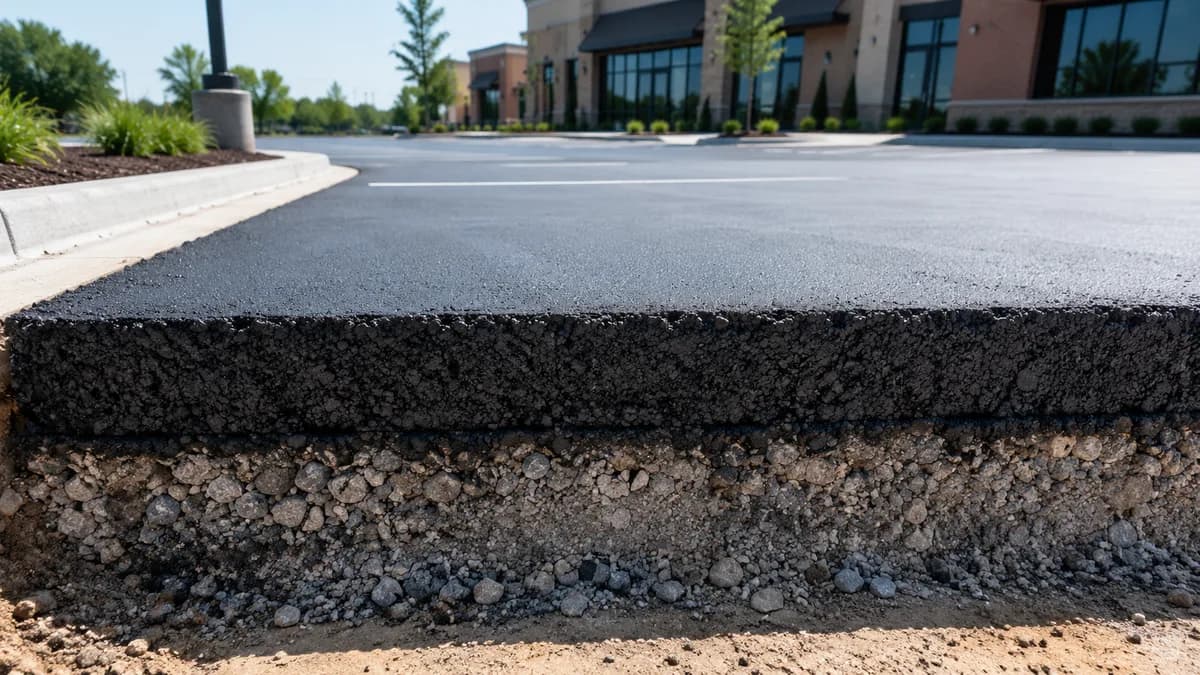
Cross-section edge of freshly paved asphalt showing compacted thickness over an aggregate base.
Asphalt Paving

Property-owner guide

Updated July 6, 2026

Asphalt Paving Thickness for Parking Lots

Typical asphalt paving thickness for parking lots: benchmarks for stalls, drive lanes, and truck areas, plus how base and soil change the answer.

Read guide
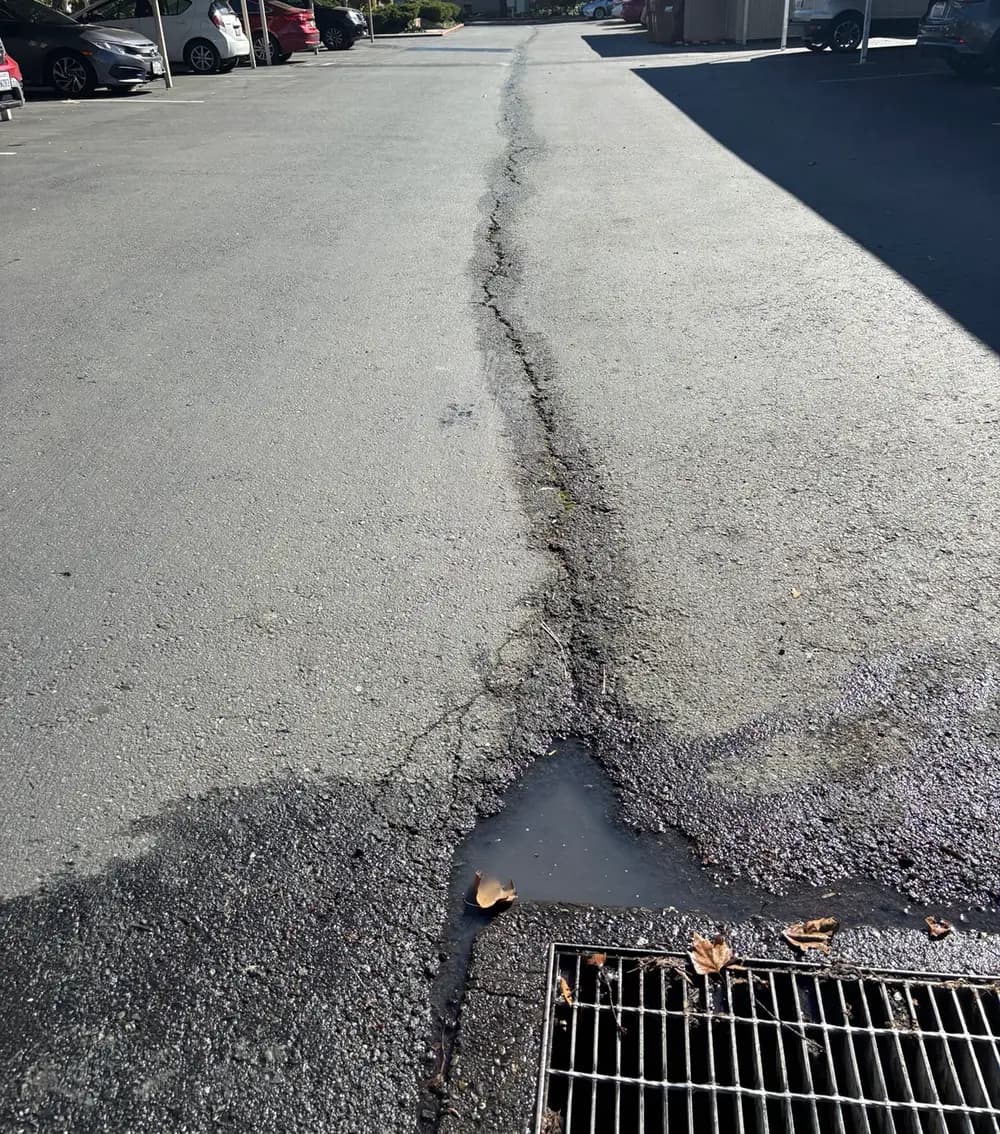
Water pooling in a low spot of a parking lot due to poor drainage.
Drainage & Sitework

Property-owner guide

Updated July 12, 2026

How Drainage Affects Pavement Life

Why drainage is the biggest factor in how long pavement lasts, how water damages asphalt from the base up, and why fixing it protects every repair.

Read guide
Property manager and asphalt paving contractor reviewing a cracked commercial parking lot together.
Contractor Hiring Guides

Property-owner guide

Updated July 6, 2026

How to Choose an Asphalt Paving Contractor

How to choose an asphalt paving contractor: project fit, relevant experience, written scope, references, insurance, and pavement qualifications.

Read guide
Repaired concrete sidewalk and curb section next to a commercial building.
Concrete Repair

Property-owner guide

Updated July 11, 2026

Concrete Repair vs. Replacement: Which Do You Need?

When to repair concrete versus replace it: how grinding, slab lifting, and patching compare to full replacement, and how to decide from the cause.

Read guide
Parking Lot Maintenance

Property-owner guide

Updated July 11, 2026

How to Create a Parking Lot Maintenance Plan

How to build a parking lot maintenance plan: inspecting condition, setting service cycles, prioritizing repairs, and budgeting over multiple years.

Read guide

North Dakota Agencies and Reference Links

This page summarizes publicly available information for general education. It is not legal, engineering, or code-compliance advice, and requirements change. Confirm anything that affects your project with the agency with jurisdiction over the property.

Regulatory content last reviewed:

For contractors

Are you a pavement contractor in North Dakota?

Get listed where property managers, owners, and facility teams search by state, city, and service.