The Pavement Directory

State pavement directory

Pavement Contractors in Massachusetts

Two features shape pavement work in Massachusetts more than the weather does, and neither is obvious from a bid sheet. The first is that the state is not authorized to run the federal construction stormwater permit program, so that permit comes from EPA rather than from a state agency. The second is that wetlands review here happens at the municipal level, through a conservation commission, and it can reach projects that owners assume are routine.

Around those two facts sits a genuinely demanding physical environment: severe freeze-thaw cycling, heavy winter deicing, glacial soils that vary from Boston's marine clay to Cape Cod's clean outwash sand, and dense, long-developed sites where staging space is scarce. This page lists pavement contractors serving Massachusetts cities and covers what actually decides scope, cost, and schedule here.

Listings
13
City
1
Services
13
Search Massachusetts

Before you hire: The Pavement Directory does not guarantee contractor performance, pricing, licensing, insurance, or availability. Business information may be submitted by contractors or gathered from public sources and should be independently verified before hiring. Always confirm licensing, insurance, references, scope of work, and written contract terms.

13 contractors in Massachusetts

Filter by service
Central Paving logo

Sutton, Massachusetts

Asphalt PavingCommercial & Residential

Central Paving serves Worcester and surrounding Massachusetts communities with paving services for residential, commercial, and industrial properties. The company offers installation, repair, and replacement of stone driveways, gravel driveways, and asphalt driveways. Central Paving reports over 48 years of experience in the paving services industry and holds an A+ Better Business Bureau rating.

(508) 868-6262Website on file
Cisternelli Brothers Inc logo

Walpole, Massachusetts

Asphalt PavingDrainage & GradingResidential

Cisternelli Brothers Inc. is a family-owned construction company based in Walpole, Massachusetts, specializing in asphalt paving and general excavation. Founded by brothers Peter and Paul Cisternelli, the business has operated for over 27 years and is currently run by Paul Cisternelli. It serves Walpole and surrounding communities with construction and asphalt-related services.

(508) 668-4544Website on file
DO - ALL - CONSTRUCTION logo

Worcester, Massachusetts

Asphalt PavingCommercial & Residential

Paving contractor in Worcester, MA offering Asphalt Paving.

(774) 242-4587Website on file
Driveways Corporation logo

Sutton, Massachusetts

Asphalt PavingDrainage & GradingCommercial

Paving contractor in Sutton, MA offering Asphalt Paving, Residential Driveway, Drainage and Sitework.

(888) 683-7283Website on file

Middleborough, Massachusetts

Asphalt PavingDrainage & GradingCommercial

Paving contractor in Middleborough, MA offering Asphalt Paving, Drainage and Sitework.

(774) 213-5728
PAVE-MINT logo

Shrewsbury, Massachusetts

Asphalt PavingCommercial & Residential

Paving contractor in Shrewsbury, MA offering Asphalt Paving.

(774) 314-5949Website on file
Asphalt PavingSealcoatingStriping & Pavement MarkingsCommercial & Residential

The company offers sealcoating, crack filling, line striping, and sport court resurfacing throughout Massachusetts, Connecticut, and Rhode Island. Services include color and traditional seal coating, cracking asphalt repairs, specialty striping and coating work for basketball and tennis courts, and touch-up, power washing, and sweeping services. The company states its seal coating process can last up to 10 years.

(508) 340-9713Website on file
Sorensen Paving logo

Holden, Massachusetts

Asphalt PavingSnow RemovalCommercial & Residential

Established in 1935, Sorensen Paving is a family-owned business operated by owner Larry Sorensen, who has 30 years of paving and excavation experience. The company completes 150 to 250 driveways and parking lots annually and represents four generations of paving and excavation experience. Services include driveway design, excavation, basecoat and topcoat paving, sealcoating, resurfacing, and snow plowing.

(508) 393-0599Website on file
T&K Asphalt Services Inc. logo

Whitman, Massachusetts

Asphalt PavingConcrete SiteworkCommercial

Based in Whitman, Massachusetts, T&K Asphalt Services Inc. was founded in 1987 and operates with over 125 employees. The company serves commercial property owners and managers throughout New England with paving, sealcoating, line striping, construction, and repair services. For residential homeowners, the company provides driveway sealcoating in southeastern Massachusetts, including the South Shore, Cape Cod, and Metro West areas.

(877) 852-7742Website on file
Waverly Development logo

Belmont, Massachusetts

Asphalt PavingSnow RemovalCommercial & Residential

Paving contractor in Belmont, MA offering Asphalt Paving.

(617) 455-5560Website on file

What makes pavement work different in Massachusetts?

Massachusetts pairs severe freeze-thaw and glacial soil variability with a permitting path that runs through EPA and the local conservation commission rather than a state stormwater agency.

  • Massachusetts is not authorized to administer the federal NPDES program, so construction stormwater permit coverage is issued by EPA rather than by MassDEP.
  • The Massachusetts Wetlands Protection Act is administered locally by municipal conservation commissions, and work near a wetland, stream, or coastal resource can require a filing regardless of how routine the pavement work seems.
  • There is no statewide license specific to commercial paving; residential work falls under home improvement contractor registration, and the Construction Supervisor License covers buildings rather than pavement.
  • Freeze-thaw cycling and sustained deicing make crack sealing and concrete surface protection higher-value here than in most of the country.
  • Subgrade varies enormously by region — Boston-area marine clay, upland glacial till, and Cape and Islands outwash sand behave nothing alike.

Pavement Conditions by Region in Massachusetts

Massachusetts does not have one climate or one soil profile, and pavement that performs well in one part of the state can fail early a few hours away. These are the divisions that matter most when scoping paving, repair, or maintenance work.

Greater Boston and the coastal lowland

Boston · Cambridge · Quincy · Somerville · Lynn

Environmental stress

  • Repeated freeze-thaw cycling with frequent winter rain-then-freeze events
  • Heavy deicing on dense commercial and institutional pavement
  • Coastal storm flooding and, in low-lying areas, tidal influence on drainage

Subgrade conditions

  • Marine clay and silt at depth in the Boston Basin
  • Extensive historic fill on made land near the harbor and rivers
  • Shallow bedrock outcropping in places within short distances

Common distress

  • Settlement over old utility trenches and buried structures
  • Alligator cracking where drainage is constrained by surrounding grades
  • Concrete surface scaling on heavily salted walks and aprons

What it means for the work

  • Staging space and truck access are frequently the binding schedule constraint
  • Made ground and unknown buried structures make test pits worthwhile before pricing
  • Night and weekend work is common because daytime closures are impractical

Central Massachusetts uplands

Worcester · Fitchburg · Leominster · Marlborough · Milford

Environmental stress

  • Colder winters and more freeze-thaw cycles than the immediate coast
  • Meaningful snowfall totals with sustained plowing
  • Rolling terrain concentrating runoff onto lower sites

Subgrade conditions

  • Dense glacial till with a mix of fines, sand, and cobbles
  • Shallow, irregular bedrock across many parcels
  • Frost-susceptible silty soils in low areas and old wetland margins

Common distress

  • Frost heave producing seasonal bumps that partly recover by summer
  • Spring potholing along crack lines opened over winter
  • Cracking where a section crosses from rock to soil subgrade

What it means for the work

  • Ledge removal is a real cost item and belongs in the bid as a unit price
  • Frost-susceptible material at transitions is a recurring source of heaving
  • Crack sealing before winter earns its cost reliably at this elevation

Connecticut River Valley

Springfield · Northampton · Holyoke · Chicopee · Amherst

Environmental stress

  • Hot, humid summers relative to the rest of the state
  • Substantial freeze-thaw cycling through winter
  • Riverine flooding along the valley floor

Subgrade conditions

  • Lake-bed silts and varved clays from glacial Lake Hitchcock
  • Sand and gravel terraces above the river floodplain
  • Traprock ridges with shallow, hard rock nearby

Common distress

  • Frost heave in fine-grained lake sediments
  • Settlement on filled or low-lying valley parcels
  • Base saturation in areas that drain slowly after river-valley rain events

What it means for the work

  • Fine lake sediments are frost-susceptible and often need a thicker granular section
  • Floodplain status can change what is permissible on a site
  • Subgrade can shift from silt to gravel within one parcel

Cape Cod and the Islands

Barnstable · Falmouth · Hyannis · Edgartown · Nantucket

Environmental stress

  • Milder winters than inland but persistent damp and salt air
  • Extremely concentrated summer traffic on lots that are quiet nine months a year
  • Coastal storms, wind-driven sand, and salt spray

Subgrade conditions

  • Clean glacial outwash sand with excellent drainage and poor lateral support
  • High water table on low-lying parcels
  • Groundwater protection districts overlying the sole-source aquifer

Common distress

  • Edge break-up and ravel where pavement is unconfined
  • Sand infiltration and surface abrasion in exposed locations
  • Rutting concentrated into the summer months when loading peaks

What it means for the work

  • Aquifer protection rules can restrict what may be applied to a surface here
  • Ferry schedules and seasonal traffic materially affect island logistics and cost
  • Edge confinement matters more than base drainage on clean sand

The Berkshires

Pittsfield · North Adams · Great Barrington · Lenox

Environmental stress

  • The state's coldest winters and heaviest snowfall
  • Deep frost penetration and numerous freeze-thaw cycles
  • Steep grades and concentrated slope runoff

Subgrade conditions

  • Rocky glacial till over bedrock at shallow depth
  • Marble and limestone belts in parts of the county
  • Saturated soils at the toe of slopes and below cut faces

Common distress

  • Severe frost heave and spring break-up
  • Plow damage at edges, joints, and raised features
  • Washout where uncontrolled runoff crosses pavement on a grade

What it means for the work

  • The practical working window is shorter here than anywhere else in the state
  • Snow storage and meltwater routing should be settled at layout, not after
  • Steep-site drainage work often costs more than the paving itself

Common Pavement Problems in Massachusetts

Frost heave and spring break-up

Pavement lifting into bumps and ridges through late winter, partly settling back by summer, and leaving cracks and potholes behind in the same places every year.

Likely causes

  • Frost-susceptible silty soils forming ice lenses as freezing penetrates
  • Water available in the subgrade with no path to drain away
  • Insufficient depth of clean granular material below the pavement
  • Differential frost penetration at transitions between materials

When to get it looked at: Heaving that recurs in the same footprint each winter is a subgrade and drainage question. Resurfacing over it produces a smooth lot that heaves in exactly the same places the following February.

Deicing damage to concrete walks and aprons

Sidewalks, entry aprons, and dumpster pads shedding their surface in thin flakes, with joints opening, edges spalling, and — on accessible routes — the surface becoming uneven enough to matter.

Likely causes

  • Repeated freezing while the concrete surface is saturated
  • Deicing chemicals applied to concrete during its first winter
  • Finishing practices that left a weak or overworked surface layer
  • Drainage that keeps the surface wet through freeze cycles

When to get it looked at: Scaling with sound concrete beneath can often be addressed without full replacement. Deterioration that reaches reinforcement, or that creates a change in level on an accessible route, needs attention on a shorter timeline.

Settlement over made ground and old utilities

Localized dips and cracking that follow a straight line across an otherwise sound lot, common on long-developed Boston-area parcels where the ground beneath has been disturbed repeatedly.

Likely causes

  • Historic fill placed without engineered compaction
  • Poorly backfilled utility trenches consolidating over time
  • Buried structures, foundations, or abandoned lines beneath the pavement
  • Groundwater movement carrying fines out of loose fill

When to get it looked at: Cracking in a straight line is a strong hint that something buried is driving it. Test pits before pricing a reconstruction are cheaper than discovering it mid-project.

Unconfined edge failure on outwash sand

On Cape and Island lots, the pavement perimeter cracks parallel to the edge, drops, and ravels away while the interior stays serviceable.

Likely causes

  • Clean sand providing very little lateral support at an unconfined edge
  • No curb, thickened edge, or compacted stabilized shoulder
  • Vehicles routinely tracking the perimeter in tight aisles
  • Runoff sheeting over the edge and eroding the supporting soil

Reflective cracking through overlays

New cracks appearing in a recently resurfaced lot in the same pattern as the cracks that were there before, typically within one or two winters.

Likely causes

  • Existing cracks not treated before the overlay was placed
  • Continued movement in the underlying pavement and base
  • An overlay too thin to resist the movement below it
  • Freeze-thaw cycling driving the old crack pattern upward

When to get it looked at: If a resurfacing that is two years old is cracking on the old pattern, the question to ask about the next one is what will be done differently to the layer underneath.

Paving and Maintenance Calendar for Massachusetts

Treat this as a planning aid, not a rule. Whether a given treatment can actually be placed on a given day depends on product requirements, surface and nighttime temperatures, the rain forecast, humidity, plant availability, the project specification, and the contractor’s means and methods.

Winter

Work often suited to this window

  • Snow and ice operations and monitoring for developing damage
  • Emergency pothole repair and trip hazard mitigation
  • Assessments, capital planning, and preparing spring bid packages

Scheduling risks

  • Paving and surface treatments are generally out of season statewide
  • Frozen and thawing ground makes structural repair unreliable
  • Salt and snow cover conceal damage until the melt reveals it

Inspect for: Track where plowed snow is stockpiled and where meltwater runs across the lot; those paths concentrate freeze-thaw damage and show it first.

Regional exception: Berkshire County sites typically have a materially longer out-of-season stretch than Cape Cod, where mild spells can open short working windows.

Spring

Work often suited to this window

  • Full-depth repair of winter damage once the subgrade firms up
  • Paving and overlays as temperatures stabilize
  • Drainage corrections and structure adjustments before summer

Scheduling risks

  • Thaw-weakened subgrade makes early structural work unreliable
  • Persistent spring rain keeps till and silt sites too wet to work
  • Conservation commission filing timelines can add weeks where wetlands review applies

Inspect for: Separate the cracks that only need sealing from the areas that flex under a slow vehicle; the second group needs base repair, not an overlay.

Summer

Work often suited to this window

  • Sealcoating and surface treatments in warm, dry conditions
  • Reconstruction and heavy repair phased around occupancy
  • Striping, signage, and accessible route upgrades

Scheduling risks

  • Cape and Island properties often cannot close a lot at all in season
  • School and campus work compresses into the same few weeks statewide
  • Humidity and afternoon storms extend cure times and interrupt applications

Inspect for: Walk drive aisles, loading areas, and drop-off lanes in the heat of the day, when rutting and shoving are actually visible.

Fall

Work often suited to this window

  • Crack sealing ahead of the first sustained freezes
  • Completing paving and overlays while conditions allow
  • Clearing catch basins, swales, and stormwater structures before winter

Scheduling risks

  • The Berkshires and central uplands lose the window earlier than the coast
  • Whether a day works depends on the product's requirements, surface and night temperatures, humidity, and the rain forecast — not the date
  • Coastal storms can deliver heavy rain well into the fall

Inspect for: Confirm every crack is sealed and every catch basin is clear before the first freeze; anything open in November takes on water until April.

Contractor Licensing and Verification in Massachusetts

Statewide licensing
Depends on scope and project value
Administering body
Massachusetts Office of Consumer Affairs and Business Regulation — Home Improvement Contractor registration (residential work)

Massachusetts does not issue a statewide license specifically for commercial asphalt paving, sealcoating, concrete, or parking lot contractors. For a shopping center, office park, or industrial property, there is generally no state paving credential to look up at all, so verification depends on the entity, its insurance, and its record.

Residential work is treated differently. Contractors performing home improvement work on residential property are generally required to register as Home Improvement Contractors, and that registration is verifiable through the state. Registration also connects to the state's guaranty fund process for eligible homeowner claims, which is a practical reason to insist on it for driveway work at a home.

One credential is commonly misapplied here. The Construction Supervisor License issued by the state relates to work on buildings and structures under the state building code, not to parking lot paving. A contractor holding one is not thereby licensed for pavement work, and a contractor without one is not thereby unqualified to pave a lot. Ask what a credential actually covers before treating it as a qualification.

Municipal requirements and public work add layers. Cities and towns may require their own permits or registration for work within their jurisdiction, and public construction in Massachusetts carries bidding, bonding, prequalification, and prevailing wage requirements that do not apply to private jobs. Confirm both with the awarding authority or the municipality before contracting.

What a contractor license does not prove

For commercial pavement in Massachusetts there is usually no state license that establishes competence. That makes verified insurance, confirmation that the contracting entity is registered and in good standing, and references on comparable local projects the substance of the check rather than a supplement to it.

  • That the proposed scope is the right fix for what is actually failing
  • That the price is fair for the local market
  • That drainage has been designed or corrected
  • That the pavement section and thickness suit the traffic the property carries
  • That the specified materials are appropriate for the site
  • That the crew will show up when promised
  • That workmanship will hold up past the first winter or summer
  • That the company is financially stable enough to honor a warranty

Ask for a certificate of insurance sent directly from the carrier or agent rather than a copy forwarded by the contractor, confirm the general liability and workers’ compensation coverage is active on the dates of your work, and ask to be named as certificate holder so you are notified if the policy lapses.

Licensing requirements can turn on project value, scope of work, property location, and whether the job is public or private. City and county rules may add registration, permitting, or bonding requirements beyond anything required at the state level. Verify current requirements with the agency directly before contracting.

Last reviewed:

Stormwater and Environmental Considerations

Massachusetts is one of a small number of states that is not authorized to administer the federal NPDES program. That means construction stormwater permit coverage for a qualifying project comes from EPA under the federal construction general permit, not from MassDEP. Owners and contractors who assume a state agency issues it can lose real time discovering otherwise, so it is worth establishing early who issues what on your project.

Wetlands review is the layer that catches Massachusetts pavement projects most often, and it is genuinely local. The Wetlands Protection Act is administered by each municipality's conservation commission, and jurisdiction extends to defined buffer areas around wetlands, streams, ponds, and coastal resources — not only to the resource itself. A resurfacing that seemed like straightforward maintenance can require a filing simply because of where the lot sits. Many communities also have their own local wetlands bylaws that are stricter than the state act.

Beyond those two, most Massachusetts municipalities operate under an MS4 stormwater permit and apply their own site plan review, drainage, and erosion control standards to development and redevelopment. On Cape Cod and the Islands, groundwater and aquifer protection districts add restrictions that can affect what may be applied to a pavement surface. Establishing which of these apply before design is the difference between a straightforward project and a stalled one.

What tends to drive requirements here

  • That EPA, not MassDEP, issues federal construction stormwater permit coverage in Massachusetts
  • Conservation commission jurisdiction, including buffer zones around wetlands, streams, and coastal resources
  • Local wetlands bylaws that go beyond the state Wetlands Protection Act
  • Municipal MS4 stormwater and site plan review requirements
  • Aquifer and groundwater protection districts on Cape Cod and the Islands
  • Erosion and sediment control, catch basin protection, and material staging during the work

Wetlands and stormwater review in Massachusetts happens largely at the municipal level and varies considerably between communities. Confirm requirements with the local conservation commission and the municipality before design.

Last reviewed:

Pavement Terms You May Encounter in Massachusetts

TermWhat it means on a Massachusetts project
Dense graded crushed stoneThe compacted stone base placed beneath asphalt in Massachusetts work. Its thickness and cleanliness do more for pavement life in a freeze-thaw climate than the surface course above it does.
Gravel borrow / processed gravelGranular material specified below the base to provide drainage and frost protection. In frost-susceptible ground the depth of clean granular material is often the most consequential number on the section detail.
LedgeThe New England term for bedrock encountered during excavation. It is common enough in central and western Massachusetts that it belongs in the bid as a unit price rather than as an assumption.
Frost-susceptible soilFine-grained material in which freezing water forms ice lenses that lift the pavement above. Identifying and replacing it at transitions is what stops the same bump reappearing every winter.
Catch basin adjustmentRaising or resetting drainage structures so their rims match the finished pavement after milling or overlay. Skipping it is a leading cause of new ponding after a resurfacing.
Resource area buffer zoneThe regulated band of land around a wetland, stream, or coastal resource in which work triggers conservation commission review. Its extent is defined by the state act and can be expanded by local bylaw.

State transportation specifications can provide useful regional terminology and material references, but they do not automatically govern private parking-lot or driveway projects unless incorporated into the contract or required by the applicable jurisdiction.

More definitions are in the pavement glossary.

Common Pavement Projects in Massachusetts

University and hospital campuses

Boston-area institutional properties combine constant occupancy, accessible routes that cannot be interrupted, and almost no staging room, so phasing and access planning usually outweigh material selection.

Life sciences and biotech facilities

Cambridge and suburban lab campuses often sit on made ground with dense buried utilities, where reconstruction runs into unknowns that test pits should surface before pricing.

Seasonal resort and marina properties

Cape and Island properties absorb a year of traffic in a few months and sit near resource areas, so both the loading pattern and the permitting path differ from an inland lot.

Distribution and manufacturing sites

Central Massachusetts and I-495 corridor facilities put trailer loading on sections built for lighter traffic, and frost-susceptible till underneath makes the aprons the first thing to fail.

Municipal and school district properties

Public work here brings bidding, bonding, and prevailing wage requirements, and bus loops carry loads far beyond the adjacent parking fields they were built alongside.

Questions to Ask a Paving Contractor in Massachusetts

Massachusetts pavement FAQs

Who issues the construction stormwater permit in Massachusetts?

EPA does. Massachusetts is not authorized to administer the federal NPDES program, so a project that disturbs enough ground obtains coverage under EPA's federal construction general permit rather than from a state permit program. MassDEP still has a role in related state review, and municipalities apply their own stormwater and site plan requirements, but the federal permit itself does not come from a state agency here. Confirming that early avoids a common and time-consuming misunderstanding.

Why does my Massachusetts parking lot project need conservation commission approval?

Because the Wetlands Protection Act is administered locally, and its jurisdiction extends to buffer areas around wetlands, streams, ponds, and coastal resources — not just to the resource itself. If any part of the work falls inside that regulated area, a filing with the town's conservation commission may be required even for work the owner considers routine maintenance. Many municipalities also have their own wetlands bylaws that reach further than the state act does. Ask the commission early; the filing timeline is often the longest item in the schedule.

Does Massachusetts license paving contractors?

Not for commercial pavement. There is no statewide Massachusetts license specific to asphalt paving, sealcoating, concrete, or parking lot work on a commercial property. Residential home improvement work does require Home Improvement Contractor registration, which is verifiable and connects to the state's guaranty fund process. The Construction Supervisor License that comes up frequently applies to buildings under the state building code, not to pavement, so it should not be treated as a paving qualification either way.

Why does the same bump come back in my lot every winter?

That is frost heave, and it recurs because the cause sits below the pavement. Frost-susceptible fine-grained soil holds water, freezing draws more water toward the freezing front, ice lenses form, and the pavement above is lifted. In spring it thaws and mostly settles back, leaving cracks behind. Because the mechanism is in the subgrade, resurfacing produces a lot that heaves in the identical footprint the following February. The durable fix is replacing frost-susceptible material with clean granular material and giving the water somewhere to go.

Why do Cape Cod lots break up at the edges first?

Glacial outwash sand drains beautifully and supports almost nothing laterally. At an unconfined pavement edge, there is very little holding the asphalt in place when a vehicle runs the perimeter, and runoff sheeting off the edge steadily removes the soil beneath it. The result is cracking parallel to the edge that works inward while the middle of the lot stays fine. Curb, a thickened edge, or a properly compacted stabilized shoulder addresses it; another patch in the same location does not.

Is sealcoating worth doing in the Massachusetts climate?

On sound asphalt it slows oxidation and keeps the surface uniform, which has real value in a climate that cycles through freezing repeatedly. On pavement that is already cracking through to the base it accomplishes very little and can obscure the condition an assessment needs to see. It is also not a substitute for crack sealing, which is the higher-value treatment here. On Cape Cod and the Islands, check whether local aquifer protection rules restrict what may be applied before assuming a product is available.

My lot was resurfaced two years ago and the old cracks are back. Why?

That is reflective cracking. When an overlay is placed over pavement whose cracks are still moving, the movement continues and works its way up through the new asphalt in the same pattern. A thin overlay resists it least, and a New England winter drives the process quickly. It usually means the underlying cracks were not treated, or the underlying pavement was too far gone for an overlay to be the right answer. Before buying the next one, ask specifically what will be done to the layer underneath.

When is paving possible in Massachusetts?

Roughly spring through fall in most of the state, with the coast typically offering more workable days at both ends than the Berkshires or the central uplands. There is no fixed date at which paving stops being possible. What decides a given day is the specific product's requirements, the surface and overnight temperatures, humidity, the rain forecast, plant availability, and the specification. A mild, dry stretch in November can be workable; a raw, wet week in April may not be.

Browse cities in Massachusetts

Browse services in Massachusetts

Related reading for Massachusetts property owners

Crack Sealing

Property-owner guide

Updated July 11, 2026

When Should You Seal Asphalt Cracks?

When to seal cracks in asphalt — which cracks to seal, the best time of year, why sealing early matters, and how crack sealing fits a maintenance schedule.

Read guide
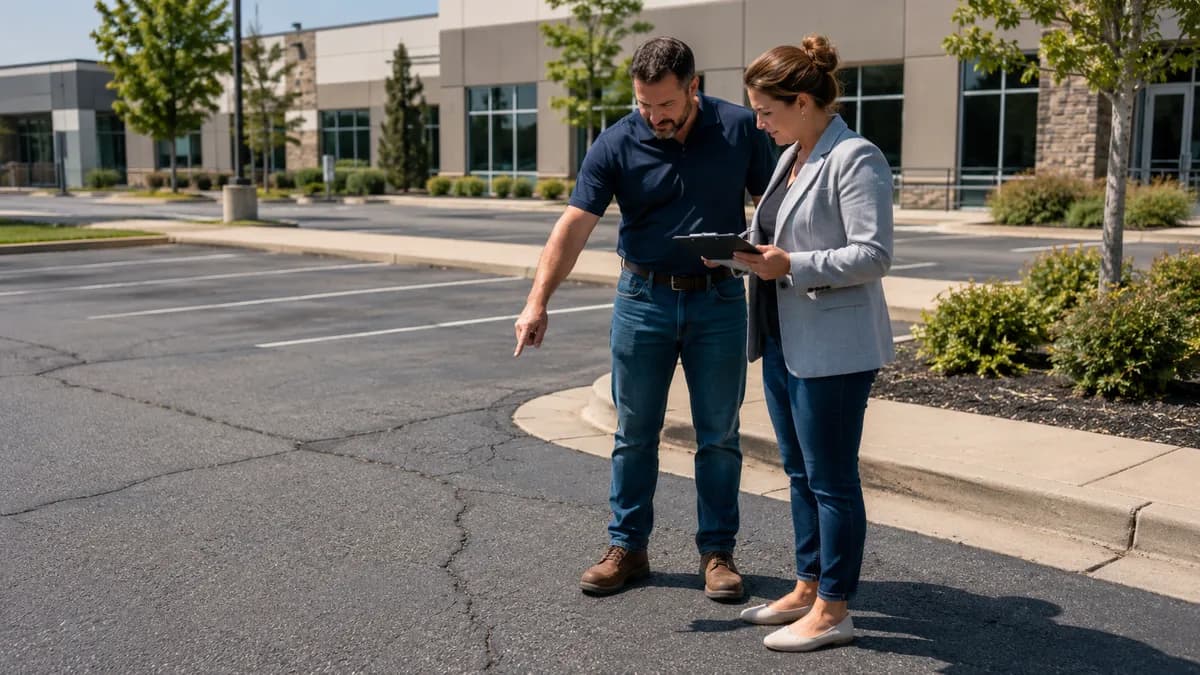
Property manager and asphalt paving contractor reviewing a cracked commercial parking lot together.
Contractor Hiring Guides

Property-owner guide

Updated July 6, 2026

How to Choose an Asphalt Paving Contractor

How to choose an asphalt paving contractor: project fit, relevant experience, written scope, references, insurance, and pavement qualifications.

Read guide
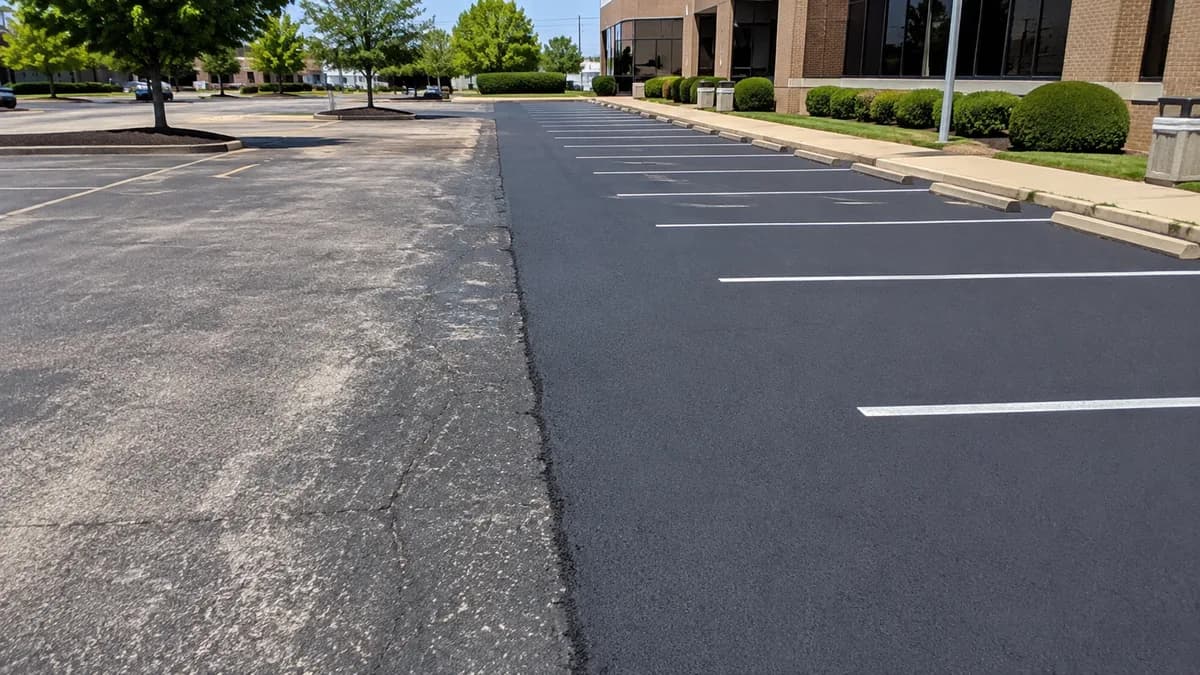
A parking lot edge where new asphalt overlay meets older, worn existing pavement.
Asphalt Paving

Property-owner guide

Updated July 6, 2026

Asphalt Paving vs Asphalt Overlay

Compare asphalt paving vs asphalt overlay. Learn when overlay works, when it fails, and what property owners should check before approving pavement resurfacing.

Read guide
Raised, offset sidewalk panel creating a trip hazard outside a commercial building, with panels summarizing common causes, repair options such as grinding, slab leveling, and patching, and liability considerations.
Concrete Repair

Property-owner guide

Updated July 11, 2026

Concrete Trip Hazards: Causes, Fixes, and Liability

What causes concrete trip hazards on sidewalks, how they are fixed by grinding, cutting, slab lifting, or replacement, and the ADA and liability stakes.

Read guide
Standing water pooled near a parking lot drain inlet after rainfall.
Drainage & Sitework

Property-owner guide

Updated July 6, 2026

Parking Lot Drainage Problems: What Property Owners Should Know

Common causes of parking lot drainage problems, why they accelerate pavement damage, and what property owners should ask contractors before a fix.

Read guide
Commercial parking lot showing a pothole, widespread alligator cracking, and faded striping near a drain inlet.
Parking Lot Maintenance

Property-owner guide

Updated July 11, 2026

Signs Your Parking Lot Needs Maintenance

How to read the warning signs a parking lot needs attention — cracks, potholes, faded striping, ponding, raveling — and what each one means.

Read guide

Massachusetts Agencies and Reference Links

This page summarizes publicly available information for general education. It is not legal, engineering, or code-compliance advice, and requirements change. Confirm anything that affects your project with the agency with jurisdiction over the property.

Regulatory content last reviewed:

For contractors

Are you a pavement contractor in Massachusetts?

Get listed where property managers, owners, and facility teams search by state, city, and service.