

What this guide covers
Match the contractor to the project type, confirm relevant experience, and review license and insurance before comparing price — a contractor who explains the proposed scope clearly is usually a better sign than the lowest bid.
This is the starting point for the asphalt paving hiring hub. See the full hub map at the end of this article for the guide on questions to ask, comparing bids, reviewing proposals, and property-type-specific hiring guidance.
Ready to reach out to contractors? Browse the asphalt paving contractor directory to compare profiles by market and specialty.
Related contractor categories
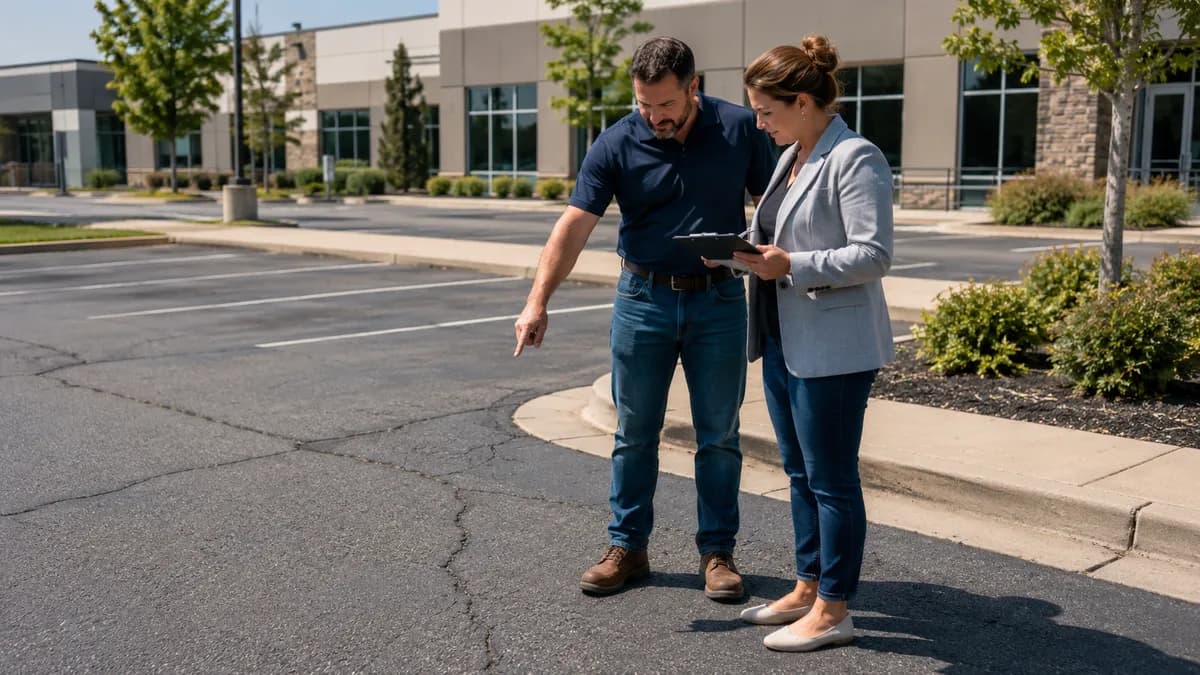
Start with project fit
The first question is not "who is cheapest?" It's whether this contractor has successfully handled this type of paving project before. A small driveway, a large HOA road system, a busy retail center, and an industrial truck yard are different projects — they may all use asphalt, but the planning, access, traffic, equipment, and risk are not the same.
Common project types include residential driveways, commercial parking lots, HOA roads and parking areas, apartment complexes, retail centers, office parks, warehouses, private roads, industrial pavement, full parking lot replacement, and mill-and-overlay projects. A contractor who mainly works on small residential driveways may not be the right fit for a phased commercial parking lot, and a contractor who focuses on large commercial paving may not be interested in small residential work.
Match project type to contractor fit
Some contractors are a clearly better fit for certain property types than others:
| Project type | Better contractor fit | Poorer contractor fit |
|---|---|---|
| Residential driveway | Driveway, garage transition, and curb tie-in experience | Large commercial-only contractor with high minimums |
| Retail center parking lot | Used to phasing, customer access, striping, and ADA areas | Small crew without traffic control experience |
| HOA private roads | Familiar with resident notices, phasing, and board approvals | No occupied-property experience |
| Warehouse or industrial yard | Familiar with truck traffic and heavier pavement use | Only handles light-duty parking areas |
| Overlay project | Can explain existing pavement limitations | Recommends overlay without reviewing failures |
Verify business basics
Before going too far, verify the basics: contractor name, business address or service area, state or local license requirements, general liability insurance, workers compensation insurance if applicable, years in business, similar project experience, references or project photos, and a written proposal process.
Requirements vary by state and local jurisdiction, so confirm what applies where the work is located. Most state license boards have a free online lookup that takes under two minutes and shows license status, classification, and bond information.
Ask about similar projects, specifically
Don't just ask, "Have you paved before?" Ask for examples that match your project: have you paved occupied apartment complexes, completed HOA road projects with resident access, handled parking lot paving for retail centers, worked on driveways with steep grades or garage transitions, or paved areas with delivery trucks, fire lanes, or garbage truck access?
A contractor's answer should help you understand whether they know the issues that matter for your property type.
Review communication before reviewing price
Communication during bidding is often a preview of communication during construction. Pay attention to whether the contractor shows up for the site visit, asks questions about access and use, notices drainage or failed areas, explains options clearly, follows up with a written proposal, clarifies exclusions, responds to questions directly, and avoids pressure tactics.
A contractor does not need to over-explain every technical detail, but they should be able to explain why they are recommending a specific scope.
Look at how they inspect the site
A useful site review goes beyond measuring square footage. A contractor should notice conditions such as failed asphalt areas, soft or sunken spots, existing overlays, poor drainage, low spots, utility covers, edge failure, heavy vehicle paths, concrete transitions, ADA parking areas, access constraints, and areas that need phasing.
A quick glance from a truck may be enough for a small driveway. It is usually not enough for a large commercial parking lot — a serious commercial site walk typically takes 30 to 60 minutes, not five.
Common selection mistakes
Avoid these mistakes when shortlisting contractors:
- Choosing only by lowest price
- Hiring a driveway contractor for a complex commercial site without confirming fit
- Accepting a vague verbal scope
- Ignoring property access needs
- Not checking insurance
- Not asking about similar projects
- Assuming sealcoating or patching experience equals paving experience
- Failing to clarify who handles striping, traffic control, or notices
The complete hiring hub
This article is step one. The rest of the hub follows the order of a real project. Before you request bids, use the master question bank in Questions to Ask an Asphalt Paving Contractor Before Hiring.
To understand the scope being proposed, see Asphalt Paving Thickness for Parking Lots, Asphalt Paving vs Asphalt Overlay, and Asphalt Paving vs Asphalt Repair.
When bids arrive, use How to Compare Asphalt Paving Bids, the Asphalt Paving Proposal Checklist, and Cheap Asphalt Paving Bid Red Flags.
For your property type specifically, see Commercial Asphalt Paving Contractors or Residential Asphalt Paving Contractors.
Frequently asked questions
What is the first thing to check before hiring an asphalt paving contractor?
Check whether the contractor has experience with your type of project. A driveway, commercial parking lot, HOA road, and industrial yard require different planning.
Should I ask for references?
Yes. Ask for references or examples of similar work, especially for larger or occupied properties.
How many bids should I get?
Three is a practical target for most projects — enough to see the pricing spread without stalling the process.
Should I hire a residential or commercial paving contractor?
Choose based on the project. Residential driveways and commercial parking lots have different access, phasing, traffic, and pavement-use concerns.
What if I am not sure what scope I need?
For larger or unclear projects, consider getting multiple contractor opinions or using a pavement consultant before requesting formal bids.
Before you hire: The Pavement Directory does not guarantee contractor performance, pricing, licensing, insurance, or availability. Business information may be submitted by contractors or gathered from public sources and should be independently verified before hiring. Always confirm licensing, insurance, references, scope of work, and written contract terms.
For property owners
Looking for a pavement contractor?
Use The Pavement Directory to search asphalt, concrete, sealcoating, striping, ADA access, and pavement maintenance contractors by service and location. Always verify license, insurance, references, and written scope before hiring.
Search contractorsFor contractors
Are you a pavement contractor?
Contractors can add or claim a company profile to help property owners find pavement professionals by service, location, and specialty.