
Oklahoma pavement guide
Pavement Conditions in Oklahoma: Regions, Soils, and Common Problems
In Oklahoma the subgrade moves seasonally and the weather arrives in extremes — and there is no state license to check, so verification falls to the owner.
- 5 regions
- 5 common problems
- 6 local terms
Jump to section
Regional differences
Pavement Conditions by Region in Oklahoma
Oklahoma does not have one climate or one soil profile, and pavement that performs well in one part of the state can fail early a few hours away. These are the divisions that matter most when scoping paving, repair, or maintenance work.
Central Oklahoma and the Cross Timbers
Oklahoma City · Norman · Edmond · Shawnee · Stillwater
Environmental stress
- Very wide annual temperature range with both hard freezes and extreme heat
- Frequent severe thunderstorms, hail, and high wind
- Rapid suburban growth loading older commercial lots
Subgrade conditions
- Red-bed clays with meaningful shrink-swell potential
- Shallow sandstone and shale bedrock in places
- Sandy soils along the Cross Timbers belt with different behavior
Common distress
- Long, wandering cracks that reopen after every repair
- Seasonal heaving and sagging that shifts with soil moisture
- Curb and gutter separation from the pavement edge
What it means for the work
- Subgrade moisture control usually matters more than added asphalt thickness
- Repairs made during a dry summer can look wrong after a wet spring
- Flexible crack treatments outperform rigid patches over moving clay
Northeastern Oklahoma and the Ozark foothills
Tulsa · Broken Arrow · Muskogee · Bartlesville · Tahlequah
Environmental stress
- Higher rainfall than the western half of the state
- Freeze-thaw crossings without prolonged deep freeze
- Heavy freight and industrial traffic through the Tulsa corridor
Subgrade conditions
- Clay and cherty clay soils over limestone and shale
- Shallow rock at variable depth across a single site
- Alluvial soils along the Arkansas and Verdigris river corridors
Common distress
- Alligator cracking where lots drain slowly after heavy rain
- Differential settlement across rock-to-soil transitions
- Rutting at industrial entrances and truck routes
What it means for the work
- Rock excavation quantity is a recurring source of change orders
- Proof-rolling catches soft pockets between rock high points
- Flooding along the river corridors can affect what is permissible on a site
Ouachita Mountains and southeastern Oklahoma
McAlester · Poteau · Idabel · Broken Bow · Hugo
Environmental stress
- The state's highest rainfall totals
- Steep terrain with concentrated slope runoff
- Heavy timber and log truck traffic
Subgrade conditions
- Rocky, thin soils over sandstone and shale on slopes
- Saturated fine-grained soils in valley bottoms
- Steep sites with limited flat working area
Common distress
- Edge erosion and undermining on sloped sites
- Rutting and edge break-up on timber haul routes
- Base saturation where water has no outlet
What it means for the work
- Log truck loading is a design load far beyond ordinary commercial use
- Concentrated runoff on a grade needs a designed, armored path
- Wet periods can close working windows for weeks at a time
Western Oklahoma and the High Plains
Woodward · Elk City · Altus · Guymon · Weatherford
Environmental stress
- Hot, dry summers with strong solar exposure
- High wind and blowing dust
- Colder winters with deeper frost than the southeast
Subgrade conditions
- Fine wind-deposited soils that soften when wet
- Gypsum-bearing ground in parts of the western counties
- Agricultural land with variable historic compaction
Common distress
- Binder oxidation, brittleness, and raveling under strong sun
- Thermal and block cracking from wide temperature swings
- Rutting at grain, feedlot, and energy facilities
What it means for the work
- Surface protection and crack sealing carry high value in this exposure
- Seasonal agricultural loading should shape the section
- Wind affects placement, curing, and striping more than owners expect
Red River valley and southern Oklahoma
Lawton · Ardmore · Duncan · Durant · Ada
Environmental stress
- Long, hot summers with limited winter relief
- Intense rainfall events and localized flooding
- Heavy cross-state freight and energy-related traffic
Subgrade conditions
- Clay and clayey sand with moderate to high plasticity
- Alluvial soils along the Red River and its tributaries
- Flat terrain with poor natural drainage in places
Common distress
- Heat-driven rutting on slow-traffic and turning areas
- Ponding-related base failure on flat sites
- Seasonal cracking driven by soil moisture change
What it means for the work
- Flat sites need designed positive drainage rather than minimal slope
- Nearly year-round working weather, but summer heat still shapes placement
- Energy and freight traffic justify a heavier section at entrances
Field conditions
Common Pavement Problems in Oklahoma
Expansive red-bed clay movement
Cracks that follow no traffic pattern, widen through a dry late summer, and partially close after wet weather. Pavement panels tilt, curb lines separate, and the same repair fails in the same place every few years.
Likely causes
- Red-bed clays with high shrink-swell potential beneath the pavement
- Moisture change from irrigation, downspouts, leaks, or drought
- Large trees drawing moisture unevenly from beneath the lot
- Subgrade placed without moisture conditioning or stabilization
When to get it looked at: If the same crack has been patched twice and reopened twice, the soil is telling you something the patch cannot fix. Moisture control and flexible treatments beat another rigid repair.
Base failure after intense rainfall
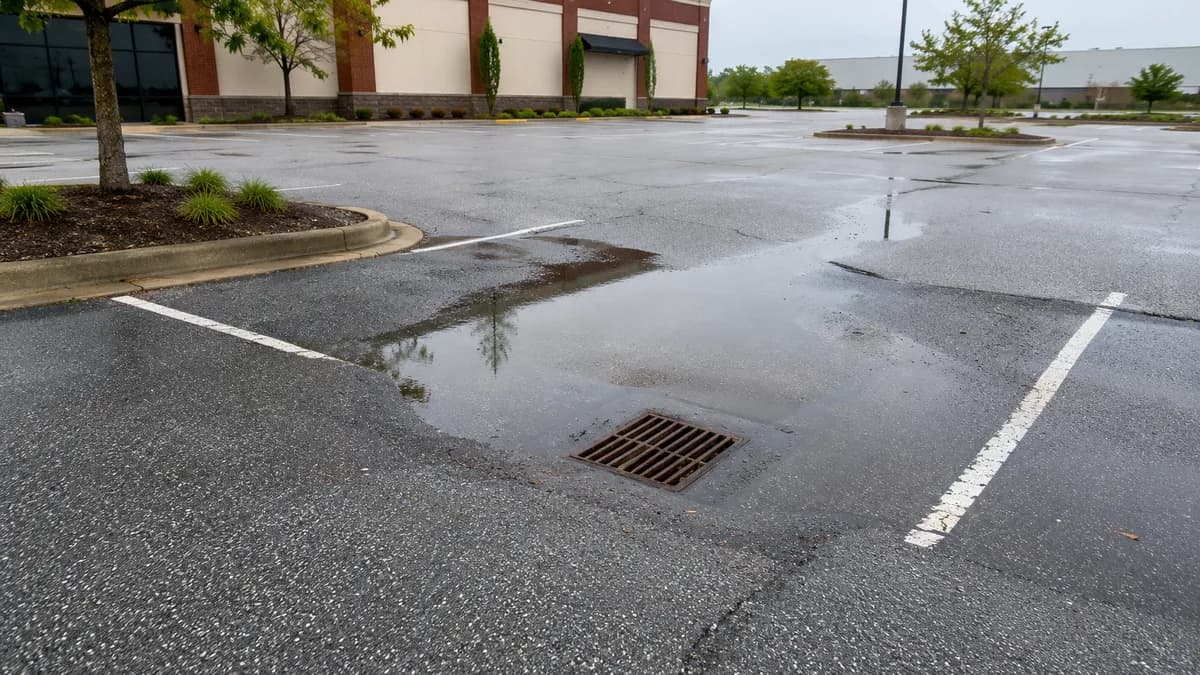
Interconnected cracking and potholes appearing in the weeks after a heavy storm, concentrated in the exact areas that held water longest.
Likely causes
- Rainfall intensity exceeding inlet and conveyance capacity
- Flat grading with no positive fall to an outlet
- Saturated fine-grained subgrade losing strength under load
- Inlets silted in or set above the pavement after repeated overlays
When to get it looked at: Photograph the lot during the storm. Where water stands is where the base is failing, and that is nearly impossible to identify on a dry inspection day.
Summer rutting on slow-traffic areas
Wheel-path depressions and pushed-up ridges at stop bars, drive-through lanes, dock aprons, and turning areas, most visible during the hottest weeks of the year.
Likely causes
- High pavement surface temperatures reducing mix stiffness
- Slow, stopped, or channelized traffic concentrating load
- A mix not matched to the site's actual traffic and temperature
- Delivery vehicles standing in the same place daily
When to get it looked at: Rutting concentrated where vehicles slow or stop rather than spread across the lot is a section and mix question. Concrete is often the better answer in those specific zones.
Hail and storm damage
Surface pitting, aggregate loss, and damage to striping, signage, wheel stops, and light bases after a severe storm — sometimes with the pavement itself less affected than the site features around it.
Likely causes
- Large hail impacting an already oxidized or brittle surface
- High wind displacing loose material and site furniture
- Flash runoff from the same storm undermining edges
- Aging surface with reduced ability to absorb impact
When to get it looked at: Document the condition of pavement, striping, and site features before storm season, not after. A dated condition record is what makes an insurance conversation about storm damage productive.
Freight and energy loading damage
Rutting, shoving, and cracking concentrated at entrances, aprons, and turning radii on distribution and energy-sector properties, while the adjacent car parking stays sound.
Likely causes
- Axle loads far beyond the original design assumption
- Unpaved shoulders giving way under wide truck turns
- Entrances built to the same section as the parking field
- Slow, heavy movement during the hottest part of the year
Property types
Common Pavement Projects in Oklahoma
Distribution and freight facilities
Oklahoma City and Tulsa area warehouses and the I-40 and I-44 corridors concentrate trailer traffic where aprons and drop lots fail years before the parking field shows any wear.
Energy sector yards and facilities
Equipment yards and service facilities carry loads far beyond ordinary commercial traffic, and entrances and turning radii break down before the main pavement does.
Agricultural, grain, and feedlot facilities
Western Oklahoma facilities absorb a year of heavy truck traffic in a few weeks, on ground where wind-deposited soils soften quickly once they take on water.
Tribal government and casino properties
High-volume visitor traffic with very limited windows for closure, plus their own procurement and approval processes that shape how a project is scoped and awarded.
University and school district campuses
Bus loops carry loads far beyond the surrounding parking, and the practical construction window is compressed into a summer break that coincides with peak Oklahoma heat.
Plain English
Pavement Terms You May Encounter in Oklahoma
| Term | What it means on a Oklahoma project |
|---|---|
| Aggregate base course | The compacted crushed stone layer beneath the asphalt. Oklahoma proposals typically name it by type and compacted thickness, and how well it drains generally governs pavement life more than the surface course does. |
| Lime or cement stabilized subgrade | Treating expansive clay subgrade with lime or cement to reduce plasticity and moisture sensitivity. It is a legitimate and meaningful line item over red-bed clay, and its absence on known expansive soil is worth a direct question. |
| Superpave mix designation | The mix classification used in Oklahoma specifications, encoding nominal aggregate size and the traffic level the mix is designed for. Asking which designation is priced is a fair check that the mix suits the loading. |
| Plasticity index | A soil test result describing how much a clay's behavior changes with moisture. On an Oklahoma site it is one of the most informative numbers a geotechnical report can give you about future cracking. |
| Cold milling | Grinding a controlled depth off the existing asphalt before resurfacing so the finished surface keeps its relationship to curbs, doors, and inlets. Skipping it on an already-overlaid lot is a common cause of new ponding. |
| Full-depth reclamation | Pulverizing the existing asphalt with the base, treating or reshaping the blend, and paving over it. It appears on larger Oklahoma lots and private roads where the base has failed and hauling everything off is impractical. |
State transportation specifications can provide useful regional terminology and material references, but they do not automatically govern private parking-lot or driveway projects unless incorporated into the contract or required by the applicable jurisdiction.
More definitions are in the pavement glossary.
Before you sign
Questions to Ask a Paving Contractor in Oklahoma
- What soil is under this pavement, and how do you know — a geotechnical report, borings, or local experience?
- Is lime or cement stabilization of the subgrade included, and if not, why is it not needed here?
- How will the proposed section handle seasonal clay movement, and what should I expect the cracking to do over the next few years?
- Does the mix account for summer surface temperatures at this site's actual loading?
- Where does water go during an intense storm, and are the areas that currently pond part of this scope?
- Does the city treat this work as maintenance or as redevelopment, and does that trigger detention requirements?
- Does this city require contractor registration, bonding, or a permit for work at this address?
- Who is your insurance carrier, and do you carry workers' compensation for the crew on this site?
- What surface and overnight temperatures does the product you have proposed require?
Oklahoma pavement condition FAQs
Why do cracks in my Oklahoma parking lot keep coming back in the same places?
Because the pavement is riding a subgrade that moves. Red-bed clays across much of the state swell as they take on moisture and shrink as they dry, and Oklahoma's cycle between drought and heavy rain produces enough seasonal change to crack pavement from below. Cracks that follow no wheel path, widen through a dry late summer, and narrow again after wet weather are the signature. Repeated rigid patches over moving ground fail repeatedly; controlling where water enters the soil and using flexible crack treatments is the productive response.
What is lime stabilization and does my Oklahoma lot need it?
Lime stabilization mixes lime into an expansive clay subgrade to reduce its plasticity and make it less sensitive to moisture change. It is common practice on Oklahoma projects over red-bed clay and is often one of the more meaningful differences between two otherwise similar bids. Whether your site needs it depends on the soil, the traffic, and the design — but on known expansive clay, a proposal that includes no subgrade treatment at all deserves a direct question about why.
How should I handle hail damage to my parking lot?
The most useful thing you can do is before the storm rather than after it: keep a dated record of the pavement's condition, the striping, the signage, and the site features. Hail tends to affect an aging, oxidized surface more than fresh pavement, and it often damages striping, wheel stops, signs, and light bases as much as the asphalt itself. Without a condition baseline, distinguishing storm damage from accumulated wear becomes an argument. Your insurance treatment of pavement is also worth understanding before you need it.
Why does the drive-through lane rut when the rest of the lot is fine?
Because that lane sees the worst possible combination for asphalt: slow or stopped traffic, in the same wheel path all day, while the surface is at its hottest. Oklahoma summer surface temperatures reduce the mix's stiffness substantially, and the vehicles deform it rather than wearing it. Repaving the same section usually reproduces the rut within a couple of summers. Many owners here move drive-through lanes, dock aprons, and dumpster pads to concrete and keep asphalt for the parking field.
Does the annual rainfall total tell me anything about my drainage needs?
Very little, in Oklahoma. What matters is intensity. A convective storm here can deliver a large share of a month's rain in an hour, and inlet and pipe capacity sized for gentler rain simply cannot pass it. That is why a lot that has handled ordinary rain for a decade can suddenly show base failure after one event. The right design question is how fast the site can pass the intense event and where the water goes when capacity is exceeded, not how many inches fall in a year.
Is Oklahoma's freeze-thaw damage significant, or is heat the real problem?
Both, which is unusual. The state has a wide enough annual temperature range that summer surface heat drives rutting and softening at slow-traffic areas, while winter freeze cycles push water into open cracks and produce late-winter potholing. Crack sealing before winter and mix selection for summer are both worth doing here, and neither substitutes for the other. That combination is part of why an Oklahoma maintenance plan borrowed from a milder state tends to underperform.
Related reading for Oklahoma property owners
Property-owner guide
Updated July 6, 2026
How to Choose an Asphalt Paving Contractor
How to choose an asphalt paving contractor: project fit, relevant experience, written scope, references, insurance, and pavement qualifications.
Property-owner guide
Updated July 6, 2026
Parking Lot Drainage Problems: What Property Owners Should Know
Common causes of parking lot drainage problems, why they accelerate pavement damage, and what property owners should ask contractors before a fix.
Property-owner guide
Updated July 11, 2026
When Should You Seal Asphalt Cracks?
When to seal cracks in asphalt — which cracks to seal, the best time of year, why sealing early matters, and how crack sealing fits a maintenance schedule.
Property-owner guide
Updated July 6, 2026
Asphalt Paving Thickness for Parking Lots
Typical asphalt paving thickness for parking lots: benchmarks for stalls, drive lanes, and truck areas, plus how base and soil change the answer.
Property-owner guide
Updated July 6, 2026
What Causes Alligator Cracking in Asphalt?
What alligator cracking is, what causes it, whether it can be patched or needs full-depth repair, and why it usually points to a failing base.
Property-owner guide
Updated August 30, 2026
Commercial Parking Lot Maintenance Guide
How to inspect, preserve, repair, and budget for a commercial parking lot: lifecycle stages, treatments, drainage, ADA, scoping, and multi-year plans.
Before you hire: The Pavement Directory does not guarantee contractor performance, pricing, licensing, insurance, or availability. Business information may be submitted by contractors or gathered from public sources and should be independently verified before hiring. Always confirm licensing, insurance, references, scope of work, and written contract terms.
For contractors
Ready to compare Oklahoma contractors?
Browse listings by city and service, then use what you have read here to check the scope, the credentials, and the timing before you sign.