

What this guide covers
Parking lots rarely fail overnight. They fail one maintenance decision at a time: cracks that were visible years earlier, drainage that never worked, sealcoat applied over pavement that was already deteriorating.
This guide covers why lots fail, the four lifecycle stages, how to inspect, which treatment fits which failure mode, how to scope and budget the work, and what to document so the reasoning survives a change of manager.
Ready to get proposals? Browse parking lot maintenance contractors, or start with the pavement condition rating tool.
Why parking lots fail
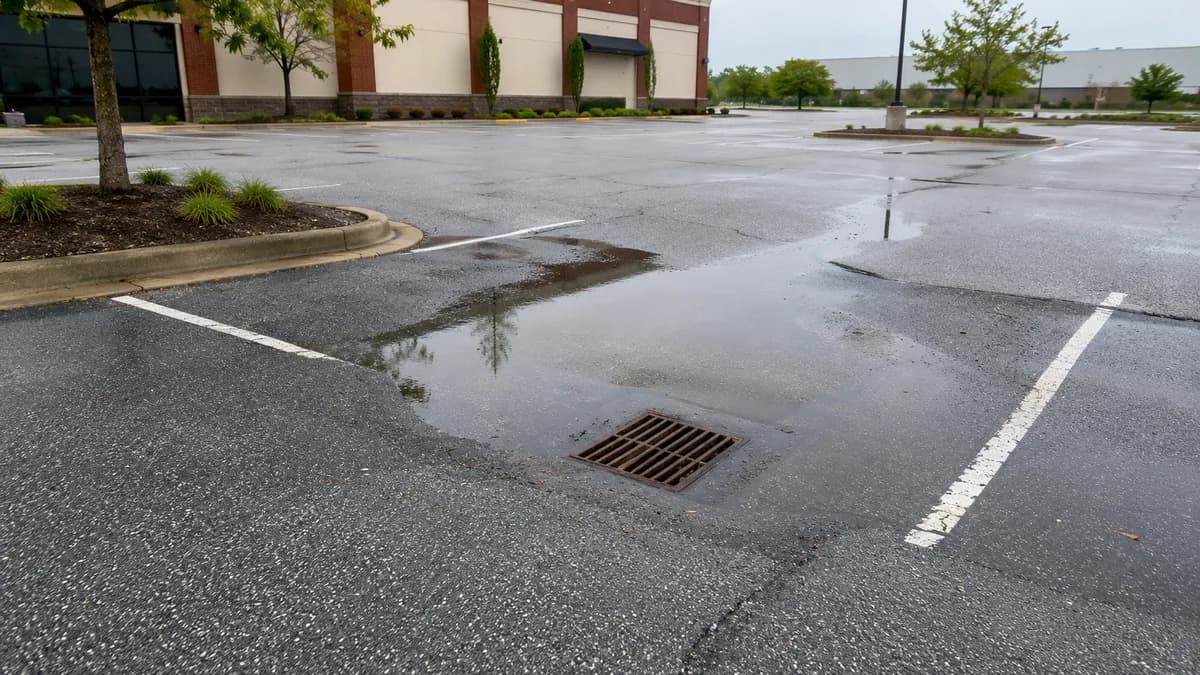
Asphalt ages, but age alone is rarely the whole explanation. Water enters open cracks, weakens the aggregate base, and leaves the surface unsupported. Heavy vehicles flex the weakened area. Small cracks connect, patches fail, potholes form, and repair costs climb.
Four causes account for most of it:
- Water and drainage. Standing water, blocked drains, low areas, and altered grades accelerate cracking and base failure.
- Deferred maintenance. Open cracks and isolated failures stay inexpensive only for a limited window. Delay lets water and traffic expand the problem.
- Heavy loads. Refuse trucks, deliveries, forklifts, and tight turning movements concentrate stress that passenger-vehicle pavement may not tolerate.
- Wrong treatment. Sealcoating structural failure, overlaying an unstable base, or repeatedly patching a drainage problem spends money without removing the cause.
The parking lot lifecycle
Knowing which stage a lot is in matters more than knowing its age. Two properties paved the same year can need very different work depending on drainage, construction quality, traffic, shade, utility cuts, and previous repairs.
| Stage | What it looks like | What the property should be doing |
|---|---|---|
| 1. New pavement (roughly 0–5 years) | Looks good; early settlement or utility-cut defects may be the only signs | Observe. Watch drainage, utility cuts, construction defects, and isolated cracks. New pavement should not be ignored because it looks fine. |
| 2. Preventive maintenance window | Oxidation and isolated cracking appear | Crack sealing and localized repairs give the best return here. This is the stage most properties skip because the lot still looks acceptable. |
| 3. Accelerated deterioration | Connected cracking, recurring potholes, depressions, water-related failures | The problem is moving below the surface. Options narrow and costs rise. Diagnose cause before selecting treatment. |
| 4. Structural failure | Widespread base failure, extensive alligator cracking, movement, repeated failed repairs | Overlays become risky. Reconstruction may be the better value. Price the decision, do not default to the cheaper scope. |
For the age-versus-condition framework behind these stages, see how long does asphalt last.
Routine inspection and the annual checklist
Inspect at least annually, and before sealcoating, restriping, reserve-study updates, board votes, and major bid requests. Photograph the same locations each year so the file shows change over time rather than a snapshot.
Ask a maintenance contractor how often they inspect, what they document, and whether you receive a written condition report after each visit. A walk that produces no record produces no leverage later.
- Open, connected, edge, reflective, and alligator cracking
- Potholes, loose aggregate, rutting, depressions, and soft areas
- Standing water, blocked catch basins, settlement, and sediment trails
- Failed utility trenches, patches, overlay edges, and drain surrounds
- Sidewalk displacement, broken curbs, curb ramps, and trip hazards
- Accessible stalls, access aisles, signs, slopes, drainage, and routes
- Faded striping, traffic flow, fire lanes, loading areas, and wheel stops
Use the pavement condition rating tool and a pavement assessment to turn a site walk into a documented condition record.
Crack sealing
Crack sealing uses flexible material to close active cracks and reduce water infiltration. It works best while cracks remain isolated and the surrounding pavement is structurally stable. It is preventive maintenance, not a cure for widespread alligator cracking.
Sequencing matters: crack sealing generally comes before sealcoating, and failed areas and drainage problems should be corrected first. See crack sealing vs sealcoating for the full sequence.
Sealcoating
Sealcoat protects healthy asphalt from oxidation, UV exposure, and surface wear, and improves appearance. It does not repair potholes, rebuild base, correct drainage, or restore structurally failed pavement.
The right question is whether the pavement is still worth preserving. Fuel islands, high-volume drive-throughs, severely alligatored lots, and properties with unresolved drainage are often poor sealcoat candidates. See when sealcoating is a waste of money and the sealcoat timing calculator.
Patching failed areas
Patching is effective when failure is localized: utility trench settlement, isolated potholes, drain failures, small alligatored areas, or individual base failures. A proper structural patch removes failed material, addresses unstable base, compacts the repair, and ties into sound pavement.
Repeated patching in the same location usually means the cause is still there. A pothole that returns after every patch is evidence, not bad luck. Compare patching against overlay and replacement in asphalt paving vs asphalt repair.
Drainage corrections
Drainage should be understood before any surface treatment is selected. Watch for water remaining after storms, algae growth, repeated potholes in low areas, drain inlets sitting high, settled trenches, and overlays that changed runoff patterns.
A new surface does not automatically correct grade. Sometimes the right scope includes drain adjustment, localized regrading, concrete drain skirts, valley gutters, or reconstruction of low areas. See parking lot drainage problems.
ADA considerations during maintenance
Pavement maintenance can create accessibility problems unintentionally. Overlay thickness can alter transitions. Restriping can reproduce a non-compliant layout. Drainage can be directed through an access aisle. Signs may no longer match the stalls they serve.
Paint follows grade. If the slope or the route is wrong, new blue paint does not make the condition compliant. Resurfacing and restriping are also generally treated as alterations that trigger current standards — see does resurfacing trigger ADA compliance and ADA parking requirements before paving or restriping accessible areas.
Escalation triggers: overlay vs reconstruction
An overlay can add useful life when the base is stable, drainage functions, structural failures are limited, and transitions can be managed. It becomes risky when movement, water, or widespread base failure remains underneath. Asphalt remembers what is beneath it: existing cracks and movement can reflect through new pavement.
Agree the escalation triggers with your contractor in advance — for example, alligator cracking spreading beyond a defined area, or ponding that recurs after drainage correction — and how that recommendation will be documented. A trigger nobody wrote down is a trigger nobody acts on.
How to budget for parking lot maintenance
A useful budget separates immediate safety and access concerns, near-term preventive maintenance, and capital rehabilitation. Avoid one undifferentiated "paving" line item — it hides both the urgency of the small work and the scale of the large work.
| Planning horizon | Typical work | Management goal |
|---|---|---|
| Immediate | Trip hazards, active potholes, access barriers, dangerous drainage | Reduce current risk |
| 1–3 years | Crack sealing, localized patches, drainage corrections, striping | Preserve remaining life |
| 3–7 years | Sealcoat where appropriate, larger repair phases, concrete work | Control lifecycle cost |
| 5–15 years | Overlay, mill-and-fill, major ADA work | Plan capital scope |
| Long term | Reconstruction and major base correction | Avoid emergency funding |
Many reserve studies separate routine maintenance from anticipated larger-scope repair, since they run on different timelines. Use the paving budget estimator for an early range and the maintenance planner to organize timing.
How to build a maintenance plan
A plan should connect current conditions to timing, responsibility, and budget. It should not be a generic schedule that says "sealcoat every three years" regardless of what the lot looks like.
- Start with a condition baseline. Create a dated map or photo log showing cracks, potholes, drainage problems, concrete defects, accessible routes, and previous patches. Record whether each observation looks cosmetic, preventive, safety-related, or structural. Do not declare a condition compliant or non-compliant unless it has been measured and reviewed by the appropriate professional.
- Separate causes from symptoms. A pothole is a symptom; the cause may be water, failed base, a poorly compacted utility trench, loading, or a weak patch edge. The plan should identify what needs diagnosis before it lists a treatment.
- Assign an urgency and a decision date. Every documented condition gets a category: immediate, current budget year, next budget cycle, or monitor. "Monitor" must include a date for the next review, or it becomes another word for ignore.
- Connect work to expected life. Ask how many useful years a proposed treatment is expected to provide under this property's actual use. A cheaper repair with a two-year life can cost more than a larger repair expected to last ten.
How property type changes the plan
The pavement principles are the same everywhere. The management constraints are not, and they usually control the phasing plan and therefore the price.
| Property type | What tends to control the plan |
|---|---|
| HOA and condo communities | Reserve-study alignment, homeowner communication, board approval, phased access, and a defensible explanation of why work is needed now and what delay would cost |
| Retail and office | Tenant access, customer circulation, appearance, delivery schedules, and business interruption. Cosmetic goals should not displace drainage, base repair, or accessibility work |
| Industrial facilities | Truck loading, turning, dock approaches, trailers, and forklifts. Passenger-vehicle assumptions are often inadequate in recurring heavy-load zones |
| Multifamily | Resident notice, towing risk, limited alternate parking, refuse pickup, emergency access, and accessible parking continuity |
How to scope maintenance work correctly
A clear scope describes areas, quantities, preparation, materials, thickness, exclusions, traffic control, accessibility responsibility, drainage, striping, cleanup, warranty, and expected service life. "Repair asphalt as needed" is not a scope, and "crack fill and sealcoat" is not enough to compare contractors.
- Define the work areas. Use marked plans, aerial images, measurements, or numbered repair areas. If one contractor prices the whole lot and another prices selected sections, the proposals are not comparable.
- Define preparation. For patches: removal depth, base correction, compaction, tack coat, asphalt thickness, edge treatment. For sealcoat: cleaning, oil-spot treatment, crack work, application method, number of coats, sand load, dilution, curing, and striping.
- Define ownership of ADA and drainage review. Do not assume the paving contractor is checking accessibility or redesigning drainage. The proposal should state who measures slopes, reviews routes and signs, sets drain elevations, and approves layout. Silence is not responsibility.
- Define acceptance and closeout. Before final payment, collect final quantities, approved changes, product information, warranties, photos, striping layout, and measurement records. Walk the site after rainfall when drainage work was in scope.
Once bids arrive, normalize them before comparing — see how to compare asphalt paving bids and the bid decoder.
Documentation that protects the property
Maintenance documentation preserves the reasoning behind decisions and lets the next manager, board, owner, consultant, or contractor understand what happened and why.
- Dated annual inspection photos and location notes
- Complaint, trip-hazard, drainage, and access records
- Contractor recommendations and professional reports
- Board minutes, owner direction, approvals, and deferrals
- Bid comparisons showing scope differences
- Temporary repairs with assigned follow-up dates
- Final construction photos, quantities, warranties, and invoices
The exposure is not only that a defect existed. It is that the property observed it, failed to assign a next step, and lost the record of why action was delayed.
Common maintenance mistakes
Most expensive parking lot outcomes trace back to one of these:
- Waiting for complaints. By the time users complain, preventive options are usually gone.
- Using appearance as the condition rating. Dark pavement can hide structural failure; faded pavement may still be structurally sound.
- Sealcoating on a calendar. Condition, use, preparation, and climate should determine timing.
- Ignoring recurring failures. A pothole that returns after every patch is evidence the cause was never addressed.
- Letting each bidder define the project. This produces incomparable prices and rewards omitted scope.
- Separating ADA, drainage, concrete, and asphalt. These systems meet at transitions, routes, drains, and grades.
- Deferring without a monitoring date. A conscious delay can be reasonable; an undocumented delay becomes unmanaged risk.
- Assuming the lowest initial price is the lowest cost. Useful life, disruption, recurring repair, and failure risk belong in the comparison.
When to bring in a pavement consultant
Independent assessment earns its cost when contractors recommend conflicting scopes, failures keep returning, drainage is unclear, ADA work is involved, the capital request is large, or a board needs a documented basis for its decision.
A consultant should help define conditions and a comparable scope *before* pricing, rather than simply collecting contractor proposals. See who provides commercial pavement assessments and browse pavement consultants.
A property manager's maintenance calendar
A workable annual rhythm for most commercial properties:
| When | What to do |
|---|---|
| After the wet season | Document ponding, drain performance, new cracks, potholes, and failed patches |
| Spring | Complete the annual inspection and prioritize drainage and structural repairs |
| Summer | Perform approved crack sealing, patching, paving, concrete, and striping work |
| Before budgeting | Update photos, condition ratings, remaining-life assumptions, and planning ranges |
| Before bids | Write one scope; confirm quantities, ADA responsibility, drainage, exclusions, and expected life |
| After construction | Photograph completed work, collect warranties, record quantities, schedule the next inspection |
Frequently asked questions
What does a parking lot maintenance plan typically include?
A recurring plan combines inspection with condition-based treatment: crack sealing while cracks are isolated, localized structural patching, drainage correction, sealcoating where the pavement is still a suitable candidate, and striping refresh. It also sets escalation triggers for moving to overlay or reconstruction, and a multi-year budget across those horizons.
How is a maintenance plan different from one-time repairs?
A maintenance plan is proactive and scheduled, aiming to catch issues while preventive options still exist. One-time repairs are reactive fixes to damage that has already developed. The financial difference is that preventive work is priced per crack; reactive work is priced per failed area.
What triggers a move from maintenance to repair or replacement?
Connected or widespread alligator cracking, potholes recurring in the same locations, ponding that persists after drainage correction, rutting and movement in loaded areas, and repeated failed repairs. Agree the specific triggers with your contractor in advance and require that the recommendation be documented.
How often should a parking lot be inspected?
At least annually, plus after severe weather and before sealcoating, restriping, reserve-study updates, board votes, or major bid requests. Photograph the same locations each time so the record shows change rather than a single snapshot.
Should an HOA budget for pavement maintenance separately from repairs?
Many reserve studies separate routine maintenance from anticipated larger-scope repair or replacement, since they occur on different timelines. Separating them also makes it easier for a board to see why one repair belongs ahead of another.
Does sealcoating count as maintenance if the lot is already cracking?
It depends on the type of cracking. Sealcoat over isolated surface cracking on structurally sound pavement is reasonable preventive maintenance. Sealcoat over widespread alligator cracking is cosmetic: it changes the colour of a structural failure without addressing it.
Author disclosure: Ryan Clark works in commercial asphalt paving in California, so he has a commercial interest in the work these guides describe. The Pavement Directory is independent, is not affiliated with his employer, does not feature or rank any contractor in exchange for content, and does not route leads from this page.
Before you hire: The Pavement Directory does not guarantee contractor performance, pricing, licensing, insurance, or availability. Business information may be submitted by contractors or gathered from public sources and should be independently verified before hiring. Always confirm licensing, insurance, references, scope of work, and written contract terms.
For property owners
Looking for a pavement contractor?
Use The Pavement Directory to search asphalt, concrete, sealcoating, striping, ADA access, and pavement maintenance contractors by service and location. Always verify license, insurance, references, and written scope before hiring.
Search contractorsFor contractors
Are you a pavement contractor?
Contractors can add or claim a company profile to help property owners find pavement professionals by service, location, and specialty.