
Eaton, Ohio
Based in Eaton, Ohio, Sowder Asphalt Sealcoating is a residential pavement contractor. Listed services include sealcoating and crack sealing. The listing reports 22 years in business.
State pavement directory
Ohio's pavement problem is moisture that never fully leaves. Winters here rarely stay cold — they cycle across freezing again and again, and each cycle works on water sitting in cracks and in the heavy clay soils that underlie much of the state. Add the manufacturing and distribution traffic that moves along the I-70, I-75, and I-71 corridors, and the pattern is consistent: pavement that was structurally marginal to begin with breaks down fast in spring.
This page lists pavement contractors serving Ohio cities and covers what actually matters: subgrade drainage on clay, freeze-thaw and salt damage, lake-effect snow in the northeast, and the fact that commercial paving in Ohio falls outside the state's trade licensing framework, which changes how you verify a contractor.
Before you hire: The Pavement Directory does not guarantee contractor performance, pricing, licensing, insurance, or availability. Business information may be submitted by contractors or gathered from public sources and should be independently verified before hiring. Always confirm licensing, insurance, references, scope of work, and written contract terms.
Directory listings

Eaton, Ohio
Based in Eaton, Ohio, Sowder Asphalt Sealcoating is a residential pavement contractor. Listed services include sealcoating and crack sealing. The listing reports 22 years in business.
Cincinnati, Ohio
ABCO Pavement Services LLC is a Cincinnati, Ohio-based contractor offering asphalt paving, concrete flatwork, sealcoating, crack sealing, drainage installation, and athletic surface construction. The company reports more than 50 years in business and serves commercial, industrial, institutional, and municipal clients across Ohio, Kentucky, and Indiana. It is also noted as a certified Dynaflex Tennis Court System installer for athletic surfaces like tennis courts and tracks.
Cleveland, Ohio
All Star Asphalt Inc provides asphalt paving, sealcoating, striping, patching, and repair services for both residential driveways and commercial parking lots. The company serves Cleveland, Ohio and nearby communities including Parma, Lakewood, Shaker Heights, Strongsville, Mentor, and Akron. It states it is licensed and insured and offers free, no-obligation estimates for local property owners.
Ravenna, Ohio
Paving contractor in Ravenna, OH offering Asphalt Paving, Sealcoating.
Niles, Ohio
Paving contractor in Niles, OH offering Asphalt Paving.
Eastlake, Ohio
The company provides asphalt paving, asphalt repair and maintenance, commercial concrete services, line striping, sealcoating, and surface treatments and coatings. Dagg's is licensed, bonded, and insured, and offers free estimates with written proposals within one business week. Payment is not due until the project is complete and meets customer expectations.
Wheelersburg, Ohio
Paving contractor in Wheelersburg, OH offering Asphalt Paving, Sealcoating.
Columbus, Ohio
Jet-Seal offers driveway sealcoating and crack filling services for asphalt driveways. The company is rated A+ by the Better Business Bureau, Google, and Angie's List according to their website. Customer reviews indicate they primarily serve commercial and residential driveway sealing, though one review notes they were not accepting residential driveway work at the time of that inquiry.
Republic, Ohio
Paving contractor in Republic, OH offering Asphalt Paving, Parking Lot Striping.
Twinsburg, Ohio
Paving contractor in Twinsburg, OH offering Asphalt Paving.
Reynoldsburg, Ohio
The company offers asphalt paving, concrete work, excavation, sealcoat, catch basin repair, and chip-and-seal services for both residential and commercial properties. Founded in 1999 and family-owned, Neff Paving is ODOT certified, fully insured and bonded, and HSE certified. The company serves over two-thirds of Ohio with projects including parking lots, roads, driveways, sidewalks, and curbs.

Cleveland, Ohio
North Coast Paving Co is a family-owned contractor based in Northeast Ohio that has operated since 1982. The company performs asphalt paving, site preparation, sealcoating, line striping, and concrete work such as sidewalks, curbs, and gutters for both residential and commercial properties. It is licensed and insured, holds SBE certification, and serves multiple counties including Cuyahoga, Lake, and Summit.
Niles, Ohio
Paving contractor in Niles, OH offering Asphalt Paving.

Cleveland, Ohio
Pavement Maintenance Specialties is a Cleveland, Ohio contractor offering asphalt paving, concrete flatwork, and pavement maintenance services including crack sealing, sealcoating, and line striping. The company serves both commercial and residential clients throughout Northeast Ohio, handling projects from driveway overlays to full parking lot construction, including drainage and sub-base work. It is a member of the Northern Ohio Apartment Association and assists clients with permitting and inspection processes for larger paving projects.
Delaware, Ohio
The company offers asphalt and concrete services including paving, repair, sealcoating, and polishing. Additional services include landscaping maintenance, snow plowing, power washing, commercial cleaning, and specialty construction projects. The company states it is a local, family-owned business certified by OSHA that serves schools, residential homes, municipalities, industrial parks, shopping centers, and other property types.

Cleveland, Ohio
Protect-A-Cote is a Cleveland, Ohio-based paving contractor offering asphalt paving, sealcoating, crack sealing, milling, and pavement repair for commercial, municipal, and residential properties. The company also performs sport court construction, excavation and grading, drainage, curbing, and line striping using its own equipment fleet. Founded in 1982, the family-owned business states it is fully licensed, bonded, and insured and has completed over 125,000 projects.
Van Wert, Ohio
Summer Sealers offers asphalt sealcoating to protect pavement from UV rays, water, and oxidation. The company also provides line striping for parking lots and fire lanes, crack filling with hot-applied treatment, interior epoxy coatings for garage floors and warehouses, polished concrete floors, and additional services including pothole repair and asphalt patching. The company reports completing over 500 projects annually and serves Van Wert County and surrounding Midwest communities.
Sandusky, Ohio
The company offers paving services including commercial paving, industrial paving, parking lot paving, driveways, and paving repairs. Asphalt services include asphalt paving, resurfacing, sealcoating, repair, and chip sealing. The company states it has three generations of experience and operates with a team equipped with tools, materials, and trained crew.
Cincinnati, Ohio
Tri-State Sealcoating provides asphalt sealcoating, hot rubberized crack filling, line striping, and asphalt patching for both residential and commercial properties. The company serves the greater Cincinnati area, Butler County, Northern Kentucky, and Southeastern Indiana, working with homeowners, businesses, and property managers on driveways and parking lots. It also offers related services such as power washing to help maintain property appearance and pavement longevity.
Cincinnati, Ohio
Wood Fundi Paving LLC is a full-service asphalt and concrete paving contractor based in Cincinnati, Ohio, with over 24 years of experience. The company handles new paving, resurfacing, seal coating, striping, and repair for parking lots, driveways, and walkways, as well as concrete work such as patios, sidewalks, curbs, and retaining walls. Clients include hospitals, churches, shopping centers, office parks, and municipal facilities across the Tri-State area.
Hebron, Ohio
The company offers asphalt paving installation, removals, replacements, overlays, resurfacing, pothole repairs, crack filling, infrared repairs, edge grinding, patching, parking lot services, driveway sealing, curb construction, speed bumps, site clearing, excavating, grading, drainage solutions, and snow removal. They serve customers throughout central Ohio and surrounding counties. The company is locally operated, insured, and a member of the Better Business Bureau.
Ohio pavement is undone by water that stays in the structure through a winter that freezes and thaws dozens of times.
Regional differences
Ohio does not have one climate or one soil profile, and pavement that performs well in one part of the state can fail early a few hours away. These are the divisions that matter most when scoping paving, repair, or maintenance work.
Environmental stress
Subgrade conditions
Common distress
What it means for the work
Environmental stress
Subgrade conditions
Common distress
What it means for the work
Environmental stress
Subgrade conditions
Common distress
What it means for the work
Environmental stress
Subgrade conditions
Common distress
What it means for the work
Field conditions
Alligator cracking and potholes concentrated in the low areas of a lot, pavement flexing underfoot after wet weather, and repairs that fail in the same places repeatedly.
Likely causes
When to get it looked at: Repeat failure in the same low areas is a drainage problem, not a surface one. Ask whether the base was dry when the last repair was placed.
Potholes forming quickly over a few weeks in late winter and early spring, frequently where there were only cracks the previous fall.
Likely causes
When to get it looked at: If potholes appear where there were only cracks last fall, the cracks stayed open all winter. Fall sealing is the fix, and it is a scheduling decision.
Sidewalks, curbs, and dock aprons scaling, flaking, and spalling at joints, deteriorating faster than the asphalt beside them.
Likely causes
When to get it looked at: Scaling across large areas or spalling that exposes reinforcement is past the point where sealers help, and on walkways it becomes a trip-hazard question.
Deep wheel paths and shoving at dock approaches, truck courts, and turning areas around Columbus, Cincinnati, and northwest Ohio distribution facilities.
Likely causes
When to get it looked at: Rutting concentrated at docks and turns is a structural question. Ask what the section actually is before agreeing to a mill-and-fill that is likely to repeat.
Pavement cracking, tilting, or dropping on sloped parcels, particularly in the hilly terrain around Cincinnati and the southeastern part of the state.
Likely causes
When to get it looked at: Pavement distress that progresses downhill, or cracks that open and step, is a slope question rather than a paving one. That warrants a geotechnical look before repaving.
Timing
Treat this as a planning aid, not a rule. Whether a given treatment can actually be placed on a given day depends on product requirements, surface and nighttime temperatures, the rain forecast, humidity, plant availability, the project specification, and the contractor’s means and methods.
Work often suited to this window
Scheduling risks
Inspect for: Note where plows catch edges, where snow is stored, and where meltwater refreezes into hazards.
Regional exception: Northeast Ohio's lake-effect snowfall is substantially higher than Cincinnati's — the snow operations budget and the pavement wear both reflect that.
Work often suited to this window
Scheduling risks
Inspect for: Map the winter's damage and separate surface distress from base failure before pricing repairs.
Work often suited to this window
Scheduling risks
Inspect for: Walk truck courts and dock areas during the hottest weeks looking for rutting and shoving.
Work often suited to this window
Scheduling risks
Inspect for: Confirm cracks are sealed and drainage is clear before freeze-up — open cracks are next spring's potholes.
Verification
Ohio licenses specific commercial trades — electrical, plumbing, HVAC, hydronics, and refrigeration — through the Ohio Construction Industry Licensing Board. Paving, sealcoating, and general parking lot work are not among the licensed trades, so there is generally no state license number to verify on an Ohio paving proposal.
Many Ohio municipalities do require contractor registration for work within their jurisdiction, and requirements differ between them. Ask the building department for the city or township where your property sits what registration or permits apply, and confirm the contractor has them.
With no state paving license, entity and insurance verification carry more weight. Confirm the exact entity name through the Secretary of State's business search and match it to the contract and the insurance certificate. Ask for a certificate of insurance sent directly from the carrier or agent, covering general liability and workers' compensation for your project dates.
Public projects in Ohio carry their own bonding and, where applicable, prevailing wage requirements. Those apply to school district, municipal, and other public properties rather than to a private commercial lot.
Because Ohio does not license paving, a contractor cannot be 'state licensed' for this work. References from Ohio properties that have been through several winters and a clear written scope do more than any license claim.
Ask for a certificate of insurance sent directly from the carrier or agent rather than a copy forwarded by the contractor, confirm the general liability and workers’ compensation coverage is active on the dates of your work, and ask to be named as certificate holder so you are notified if the policy lapses.
Licensing requirements can turn on project value, scope of work, property location, and whether the job is public or private. City and county rules may add registration, permitting, or bonding requirements beyond anything required at the state level. Verify current requirements with the agency directly before contracting.
Last reviewed:
Permitting
Ohio Environmental Protection Agency (Ohio EPA)
Ohio administers construction stormwater permitting through the Ohio Environmental Protection Agency. Construction that disturbs enough ground generally requires coverage under the state's construction general permit, with a stormwater pollution prevention plan and erosion and sediment controls in place during the work.
Local requirements often govern more of a paving project than the state permit does. Ohio counties and municipalities administer their own stormwater, detention, and floodplain rules, and many operate under municipal separate storm sewer system programs with post-construction requirements tied to how much impervious area a project creates or redevelops. A full lot reconstruction can trigger review that a mill-and-overlay of the same lot would not.
Ohio also has a substantial history of underground mining in the southeastern part of the state and abandoned wells in various areas. For major reconstruction in those regions, it is worth confirming what is known about the subsurface before committing to a design.
County and municipal stormwater requirements in Ohio vary and can exceed state minimums. Confirm with the local authority before design.
Last reviewed:
Plain English
| Term | What it means on a Ohio project |
|---|---|
| Item 441 / asphalt concrete | Ohio specifications identify asphalt mixes by item number and type. Local suppliers use the same vocabulary, and it is reasonable to ask which mix a proposal includes for truck areas. |
| Aggregate base (Item 304) | The dense-graded crushed aggregate base commonly specified in Ohio. Its compaction and drainage quality usually determine pavement life more than the asphalt above it. |
| Stabilized subgrade | Treating clay subgrade with lime, cement, or a similar agent to reduce moisture sensitivity. Worth asking about on clay-heavy Ohio sites carrying truck traffic. |
| Air-entrained concrete | Concrete with microscopic air voids that give freezing water somewhere to expand. Standard for exterior concrete in Ohio and a real factor in whether a walk or apron scales under salt. |
| Underdrain | A perforated pipe in stone that gives water trapped in the pavement structure a path out. On Ohio clay this can matter more than adding thickness. |
| Full-depth reclamation (FDR) | Pulverizing existing asphalt and base together, treating the blend, and repaving over it. Useful where the base has failed and hauling everything off is impractical. |
State transportation specifications can provide useful regional terminology and material references, but they do not automatically govern private parking-lot or driveway projects unless incorporated into the contract or required by the applicable jurisdiction.
More definitions are in the pavement glossary.
Property types
Central Ohio's logistics growth puts heavy truck courts on clay subgrade, and those areas fail years before the parking fields do.
Continuous heavy equipment and truck movement in a severe freeze-thaw climate, with yard pavement rarely built for the actual loads.
Continuous access requirements and pedestrian safety make concrete deterioration and trip hazards a higher priority than surface appearance.
Large lots on poorly draining clay develop drainage-driven cracking, and phasing around continuous operation drives the schedule.
Northwest Ohio facilities take very heavy loading concentrated into a few harvest weeks on flat sites with limited drainage.
Before you sign
No. Ohio licenses specific commercial trades — electrical, plumbing, HVAC, hydronics, and refrigeration — through the Ohio Construction Industry Licensing Board, but paving, sealcoating, and parking lot work are not among them. There is generally no state license to verify. Many Ohio municipalities do require contractor registration for work in their jurisdiction, so ask the local building department what applies, and lean on entity, insurance, and reference checks.
Ohio winters cycle across freezing repeatedly rather than staying cold. Water in unsealed cracks freezes, expands, and pries them wider through dozens of cycles, while meltwater sits in the base above still-frozen subgrade and takes away support. Heavy clay soils across much of the state keep that water in the structure instead of draining it. When traffic hits a weakened area with widened cracks, the surface breaks out quickly — which is why fall crack sealing does more here than any spring repair program.
Because it usually carries a different load on the same pavement section. Distribution and manufacturing facilities often build the truck court to the same design as the parking field, but slow, heavy, channelized truck movement imposes far more stress — and on clay subgrade that has lost strength to moisture, it fails quickly. Building dock and yard areas to a heavier section than the parking field is generally more economical than resurfacing everything on a short cycle.
The snowbelt east of Cleveland receives lake-effect snowfall well above what Columbus or Cincinnati see, which means more plowing, more salt, and more meltwater working into the pavement over a season. Practically, that raises the value of durable striping materials, makes snow storage location a design decision, and means concrete surfaces there need more attention than the same surfaces in southwest Ohio would.
Southwest Ohio's hilly terrain includes slopes that are genuinely marginal in clay and colluvial soils, and water infiltrating a slope adds both weight and lubrication. Pavement distress that progresses downhill, or cracks that open and step vertically, points to slope movement rather than to a pavement defect. Repaving over active slope movement does not last — that condition warrants a geotechnical evaluation before any significant investment.
An underdrain is a perforated pipe in stone placed within or beside the pavement structure to give trapped water a path out. On Ohio's heavy clay soils, where water that enters the base has nowhere to go, an underdrain can do more for pavement life than adding asphalt thickness. Whether it makes sense depends on your grades, where water can be discharged, and how the site currently drains — which is a question worth asking directly.
Fall, before the first hard freeze, is the highest-return window. Cracks are open enough to fill, temperatures are still workable, and sealing them keeps water out of the structure through the winter when repeated freezing does the damage. Because crack sealing crews book out through the fall and night temperatures close the window earlier than most owners expect, scheduling well ahead makes a practical difference.
Local coverage
Explore by location
Property-owner guide
Updated July 11, 2026
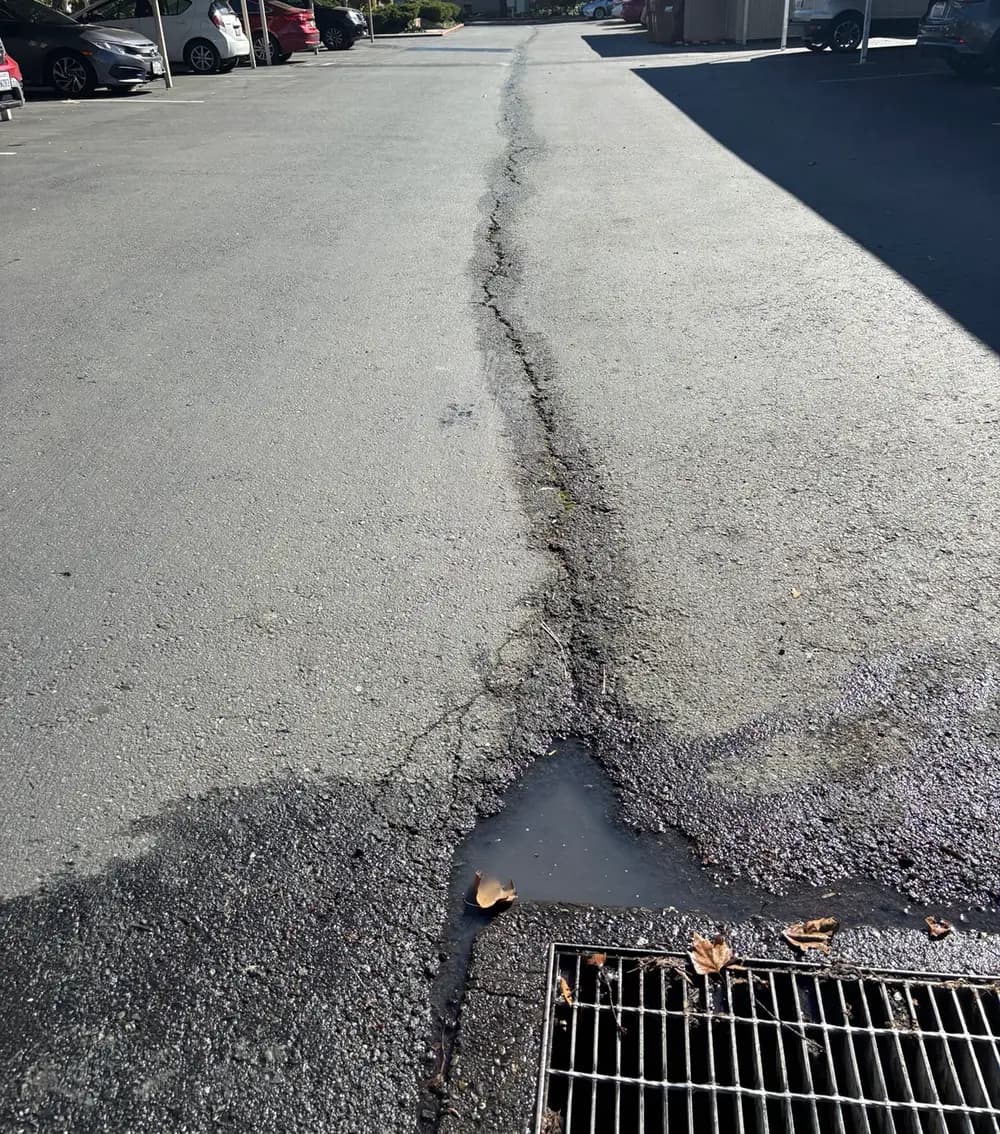
When to seal cracks in asphalt — which cracks to seal, the best time of year, why sealing early matters, and how crack sealing fits a maintenance schedule.
Property-owner guide
Updated July 12, 2026
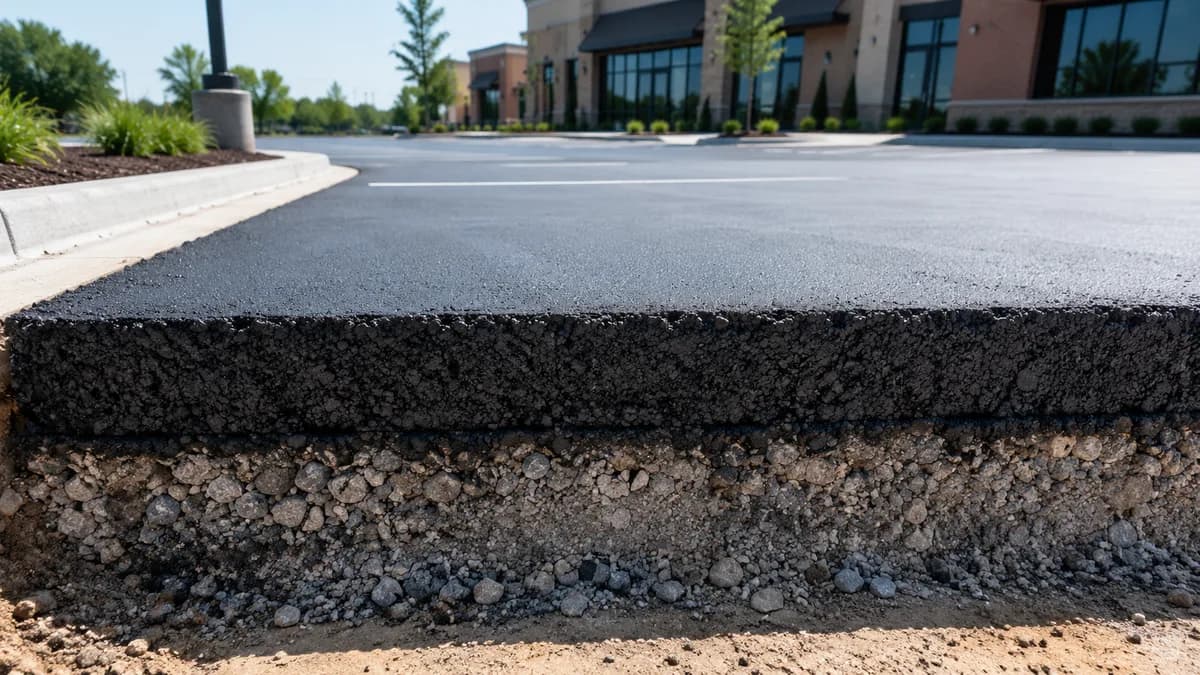
Why drainage is the biggest factor in how long pavement lasts, how water damages asphalt from the base up, and why fixing it protects every repair.
Property-owner guide
Updated July 6, 2026
Typical asphalt paving thickness for parking lots: benchmarks for stalls, drive lanes, and truck areas, plus how base and soil change the answer.

Property-owner guide
Updated July 11, 2026
Why concrete cracks — shrinkage, settlement, freeze-thaw, roots, and loads — the difference between cosmetic and structural, and when to repair.
Property-owner guide
Updated July 11, 2026
How to build a parking lot maintenance plan: inspecting condition, setting service cycles, prioritizing repairs, and budgeting over multiple years.
Official sources
Contractor licensing
Ohio eLicense verificationVerify licenses for the trades Ohio does regulate; paving contractors are not licensed by the state.
Business registration
Ohio Secretary of State business searchConfirm the contracting entity is registered and in good standing in Ohio.
Environmental
Ohio EPA construction stormwaterConstruction general permit requirements and stormwater guidance.
Transportation
Ohio Department of TransportationState specifications and materials terminology used by Ohio suppliers.
Consumer protection
Ohio Attorney General consumer protectionWhere to file a complaint about a contractor or business practice.
This page summarizes publicly available information for general education. It is not legal, engineering, or code-compliance advice, and requirements change. Confirm anything that affects your project with the agency with jurisdiction over the property.
Regulatory content last reviewed:
For contractors
Get listed where property managers, owners, and facility teams search by state, city, and service.