
Nebraska pavement guide
Pavement Conditions in Nebraska: Regions, Soils, and Common Problems
Nebraska pavement is defined by loess that can collapse when it first gets wet, sand that will not confine an edge, and truck loading that arrives all year rather than at harvest.
- 5 regions
- 5 common problems
- 7 local terms
Jump to section
Regional differences
Pavement Conditions by Region in Nebraska
Nebraska does not have one climate or one soil profile, and pavement that performs well in one part of the state can fail early a few hours away. These are the divisions that matter most when scoping paving, repair, or maintenance work.
Eastern Nebraska and the Missouri River bluffs
Omaha · Lincoln · Bellevue · Papillion · Nebraska City
Environmental stress
- The state's heaviest commercial traffic and largest commercial lots
- Substantial freeze-thaw cycling with sustained winter deicing
- Intense summer thunderstorms delivering high rainfall in short events
Subgrade conditions
- Very deep windblown loess, in places tens of feet thick
- Loess that can be collapsible when wetted under load in its natural state
- Glacial till beneath the loess in parts of the region
Common distress
- Sudden localized settlement with no preceding crack pattern
- Deep gullying where concentrated runoff reaches unprotected loess
- Concrete joint deterioration and scaling on heavily salted surfaces
What it means for the work
- Proof rolling and moisture conditioning of loess subgrade matter more here than surface thickness does
- An unprotected outfall in loess can cut a substantial gully in a single storm
- This is the deepest contractor and supplier market in the state
The Platte Valley and central Nebraska
Grand Island · Kearney · Columbus · Fremont · Hastings
Environmental stress
- Heavy year-round truck traffic serving agriculture, ethanol, and rail
- Wide annual temperature range from severe cold to high summer heat
- Intense convective rainfall on flat terrain with limited natural fall
Subgrade conditions
- Alluvial sand and gravel along the Platte with good bearing where present
- Loess and silty soils on the terraces above the valley floor
- High water table on low parcels near the river
Common distress
- Rutting and shoving at scale approaches, plant entrances, and turning areas
- Ponding on flat sites where no positive fall was established
- Freeze-thaw potholing where water has reached the base
What it means for the work
- Ethanol and processing plant traffic is a genuine design load rather than incidental
- Alluvial gravel and loess terrace soils sit close together and need different assumptions
- Flat sites need designed positive drainage, not a minimum slope satisfied on paper
The Sand Hills
Valentine · Ainsworth · Broken Bow · Thedford · Mullen
Environmental stress
- Severe wind with blowing sand and drifting snow
- Very long distances between commercial centers and material sources
- Wide temperature range with deep winter frost
Subgrade conditions
- Stabilized dune sand with excellent drainage and almost no cohesion
- A high water table in the interdunal valleys, sometimes at or near the surface
- Very limited local aggregate sources
Common distress
- Edge break-up and ravel where pavement is unconfined
- Sand infiltration and surface abrasion in exposed locations
- Settlement where a section crosses from dune sand into a wet interdunal area
What it means for the work
- Edge confinement is the controlling design decision on sand, more than base thickness
- Haul distance is frequently what determines whether a project is feasible in a given season
- The high water table in valleys between dunes limits how deep a section can be built
The Panhandle and the High Plains
Scottsbluff · Gering · Sidney · Alliance · Chadron
Environmental stress
- A semi-arid climate with strong ultraviolet exposure and large daily temperature swings
- Cold winters with deep frost penetration
- Wind carrying dust and drifting snow across exposed sites
Subgrade conditions
- Silty and clayey soils over sandstone and siltstone bedrock
- Irrigated agricultural ground in the North Platte valley with applied water year after year
- Alkali and sulfate-bearing soils in some locations
Common distress
- Block and thermal cracking from a very wide temperature range
- Binder oxidation and raveling under sustained ultraviolet exposure
- Base saturation near irrigated ground and canal systems
What it means for the work
- Sulfate exposure is worth testing before specifying concrete rather than assuming
- Sugar beet, potato, and cattle traffic concentrates at specific facilities and seasons
- Distance to a plant affects both cost and shoulder-season feasibility
Southeast Nebraska and the Republican basin
Beatrice · McCook · Falls City · Auburn · Red Cloud
Environmental stress
- Freeze-thaw cycling with frequent winter crossings of freezing
- Intense summer storms producing rapid runoff on rolling terrain
- Agricultural truck traffic concentrated into harvest periods
Subgrade conditions
- Loess over glacial till, with clays that hold water at shallow depth
- Rolling terrain concentrating runoff onto lower parcels
- Poorly drained flats where water perches above a clay layer
Common distress
- Pavement flexing where water perches above a clay layer beneath the base
- Late-winter potholing along crack lines opened over the season
- Erosion at outfalls where runoff leaves a sloped site
What it means for the work
- Perched water above a clay layer is a subsurface drainage problem, not a grading one
- Harvest loading arrives in bursts and concentrates at elevator entrances
- Smaller markets here have less local plant capacity and longer lead times
Field conditions
Common Pavement Problems in Nebraska
Collapsible loess settlement
A localized area of an otherwise sound lot drops noticeably over a short period after a wet spell, with little or no crack pattern leading up to it and no relationship to where traffic goes.
Likely causes
- Deep loess in its natural low-density state losing strength when thoroughly wetted under load
- A leaking water or irrigation line providing a sustained source of water
- Downspouts, a failed inlet, or ponding delivering water to one location repeatedly
- Subgrade placed without proof rolling or moisture conditioning during construction
When to get it looked at: Sudden settlement without preceding cracking is a soil behavior rather than a pavement failure. Find and stop the water source before filling the depression, or it will settle again.
Loess erosion and gullying at outfalls
A gully appearing at a discharge point or along a pavement edge after a single intense storm, sometimes deep enough to undermine the pavement structure.
Likely causes
- Loess eroding rapidly once concentrated flow reaches it
- No armoring or energy dissipation at the discharge point
- Rolling terrain shortening the distance runoff has to gather speed
- Storm intensity exceeding what the drainage design accounted for
When to get it looked at: If a gully has formed once at the same outfall, it will form again. Rebuilding it without changing the discharge is buying the same repair on the storm cycle's schedule.
Unconfined edge failure on sandy subgrade
The perimeter of a Sand Hills or Platte valley lot cracks parallel to the edge, drops, and ravels away while the interior of the pavement remains serviceable.
Likely causes
- Sand giving very little lateral support at an unconfined pavement edge
- No curb, thickened edge, or compacted stabilized shoulder
- Vehicles routinely tracking the perimeter, particularly wide-turning trucks
- Wind and runoff removing the material supporting the edge
When to get it looked at: When the same edge has been patched twice, the fix is confinement rather than more asphalt in the same location.
Year-round heavy truck loading at agricultural facilities
Scale approaches, plant entrances, and turning radii breaking up while the adjacent parking areas remain intact, with the damage progressing steadily rather than seasonally.
Likely causes
- Feedlot, ethanol, and processing traffic running continuously rather than at harvest
- Loaded trucks imposing axle loads far beyond the parking lot's design assumption
- Slow, channelized movements repeatedly over the same wheel paths
- Unpaved shoulders giving way under wide turns
When to get it looked at: Damage concentrated where trucks turn, queue, or stop is a section and loading question. Those areas usually need a heavier design than the parking field, and often a different material.
Applied irrigation water in the subgrade
Soft areas and alligator cracking near irrigated ground, canals, or landscaping, worst during the irrigation season rather than after storms.
Likely causes
- Center-pivot overspray and canal seepage raising the water table beneath adjacent pavement
- Landscape irrigation applying water directly at the pavement edge
- A section built without a subdrain in a setting where applied water is continuous
- Historic field drainage patterns interrupted by the site's construction
When to get it looked at: If the softness tracks the irrigation calendar rather than the weather, the water is applied rather than natural, and irrigation or subdrainage changes will do more than resurfacing.
Property types
Common Pavement Projects in Nebraska
Ethanol plants and grain processing facilities
Continuous loaded truck traffic year-round means these sites never get a quiet season, so work has to be phased around operations and the section at entrances designed for the actual loading.
Feedlots and livestock facilities
Cattle transport and feed delivery run steadily rather than seasonally, and the combination of heavy loading and constant moisture at approaches makes those areas the first to fail.
Omaha and Lincoln commercial and institutional properties
Large lots over deep loess where sudden settlement, deicing damage to concrete, and constrained phasing on occupied sites are the recurring issues rather than material selection.
Rail-served industrial and distribution facilities
Platte valley sites combine heavy truck movements with pavement that meets rail infrastructure, and the transitions between the two are where failures concentrate.
Sand Hills ranch and community properties
Long hauls, limited local materials, and sand subgrade with no cohesion make edge confinement and logistics the two variables that determine whether a project succeeds.
Plain English
Pavement Terms You May Encounter in Nebraska
| Term | What it means on a Nebraska project |
|---|---|
| Collapsible loess | Windblown silt that holds a low-density open structure in its natural state and can lose strength abruptly when thoroughly wetted under load. It produces sudden settlement without the crack pattern that normally precedes a pavement failure. |
| Proof rolling | Driving a loaded vehicle over prepared subgrade to find soft areas before anything is built on top. On loess it is one of the more valuable line items on a proposal and one of the easiest to leave out. |
| Moisture conditioning | Adjusting subgrade moisture content before compaction so the soil is compacted at a density and moisture level that will not change dramatically later. On collapsible loess it is central rather than optional. |
| Aggregate base course | The compacted stone layer beneath the asphalt. In much of Nebraska it is hauled some distance, and its thickness and quality usually decide pavement life more than the surface course does. |
| Thickened edge | Increasing pavement depth at an unconfined perimeter so the edge can carry load without curb. On sandy subgrade it is frequently the difference between an edge that holds and one that ravels away. |
| Natural Resources District | Nebraska's watershed-based local government bodies managing groundwater, surface water, and drainage. They can have requirements affecting a project that neither the city nor the county administers. |
| Portland cement concrete pavement | Concrete pavement, used widely in Nebraska for heavy-duty commercial and truck areas. Its performance depends heavily on joint spacing and joint maintenance, which are frequently neglected until deterioration is visible. |
State transportation specifications can provide useful regional terminology and material references, but they do not automatically govern private parking-lot or driveway projects unless incorporated into the contract or required by the applicable jurisdiction.
More definitions are in the pavement glossary.
Before you sign
Questions to Ask a Paving Contractor in Nebraska
- What is your Nebraska contractor registration number, and does the registered name match the entity on this contract?
- Is proof rolling and moisture conditioning of the subgrade included in this scope?
- Has anyone identified whether the loess under this site is collapsible, and how would you find out?
- Where is water reaching the area that settled, and does this scope address the source?
- How will the pavement edge be confined here — curb, thickened edge, or stabilized shoulder?
- What is being done to armor or dissipate energy at the outfall?
- Does the proposed section reflect the truck traffic this facility actually receives year-round?
- Does this project need to involve the Natural Resources District as well as the city or county?
- Is there irrigation or a canal near this site that puts applied water into the subgrade?
- Should the heavy truck areas here be concrete rather than asphalt, and why or why not?
Nebraska pavement condition FAQs
Why did part of my Nebraska parking lot suddenly drop with no cracking first?
That pattern is characteristic of collapsible loess. Deep windblown silt across eastern Nebraska holds a low-density open structure in its natural state, and when it is thoroughly wetted while carrying a load, that structure can collapse and the ground settles quickly. Because the mechanism is a soil behavior rather than a gradual pavement failure, there is often no crack pattern warning of it. The productive response is finding and stopping the water source — frequently a leaking line, a failed inlet, or persistent ponding — before the depression is filled.
Why did a gully appear at my outfall after one storm?
Because loess erodes extraordinarily quickly once concentrated flow reaches it. The soil is fine, deep, and windblown, which makes it excellent farmland and very poor at resisting moving water. A discharge point without armoring or energy dissipation can cut a substantial gully in a single intense storm, and a gully near a pavement edge becomes undermining shortly afterward. Rebuilding the gully without changing the discharge produces the same result the next time a comparable storm arrives.
Why do the edges of my Sand Hills lot break away?
Because stabilized dune sand drains beautifully and supports essentially nothing laterally. At an unconfined edge there is very little holding the asphalt when a vehicle runs the perimeter, and wind and runoff steadily remove the material supporting it. The failure works inward while the middle of the lot stays serviceable. Curb, a thickened edge, or a properly compacted stabilized shoulder addresses the cause. Patching the same strip repeatedly does not.
Why does the entrance at my Nebraska feedlot or ethanol plant fail before the rest of the site?
Because it carries entirely different loading, and unlike a grain elevator it never gets a quiet season. Loaded cattle trucks, feed deliveries, and ethanol shipments run year-round, imposing axle loads far beyond what a lot designed for employee parking can take, and the damage concentrates where those trucks turn, queue, and stop. Those areas usually need a heavier section and, in many cases, concrete rather than asphalt — the parking field's design is simply the wrong reference for them.
Does irrigation affect pavement in Nebraska?
Yes, and it operates on a schedule rainfall totals will not predict. Center-pivot overspray, canal and lateral seepage, and landscape irrigation apply water to the ground through a season when natural precipitation may be modest, and that water can reach the subgrade beneath adjacent pavement. The tell is timing: if soft areas correspond to the irrigation calendar rather than to storms, the source is applied water, and a subdrain or an irrigation change accomplishes more than resurfacing will.
Should heavy truck areas in Nebraska be concrete instead of asphalt?
It is a legitimate question at facilities with concentrated, slow-moving, year-round truck loading, and concrete is used widely in the state for exactly those areas. Concrete resists the shoving and rutting that slow heavy movements produce, and it tolerates the standing loads at scales and docks better. The trade-off is higher initial cost and a maintenance obligation that shifts to joints. What it does not fix is a weak or moisture-sensitive subgrade underneath — that has to be addressed either way.
Related reading for Nebraska property owners
Property-owner guide
Updated July 12, 2026
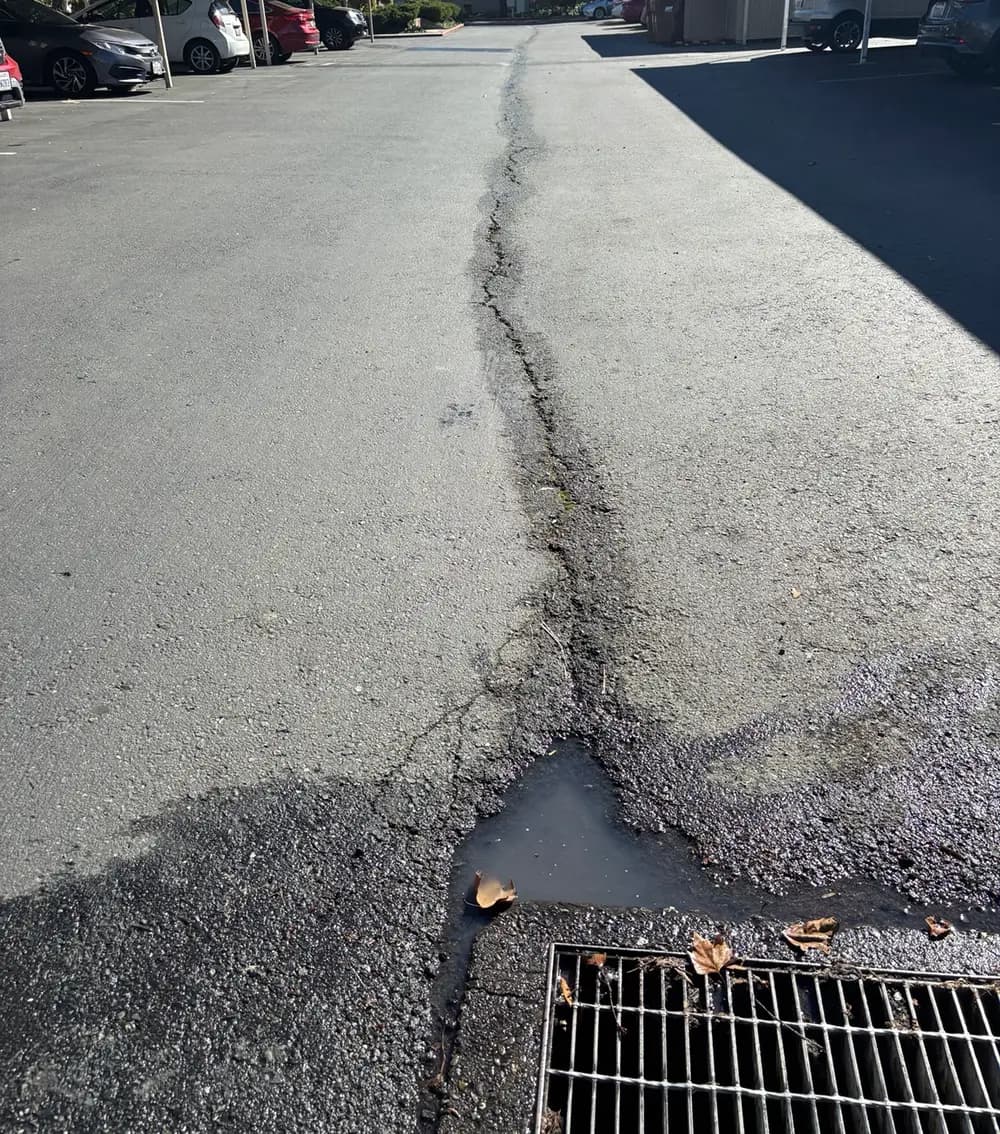
How Drainage Affects Pavement Life
Why drainage is the biggest factor in how long pavement lasts, how water damages asphalt from the base up, and why fixing it protects every repair.
Property-owner guide
Updated July 12, 2026
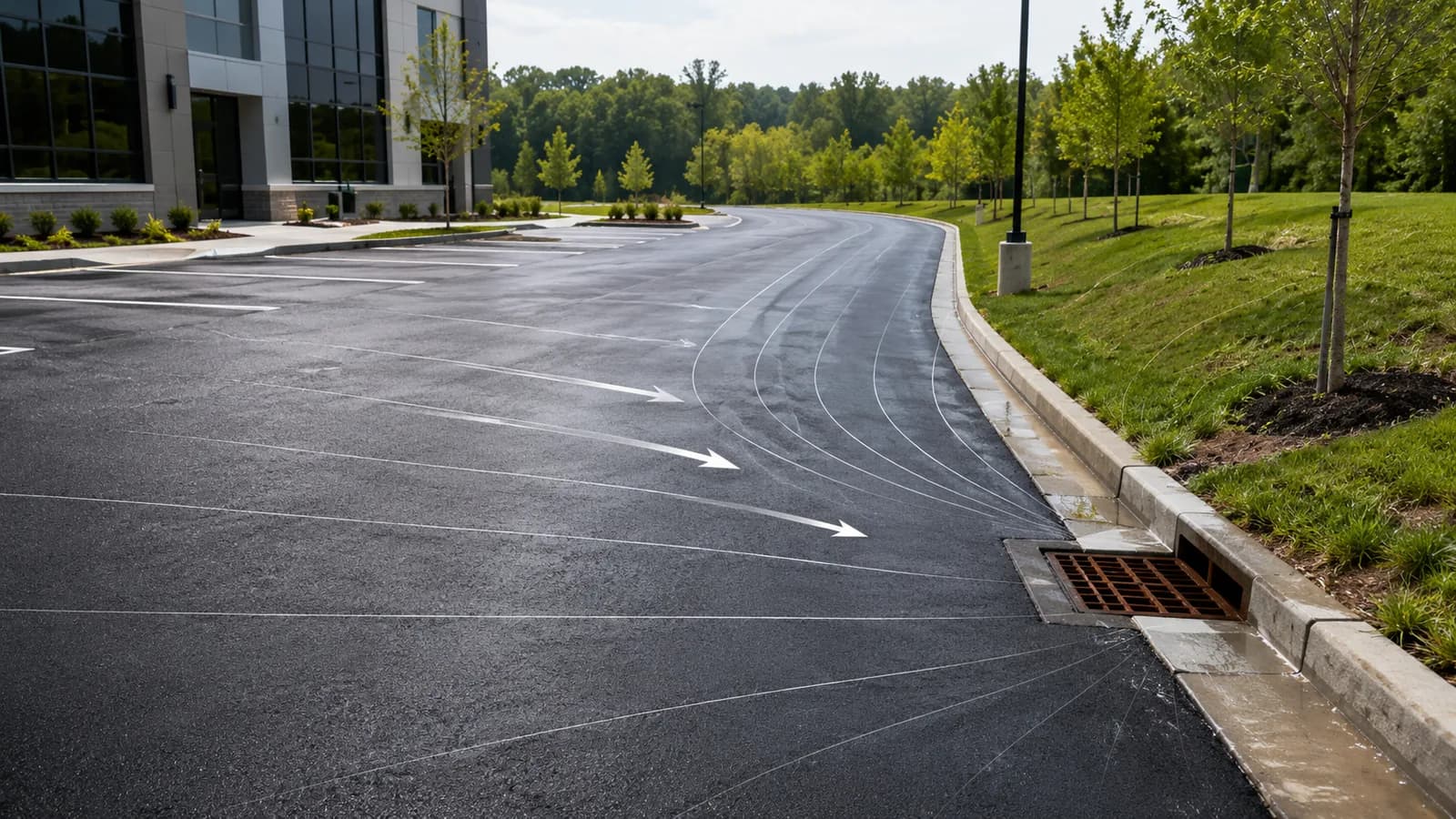
Grading and Slope Basics for Pavement
Grading and slope basics for pavement: what positive drainage means, why slope matters, common grading problems, and where engineering comes in.
Property-owner guide
Updated July 6, 2026
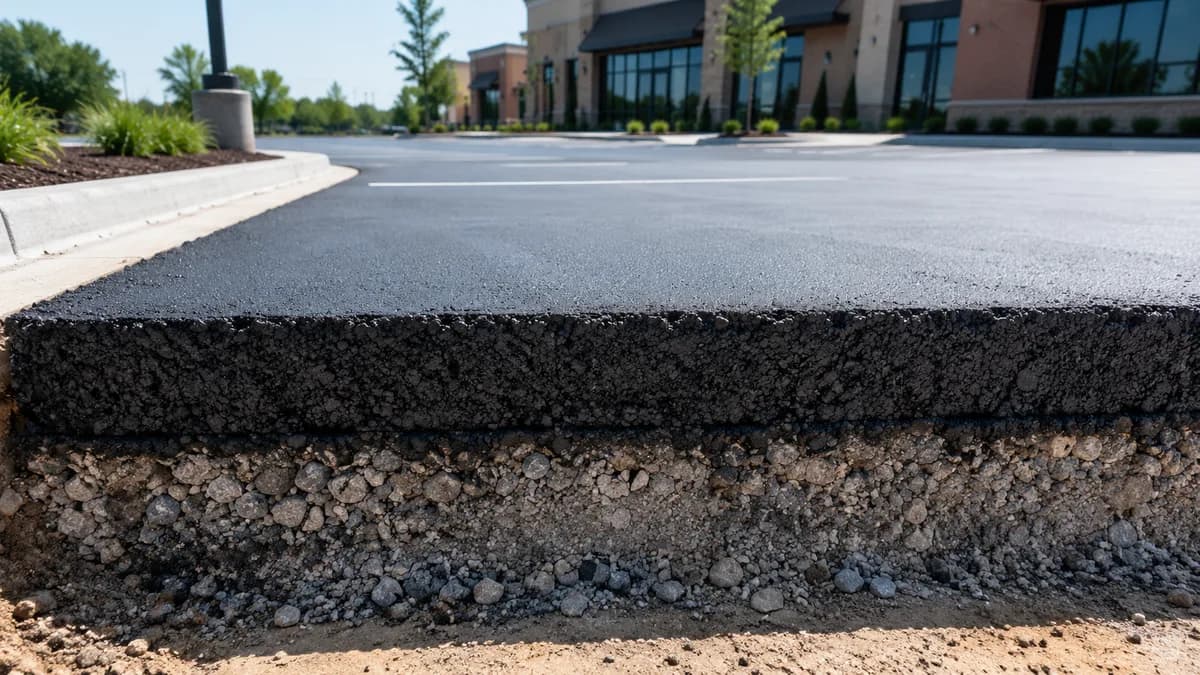
Asphalt Paving Thickness for Parking Lots
Typical asphalt paving thickness for parking lots: benchmarks for stalls, drive lanes, and truck areas, plus how base and soil change the answer.
Property-owner guide
Updated July 6, 2026
How to Choose an Asphalt Paving Contractor
How to choose an asphalt paving contractor: project fit, relevant experience, written scope, references, insurance, and pavement qualifications.
Property-owner guide
Updated July 11, 2026
Concrete Repair vs. Replacement: Which Do You Need?
When to repair concrete versus replace it: how grinding, slab lifting, and patching compare to full replacement, and how to decide from the cause.
Property-owner guide
Updated July 12, 2026
How to Choose a Drainage and Sitework Contractor
How to choose a drainage and sitework contractor: one who diagnoses the cause of water problems and knows when an engineer is needed.
Before you hire: The Pavement Directory does not guarantee contractor performance, pricing, licensing, insurance, or availability. Business information may be submitted by contractors or gathered from public sources and should be independently verified before hiring. Always confirm licensing, insurance, references, scope of work, and written contract terms.
For contractors
Ready to compare Nebraska contractors?
Browse listings by city and service, then use what you have read here to check the scope, the credentials, and the timing before you sign.