
District of Columbia pavement guide
Pavement Conditions in District of Columbia: Regions, Soils, and Common Problems
In Washington, D.C. the hardest part of a pavement project is usually establishing which of three regulators has jurisdiction over which part of it.
- 3 regions
- 5 common problems
- 7 local terms
Jump to section
Regional differences
Pavement Conditions by Region in District of Columbia
District of Columbia does not have one climate or one soil profile, and pavement that performs well in one part of the state can fail early a few hours away. These are the divisions that matter most when scoping paving, repair, or maintenance work.
The Piedmont uplands northwest of the Fall Line
Upper Northwest · Tenleytown · Cleveland Park · Chevy Chase D.C. · Petworth
Environmental stress
- Freeze-thaw cycling with frequent winter rain-then-freeze events
- Mature tree canopy shading pavement and dropping heavy organic debris
- Rolling terrain concentrating runoff onto lower parcels
Subgrade conditions
- Residual clay soils weathered from crystalline bedrock
- Saprolite and partly weathered rock at variable depth
- Rock close enough to the surface in places to complicate excavation
Common distress
- Root heaving and cracking beneath and beside mature street trees
- Alligator cracking where residual clay holds water under the base
- Organic debris blocking inlets and keeping pavement damp
What it means for the work
- Tree protection requirements are substantial in the District and affect what excavation is permissible near a tree
- Residual clay drains slowly and often warrants an underdrain rather than more surface thickness
- Rock depth on the higher ground can vary within a parcel, so test pits are worth doing before pricing
The monumental core and the filled lowlands
Downtown · Federal Triangle · Southwest Waterfront · Foggy Bottom · Navy Yard
Environmental stress
- The District's densest traffic and most constrained sites
- Sustained deicing on institutional, federal, and commercial pavement
- Tidal influence and flood exposure on the lowest waterfront parcels
Subgrade conditions
- Extensive historic fill placed over former tidal flats and marsh
- A high water table across much of the low-lying core
- Dense buried utilities, vaults, and abandoned infrastructure
Common distress
- Settlement following straight lines across otherwise sound pavement
- Utility cut failures that reappear after each repair
- Ponding where the outfall is tidally influenced and grading alone cannot resolve it
What it means for the work
- Staging space and truck access are almost always the binding schedule constraint
- Test pits before pricing a reconstruction are cheaper than discovering what is buried mid-project
- Night and weekend work is common because daytime closures are impractical
The Anacostia corridor and the Coastal Plain
Anacostia · Congress Heights · Deanwood · Fort Totten · Benning
Environmental stress
- Flood exposure along the Anacostia River and its tributaries
- Freeze-thaw cycling with substantial winter deicing
- Substantial redevelopment activity putting new traffic on older pavement
Subgrade conditions
- Coastal Plain sands, silts, and clays below the Fall Line
- A high water table on low parcels near the river
- Fill on parcels that have been redeveloped repeatedly
Common distress
- Base saturation and alligator cracking in the lowest parts of a lot
- Edge failure where pavement is unconfined on sandy subgrade
- Flood-related base damage beneath a surface that still looks intact
What it means for the work
- Anacostia watershed water quality attention affects redevelopment stormwater expectations
- Sandy Coastal Plain subgrade supports edges poorly, so confinement is a real design decision
- Floodplain status can change what is permissible on a parcel and how it should be detailed
Field conditions
Common Pavement Problems in District of Columbia
Work crossing into public space without a permit
A project is stopped, or a completed installation has to be removed and redone, because part of it sits in public space under DDOT jurisdiction rather than on private property.
Likely causes
- The public space boundary sitting well inside what an owner considers their frontage
- Curb cuts, aprons, sidewalks, and alley connections falling under DDOT rather than the property
- A contractor pricing the visible pavement rather than checking the property line
- Assuming that maintaining an area for years establishes the right to alter it
When to get it looked at: Before the scope is finalized. Establishing where public space begins is a records question that takes far less time than unwinding a permit problem after the work has started.
Settlement over historic fill and buried infrastructure
Localized dips and cracking following straight lines across otherwise sound pavement, often reappearing within a year or two of being repaired.
Likely causes
- Historic fill placed over former tidal flats and marsh long before engineered compaction was standard
- Poorly backfilled utility trenches consolidating over time
- Buried vaults, foundations, and abandoned lines beneath the pavement
- Groundwater movement carrying fines out of loose fill
When to get it looked at: Cracking in a straight line is a strong hint that something buried is driving it. On a District parcel, test pits before pricing a reconstruction are close to essential rather than optional.
Root heaving and damage near mature trees
Pavement lifting and cracking in an irregular pattern radiating from a tree, with the surface rising enough to create trip hazards on adjacent walks and accessible routes.
Likely causes
- Roots growing beneath pavement in search of water and air
- Sections placed directly over root zones without a barrier or a designed detail
- Compacted urban soils pushing roots toward the shallow, looser material under pavement
- Repairs made without addressing the root that caused the problem
When to get it looked at: Root-related heaving on an accessible route creates a change in level that matters beyond appearance. Tree protection requirements in the District also mean the fix has to be planned rather than improvised with a saw.
Deicing damage to concrete on accessible routes
Walks, entry aprons, and accessible route surfaces shedding material in thin flakes, with joints opening and level changes developing where a smooth uniform surface is required.
Likely causes
- Repeated freezing while the concrete surface is saturated
- Deicing chemicals applied to concrete during its first winter
- Finishing practices that left a weak surface layer
- Drainage keeping the surface wet through freeze cycles
When to get it looked at: Scaling over sound concrete can often be addressed without replacement. Deterioration creating a change in level on an accessible route warrants a shorter timeline than appearance alone would suggest.
Neglected stormwater practices from earlier approvals
A bioretention area, permeable pavement section, or underground storage installed under a previous approval that has silted in, clogged, or been paved over, leaving the property out of step with what was permitted.
Likely causes
- Maintenance obligations that transferred with the property but were never communicated
- Sediment from the contributing pavement never removed from the practice
- Permeable pavement never vacuumed and now functioning as ordinary pavement
- Landscaping or repaving decisions made without knowing the feature was a permitted practice
When to get it looked at: Before scoping any pavement work, find out what stormwater practices the property is required to have and what condition they are in. Repaving around a failed practice does not discharge the obligation.
Property types
Common Pavement Projects in District of Columbia
Federal and institutional properties
Security-driven access constraints, constant occupancy, accessible routes that cannot be interrupted, and specification requirements that differ from ordinary commercial work all narrow what is possible and when.
Embassies, associations, and office properties downtown
Extremely constrained staging, work that frequently crosses into public space, and historic fill beneath make phasing and permitting the dominant variables rather than material selection.
Hospital and university campuses
Continuous operation, heavy service and emergency vehicle loading, and accessible route continuity mean campus pavement work is planned around access rather than around weather.
Multifamily and mixed-use redevelopment
New development triggers District retention requirements that reshape parking layouts, and the resulting green infrastructure carries maintenance obligations the eventual owner inherits.
Retail, church, and community properties in the Anacostia corridor
Coastal Plain subgrade with poor edge support, flood exposure near the river, and watershed water quality expectations combine on properties that often have limited capital budgets.
Plain English
Pavement Terms You May Encounter in District of Columbia
| Term | What it means on a District of Columbia project |
|---|---|
| Public space | Land under District jurisdiction between the property line and the street, including sidewalks, tree boxes, alleys, and curb cuts. Work there requires a DDOT public space permit, and the boundary is often inside what an owner considers their frontage. |
| Stormwater retention volume | The volume of runoff a qualifying District project is required to retain on site. Because retaining it usually means green infrastructure rather than conveyance, it can reshape a parking lot's layout rather than just its drainage. |
| Stormwater retention credit | A tradable credit generated by retaining stormwater beyond what a property is required to. The District's trading program lets part of an obligation be met by purchasing credits, which is unusual and can change a project's economics. |
| Green infrastructure | Bioretention areas, permeable pavement, and similar features that manage runoff where it falls. In the District these are frequently a requirement rather than an option, and they carry ongoing maintenance obligations. |
| Fall Line | The boundary between the crystalline Piedmont and the softer Coastal Plain, which runs through the city. It is why northwest properties sit on residual clay over rock and eastern properties sit on sand and silt. |
| Historic fill | Material placed over former tidal flats and marsh to create the low-lying parts of the city, generally without engineered compaction. It is the reason settlement over buried material is a normal reconstruction risk here. |
| Utility cut restoration | Repaving a trench after underground work. Poorly compacted restorations settle and crack repeatedly, and on a dense urban parcel they are one of the more common recurring pavement defects. |
State transportation specifications can provide useful regional terminology and material references, but they do not automatically govern private parking-lot or driveway projects unless incorporated into the contract or required by the applicable jurisdiction.
More definitions are in the pavement glossary.
Before you sign
Questions to Ask a Paving Contractor in District of Columbia
- Where does public space begin at this property, and does any part of this scope fall inside it?
- Who is responsible for obtaining the DDOT public space permit if one is needed?
- Does this project trigger DOEE retention volume requirements, and who determines that?
- Are there existing permitted stormwater practices on this property, and does this scope include restoring them?
- Are you clear that the federal construction stormwater permit here comes from EPA rather than from a District agency?
- Do you know whether this parcel is historic fill, and would test pits be worth doing before we finalize scope?
- Does this work affect accessible routes or accessible parking, and how is that being handled?
- What tree protection requirements apply here, and how does that affect excavation near the canopy?
- How will staging and truck access work on this site, and does that require additional permits?
- Are your subcontractors licensed to work in the District, and do they carry their own insurance?
District of Columbia pavement condition FAQs
What is public space in Washington, D.C. and why does it affect my parking lot?
Public space is the land under District jurisdiction between the property line and the street — sidewalks, tree boxes, alleys, and curb cuts. Work in it requires a DDOT public space permit regardless of who has been maintaining it. The complication is that the boundary frequently sits inside what an owner thinks of as their own frontage, so a project scoped from what looks like the property can cross the line without anyone noticing. Establishing where public space begins before finalizing scope is one of the highest-value early steps here.
Why do parts of my downtown D.C. lot keep settling?
Because much of the low-lying District is built on historic fill placed over former tidal flats and marsh, generally without engineered compaction, and threaded with generations of buried utilities, vaults, and abandoned lines. Settlement over that material follows straight lines rather than traffic patterns, and it reappears after repairs because the cause is below the pavement. On a District reconstruction, test pits before pricing are close to essential — the alternative is discovering what is down there with a crew mobilized.
Is D.C. pavement different from Maryland and Virginia pavement?
Physically, the District spans the same Fall Line boundary its neighbors do, so northwest properties on Piedmont residual clay and eastern properties on Coastal Plain sand behave much as they would across the line. Regulatorily it is quite different: public space permitting through DDOT, retention requirements and credit trading through DOEE, and a federal stormwater permit issued by EPA rather than a state agency. A contractor experienced in the suburbs may know the soil well and the permitting process not at all.
Can tree roots really damage a District parking lot?
Yes, and the District's mature canopy makes it common. Roots grow into the looser, better-aerated material beneath pavement and lift it, producing irregular heaving that radiates from the tree and, on walks and accessible routes, changes in level that matter beyond appearance. The complication is that tree protection requirements here are substantial, so cutting the offending root is generally not an available answer. The fix has to be designed — a modified detail, a barrier, or a reconfiguration — rather than improvised.
Related reading for District of Columbia property owners
Property-owner guide
Updated September 10, 2026
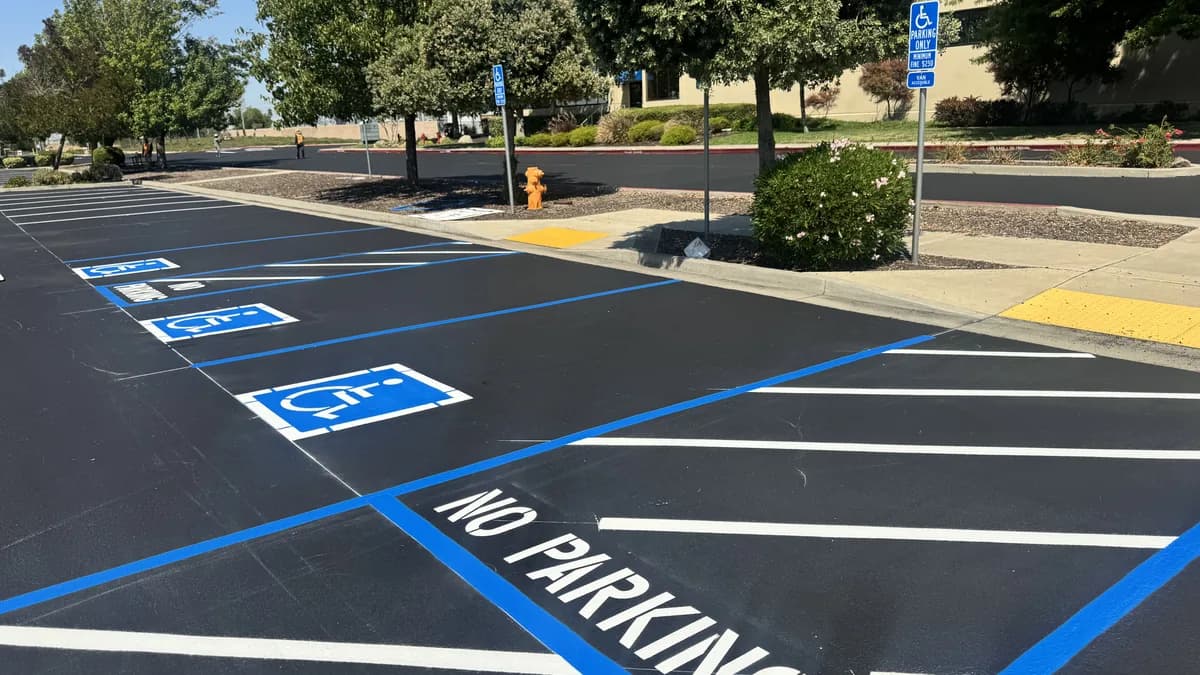
ADA Parking Requirements: Stalls, Aisles, Slopes, and Signs
What ADA parking requirements cover: how many accessible stalls a lot needs, access aisle and van stall rules, slope limits, sign height, and path of travel.
Property-owner guide
Updated July 11, 2026
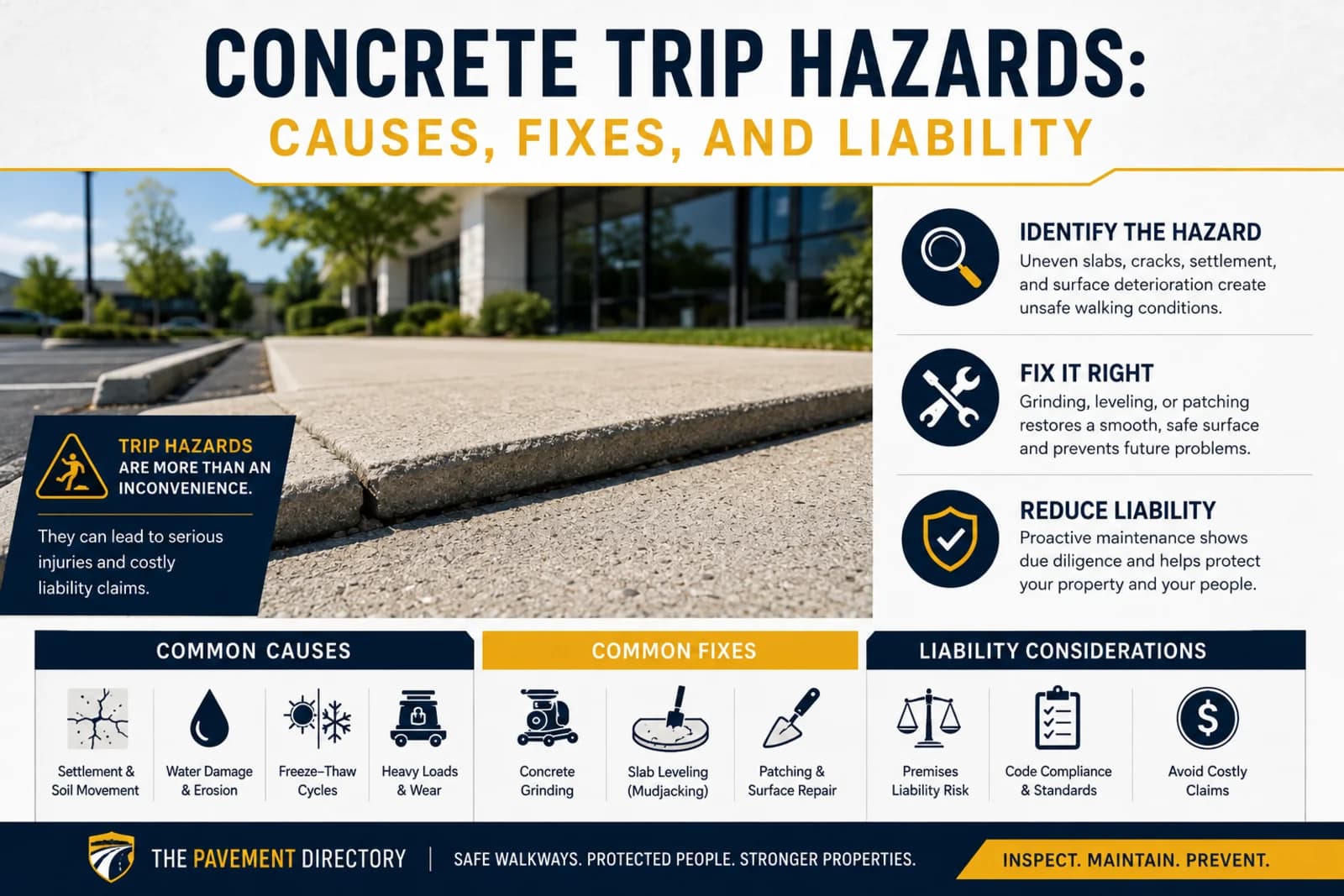
Concrete Trip Hazards: Causes, Fixes, and Liability
What causes concrete trip hazards on sidewalks, how they are fixed by grinding, cutting, slab lifting, or replacement, and the ADA and liability stakes.
Property-owner guide
Updated July 6, 2026
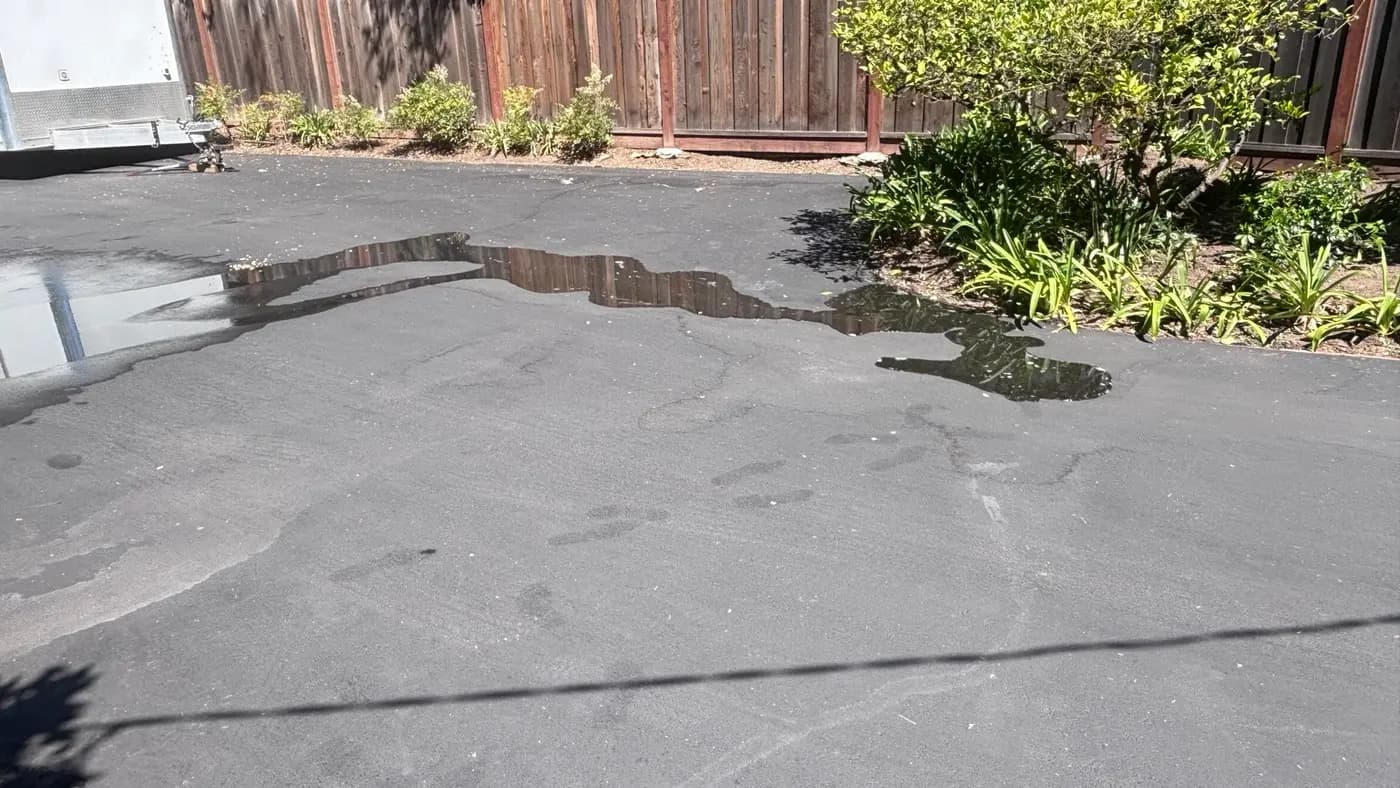
Parking Lot Drainage Problems: What Property Owners Should Know
Common causes of parking lot drainage problems, why they accelerate pavement damage, and what property owners should ask contractors before a fix.
Property-owner guide
Updated July 6, 2026
How to Choose an Asphalt Paving Contractor
How to choose an asphalt paving contractor: project fit, relevant experience, written scope, references, insurance, and pavement qualifications.
Property-owner guide
Updated July 11, 2026
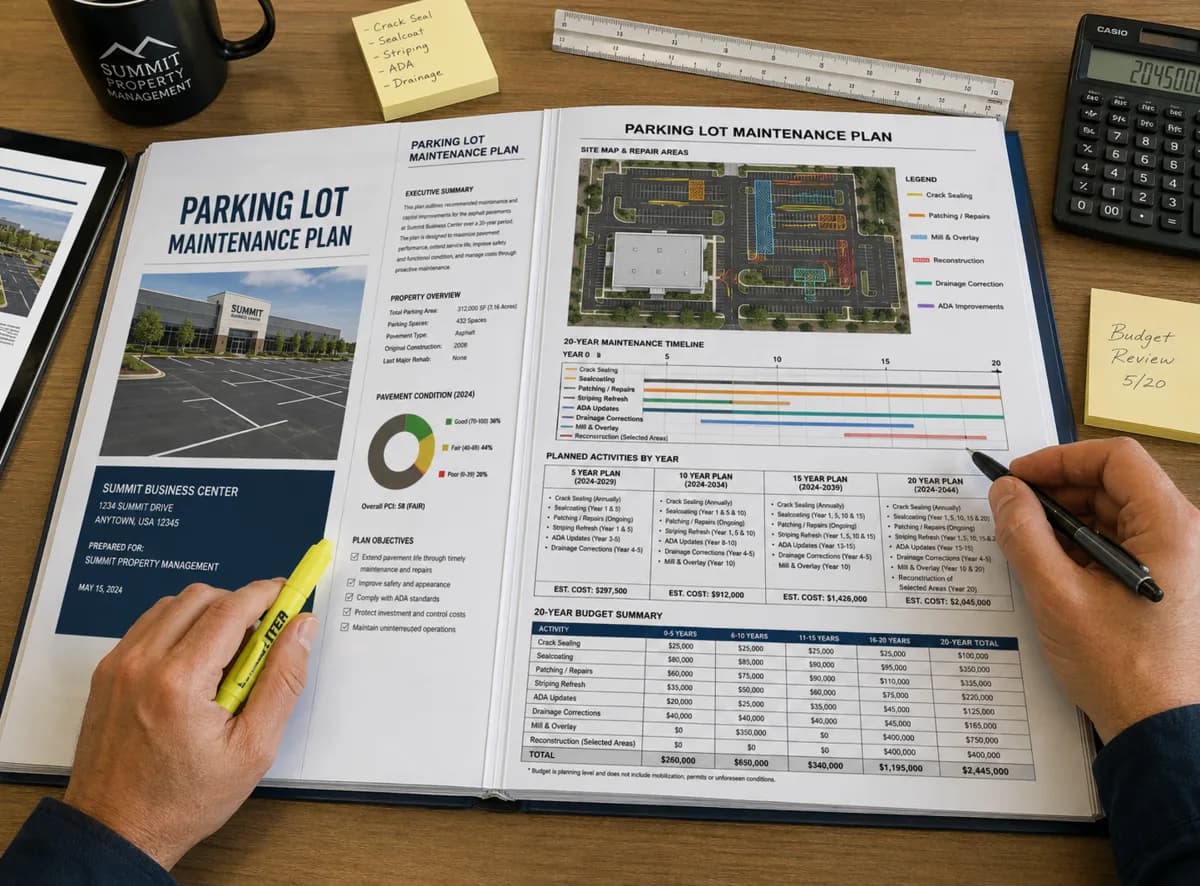
How to Create a Parking Lot Maintenance Plan
How to build a parking lot maintenance plan: inspecting condition, setting service cycles, prioritizing repairs, and budgeting over multiple years.
Property-owner guide
Updated July 6, 2026
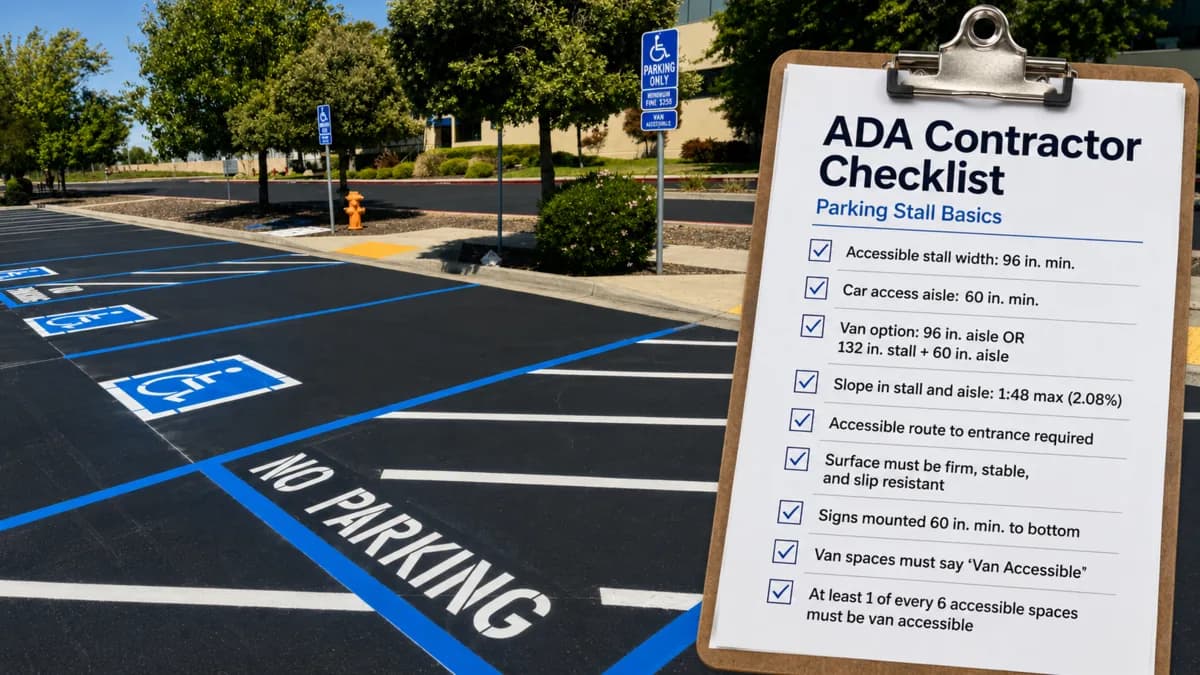
ADA Parking Contractor Checklist
A checklist for ADA parking projects covering accessible stall counts, slopes, signage, access aisles, and the paperwork worth asking a contractor for.
Before you hire: The Pavement Directory does not guarantee contractor performance, pricing, licensing, insurance, or availability. Business information may be submitted by contractors or gathered from public sources and should be independently verified before hiring. Always confirm licensing, insurance, references, scope of work, and written contract terms.
For contractors
Ready to compare District of Columbia contractors?
Browse listings by city and service, then use what you have read here to check the scope, the credentials, and the timing before you sign.