

What this guide covers
Density converts compacted asphalt volume into weight. It is why square feet and thickness can become tons—and why a cubic-yard-to-ton conversion changes when the mix unit weight changes.
This guide explains the assumption behind the math. Use the Asphalt Tonnage Calculator when you want to enter a plant or job-mix density, calculate multiple lifts, convert compacted cubic yards, or see coverage per ton.
A supplier or project-specific compacted unit weight should replace a generic estimating value when available. Keep the density and thickness assumptions with the result so another person can reproduce it.
Related contractor categories
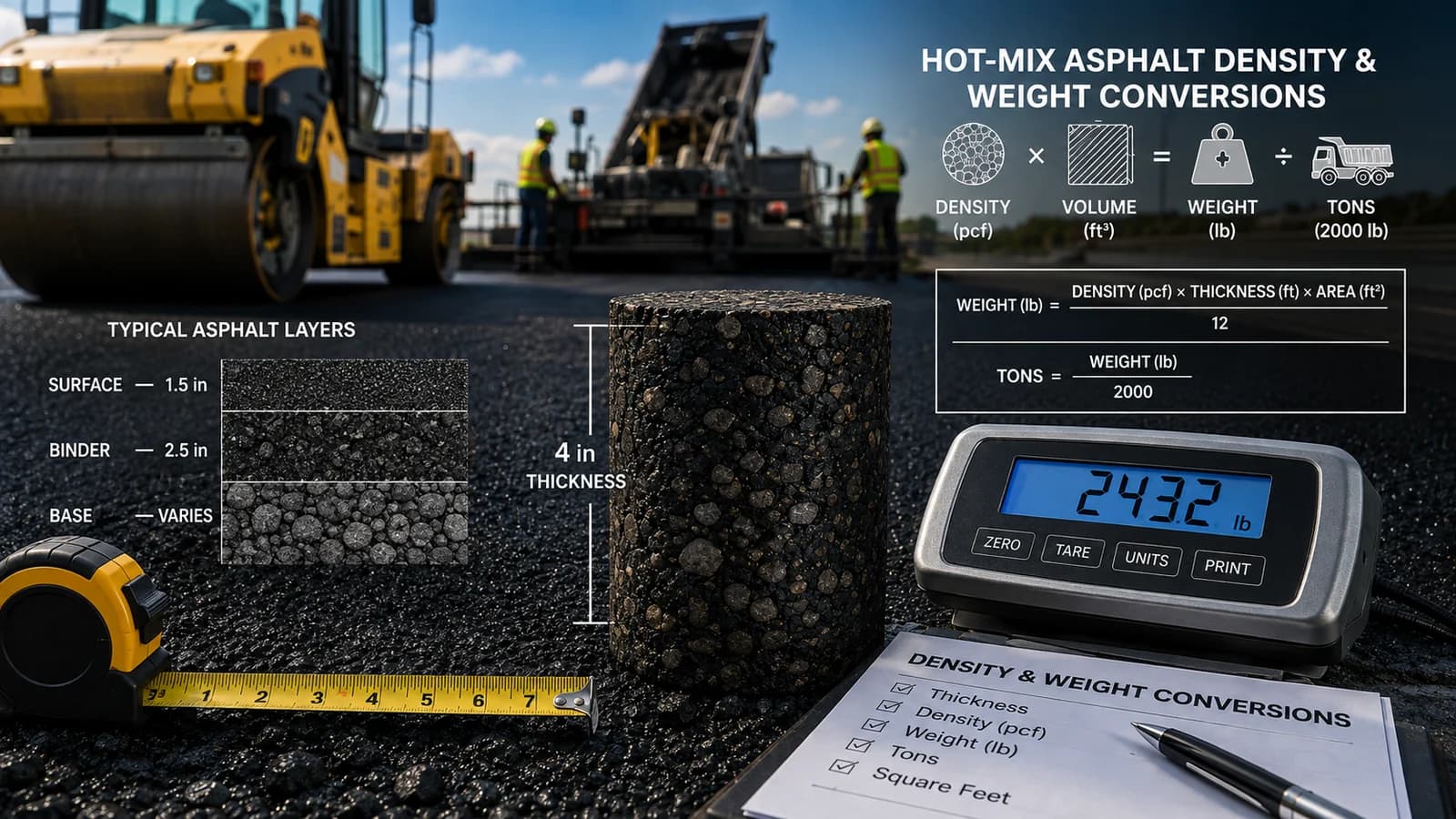
What hot-mix asphalt density means
Density is weight per unit of volume. In US paving calculations it is commonly entered as pounds per cubic foot; metric calculations may use kilograms per cubic meter. Density is not the same thing as total tons, surface area, or thickness.
A compacted density belongs with a compacted volume. The tonnage formula multiplies compacted cubic feet by lb/ft³ and divides by 2,000 lb per US ton. If the density assumption rises while area and thickness stay fixed, calculated tons rise proportionally.
The FHWA Federal Lands estimating table lists hot asphalt mix at 2,325 kg/m³ (145.2 lb/ft³). That makes 145.2 a defensible estimating default, but the table does not say every project mix will have that exact unit weight.
Why asphalt density is not one universal number
Hot-mix asphalt is a designed combination of aggregate and asphalt binder. Aggregate source, gradation, binder content, air voids, and achieved field compaction affect the weight occupying a given compacted volume.
That variability is the reason a calculator should keep density editable and visible. A named mix category alone should not silently substitute an exact density unless a reliable project or supplier source supports it.
For early planning, document the estimating value. For a bid check or order worksheet, look for the plant's unit weight, approved mix information, job-mix formula, project specification, or another value supplied by the project team.
Convert compacted cubic yards to US tons
One cubic yard contains 27 cubic feet. The formula is US tons = Compacted yd³ × 27 × Density (lb/ft³) ÷ 2,000.
At 145.2 lb/ft³, one compacted cubic yard weighs 27 × 145.2 = 3,920.4 lb. Divide by 2,000 and the result is 1.9602 US tons per compacted cubic yard.
For example, 10 compacted cubic yards at that density equals 19.602 theoretical US tons. If the density entered were different, the result would change in direct proportion.
| Compacted volume | Weight at 145.2 lb/ft³ | US tons |
|---|---|---|
| 1 yd³ | 3,920.4 lb | 1.9602 |
| 5 yd³ | 19,602 lb | 9.801 |
| 10 yd³ | 39,204 lb | 19.602 |
| 20 yd³ | 78,408 lb | 39.204 |
Convert US tons to compacted cubic yards
Reverse the formula when weight is known: Compacted yd³ = US tons × 2,000 ÷ Density (lb/ft³) ÷ 27.
At 145.2 lb/ft³, one US ton occupies about 0.5102 compacted cubic yard. A 20-ton load occupies about 10.20 compacted cubic yards at the same assumed density.
This is a geometric compacted-volume conversion. Truck-bed volume, loose material depth, load shape, and field placement are different questions and should not be inferred from compacted cubic yards alone.
Convert lb/ft³ and kg/m³
To convert density from kg/m³ to lb/ft³, multiply by approximately 0.062428. To convert lb/ft³ to kg/m³, multiply by approximately 16.01846.
The FHWA table prints 2,325 kg/m³ and 145.2 lb/ft³. Those displayed figures are rounded independently, so converting one printed value may not reproduce every final digit of the other. Preserve the source value and avoid implying more precision than the source provides.
US short tons and metric tonnes are also different units: one metric tonne equals approximately 1.10231 US short tons. A professional worksheet should label which unit it uses instead of writing only “tons.”
| Conversion | Formula |
|---|---|
| kg/m³ → lb/ft³ | kg/m³ × 0.062428 |
| lb/ft³ → kg/m³ | lb/ft³ × 16.01846 |
| Metric tonnes → US tons | tonnes × 1.10231 |
| US tons → metric tonnes | US tons ÷ 1.10231 |
Pounds per square yard per inch
Paving takeoffs sometimes express an application rate as pounds per square yard per inch of compacted thickness. The density-based formula is lb/yd²/in = Density (lb/ft³) × 9 ft²/yd² ÷ 12 in/ft.
At 145.2 lb/ft³, the result is 108.9 lb/yd² per compacted inch. Therefore, 1 square yard at 2 inches is 217.8 lb, and 1,000 square yards at 2 inches is 217,800 lb or 108.9 US tons.
A rounded field rule can be useful for a quick check, but calculations and proposal comparisons should retain the density and finished-thickness assumptions that produced it.
Compacted density and loose placement depth
The calculator's density is for the finished compacted material volume. Loose placement depth is greater than finished depth because rolling reduces air voids and changes the material's occupied volume.
Do not multiply tons by a second generic compaction factor when the calculation already uses finished compacted thickness and compacted density. That can count the same concept twice. If only a loose depth is provided, ask for the intended finished compacted thickness or a project-specific conversion.
The distinction matters when comparing proposals. Two bids that both say “3 inches” may not describe the same finished pavement if one means loose placement and the other means compacted thickness.
Which density should go into the calculator
Use the most project-specific reliable value available. A practical hierarchy is: plant or approved job-mix information; a project specification or engineer-provided unit weight; a supplier-confirmed value for the selected mix; and finally a clearly labeled estimating value for early planning.
Enter density separately for each lift when the surface, binder, or asphalt base mix differs. The Asphalt Tonnage Calculator keeps lift density visible and returns separate tonnage before totaling the project.
Do not choose a density merely because it makes a contractor's quoted tons match the calculation. Treat a difference as a prompt to verify area, compacted thickness, mix, lift count, leveling, variable grade, and order allowance.
Common density and conversion mistakes
Watch for these problems when converting hot-mix asphalt volume and weight:
- Treating 1 cubic yard as a fixed number of tons without stating density
- Using a loose volume with a compacted density without explaining the relationship
- Applying a second compaction factor to compacted thickness and compacted density
- Confusing US short tons with metric tonnes
- Using one global density for different lifts without checking the mix information
- Rounding the density and every intermediate conversion too early
- Presenting an estimating default as a supplier-guaranteed yield
- Hiding the density assumption when sharing or checking a quantity
Frequently asked questions
What density should I use for hot-mix asphalt?
Use a plant, approved job-mix, project-specification, or supplier-provided compacted unit weight when available. For early estimating, the FHWA Federal Lands table lists hot asphalt mix at 145.2 lb/ft³ or 2,325 kg/m³.
How many tons are in one cubic yard of asphalt?
At 145.2 lb/ft³, one compacted cubic yard weighs about 1.9602 US tons. The answer changes with density, so it is not a universal conversion for every asphalt mix.
How many cubic yards are in one ton of asphalt?
At 145.2 lb/ft³, one US short ton occupies about 0.5102 compacted cubic yard. This describes compacted material volume, not loose truck-bed volume.
How many pounds per square yard per inch is asphalt?
At 145.2 lb/ft³, the density-based rate is 108.9 pounds per square yard per compacted inch. Change the density and the rate changes proportionally.
Is asphalt density the same before and after compaction?
No. Compaction reduces air voids and increases unit weight within the occupied volume. Pair the calculator's compacted density with finished compacted thickness rather than loose placement depth.
Are US tons and metric tonnes the same?
No. One metric tonne equals approximately 1.10231 US short tons. Label the unit in every worksheet, proposal comparison, and supplier conversation.
Before you hire: The Pavement Directory does not guarantee contractor performance, pricing, licensing, insurance, or availability. Business information may be submitted by contractors or gathered from public sources and should be independently verified before hiring. Always confirm licensing, insurance, references, scope of work, and written contract terms.
For property owners
Looking for a pavement contractor?
Use The Pavement Directory to search asphalt, concrete, sealcoating, striping, ADA access, and pavement maintenance contractors by service and location. Always verify license, insurance, references, and written scope before hiring.
Search contractorsFor contractors
Are you a pavement contractor?
Contractors can add or claim a company profile to help property owners find pavement professionals by service, location, and specialty.