

What this guide covers
A useful proposal states where the work happens, how much area is included, what paving method and thickness are proposed, what base preparation and drainage assumptions apply, and what is included and excluded.
This article focuses on the written proposal document itself — the verification step after the conversation. For what to ask before and during bidding, see Questions to Ask an Asphalt Paving Contractor. For comparing multiple proposals side by side, see How to Compare Asphalt Paving Bids.
Search paving contractors for parking lots and driveways to request proposals from contractors who serve your area, and see the asphalt paving cost guide for the planning ranges a complete proposal should land near.
Related contractor categories
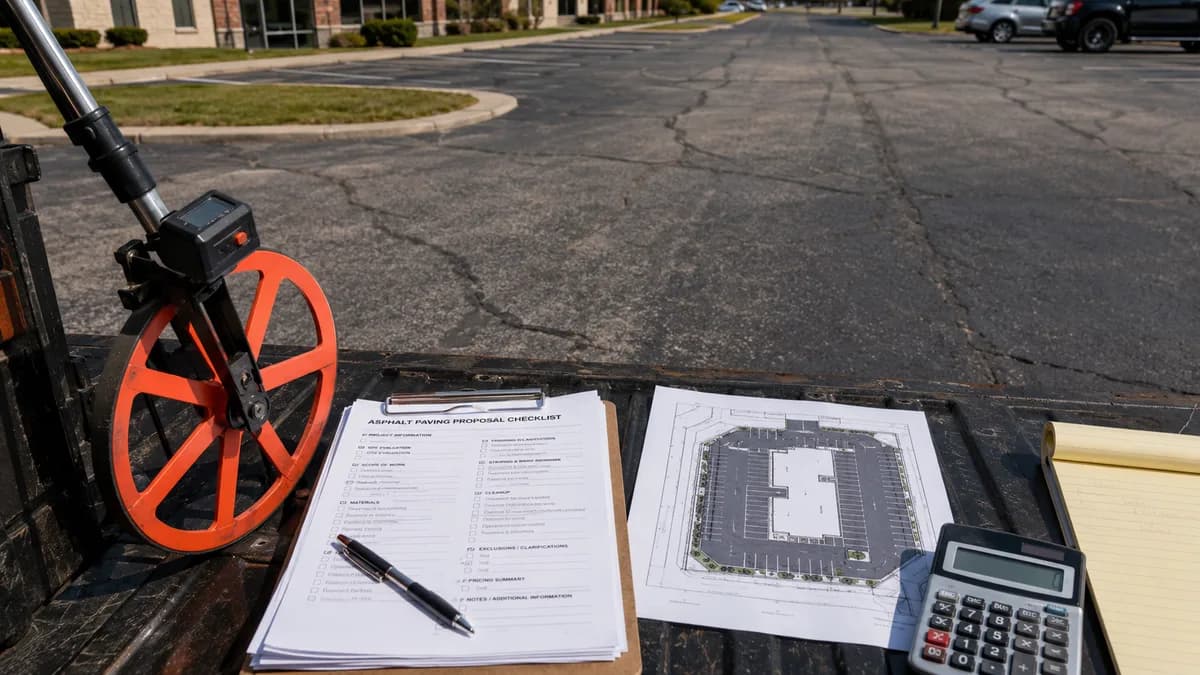
Must-have proposal items
At minimum, a paving proposal should include contractor name, project address, date, work area description, approximate quantity, paving method, asphalt thickness, preparation scope, price, exclusions, and payment terms. Without these items, the proposal is difficult to compare or enforce.
Work limits
The proposal should describe exactly where the work occurs. Clear wording: "Remove and replace approximately 18,500 square feet of asphalt in the north parking lot drive lanes as shown on attached diagram." Vague wording: "Pave parking lot." The clearer version tells the owner what area is included; the vague version creates room for disagreement.
Quantities
Useful quantities may include square footage, linear footage, tons, cubic yards, number of patches, number of stalls, number of phases, and number of mobilizations. For most property owners, square footage is the key starting point.
When a proposal lists both tons and square footage, use the Asphalt Tonnage Calculator to enter the stated compacted thickness, mix density, and separate lifts. If the documented planning quantity and quoted tonnage do not roughly reconcile, ask whether leveling, grade variation, handwork, field measurements, plant rounding, or other scope explains the difference before signing.
Paving method
The proposal should state the method: asphalt overlay, mill and overlay, full-depth replacement, new asphalt paving, full-depth patching, remove and replace asphalt, private road paving, or driveway paving. The method should match the pavement condition — a proposal that doesn't say whether the work is overlay, milling, or replacement is incomplete.
Asphalt thickness
The proposal should state asphalt thickness and clarify whether it is compacted thickness. Clear wording: "Install 3 inches compacted hot mix asphalt." Vague wording: "Install asphalt." If thickness changes by area, the proposal should say where. For typical thickness benchmarks by area type, see Asphalt Paving Thickness for Parking Lots.
Base preparation
The proposal should explain what happens below the asphalt — fine grading, compacting the existing base, installing aggregate base, repairing soft spots, removing unsuitable material, and whether base repair is excluded, priced by unit, or handled by change order. Base work is one of the most common scope gaps.
Drainage assumptions
The proposal should address drainage when visible problems exist: low spots, catch basins, utility covers, grade adjustments, water flow, ponding areas, and ADA access aisles. If drainage is not included, the proposal should say so.
Striping and markings
For parking lots, the proposal should say whether striping is included — stall lines, ADA stalls, access aisles, fire lanes, arrows, crosswalks, curb painting, wheel stops, and signs. If excluded, get a separate proposal from Parking Lot Striping Contractors.
Access and phasing
Occupied properties need access planning. The proposal should clarify work days, work hours, phasing, closures, reopening time, notices, traffic control, barricades, and emergency access. This is especially important for commercial properties, HOAs, apartments, retail centers, and facilities that stay open during work. For what a complete access plan looks like in practice, see Commercial Asphalt Paving Contractors.
Exclusions
Common exclusions include permits, engineering, testing, base repair, drainage correction, utility adjustment, striping, concrete repair, ADA compliance review, traffic control, night work, weekend work, and unforeseen conditions. Exclusions are not automatically bad — missing exclusions are the risk.
Warranty language
The proposal should say whether a warranty is included. One to two years is common for commercial paving workmanship warranties, though terms vary widely. Ask what it covers and excludes — common exclusions include base failure, drainage problems, heavy vehicle damage, utility trench settlement, standing water, oil damage, lack of maintenance, and existing pavement movement.
Proposal wording to question
Ask for clarification if you see phrases like "as needed," "where necessary," "pave area," "repair bad spots," "standard thickness," "includes prep," "warranty included," or "ADA included." These phrases may be acceptable if they are defined, but risky if left vague.
Frequently asked questions
What is the most important part of an asphalt paving proposal?
The most important parts are work limits, quantities, paving method, asphalt thickness, preparation scope, exclusions, and price.
Should a proposal include square footage?
Yes. Square footage helps confirm the work area and compare proposals. When tonnage is also listed, check that the two roughly reconcile.
Should thickness be listed?
Yes. Thickness should be listed clearly, preferably as compacted thickness.
Are exclusions bad?
No. Exclusions are useful when they are clear. Hidden or missing exclusions are the problem.
Should striping be included?
For parking lots, striping should either be included or clearly excluded.
Before you hire: The Pavement Directory does not guarantee contractor performance, pricing, licensing, insurance, or availability. Business information may be submitted by contractors or gathered from public sources and should be independently verified before hiring. Always confirm licensing, insurance, references, scope of work, and written contract terms.
For property owners
Looking for a pavement contractor?
Use The Pavement Directory to search asphalt, concrete, sealcoating, striping, ADA access, and pavement maintenance contractors by service and location. Always verify license, insurance, references, and written scope before hiring.
Search contractorsFor contractors
Are you a pavement contractor?
Contractors can add or claim a company profile to help property owners find pavement professionals by service, location, and specialty.