

What this guide covers
A square-foot or square-yard takeoff tells you surface area, while asphalt is ordered by weight. Compacted thickness turns area into volume; compacted density turns that volume into pounds and US tons.
This guide shows the formula and reproducible examples. When you are ready to run your own project, use the Asphalt Tonnage Calculator to enter square feet, square yards, dimensions, multiple paving sections, and separate asphalt lifts.
The result is a planning quantity, not an automatic purchase order. Plant minimums, truck payload, uneven grade, variable milling depth, leveling, transitions, and the actual mix density can all change the quantity delivered or placed.
Related contractor categories
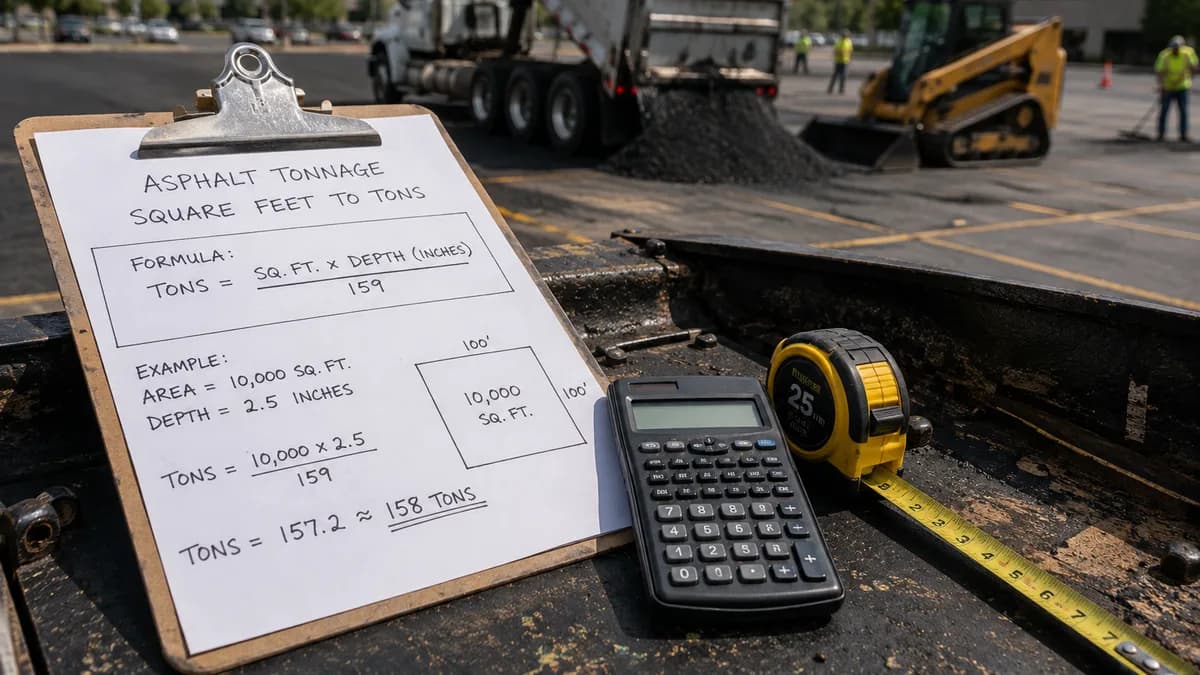
The asphalt tonnage formula
The calculation has three steps: turn area and finished compacted thickness into cubic feet, multiply cubic feet by compacted density to get pounds, then divide pounds by 2,000 to get US short tons.
For an area already measured in square feet: US tons = Area (ft²) × (Compacted thickness in ÷ 12) × Density (lb/ft³) ÷ 2,000. Keep full precision through the calculation and round only the displayed planning result.
The calculator uses 145.2 lb/ft³ as an editable starting point because the FHWA Federal Lands estimating table lists that unit weight for hot asphalt mix. A plant or job-mix value is more relevant when available.
Square feet to tons: worked example
Suppose a paving area is 1,000 square feet, the specified finished compacted thickness is 2 inches, and the planning density is 145.2 lb/ft³.
First calculate compacted volume: 1,000 ft² × (2 ÷ 12 ft) = 166.67 ft³. Then calculate weight: 166.67 ft³ × 145.2 lb/ft³ = 24,200 lb. Finally, divide by 2,000 lb per US ton: 24,200 ÷ 2,000 = 12.1 theoretical tons.
An order allowance is a separate decision. Adding 5% would produce a 12.705-ton planning quantity before any plant minimum or delivery rounding. Keeping the 12.1 theoretical tons visible makes the assumption easier to audit.
| Input or step | Value | Calculation |
|---|---|---|
| Area | 1,000 ft² | Measured or taken from plans |
| Compacted thickness | 2 in | 2 ÷ 12 = 0.1667 ft |
| Compacted volume | 166.67 ft³ | 1,000 × 0.1667 |
| Planning density | 145.2 lb/ft³ | Editable mix assumption |
| Weight | 24,200 lb | 166.67 × 145.2 |
| Theoretical quantity | 12.1 US tons | 24,200 ÷ 2,000 |
Square yards to tons: formula and example
One square yard contains 9 square feet. Convert the area first, then use the same compacted-volume formula: US tons = Area (yd²) × 9 × (Compacted thickness in ÷ 12) × Density (lb/ft³) ÷ 2,000.
At 145.2 lb/ft³, 1,000 square yards at 2 inches compacted equals 9,000 ft² × 2/12 × 145.2 ÷ 2,000 = 108.9 theoretical tons. At 3 inches compacted, the same 1,000 square yards equals 163.35 theoretical tons.
This is why a bid that lists only square yards and tons is incomplete for a quantity check. You also need the finished compacted thickness and the density assumption, especially when surface and binder lifts use different values.
Asphalt coverage and tons by compacted thickness
Coverage moves inversely with compacted thickness. At the same density, doubling thickness doubles tons per 1,000 square feet and cuts square feet per ton in half.
The table below is calculated at 145.2 lb/ft³. It is a transparent reference table, not a claim that every hot-mix asphalt product has the same density. Use the calculator's Area covered mode to change thickness and density for a known load.
| Compacted thickness | Tons per 1,000 ft² | Ft² per US ton | Yd² per US ton |
|---|---|---|---|
| 1.5 in | 9.08 | 110.2 | 12.24 |
| 2 in | 12.10 | 82.6 | 9.18 |
| 2.5 in | 15.13 | 66.1 | 7.35 |
| 3 in | 18.15 | 55.1 | 6.12 |
| 4 in | 24.20 | 41.3 | 4.59 |
Why finished compacted thickness matters
Tonnage calculations should use the intended thickness after rolling and compaction. Loose placement depth is greater than finished compacted thickness, but the relationship is not one universal factor that can be applied safely to every mix and operation.
If a proposal says only “2 inches of asphalt,” ask whether that means loose placement or finished compacted thickness. When a pavement uses more than one lift, enter each lift separately so surface, binder, and asphalt base quantities remain visible instead of hiding everything inside one total depth.
Thickness is a pavement-design input, not something a quantity calculator should choose automatically. Traffic, subgrade, aggregate base, drainage, climate, and local specifications affect the appropriate section. See Asphalt Paving Thickness for Parking Lots for the questions that belong before tonnage calculation.
Why density changes asphalt tonnage
Density is the link between compacted volume and weight. A denser mix places more pounds in the same compacted cubic volume, which raises tons required and reduces coverage per ton.
The calculator default is an estimating value, not a substitute for project information. If the asphalt plant, mix submittal, or job-mix formula provides a compacted unit weight, enter that value and preserve it with the result. For the complete conversion explanation, see Hot-Mix Asphalt Density and Weight Conversions.
From theoretical tons to a plant order
The formula produces a theoretical compacted material quantity. A planning order may also carry an explicit allowance for measurement uncertainty, irregular edges, transitions, leveling, variable grade, handwork, or other conditions documented by the estimator.
The plant may apply minimum-order, load-size, or rounding rules, and legal payload can vary by truck and jurisdiction. Use the calculator's full-load and partial-load result as a conversation aid, then confirm the actual order and delivery plan with the plant or paving contractor.
When checking a proposal, do not treat a difference as proof that a bid is wrong. Compare work limits, compacted thickness, lift count, density, leveling, milling profile, and order assumptions. The Asphalt Paving Proposal Checklist explains what should be written down.
Common asphalt calculation mistakes
Avoid these errors when converting an area takeoff to hot-mix asphalt tons:
- Converting area directly to tons without a compacted thickness
- Treating one density value as exact for every asphalt mix
- Using loose placement depth as if it were finished compacted thickness
- Forgetting that 1 square yard equals 9 square feet
- Combining multiple lifts into one hidden assumption
- Adding an allowance without showing the theoretical tons first
- Rounding at every intermediate step instead of only at the end
- Treating calculated tons as a final plant order without confirming load rules
Frequently asked questions
How many tons of asphalt do I need for 1,000 square feet?
At 145.2 lb/ft³, 1,000 square feet needs about 12.1 theoretical US tons at 2 inches compacted, 15.13 tons at 2.5 inches, or 18.15 tons at 3 inches. Actual density and any documented order allowance change the planning quantity.
Can square feet be converted directly to asphalt tons?
No. Square feet measures area while tons measures weight. You need finished compacted thickness to calculate volume and compacted density to convert that volume to weight.
How do I convert square yards of asphalt to tons?
Multiply square yards by 9, multiply by compacted thickness in feet, multiply by density in pounds per cubic foot, and divide by 2,000. The calculator performs the same conversion while keeping every assumption visible.
How many square feet does one ton of asphalt cover?
At 145.2 lb/ft³, one US ton covers about 82.6 square feet at 2 inches compacted, 55.1 square feet at 3 inches, or 41.3 square feet at 4 inches. Coverage changes with both thickness and density.
Should I add extra asphalt to the calculated tons?
An allowance may be appropriate for documented measurement or field uncertainty, but there is no universal percentage. Keep theoretical tons separate, identify what the allowance covers, and confirm the final order with the plant or contractor.
Does this calculation include aggregate base?
No. It calculates hot-mix asphalt only. Aggregate base, tack coat, milling, demolition, subgrade correction, labor, equipment, and hauling charges are separate quantities or scope items.
Before you hire: The Pavement Directory does not guarantee contractor performance, pricing, licensing, insurance, or availability. Business information may be submitted by contractors or gathered from public sources and should be independently verified before hiring. Always confirm licensing, insurance, references, scope of work, and written contract terms.
For property owners
Looking for a pavement contractor?
Use The Pavement Directory to search asphalt, concrete, sealcoating, striping, ADA access, and pavement maintenance contractors by service and location. Always verify license, insurance, references, and written scope before hiring.
Search contractorsFor contractors
Are you a pavement contractor?
Contractors can add or claim a company profile to help property owners find pavement professionals by service, location, and specialty.