The Pavement Directory

State pavement directory

Pavement Contractors in Maryland

Maryland is a small state that manages to contain a genuinely wide range of pavement conditions — from Eastern Shore sites where the water table is a few feet down, through the Piedmont clay of the Baltimore–Washington corridor, to Garrett County in the far west where snowfall and freeze-thaw resemble New England more than the Chesapeake.

What ties the state together is its stormwater framework. Maryland's approach puts environmental site design at the front of the conversation, which means a project that changes impervious surface can face a different review than an owner expects. This page lists pavement contractors serving Maryland cities and covers what actually drives scope here: stormwater management triggers, high groundwater near tidal water, clay and marine sediments, deicing exposure through a variable winter, and the port and distribution loading concentrated around Baltimore.

Listings
32
Cities
5
Services
13
Search Maryland

Before you hire: The Pavement Directory does not guarantee contractor performance, pricing, licensing, insurance, or availability. Business information may be submitted by contractors or gathered from public sources and should be independently verified before hiring. Always confirm licensing, insurance, references, scope of work, and written contract terms.

32 contractors in Maryland

Filter by service
Aggregate Industries logo

Hyattsville, Maryland

Asphalt PavingCommercial & Residential

Aggregate Industries is a commercial and residential pavement contractor based in Hyattsville, Maryland. The listing covers asphalt paving.

(301) 454-8172Website on file
Alcoa Concrete & Masonry Inc. logo

Hyattsville, Maryland

Concrete SiteworkCommercial & Residential

Alcoa Concrete & Masonry Inc. provides residential and commercial concrete and masonry construction services throughout the DC, Maryland, and Northern Virginia area. The company handles foundation work, driveways, sidewalks, patios, retaining walls, pool decks, parking lots, and asphalt paving. The family-owned business has operated from Hyattsville, Maryland since 2004.

(301) 699-9300Website on file
All State Paving, LLC logo

Catonsville, Maryland

Asphalt PavingSealcoatingConcrete SiteworkCommercial & Residential

All State Paving, LLC is an asphalt paving contractor based in Catonsville, Maryland, operating since 1990. The company provides driveway installation, repair, replacement, and sealcoating for residential customers, as well as parking lot paving, repair, and maintenance for commercial properties. Additional services include catch basin drainage work and sport court paving. It is licensed under MHIC #84359 and bonded, serving Catonsville, Ellicott City, Columbia, Towson, and other communities in Central Maryland.

(443) 810-0461Website on file
Asphalt Solutions, LLC. logo

Glen Burnie, Maryland

Asphalt PavingSealcoatingCrack SealingCommercial & Residential

Asphalt Solutions LLC is a paving and maintenance company operating in Central Maryland since 2004, working on residential driveways, private roads, and commercial parking lots. Services include new asphalt installation, sealcoating, crack and pothole repair, and parking lot striping. The company states it is licensed and insured and serves both homeowners and businesses in areas including Millersville, Annapolis, and Glen Burnie.

(443) 875-8951Website on file
Bayside Asphalt, LLC logo

Glen Burnie, Maryland

Asphalt PavingCommercial & Residential

Based in Glen Burnie, Maryland, Bayside Asphalt, LLC is a commercial and residential pavement contractor. The listing covers asphalt paving.

(443) 699-5179Website on file
Bob Nichols Paving logo

Frederick, Maryland

Asphalt PavingConcrete SiteworkCommercial & Residential

Paving contractor in Frederick, MD offering Asphalt Paving, Concrete Repair, Residential Driveway.

(240) 422-2815Website on file
Chamberlain Contractors logo

Laurel, Maryland

Asphalt PavingConcrete SiteworkCommercial & Residential

Chamberlain Contractors LLC provides asphalt paving, concrete repair, sealcoating, crack filling, pavement markings, pothole repairs, parking lot maintenance, infrared asphalt repairs, and sports court construction. The company serves commercial properties across Annapolis, Baltimore, Columbia, and Laurel in Maryland, plus Delaware and Arlington, Virginia. Based in Laurel, MD, the company emphasizes delivering exceptional paving solutions through skilled team members.

(301) 479-6876Website on file
Dailys Paving logo

Baltimore, Maryland

Asphalt PavingConcrete SiteworkCommercial & Residential

The company offers concrete paving and repair, asphalt paving and repair, mill and overlay, and utility cuts. Dailys Paving operates its own fleet of equipment and employs asphalt professionals, drivers, traffic-safety certified setup crews, and traffic control services. The company handles projects from start to finish, including road closures and traffic safety setup, and maintains working relationships with Baltimore City and County inspectors.

(410) 350-4119Website on file
Dix Hollow Contracting logo

Elkton, Maryland

Asphalt PavingCommercial & Residential

Paving contractor in Elkton, MD offering Asphalt Paving.

(410) 398-9004Website on file
Dustin's Driveways logo

Pasadena, Maryland

Asphalt PavingConcrete SiteworkDrainage & GradingCommercial

Dustin's Driveways is a family-owned and operated paving contractor located in Pasadena, Maryland. The company offers asphalt paving, concrete paving, brick paving, seal coating, land excavation, snow plowing, and small projects. The owner is described as a third-generation paving contractor.

(410) 777-0169Website on file
Asphalt PavingConcrete SiteworkDrainage & GradingCommercial & Residential

E.S. Paving Construction provides asphalt paving, concrete work, seal coating, parking lot maintenance, and fence installation for residential and commercial properties in the Baltimore area. The company offers services including driveway and parking lot installation, concrete driveways and sidewalks, asphalt seal coating, and parking lot striping. The site references 5 generations of paving expertise and operates under the MHIC license number 92564.

(410) 519-3667Website on file
F&M Contractors, Inc. logo

Cockeysville, Maryland

Asphalt PavingConcrete SiteworkResidential

F&M Contractors, Inc. offers driveway installation and repair in concrete and asphalt, sidewalk construction, patio and retaining wall installation using pavers, and landscaping services. The company serves residential and commercial customers in the Baltimore, Maryland area. They state their mission is to provide total customer satisfaction to Baltimore, Maryland consumers.

(410) 667-8900Website on file
Fairway Asphalt Services logo

Silver Spring, Maryland

Asphalt PavingCommercial & Residential

Fairway Asphalt Services provides asphalt sealcoating, crack filling, and repair services for residential driveways and commercial parking lots across Central Maryland. Operating for over 20 years, the company serves Montgomery, Howard, Frederick, and Carroll counties plus the Washington DC Metro area. They use commercial-grade Neyra Force emulsion sealers and offer both spray and squeegee application methods, along with debris removal, oil spot cleaning, and lot re-striping.

(301) 879-3697Website on file
Goode Paving & Sealcoating INC. logo

Forest Hill, Maryland

Asphalt PavingSealcoatingCommercial & Residential

Founded in 1989 by Denny Goode, the company serves the Baltimore area and surrounding counties. Services include paving private and commercial driveways, parking lots, and subdivisions, along with hot and cold mix asphalt patching, sealcoating, and crack sealing. The company is fully licensed and insured.

(443) 827-8601Website on file
HF Concrete Contractor logo

Silver Spring, Maryland

Asphalt PavingConcrete SiteworkCommercial & Residential

HF Concrete is a family-owned concrete contractor serving Northern and Southern Maryland including Silver Spring, Chevy Chase, Columbia, and Bowie. The company provides concrete driveways, patios, paver installations, retaining walls, outdoor steps, basement waterproofing, grading and resloping, and concrete repairs. They emphasize expert craftsmanship, affordable pricing, and customer satisfaction on residential projects.

(301) 453-8021Website on file

Elkton, Maryland

Asphalt PavingSealcoatingCommercial & Residential

Paving contractor in Elkton, MD offering Asphalt Paving, Sealcoating.

(410) 392-8041
Asphalt PavingSealcoatingCrack SealingCommercial & Residential

Jones Asphalt, Maintenance & Construction LLC is a commercial and residential pavement contractor based in Baltimore, Maryland. Listed services include asphalt paving, sealcoating, crack sealing, and concrete sitework. The listing reports license number 152176.

(301) 250-6906Website on file
Liller Bro's Asphalt Inc logo

Cresaptown, Maryland

Asphalt PavingSealcoatingSnow RemovalCommercial & Residential

The company offers new road, parking lot, and driveway construction, as well as resurfacing and pothole repair services. They provide sealcoating to protect pavement, parking lot striping, 24/7 commercial snow removal, and full-service parking lot maintenance. The company serves Pennsylvania, Maryland, and West Virginia.

(301) 729-0505Website on file
M&D Paving logo

Laurel, Maryland

Asphalt PavingConcrete SiteworkCommercial & Residential

M&D Paving is a commercial and residential pavement contractor listed in Laurel, Maryland. The listing covers asphalt paving and concrete sitework.

(443) 820-5442Website on file
MD Paving Pros logo

Baltimore, Maryland

Asphalt PavingSealcoatingCrack SealingCommercial & Residential

MD Paving Pros provides asphalt and concrete paving services for both residential and commercial properties throughout Maryland and Washington DC. Their work includes driveway and parking lot installation, concrete construction and repair, sealcoating, line striping, drainage and catch basin work, and commercial snow removal. The company states its contractors carry proper licensing, bonding, and insurance and have an average of over 20 years of industry experience.

(443) 219-8268Website on file
MundoverdeLC logo

Hyattsville, Maryland

Asphalt PavingConcrete SiteworkCommercial & Residential

MundoVerdeLc is a full-service exterior contractor based in Hyattsville, Maryland, providing asphalt paving, concrete repair, pavers, landscaping, masonry, patios, tree services, and snow removal. The company serves both residential and commercial properties with a focus on durable, quality work that protects and improves properties.

(240) 960-4802Website on file
Asphalt PavingCommercial & Residential

Based in Frederick, Maryland, Pristine Pavement & Construction Services, LLC is a commercial and residential pavement contractor. The listing covers asphalt paving.

(240) 316-2878Website on file
Ray's Paving, LLC logo

Damascus, Maryland

Asphalt PavingSnow RemovalCommercial & Residential

Ray's Paving, LLC provides asphalt paving services for both commercial and residential customers, including new construction, resurfacing, maintenance, and repairs. The company also offers concrete work, asphalt maintenance services such as sealcoating and crack fill, milling services, snow removal, and dump truck rental and hauling. They serve commercial property owners, property management firms, apartment communities, shopping centers, industrial facilities, and residential homeowners.

(301) 366-1461Website on file
Rock on Paving & Construction logo

Germantown, Maryland

Asphalt PavingConcrete SiteworkCommercial & Residential

Rock on Paving & Construction specializes in driveway installation, driveway resurfacing, and retaining wall construction across Maryland, Virginia, and surrounding areas. The company offers concrete driveway installation, asphalt paving, cinder block wall installation, and stone retaining wall services. Founded in 2019, they provide free estimates within 24 hours, financing options, and back their work with 3-year workmanship warranties.

(202) 774-8797Website on file

Aberdeen, Maryland

Asphalt PavingCommercial & Residential

Paving contractor in Aberdeen, MD offering Asphalt Paving.

(410) 272-5672
Testa Asphalt Paving, Inc. logo

Frederick, Maryland

Asphalt PavingConcrete SiteworkCommercial & Residential

Testa Asphalt Paving provides asphalt installation, repair, maintenance, and concrete services to residential and commercial properties across Maryland and Virginia. The company specializes in driveway paving, parking lot paving, sealcoating, crack filling, pothole repair, and hardscape construction. The company serves Frederick County, Baltimore, Columbia, Potomac, and Dulles.

(301) 663-5861Website on file
Town and Country Asphalt logo

Germantown, Maryland

Asphalt PavingCommercial & Residential

Town and Country Asphalt offers asphalt paving services for driveways and parking lots. The company states it uses skilled team members and quality materials for projects. The business is located in Germantown, Maryland and operates Monday through Saturday with Sunday appointments available.

(301) 695-3503Website on file

What makes pavement work different in Maryland?

In Maryland, the stormwater question often shapes a paving project's budget more than the pavement question does.

  • Maryland has no statewide license specifically for commercial paving; the state's home improvement licensing covers residential work, and county and municipal requirements sit on top.
  • Maryland stormwater management is built around environmental site design, so adding or reconfiguring impervious area can pull a lot project into design review that a straight resurfacing would not.
  • Properties in the Chesapeake and Atlantic Coastal Bays Critical Area face an additional layer of review tied to proximity to tidal waters — separate from ordinary stormwater rules.
  • Eastern Shore and tidewater sites combine a high water table with sandy or soft subgrade, where drainage and edge support decide pavement life.
  • Winter severity varies enormously between the Lower Shore and Garrett County, so a single statewide maintenance calendar does not fit.

Pavement Conditions by Region in Maryland

Maryland does not have one climate or one soil profile, and pavement that performs well in one part of the state can fail early a few hours away. These are the divisions that matter most when scoping paving, repair, or maintenance work.

Eastern Shore and lower Coastal Plain

Salisbury · Easton · Cambridge · Ocean City · Elkton

Environmental stress

  • High groundwater and slow subsurface drainage near tidal water
  • Milder winters than western Maryland but frequent wet freeze-thaw
  • Salt spray and coastal storm exposure in shoreline communities

Subgrade conditions

  • Sandy Coastal Plain soils that drain well but offer little edge support
  • Soft organic and marsh-edge soils on low-lying parcels
  • Water table close enough to the surface to affect base performance

Common distress

  • Edge cracking and break-up where pavement is unconfined
  • Settlement on filled or marsh-edge ground
  • Ponding in flat lots with no viable outfall

What it means for the work

  • Edge confinement — curb, thickened edge, or a stabilized shoulder — matters more here than owners expect
  • Seasonal resort traffic compresses the workable schedule in coastal towns
  • Critical Area review can apply on parcels near tidal water

Baltimore–Washington corridor

Baltimore · Columbia · Silver Spring · Bowie · Annapolis

Environmental stress

  • Humid summers with high pavement surface temperatures
  • Freeze-thaw cycling and steady winter deicing
  • Very high traffic volume on constrained, long-developed sites

Subgrade conditions

  • Piedmont residual clay and silty clay with poor drainage
  • Coastal Plain sands and clays east of the fall line
  • Deep fill and buried utilities on redevelopment parcels

Common distress

  • Alligator cracking in slow-draining low areas
  • Settlement over utility trenches in older corridors
  • Rutting at bus stops, loading zones, and drive-through lanes

What it means for the work

  • County stormwater review is usually the gating item on any grading change
  • Night and weekend work is common because closures are hard to arrange
  • Fall line geology means subgrade can change across a single large site

Piedmont and central Maryland

Frederick · Westminster · Bel Air · Rockville · Gaithersburg

Environmental stress

  • Meaningful freeze-thaw cycling through winter
  • Intense summer thunderstorms on rolling terrain
  • Rapid suburban growth loading older private streets and lots

Subgrade conditions

  • Residual clay soils weathered from underlying rock
  • Shallow bedrock in places, with irregular rock surface
  • Marble and limestone belts in parts of the region

Common distress

  • Cracking that follows a buried change in subgrade rather than a wheel path
  • Runoff-driven erosion at pavement edges on sloped sites
  • Frost heave at transitions between different materials

What it means for the work

  • Proof-rolling before paving catches soft areas in variable residual soils
  • Concentrated runoff on rolling ground needs a designed path to an outfall
  • Rock excavation can appear unexpectedly and should be priced as a unit item

Hagerstown Valley and Blue Ridge

Hagerstown · Frederick (western edge) · Boonsboro · Thurmont

Environmental stress

  • Colder winters and more freeze-thaw cycles than the tidewater counties
  • Heavy freight traffic on the I-70 and I-81 corridors
  • Seasonal runoff off steep Blue Ridge slopes

Subgrade conditions

  • Limestone valley floor with karst features in places
  • Cherty and rocky residual clay
  • Shallow, irregular bedrock in the ridges

Common distress

  • Isolated depressions with little surrounding cracking in karst areas
  • Rutting on distribution and freight-served properties
  • Winter potholing along unsealed crack lines

What it means for the work

  • Concentrated infiltration in limestone terrain warrants geotechnical input
  • Freight loading here justifies a heavier section at entrances and aprons
  • Crack sealing before winter carries more value here than on the Lower Shore

Allegheny Plateau (Western Maryland)

Cumberland · Frostburg · Oakland · Grantsville

Environmental stress

  • The state's coldest winters and heaviest snowfall
  • Numerous freeze-thaw cycles and deep frost penetration
  • Sustained plowing and abrasive use on commercial pavement

Subgrade conditions

  • Thin soils over sandstone and shale
  • Steep terrain with limited flat working area
  • Historic mining ground in parts of the region

Common distress

  • Severe seasonal frost heave and spring break-up
  • Plow damage at joints, edges, and raised features
  • Surface raveling on shaded pavement that stays damp

What it means for the work

  • The practical working season is shorter here than anywhere else in Maryland
  • Snow storage and meltwater routing belong in the site layout
  • Raised features and drainage structures should be detailed with plows in mind

Common Pavement Problems in Maryland

Pavement edge failure on unconfined Coastal Plain lots

The outermost two or three feet of pavement crack parallel to the edge, drop, and eventually crumble away, while the interior of the lot stays in reasonable condition.

Likely causes

  • Sandy subgrade providing little lateral support at an unconfined edge
  • No curb, thickened edge, or stabilized shoulder along the perimeter
  • Vehicles regularly running the edge in tight drive aisles
  • Runoff sheeting off the edge and eroding the soil supporting it

When to get it looked at: If the same edge has been patched more than once, the fix is edge support and runoff control rather than more asphalt in the same place.

High water table undermining the base

Pavement near tidal water that feels soft, flexes under slow-moving vehicles, and develops interconnected cracking in the lowest areas of the lot.

Likely causes

  • Groundwater sitting close enough to the surface to keep the base damp
  • Tidal influence limiting how far and how fast the site can drain
  • Fill placed over soft organic soils during original construction
  • Storm surge or flooding events saturating the section

When to get it looked at: Where the outfall elevation is controlled by tide, surface grading alone may not solve it. That is a design question worth answering before pricing a resurfacing.

Deicing and freeze-thaw damage to concrete

Sidewalks, aprons, curbs, and dumpster pads losing their surface in thin flakes, with joints opening and edges spalling — concentrated where salted slush collects and refreezes.

Likely causes

  • Repeated freezing while the concrete surface is saturated
  • Deicing chemicals applied to concrete in its first winter
  • Finishing practices that produced a weak surface layer
  • Drainage that keeps the surface wet through freeze cycles

When to get it looked at: Scaling with sound concrete beneath may be repairable. Deterioration reaching reinforcement, or a panel that rocks under load, usually means replacement — and on accessible routes, a deteriorating surface can become a compliance issue as well.

Ponding created by repeated overlays

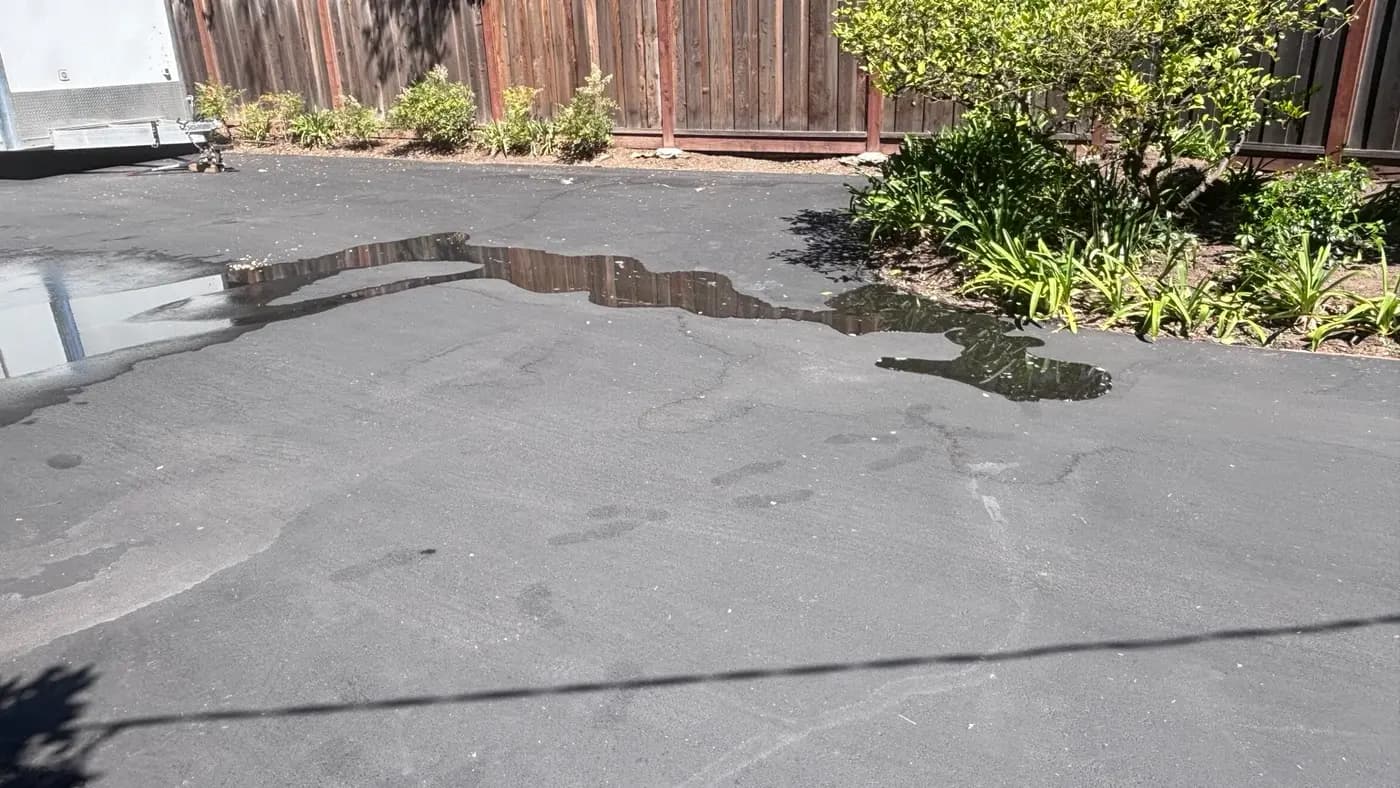
Water standing in places it never used to, often against buildings or at inlets, on a lot that has been resurfaced two or more times without milling.

Likely causes

  • Successive overlays raising the surface above inlet rims and curb reveals
  • Loss of the original designed slope through accumulated thickness
  • Settlement around structures that were not adjusted during resurfacing

When to get it looked at: If the inlet rim now sits above the pavement around it, another overlay makes it worse. Milling and adjusting structures is the correction.

Freight and port loading damage

Rutting, shoving, and cracking concentrated at entrances, dock aprons, and container staging on distribution properties around Baltimore and the I-70/I-81 corridors.

Likely causes

  • Axle and container loads exceeding the original design assumption
  • Trailer landing gear point-loading asphalt in drop lots
  • Slow and stationary loading during the hottest summer weeks
  • Entrance aprons built to the same section as the parking field

Paving and Maintenance Calendar for Maryland

Treat this as a planning aid, not a rule. Whether a given treatment can actually be placed on a given day depends on product requirements, surface and nighttime temperatures, the rain forecast, humidity, plant availability, the project specification, and the contractor’s means and methods.

Winter

Work often suited to this window

  • Snow and ice operations and monitoring for developing damage
  • Safety repairs, pothole patching, and trip hazard mitigation
  • Condition surveys, capital planning, and spring bid preparation

Scheduling risks

  • Paving and surface treatments are generally out of season across most of the state
  • Wet and frozen ground makes structural work unreliable
  • Salt and slush hide damage until the thaw exposes it

Inspect for: Watch where plowed snow is stockpiled and where the meltwater runs; that path concentrates freeze-thaw damage and shows it first in March.

Regional exception: Garrett and Allegany county sites see a materially harder and longer winter than the Lower Shore, and their maintenance calendars should not match.

Spring

Work often suited to this window

  • Full-depth repair of winter damage once subgrade firms up
  • Paving and overlays as temperatures stabilize
  • Drainage corrections and structure adjustments before summer storms

Scheduling risks

  • Thaw-weakened subgrade makes early structural work unreliable
  • Persistent spring rain keeps clay sites too wet to work
  • County stormwater review timelines can add weeks to a permitted project

Inspect for: Separate cracks that need sealing from areas that flex underfoot; the second group needs base repair and should not simply be overlaid.

Summer

Work often suited to this window

  • Sealcoating and surface treatments in warm, dry stretches
  • Reconstruction and heavy repair, usually phased around occupancy
  • Striping, signage, and accessible route upgrades

Scheduling risks

  • Afternoon thunderstorms interrupt or ruin surface applications
  • Humidity extends cure times beyond what temperature alone suggests
  • School and campus work compresses into the same weeks statewide

Inspect for: Inspect truck routes, loading zones, and drive-through lanes during the hottest part of the day, when rutting and shoving are visible.

Regional exception: Ocean City and shore resort properties often cannot take a lot out of service at all during peak season, which pushes major work to spring or fall.

Fall

Work often suited to this window

  • Crack sealing ahead of the first sustained freezes
  • Completing paving and overlays while conditions allow
  • Clearing inlets, swales, and stormwater facilities before winter

Scheduling risks

  • Western Maryland loses the window earlier than the tidewater counties
  • The product's requirements, surface and night temperatures, humidity, and the rain forecast decide whether a day works — not the date on the calendar
  • Tropical systems can still deliver heavy rain into the fall

Inspect for: Confirm every open crack is sealed and every stormwater structure is clear; a facility that fails to drain in December will not be fixed until spring.

Contractor Licensing and Verification in Maryland

Statewide licensing
Depends on scope and project value
Administering body
Maryland Department of Labor — Maryland Home Improvement Commission (residential home improvement work)

Maryland's answer depends on what kind of property you own. Residential home improvement work — which can include driveway work at a home — falls under the Maryland Home Improvement Commission, and contractors performing it are generally required to be licensed by the commission. That license is verifiable online, and the commission also administers a guaranty fund for eligible homeowner claims, which is a genuine advantage of hiring a licensed contractor for residential work.

Commercial paving is different. Maryland does not issue a statewide license specifically for commercial asphalt, concrete, sealcoating, or parking lot contractors. For a shopping center, office park, or industrial site, there is generally no state license to look up, so verification shifts to the entity, its insurance, and its record.

County and municipal requirements sit on top of both. Maryland counties and larger municipalities may require their own contractor registration, permits, or bonds for work performed in their jurisdiction, and these are not uniform across the state. Confirm with the county or city where the property sits, particularly before any work that changes grading or impervious area.

For any Maryland project, confirm the exact entity on the proposal is registered with the state and matches the name on the insurance certificate and the contract, and verify general liability and workers' compensation directly with the carrier for the dates of your work. Public projects add bonding, prequalification, and potentially prevailing wage requirements that are separate from anything described here.

What a contractor license does not prove

A home improvement license covers residential work and does not speak to commercial capability. For a commercial lot in Maryland there is usually no state credential at all, which makes verified insurance, county registration where required, and references on comparable local projects the substance of the check.

  • That the proposed scope is the right fix for what is actually failing
  • That the price is fair for the local market
  • That drainage has been designed or corrected
  • That the pavement section and thickness suit the traffic the property carries
  • That the specified materials are appropriate for the site
  • That the crew will show up when promised
  • That workmanship will hold up past the first winter or summer
  • That the company is financially stable enough to honor a warranty

Ask for a certificate of insurance sent directly from the carrier or agent rather than a copy forwarded by the contractor, confirm the general liability and workers’ compensation coverage is active on the dates of your work, and ask to be named as certificate holder so you are notified if the policy lapses.

Licensing requirements can turn on project value, scope of work, property location, and whether the job is public or private. City and county rules may add registration, permitting, or bonding requirements beyond anything required at the state level. Verify current requirements with the agency directly before contracting.

Last reviewed:

Stormwater and Environmental Considerations

Maryland administers construction stormwater and erosion and sediment control through the Department of the Environment, with counties and municipalities running approved local programs that usually handle the actual plan review. The distinguishing feature of Maryland's framework is its emphasis on environmental site design — the expectation that runoff is managed through small-scale, distributed practices to the maximum extent practicable before conventional structural facilities are relied on. For a paving project that means the review often asks how the site treats water, not just how much it detains.

That emphasis has a practical consequence property owners frequently discover late: how the work is classified determines how much review it attracts. Resurfacing in place is generally treated as maintenance. Expanding a lot, changing its footprint, or substantially regrading it can be treated as new development or redevelopment, which brings stormwater management design, plan approval, and often an engineer into a project the owner had budgeted as pavement work. Establishing that classification with the county early is the single most useful thing to do before setting a budget.

A second, separate layer applies near tidal water. Maryland's Critical Area program governs land within a defined distance of the Chesapeake Bay, the Atlantic Coastal Bays, and their tidal tributaries, and it imposes its own limits on impervious surface and development within that area. It is administered through local Critical Area programs and is distinct from ordinary stormwater review — a project can satisfy one and still need to address the other.

What tends to drive requirements here

  • Whether the county classifies the work as maintenance, redevelopment, or new development
  • Environmental site design expectations before conventional detention is accepted
  • Critical Area requirements on parcels near the Chesapeake Bay, the Atlantic Coastal Bays, and tidal tributaries
  • Local program review timelines, which can be the long pole in a permitted project
  • Any net change in impervious surface, which frequently triggers requirements
  • Erosion and sediment control, inlet protection, and sediment tracking during construction

Maryland counties and municipalities administer stormwater and Critical Area review locally and may apply requirements beyond the state minimum. Confirm with the local program before design, and confirm early — classification of the work drives the entire schedule.

Last reviewed:

Pavement Terms You May Encounter in Maryland

TermWhat it means on a Maryland project
Environmental site design (ESD)Maryland's approach of managing runoff with small, distributed practices integrated into the site rather than routing everything to one pond. On a lot project it can influence layout, island design, and where pavement can go.
Graded aggregate base (GAB)The compacted crushed stone layer placed beneath asphalt. Maryland proposals typically specify it by compacted thickness; how well that layer drains generally matters more to pavement life than the surface course does.
Superpave mix designationThe mix classification system used in Maryland specifications, which encodes nominal aggregate size and the traffic level the mix is designed for. Asking which designation is being priced is a fair way to check the mix suits your loading.
Milling (cold planing)Grinding off a controlled depth of existing asphalt before resurfacing so the finished surface holds its original relationship to curbs, doors, and inlets. Skipping it on an already-overlaid lot is a common cause of new ponding.
Critical AreaThe regulated land area near tidal waters in Maryland, subject to additional development and impervious surface requirements administered by local Critical Area programs. Whether a parcel is inside it is a location question worth answering early.
Tack coatThe thin bituminous bond applied between an existing surface and a new asphalt layer. It is easy to underspecify and it is a common contributor to overlays that slip or delaminate within a few years.

State transportation specifications can provide useful regional terminology and material references, but they do not automatically govern private parking-lot or driveway projects unless incorporated into the contract or required by the applicable jurisdiction.

More definitions are in the pavement glossary.

Common Pavement Projects in Maryland

Port and distribution facilities

Baltimore-area port-adjacent yards and I-95 distribution sites carry container and trailer loads that concentrate on aprons and staging areas, where the section usually needs to differ from the parking field.

Federal and defense installations

Facilities across central Maryland bring their own specifications, security-driven access constraints, and inspection expectations that reshape both the schedule and the submittal process.

Coastal resort and hospitality properties

Ocean City and Eastern Shore properties combine high groundwater, sandy subgrade, and a season during which the lot effectively cannot be closed, which forces work into narrow shoulder windows.

Life sciences and office campuses

Montgomery and Howard County campuses often sit on sites where any regrading pulls in county stormwater review, so scope decisions have permitting consequences well beyond the pavement.

Agricultural and poultry operations

Eastern Shore facilities put heavy, concentrated truck traffic on soft Coastal Plain subgrade, where drainage and edge support determine whether the pavement survives more than a few seasons.

Questions to Ask a Paving Contractor in Maryland

Maryland pavement FAQs

Does Maryland require a license to pave a commercial parking lot?

Generally there is no statewide Maryland license specific to commercial paving, sealcoating, or concrete work. Residential home improvement is different — that falls under the Maryland Home Improvement Commission and does require a license, which is verifiable online and comes with access to a guaranty fund for eligible homeowner claims. For a commercial property, verification shifts to confirming the entity's registration, verifying insurance directly with the carrier, checking whether the county requires its own registration, and calling references on comparable local work.

Why does resurfacing my Maryland lot suddenly require stormwater approval?

It usually comes down to how the reviewing county classifies the work. Resurfacing in place is typically treated as maintenance and attracts little review. Changing the footprint, regrading, or adding impervious surface can push the project into redevelopment or new development territory, which brings Maryland's stormwater management requirements and their environmental site design expectations into play — often with a design professional and a plan approval timeline attached. Getting that classification confirmed by the county before setting a budget avoids the most expensive surprise in Maryland pavement work.

What is the Critical Area and does it affect my parking lot?

Maryland's Critical Area program regulates land within a defined distance of the Chesapeake Bay, the Atlantic Coastal Bays, and their tidal tributaries, with its own limits on development and impervious surface administered through local programs. Whether it applies is purely a question of where the parcel sits. It operates separately from ordinary stormwater review, so a project can meet stormwater requirements and still need Critical Area consideration. If your property is anywhere near tidal water, ask the county's Critical Area contact before design rather than after.

Why do the edges of my Eastern Shore lot break up before the middle does?

Coastal Plain sands drain well but provide very little lateral support at an unconfined pavement edge. Without a curb, a thickened edge, or a compacted stabilized shoulder, a vehicle running the perimeter pushes the edge outward and downward, and runoff sheeting over that edge erodes the soil holding it up. The result is cracking parallel to the edge that progresses inward. Patching the same edge repeatedly does not address it; edge support and runoff control do.

How different is winter maintenance in Garrett County from the Lower Shore?

Substantially. Western Maryland's plateau counties see far more snowfall, deeper frost penetration, and many more freeze-thaw cycles than the tidewater counties, and pavement there takes sustained plowing and abrasive use every winter. A crack sealing program that is worthwhile in Salisbury is close to essential in Oakland, and site features like raised islands, drainage structures, and curb transitions should be detailed with a plow blade in mind. One statewide maintenance calendar does not fit Maryland.

Water now stands in my lot where it never used to. What changed?

The most common cause is accumulated overlay thickness. Each resurfacing that goes down without milling raises the pavement, and after two or three of them the surface can sit at or above the inlet rims and curb reveals that were supposed to drain it. The original slope is gone, and water has nowhere to go. Another overlay makes it worse. The correction is milling to restore grade and adjusting the drainage structures to match.

Should I sealcoat a Maryland parking lot, and how often?

Sealcoating is a surface protection measure, not a structural one, and its value depends on the pavement's condition and the property's expectations. On sound asphalt it slows oxidation and keeps the surface uniform; on pavement that is already cracking through the base it delays nothing and hides what an assessment should be seeing. Frequency depends on traffic, sun exposure, and the product, and it is worth asking a contractor to justify the interval they propose rather than accepting a standard cycle.

Is concrete a better choice than asphalt for Maryland truck areas?

For dock aprons, trailer landing areas, and dumpster pads, the case for concrete is strong. Trailers set down on landing gear concentrate load onto a very small area, dumpster trucks apply repeated point loading in the same spot, and both happen while asphalt is at its softest in a humid Maryland summer. Many owners here use concrete in those specific locations and asphalt for drive aisles and car parking. That is a considered split rather than a compromise.

Browse cities in Maryland

Browse services in Maryland

State and local licensing rules vary, and Maryland appears in the national comparison of commercial and residential paving-contractor requirements. Review the national paving-contractor licensing comparison, then verify current requirements with the applicable licensing authority.

Related reading for Maryland property owners

Standing water pooled near a parking lot drain inlet after rainfall.
Drainage & Sitework

Property-owner guide

Updated July 6, 2026

Parking Lot Drainage Problems: What Property Owners Should Know

Common causes of parking lot drainage problems, why they accelerate pavement damage, and what property owners should ask contractors before a fix.

Read guide
Property manager and asphalt paving contractor reviewing a cracked commercial parking lot together.
Contractor Hiring Guides

Property-owner guide

Updated July 6, 2026

How to Choose an Asphalt Paving Contractor

How to choose an asphalt paving contractor: project fit, relevant experience, written scope, references, insurance, and pavement qualifications.

Read guide
A parking lot edge where new asphalt overlay meets older, worn existing pavement.
Asphalt Paving

Property-owner guide

Updated July 6, 2026

Asphalt Paving vs Asphalt Overlay

Compare asphalt paving vs asphalt overlay. Learn when overlay works, when it fails, and what property owners should check before approving pavement resurfacing.

Read guide
Raised, offset sidewalk panel creating a trip hazard outside a commercial building, with panels summarizing common causes, repair options such as grinding, slab leveling, and patching, and liability considerations.
Concrete Repair

Property-owner guide

Updated July 11, 2026

Concrete Trip Hazards: Causes, Fixes, and Liability

What causes concrete trip hazards on sidewalks, how they are fixed by grinding, cutting, slab lifting, or replacement, and the ADA and liability stakes.

Read guide
Water pooling in a low spot of a parking lot due to poor drainage.
Parking Lot Maintenance

Property-owner guide

Updated July 6, 2026

Commercial Parking Lot Maintenance Guide

A guide to building a recurring parking lot maintenance plan for commercial properties, including inspection cycles and escalation triggers.

Read guide
Drainage & Sitework

Property-owner guide

Updated July 12, 2026

Grading and Slope Basics for Pavement

Grading and slope basics for pavement: what positive drainage means, why slope matters, common grading problems, and where engineering comes in.

Read guide

Maryland Agencies and Reference Links

This page summarizes publicly available information for general education. It is not legal, engineering, or code-compliance advice, and requirements change. Confirm anything that affects your project with the agency with jurisdiction over the property.

Regulatory content last reviewed:

For contractors

Are you a pavement contractor in Maryland?

Get listed where property managers, owners, and facility teams search by state, city, and service.