
Arkansas pavement guide
Pavement Conditions in Arkansas: Regions, Soils, and Common Problems
Arkansas splits into rocky, karst-prone highlands and soft Delta alluvium, with heavy freight loading running across both.
- 5 regions
- 5 common problems
- 6 local terms
Jump to section
Regional differences
Pavement Conditions by Region in Arkansas
Arkansas does not have one climate or one soil profile, and pavement that performs well in one part of the state can fail early a few hours away. These are the divisions that matter most when scoping paving, repair, or maintenance work.
Ozark Plateau and northwest Arkansas
Fayetteville · Springdale · Rogers · Bentonville · Harrison
Environmental stress
- Frequent freeze-thaw crossings through winter
- Heavy rainfall on thin soils over limestone
- Rapid growth and very heavy distribution and trucking traffic
Subgrade conditions
- Shallow limestone and dolomite with irregular rock surface
- Cherty residual clay filling voids between rock pinnacles
- Karst features including sinkholes and solution channels
Common distress
- Circular depressions with little cracking around their perimeter
- Differential settlement across rock-to-soil transitions
- Rutting and shoving at distribution entrances and aprons
What it means for the work
- Rock excavation quantity is a frequent source of change orders
- Concentrated infiltration over karst warrants geotechnical input
- Freight loading here justifies a heavier section than the parking field
Arkansas River Valley
Little Rock · North Little Rock · Fort Smith · Conway · Russellville
Environmental stress
- Hot, humid summers with high pavement surface temperatures
- Freeze-thaw cycling through winter without long deep freezes
- Very heavy interstate freight traffic along the I-40 corridor
Subgrade conditions
- Alluvial silts and clays on river terraces
- Clay-rich soils with moderate shrink-swell behavior
- Shale and sandstone bedrock at variable depth in the valley walls
Common distress
- Alligator cracking where lots drain slowly
- Rutting at truck stops, terminals, and dock approaches
- Seasonal cracking driven by soil moisture change
What it means for the work
- Subgrade moisture control matters as much as compaction on clay
- Floodplain status affects what is permissible on valley-floor sites
- Phasing around continuous operations usually drives the schedule
Ouachita Mountains
Hot Springs · Mena · Arkadelphia · Mount Ida
Environmental stress
- High rainfall on steep, rocky terrain
- Concentrated slope runoff after heavy storms
- Timber and log truck traffic on rural commercial sites
Subgrade conditions
- Thin, rocky soils over sandstone, shale, and novaculite
- Steep sites with limited flat working area
- Colluvium and slope debris at the base of cut faces
Common distress
- Erosion and undermining at pavement edges on grades
- Slope movement pulling pavement apart at a downhill edge
- Rutting and edge break-up on timber haul routes
What it means for the work
- Retaining and drainage work often exceeds the paving cost on steep sites
- Rock excavation should be a unit price rather than an assumption
- Log truck loading is a design load far beyond ordinary commercial use
West Gulf Coastal Plain and southern Arkansas
Texarkana · El Dorado · Camden · Magnolia · Pine Bluff
Environmental stress
- Long, hot, humid summers with mild winters
- Heavy rainfall with localized flooding
- Timber, paper, and chemical industry truck traffic
Subgrade conditions
- Sandy and clayey coastal plain soils with variable behavior
- Locally expansive clays in some formations
- Poorly drained flatwoods soils in low areas
Common distress
- Edge break-up where pavement is unconfined on sandy ground
- Ponding on flat sites with no viable outlet
- Heat-driven rutting at slow-traffic and turning areas
What it means for the work
- Edge confinement matters more than owners expect on sandy soils
- Industrial loading justifies a different section at entrances and aprons
- Nearly year-round working weather, though wet spells limit earthwork
Mississippi Alluvial Plain and Crowley's Ridge
Jonesboro · West Memphis · Blytheville · Stuttgart · Helena-West Helena
Environmental stress
- Mild winters with frequent saturation rather than deep freezing
- Very heavy agricultural and grain truck traffic in season
- River flooding and backwater on low-lying parcels
Subgrade conditions
- Deep, soft alluvial silts and clays with limited bearing capacity
- Deep wind-deposited loess along Crowley's Ridge
- High water table and almost no natural fall across many parcels
Common distress
- Broad settlement rather than isolated failures
- Rapid gullying where runoff reaches bare loess on the ridge
- Base saturation producing interconnected cracking
What it means for the work
- Positive drainage must be designed, not assumed, on ground this flat
- Subgrade improvement is often the deciding cost item, not the asphalt
- Loess on the ridge erodes very quickly once concentrated water reaches it
Field conditions
Common Pavement Problems in Arkansas
Karst settlement in the Ozarks
A rounded depression that keeps deepening in an otherwise sound northwest Arkansas lot, typically with little or no cracking radiating from its edge, and that returns after being filled.
Likely causes
- Soil migrating downward into solution channels in the limestone below
- Concentrated runoff discharged onto a single point over karst ground
- A leaking storm or utility line washing fines into an existing void
- Previously filled features reactivating as water finds them again
When to get it looked at: Investigate below the pavement before filling a returning depression a second time. Additional asphalt is additional weight over a void that has not stopped enlarging.
Distribution and freight loading damage
Rutting, shoving, and cracking concentrated at entrances, dock aprons, and trailer parking on northwest Arkansas and I-40 corridor properties, while the adjacent car lot stays sound.
Likely causes
- Axle loads far beyond the original design assumption
- Trailer landing gear point-loading asphalt in drop lots
- Slow and stationary loading through hot, humid summers
- Entrance aprons built to the same section as the parking field
When to get it looked at: Damage that stops abruptly where truck movement stops is a section question. Ask whether concrete is warranted at aprons and trailer landing areas rather than a thicker asphalt patch.
Soft subgrade settlement in the Delta
Broad, gradual settlement across large portions of a lot rather than localized failures, often with pavement that feels soft or flexes under a slow-moving truck.
Likely causes
- Deep, soft alluvial soils with limited bearing capacity
- High groundwater keeping the subgrade near saturation
- Flat grading with no viable outlet for surface water
- Heavy seasonal loading applied to a light-duty section
When to get it looked at: Broad settlement rather than pothole-and-crack failure points to bearing capacity. Adding thickness over ground that cannot support it returns you to the same condition at greater cost.
Loess erosion on and around Crowley's Ridge
Rapid gullying, undercutting, and edge loss where runoff leaves a lot onto bare wind-deposited soil, sometimes progressing dramatically after a single storm.
Likely causes
- Concentrated discharge onto erodible loess with no energy dissipation
- No armored outfall, curb, or stabilized shoulder at the discharge point
- Steep slopes below the pavement edge
- Disturbed ground left unstabilized after construction
When to get it looked at: If a gully has formed at an outfall, the pipe is not the problem — the discharge condition is. Repairing the gully without dissipating the energy repeats it in the next storm.
Slope-edge failure in the Ouachitas
Cracking parallel to the downhill edge of a hillside lot, with the outer portion dropping relative to the rest, and washed-out soil visible beneath the pavement edge.
Likely causes
- Runoff discharging over an unprotected pavement edge on a grade
- Fill placed on a slope without adequate compaction or benching
- No curb, shoulder, or armored outfall at the low side
- Saturated colluvium moving slowly downslope
Property types
Common Pavement Projects in Arkansas
Distribution centers and trucking terminals
Northwest Arkansas and the I-40 corridor concentrate trailer and terminal traffic where aprons and drop lots fail years before the parking field does, which argues for different sections in different zones.
Poultry and food processing facilities
Continuous heavy truck movement combined with wash-down water keeps the pavement and its base wetter than an ordinary industrial site, accelerating every deterioration mechanism.
Corporate campuses in northwest Arkansas
Rapidly built campuses on shallow limestone combine rock excavation variability with karst risk, so the subsurface question deserves attention before a section is priced.
Agricultural and grain facilities
Delta elevators and rice and soybean operations take a year of heavy loading in a few weeks, on some of the softest and flattest ground in the state.
Tourism and resort properties
Hot Springs and northwest Arkansas visitor properties sit on steep or rocky ground with concentrated seasonal traffic and narrow windows during which work can happen at all.
Plain English
Pavement Terms You May Encounter in Arkansas
| Term | What it means on a Arkansas project |
|---|---|
| Class 7 aggregate base | A crushed stone base gradation referenced on Arkansas projects. Proposals typically name the base class and compacted thickness, and how well that layer drains generally governs pavement life more than the surface course. |
| Proof rolling | Driving a loaded truck over the prepared subgrade and watching for deflection before base is placed. On Arkansas's variable subgrade — rock pinnacles in the north, soft alluvium in the east — it is the cheapest way to find trouble early. |
| Undercut and stone backfill | Removing subgrade found unsuitable during construction and replacing it with compacted stone. It is common on both Delta and highland sites, and it should be priced as a unit item with a clear rule for who determines it is needed. |
| Sinkhole throat | The opening through which soil is draining into a karst void below. Filling the surface depression without addressing the throat and the water reaching it generally means the depression returns. |
| Geogrid and geotextile stabilization | Materials placed between soft subgrade and the aggregate above it to keep the two from mixing and to spread load. On soft Delta ground it is a legitimate and often necessary line item worth asking about. |
| Full-depth reclamation | Pulverizing existing asphalt with the base, treating or reshaping the blend, and paving over it. It appears on larger Arkansas lots and private roads where the base has failed and hauling everything off is impractical. |
State transportation specifications can provide useful regional terminology and material references, but they do not automatically govern private parking-lot or driveway projects unless incorporated into the contract or required by the applicable jurisdiction.
More definitions are in the pavement glossary.
Before you sign
Questions to Ask a Paving Contractor in Arkansas
- Does your Arkansas contractor license classification cover the work in this proposal?
- Has anyone evaluated whether this site sits on karst, and does that change your approach?
- For the depression that keeps returning, what do you think is happening below the pavement?
- Will the subgrade be proof-rolled before base is placed, and can I be present?
- If you find unsuitable subgrade, how is undercut measured and priced, and who decides it is needed?
- On this Delta site, is geogrid or geotextile stabilization included, and why or why not?
- Where does runoff discharge, and what is protecting the soil at that discharge point?
- Is the dock apron or trailer area getting a different section from the car parking, and why?
- What surface and overnight temperatures does the product you have proposed require, and how does humidity affect the cure?
Arkansas pavement condition FAQs
Why does a depression in my northwest Arkansas lot keep coming back?
The Ozark Plateau is karst — limestone and dolomite that groundwater has dissolved into channels and voids over a very long time. Soil above those channels can migrate downward, and the pavement settles into the space left behind. The distinguishing sign is a rounded depression with little cracking radiating from its edge, unlike base failure, which cracks in an interconnected pattern first. Because the void below can keep enlarging, filling the dip with asphalt adds weight without addressing the cause.
Why do the truck areas at my Arkansas distribution facility fail first?
Because they carry a completely different load. Loaded trailers impose axle weights far beyond what a car parking section is built for, and trailer landing gear concentrates a very large load onto two small pads while the trailer sits stationary — often through the hottest, most humid weeks of an Arkansas summer, when asphalt resists deformation least. Damage that stops abruptly where truck movement stops is a section question, and concrete is frequently the right answer at aprons and landing areas.
Why does my Delta parking lot settle across whole areas rather than in spots?
Sites in the Mississippi Alluvial Plain sit on deep, soft, saturated silts and clays with limited bearing capacity, on ground so flat that there is often no natural fall to drain it. That combination produces broad, gradual settlement rather than the localized failures common on firmer ground. The controlling decisions are subgrade improvement — including stabilization materials where warranted — and designed positive drainage. Additional asphalt over ground that cannot support it returns you to the same place at greater cost.
Why did a gully appear at my Crowley's Ridge outfall after one storm?
Loess. Crowley's Ridge and other loess deposits carry deep wind-blown silt that stands nearly vertical when dry and undisturbed and erodes remarkably quickly once concentrated water reaches it. A pipe discharging without energy dissipation can cut a substantial gully in a single event. Repairing the gully without changing the discharge condition simply repeats it. Armored outfalls, dissipation structures, and prompt stabilization of disturbed ground are practical necessities on that soil.
How much does humidity affect paving work in Arkansas?
More than owners generally expect. Many pavement products cure by losing water or solvent to the air, and very humid air slows that considerably. Sealcoats, some crack sealants, striping paint, and surface treatments can all take substantially longer to cure here than the temperature alone suggests, and returning traffic to a surface that has not cured is a common way to ruin new work. When a contractor gives you a return-to-service time, ask what humidity assumption it is based on.
Related reading for Arkansas property owners
Property-owner guide
Updated July 6, 2026
How to Choose an Asphalt Paving Contractor
How to choose an asphalt paving contractor: project fit, relevant experience, written scope, references, insurance, and pavement qualifications.
Property-owner guide
Updated July 6, 2026
Parking Lot Drainage Problems: What Property Owners Should Know
Common causes of parking lot drainage problems, why they accelerate pavement damage, and what property owners should ask contractors before a fix.
Property-owner guide
Updated July 6, 2026
Asphalt Paving Thickness for Parking Lots
Typical asphalt paving thickness for parking lots: benchmarks for stalls, drive lanes, and truck areas, plus how base and soil change the answer.
Property-owner guide
Updated July 12, 2026
How Drainage Affects Pavement Life
Why drainage is the biggest factor in how long pavement lasts, how water damages asphalt from the base up, and why fixing it protects every repair.
Property-owner guide
Updated July 11, 2026
When Should You Seal Asphalt Cracks?
When to seal cracks in asphalt — which cracks to seal, the best time of year, why sealing early matters, and how crack sealing fits a maintenance schedule.
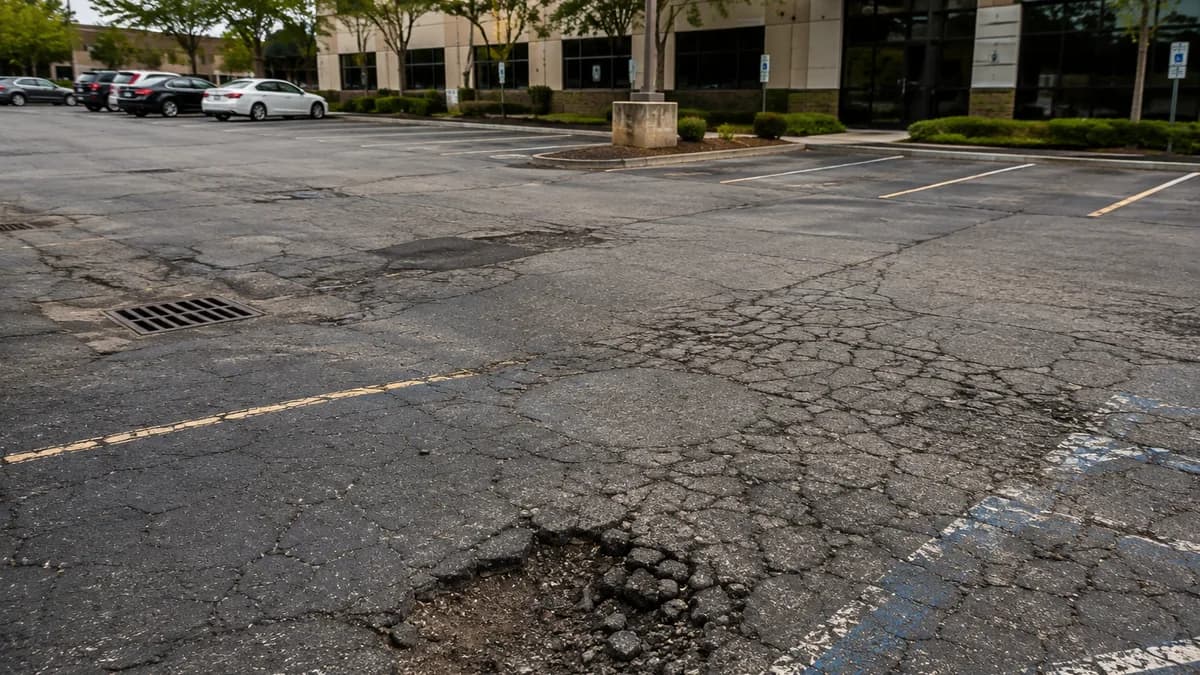
Property-owner guide
Updated July 11, 2026
Signs Your Parking Lot Needs Maintenance
How to read the warning signs a parking lot needs attention — cracks, potholes, faded striping, ponding, raveling — and what each one means.
Before you hire: The Pavement Directory does not guarantee contractor performance, pricing, licensing, insurance, or availability. Business information may be submitted by contractors or gathered from public sources and should be independently verified before hiring. Always confirm licensing, insurance, references, scope of work, and written contract terms.
For contractors
Ready to compare Arkansas contractors?
Browse listings by city and service, then use what you have read here to check the scope, the credentials, and the timing before you sign.