

What this guide covers
Disturbed soil, not total paved area or contract value, is central to the statewide one-acre applicability test.
Municipal grading, erosion-control, and post-construction stormwater requirements can apply even when statewide permit coverage does not.
Coverage continues until the Notice of Termination is submitted and approved. Physical completion alone does not end permit obligations.
Related contractor categories
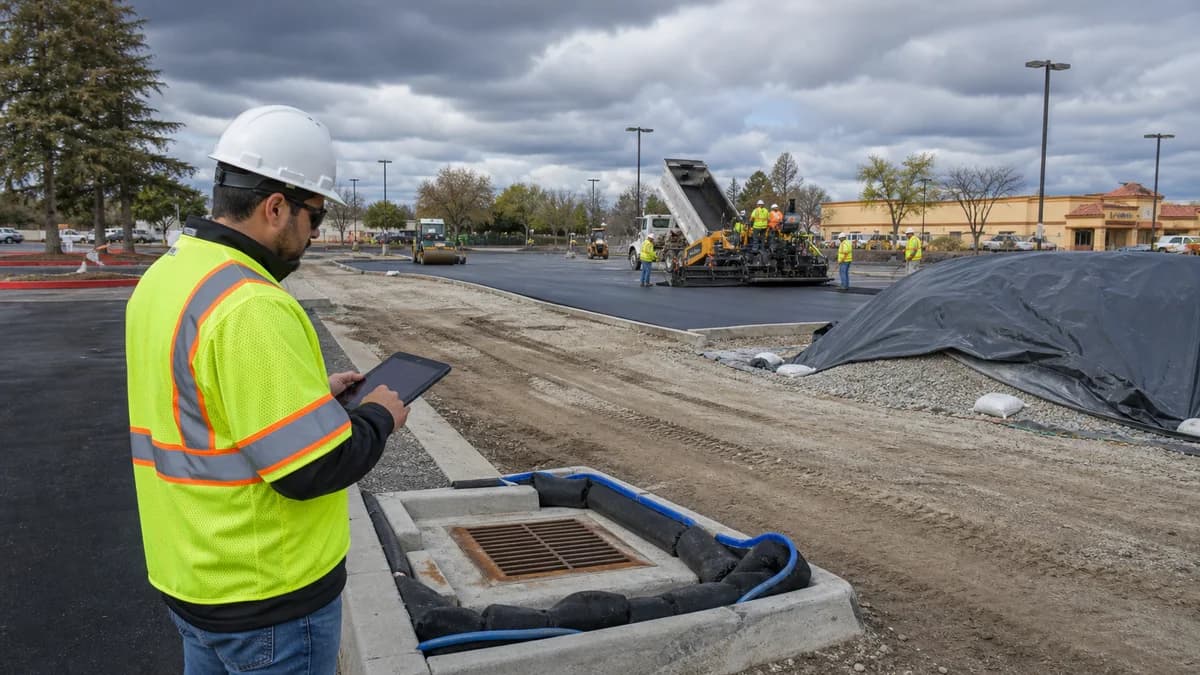
When paving work may require permit coverage
The State Water Board identifies construction activity that disturbs one acre or more of soil, or less than one acre when part of a larger common plan that reaches one acre, as generally subject to the Construction General Permit. Clearing, grading, excavation, stockpiling, and connected site development can contribute to disturbed area.
Regular maintenance performed to restore the original line, grade, or capacity of a facility is excluded from the permit's construction-activity definition. That is not a universal asphalt exemption. Base reconstruction, widening, drainage work, new grades, staging, or related phases can change the facts. The Lake Tahoe Hydrologic Unit follows a separate regional construction stormwater permit.
How to calculate disturbed area
Map every place where soil is exposed or disturbed, including pavement removal that reaches base or subgrade, grading, trenching, drainage features, material storage, temporary access, landscaping, and off-site support areas that belong to the plan. Do not substitute total pavement area without examining the construction method.
| Area or activity | Applicability question | Project record |
|---|---|---|
| Full-depth pavement removal | Will base or soil be exposed or reworked? | Limits and removal depth |
| Mill and overlay | Does milling remain within pavement, and what repairs or staging are connected? | Milling depth, repair map, and stockpile areas |
| Grading and drainage | Where will excavation, fill, swales, basins, or utilities disturb soil? | Grading and utility plans |
| Staging and stockpiles | Are temporary support areas part of the construction site? | Logistics and erosion-control plan |
| Larger common plan | Is this phase part of related development or sale activity? | Master plan, permits, contracts, and schedule |
SWPPP, QSD, and QSP roles
A SWPPP identifies project activities, pollutant sources, site conditions, erosion and sediment controls, good housekeeping, inspections, monitoring, reporting, and responsible parties. Under the 2022 permit, a QSD develops and revises the plan. A QSP implements it and performs or oversees required site activities within the permit's role structure.
The discharger is the legally responsible entity and remains responsible when consultants or contractors perform technical tasks. Contracts should define who holds SMARTS authority, who responds to rain forecasts and field conditions, who samples when required, and who pays for corrections and closeout.
Permit Registration Documents and SMARTS
Covered dischargers submit Permit Registration Documents electronically through the Stormwater Multiple Application and Report Tracking System, or SMARTS. The package can include the Notice of Intent, risk information, site map, SWPPP, post-construction documentation, certifications, and fees required by the permit and system.
Plan the filing before mobilization. Agency processing, ownership signatures, professional work, fee payment, and a Waste Discharger Identification number can affect the start date. Do not treat a draft SWPPP as evidence that coverage is active.
Risk levels, BMPs, inspections, and monitoring
The permit uses project and receiving-water information to establish applicable requirements. Erosion and sediment risk, active construction, season, pollutants, and discharge conditions affect BMP selection and monitoring. A generic binder cannot substitute for a site-specific plan that changes with the work.
Paving projects commonly need controls for run-on, exposed soil, stockpiles, concrete washout, fueling, leaks, track-out, inlet protection, paving materials, sawcut slurry, waste, and stabilization. The QSD and QSP determine the permit-specific program; local ordinances and specifications may add controls.
SWPPP vs. local erosion control and post-construction review
A project below the statewide coverage threshold can still need a local erosion and sediment control plan under grading or stormwater ordinances. Separately, municipal post-construction rules evaluate permanent runoff controls using new or replaced impervious surface and project categories rather than the statewide disturbed-soil threshold.
In the Bay Area, review Bay Area 5,000-Square-Foot Stormwater Rule. Do not use the one-acre and 5,000-square-foot numbers as substitutes for one another.
Closeout and Notice of Termination
Coverage does not end automatically when paving is complete. The discharger must meet the permit's stabilization and closeout conditions, submit a Notice of Termination in SMARTS, and receive approval from the applicable Regional Water Board. Until then, inspection, monitoring, reporting, and fee obligations can continue.
Build closeout into the schedule. Collect final stabilization evidence, remove temporary controls when authorized, resolve open corrective actions, complete post-construction measures, organize records, and identify who will track the Notice of Termination review.
Owner planning checklist
Resolve permit responsibility before the paving contract is awarded.
- Complete project and larger common plan identified
- Disturbed-soil map and acreage calculation prepared
- Statewide or Lake Tahoe permit path confirmed
- Discharger and SMARTS account authority assigned
- QSD and QSP retained early enough for design and mobilization
- Permit coverage and WDID verified before applicable construction starts
- Rain response, inspections, monitoring, and corrective action responsibilities written into contracts
- Final stabilization and Notice of Termination included in schedule and budget
Editorial sources
This guide was reviewed against current State Water Board sources on August 2, 2026. Check the adopted permit, current FAQs, SMARTS instructions, and Regional Water Board direction for the project.
Frequently asked questions
When does a California paving project need a SWPPP?
A SWPPP is part of Construction General Permit coverage, which generally applies at one acre or more of soil disturbance or when a smaller project is part of a larger common plan that reaches one acre. Project facts and the applicable permit control.
Does one acre of asphalt automatically require a SWPPP?
No. The statewide test focuses on disturbed soil and the larger common plan, not total asphalt area alone. Full-depth work may disturb soil while some surface-only work may not.
Does a mill and overlay require a SWPPP?
Not automatically. Review milling depth, base repairs, grading, drainage, staging, stockpiles, and related phases to calculate actual disturbed soil and classify the work.
What is a SWPPP?
A Stormwater Pollution Prevention Plan is a site-specific document describing construction activities, pollutant sources, BMPs, inspections, monitoring, reporting, and responsible parties under applicable permit coverage.
What is the difference between a QSD and QSP?
A Qualified SWPPP Developer develops and revises the SWPPP. A Qualified SWPPP Practitioner implements the plan and performs or oversees required field compliance activities under the permit.
What is SMARTS?
SMARTS is the State Water Board's online system for stormwater applications, certifications, reports, permit records, and termination submissions.
Can the contractor be the discharger?
Legal responsibility depends on ownership, control, and the permit's discharger provisions. The parties should determine and document the responsible entity rather than assuming the paving contractor automatically holds coverage.
Does a project below one acre need erosion controls?
It can. Local grading and stormwater ordinances commonly prohibit sediment discharges and may require an erosion-control plan even without statewide Construction General Permit coverage.
Does coverage end when construction is finished?
No. Coverage continues until termination conditions are met and the Notice of Termination is submitted in SMARTS and approved by the applicable Regional Water Board.
Before you hire: This guide provides general educational information, not legal, environmental, engineering, or permit advice. The adopted permit, Regional Water Board, State Water Board, local agencies, site conditions, project documents, and qualified stormwater professionals control project obligations.
For property owners
Looking for a pavement contractor?
Use The Pavement Directory to search asphalt, concrete, sealcoating, striping, ADA access, and pavement maintenance contractors by service and location. Always verify license, insurance, references, and written scope before hiring.
Browse California drainage contractorsFor contractors
Are you a pavement contractor?
Contractors can add or claim a company profile to help property owners find pavement professionals by service, location, and specialty.