

What this guide covers
California pavement projects can be affected by contractor licensing rules, accessibility standards, stormwater permits, local development requirements, and environmental controls. The requirements depend on the project type, disturbed area, location, ownership, and whether the work is classified as maintenance, repair, redevelopment, or new construction.
Property owners should not assume every asphalt repair, overlay, reconstruction, or striping project is governed by the same rules. State requirements can overlap with regional permits, city ordinances, county standards, fire authority criteria, and project-specific conditions of approval.
Start with the local planning, building, public works, and stormwater contacts for the property. For the contractor side of the review, use California paving contractor license requirements and independently verify the license record before award.
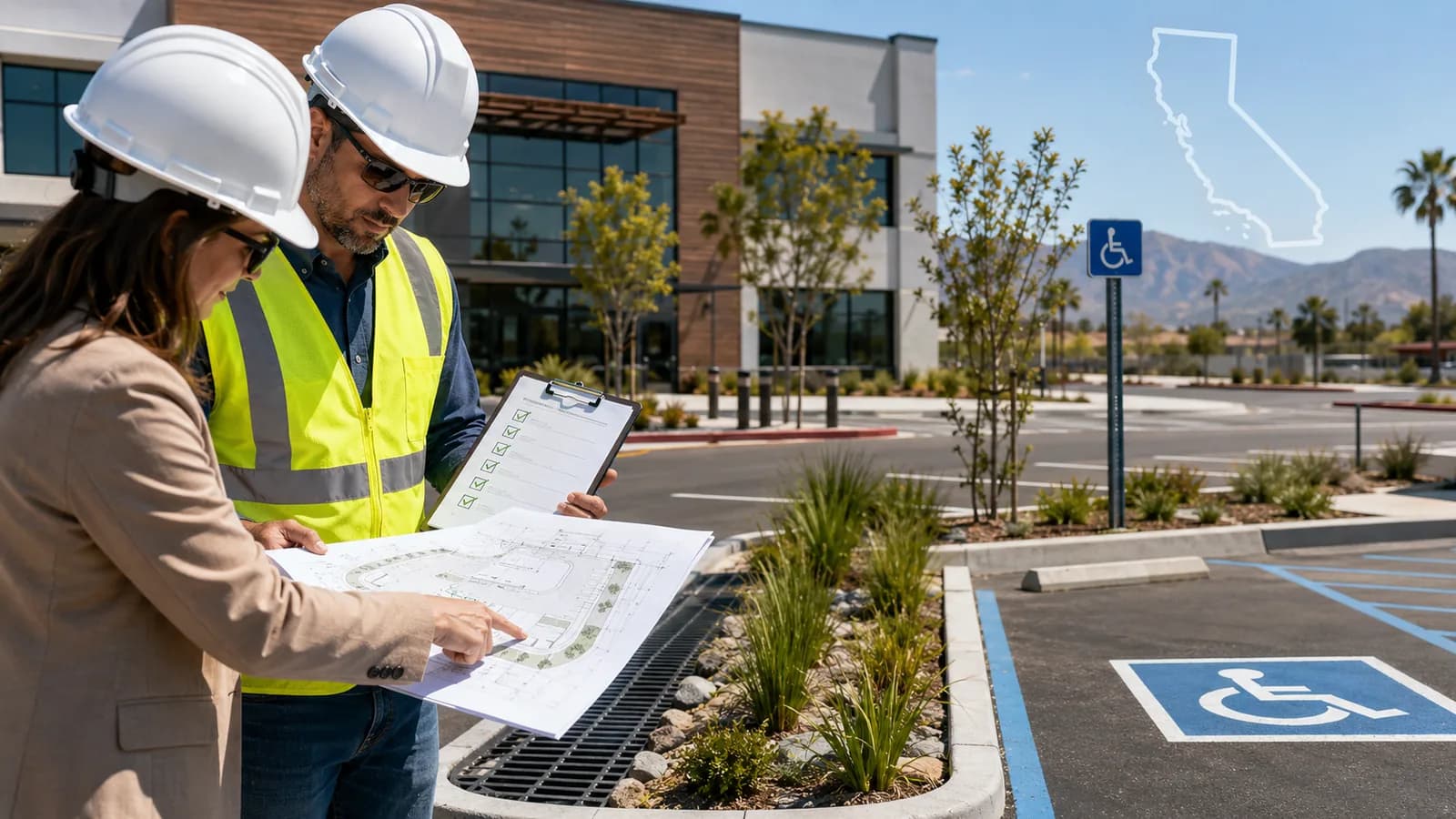
Quick summary of California pavement regulations
A California pavement project may require more than a paving proposal. The practical review usually covers five layers: who is licensed to perform the work, whether the parking and access layout is affected, how runoff and construction discharges are handled, which local permits apply, and whether the site has special conditions such as a public right of way, coastal location, hillside, fire lane, or prior development approval.
- Define the complete scope, including demolition, excavation, grading, base repair, paving, coatings, striping, signs, drainage, and landscaping.
- Measure disturbed soil and new or replaced impervious surface separately. They are used by different stormwater programs.
- Ask the city or county which permits, prior approvals, and current code edition apply before the contract is signed.
- Verify contractor classifications against the actual work, not the company name.
- Use qualified accessibility, civil engineering, stormwater, or environmental professionals when the scope needs their judgment.
Why California pavement requirements vary by project and jurisdiction
California does not have one universal permit called a paving permit. A private parking lot may be reviewed by a city building division, public works department, planning department, municipal separate storm sewer system program, fire authority, air district, or another agency. A state highway connection can bring in Caltrans. A coastal property can involve a local coastal program or the California Coastal Commission. Public, school, state, federal, tribal, and special district properties can have different reviewers.
Project labels are not controlling by themselves. Agencies may distinguish routine maintenance from alteration, redevelopment, reconstruction, or land disturbance by examining what is removed, what is replaced, how much soil is disturbed, whether grades or drainage change, and whether permits or discretionary approvals are needed. Phasing does not necessarily turn one planned project into unrelated small projects. Give the reviewer the complete anticipated scope and schedule.
| Requirement area | Projects that may be affected | Authority or reviewer | Questions to verify |
|---|---|---|---|
| Contractor licensing | Paving, grading, coatings, striping, signs, and related improvements | California Contractors State License Board (CSLB) | Which classification covers each contracted activity? |
| Accessible parking | Alterations to parking, routes, entrances, curbs, or site features | Local building official, design professional, or Certified Access Specialist (CASp) | Does the scope alter accessible features or the path of travel? |
| Municipal stormwater | Development or redevelopment creating or replacing impervious surface | City or county MS4 and applicable Regional Water Board permit | What threshold, definition, treatment, and exemption applies locally? |
| Construction stormwater | Soil disturbance of one acre or more, or part of a larger common plan | State Water Board or applicable Regional Water Board | What is the total disturbed area and is separate regional coverage required? |
| Grading | Excavation, fill, slope work, drainage changes, or base reconstruction | City or county engineering, building, or public works department | Is a grading plan, erosion plan, bond, or inspection required? |
| Encroachment | Driveways, curb returns, sidewalks, utilities, or work in public right of way | City, county, or Caltrans | Who owns the right of way and what traffic control is required? |
| Fire lanes | Restriping, access-road changes, curbs, gates, or designated fire apparatus routes | Local fire department or fire district | Must the layout, wording, color, signs, or dimensions be approved? |
| Permeable pavement | Projects using infiltration as a site design or treatment measure | Municipal stormwater reviewer and geotechnical or civil design team | Are soil, groundwater, loading, overflow, and maintenance conditions suitable? |
| Bioretention | Projects routing runoff to landscaped treatment areas | Municipal stormwater reviewer and civil or landscape design team | What sizing, soil media, underdrain, planting, and maintenance rules apply? |
| Disposal and hauling | Milling, demolition, soil export, imported base, or contaminated material | Local agency, air district, waste facility, and project specifications | Where will material go and what tickets, routes, or controls are required? |
| Planning conditions | Redevelopment, use changes, discretionary approvals, or previously conditioned sites | City or county planning department | Do old approvals dictate parking, landscaping, drainage, lighting, or access? |
California contractor licensing for paving work
The California Contractors State License Board (CSLB) regulates contractor licenses and classifications. The correct classification follows the work in the contract. The official C-12 Earthwork and Paving classification includes earthwork and the mixing, fabricating, and placement of paving and surfacing materials. The C-32 Parking and Highway Improvement classification covers listed parking and highway improvements such as protective coatings, vehicle stops, guardrails, directional lines, markers, signs, and arrows, but its text expressly excludes repaving those surfaces.
An A General Engineering contractor classification covers specified fixed works requiring specialized engineering knowledge, including highways, streets, roads, drainage, grading, paving, and surfacing work connected with those works. That does not mean every parking lot contract automatically belongs under A. Review the complete scope and obtain a CSLB classification determination when the boundary is unclear.
Accessible parking and California Building Code considerations
Accessible parking review can involve the California Building Code (CBC), federal accessibility standards, the permitted scope, and the facility's alteration history. The California Building Standards Commission publishes the current California Building Standards Code. The California Commission on Disability Access also provides an official Guide to Accessible Parking for parking lot construction and maintenance contexts.
Restriping or repaving should not be treated as an automatic answer to whether upgrades are required. Work can affect stall count, access aisles, slopes, signs, curb ramps, detectable warnings, and the accessible route from parking to the facility. The Division of the State Architect explains that alterations can require an accessible path of travel to the altered area, including connections to site arrival points such as accessible parking. A Certified Access Specialist property inspection can help identify which standards apply based on the facility and its improvement history.
California municipal stormwater requirements
A municipal separate storm sewer system (MS4) is a publicly operated system that conveys stormwater. MS4 permits issued by California Regional Water Quality Control Boards require covered cities and counties to implement development and redevelopment controls. Those local programs can require site design, source control, treatment, operation and maintenance obligations, and documentation before a city issues approvals.
Low Impact Development (LID) is a design approach that manages runoff near its source. Best Management Practices (BMPs) are structural or operational controls used to prevent or reduce pollutants and runoff impacts. Whether municipal stormwater review applies depends on the governing permit, local ordinance and guidance, project category, approval type, and the amount of new or replaced impervious surface. Impervious surface is a hard surface, such as conventional asphalt or concrete, that limits water infiltration.
Bay Area 5,000-square-foot stormwater threshold
The Bay Area threshold should not be treated as one uniform statewide California paving rule. Under the San Francisco Bay Regional Water Board's Municipal Regional Stormwater Permit (MRP), Order R2-2022-0018, certain Provision C.3 thresholds changed from 10,000 to 5,000 square feet beginning July 1, 2023. Covered municipalities implement those requirements through their own development review processes.
Redevelopment generally concerns work on a previously developed site, but the applicable permit supplies the controlling definition. The calculation can focus on impervious surface created or replaced, not simply the paving contract value or total parcel area. Thresholds, exclusions, grandfathering rules, road and parking-lot categories, treatment requirements, and local forms vary by permit and jurisdiction. Alameda County's official Clean Water Program development guidance identifies pavement and parking lots as impervious area and publishes current C.3 technical materials for local implementation.
Do not assume patching, sealcoating, an overlay, full-depth replacement, or phased work is automatically included or excluded. Ask the municipal stormwater reviewer to classify the complete scope in writing. Provide a plan showing retained, removed, replaced, and newly created impervious surfaces, plus any soil disturbance and drainage changes.
Construction Stormwater General Permit and land disturbance
The statewide Construction Stormwater General Permit is a separate program from municipal post-construction stormwater review. The State Water Board Construction Stormwater Program states that projects disturbing one acre or more of soil, or less than one acre when part of a larger common plan of development or sale that disturbs one acre or more, generally require permit coverage. Clearing, grading, stockpiling, and excavation can count as construction activity.
The Water Board says regular maintenance performed to restore the original line, grade, or capacity of a facility is not construction activity under this permit. That language is not a blanket paving exemption. Full-depth reconstruction, base removal, widening, drainage work, staging, stockpiles, and connected phases can change the analysis. The Lake Tahoe Hydrologic Unit uses a separate regional construction stormwater permit, which is another reason to confirm the location-specific path.
SWPPP, QSD, and QSP considerations
A Stormwater Pollution Prevention Plan (SWPPP) is the site-specific plan used to identify construction activities, pollutant sources, BMPs, inspection and monitoring procedures, and responsible parties under applicable permit coverage. The State Water Board's 2022 Construction Stormwater General Permit resources explain that covered dischargers use qualified stormwater professionals to develop and implement SWPPPs.
A Qualified SWPPP Developer (QSD) generally develops and revises the SWPPP. A Qualified SWPPP Practitioner (QSP) generally implements the plan, conducts required activities, and supports inspection and monitoring obligations. Roles depend on the permit and project. The discharger remains ultimately responsible for compliance, even when consultants or contractors perform QSD or QSP services. Confirm responsibility, reporting access, inspection coverage, rain-event response, and closeout before mobilization.
Permeable pavement and Low Impact Development
Permeable pavement allows water to pass through openings or a porous surface into an underlying stone reservoir and, where appropriate, soil. It may be used as an LID site design or treatment measure, but California does not require permeable pavement for every paving project. Municipal permit conditions may require runoff reduction or treatment while allowing more than one compliant design approach.
A workable design considers traffic loading, subgrade, infiltration rate, groundwater separation, nearby foundations, utilities, slopes, underdrains, overflow routing, sediment exposure, and maintenance access. Treating permeable pavement as a simple material substitution can cause clogging, settlement, or drainage problems. Use the local C.3 or equivalent manual and qualified civil and geotechnical input where the system is part of compliance.
Bioretention areas, bioswales, and rain gardens
Bioretention is a landscaped treatment system that filters and temporarily stores runoff through engineered soil and vegetation. Bioswales convey and treat runoff in a vegetated channel. Rain gardens are shallow planted depressions, but that informal label does not establish that a feature meets a permit's engineered treatment standard.
Paving work can alter the tributary area, curb cuts, elevations, inflow points, overflow routes, and sediment load reaching these systems. A contractor should not pave over, isolate, or redirect runoff away from an approved facility without design review. Confirm sizing, soil media, underdrain, planting, protection during construction, inspection, and long-term maintenance requirements with the municipal reviewer and project designer.
Local permits and municipal requirements
A city or county may require building, grading, site development, demolition, stormwater, planning, or public works review. Permit triggers can depend on excavation depth, cut and fill quantities, slope, drainage modifications, retaining conditions, surface replacement, use, or prior conditions of approval. Local noise hours, traffic control, staging, tree protection, and business operations can also affect how work is scheduled.
Ask for a parcel-specific permit history and identify any approved parking count, landscape plan, drainage plan, accessible route, conditional use permit, or development agreement that the pavement scope could change. A contractor's statement that a permit is unnecessary is useful input, but the authority having jurisdiction should make the final permit determination.
Encroachment permits for work in public rights of way
Work at driveways, curb returns, gutters, sidewalks, utility covers, or road connections can enter a city, county, or state right of way. The owner of the right of way controls the permit. Caltrans states that an encroachment permit is required for proposed activities related to encroachments within, under, or over State highway right of way, including excavations and driveways.
An encroachment package can require plans, a location map, environmental documentation, authorization, bonding, insurance, traffic control, and inspections. Local agencies have their own forms and standards. Confirm the boundary through records or survey information instead of assuming the back of curb or property fence is the legal line.
Grading, erosion-control, dust-control, hauling, and disposal requirements
Full-depth pavement work can become a grading and earthwork project when it removes base, changes elevations, exports soil, imports aggregate, or modifies slopes and drainage. Local requirements may include a grading plan, erosion and sediment controls, wet-season limitations, inspection, compaction testing, hauling routes, street sweeping, track-out controls, and bonds.
Dust control can be regulated by a local air pollution control or air quality management district. Caltrans construction guidance directs compliance with local air district dust mitigation requirements on its projects. Disposal facilities may impose acceptance criteria for asphalt, concrete, soil, and suspect contaminated material. The proposal should identify legal destinations, recycling assumptions, haul tickets, and who pays if testing or special handling is required.
Coastal, hillside, environmentally sensitive, and special-jurisdiction projects
The California Coastal Commission explains that development in the coastal zone generally may not begin until a coastal development permit is issued by the Commission or the applicable local government, and the Coastal Act defines development broadly. A parking area change can require review even when it does not resemble a building project. Local coastal program exemptions and procedures must be checked for the site.
Hillsides, flood zones, wetlands, sensitive habitat, contaminated sites, tribal lands, school properties, state facilities, and federal property can involve specialized design, environmental review, agency jurisdiction, or separate permits. Early screening is less expensive than discovering a restriction after demolition. Share the full scope with planning and environmental reviewers, including drainage discharge points, night work, vegetation removal, and material stockpiles.
Questions property owners should ask before approving a project
The best time to resolve regulatory responsibility is before the owner signs the proposal. Ask each question against a plan and written scope, then identify who will obtain approvals and who bears redesign or delay costs.
- What exactly will be removed, disturbed, replaced, coated, restriped, or added?
- What are the disturbed soil area and new or replaced impervious surface area?
- Which agency has confirmed the permit and stormwater classification?
- Will grades, drainage patterns, accessible routes, stall counts, or fire access change?
- Does the property have prior planning, drainage, coastal, or fire conditions?
- Who prepares plans, obtains permits, pays fees, attends inspections, and closes permits?
- Which contractor classifications cover each part of the work?
- Who manages SWPPP, erosion, dust, traffic, hauling, and disposal documentation?
Regulatory review checklist
Use the practical checklist beside this article as a pre-bid screen. For a larger project, convert it into a responsibility matrix with the owner, designer, consultant, contractor, and agency contact assigned to each line. Keep written agency responses and approved plans with the contract documents.
A useful permit log records the agency, application number, reviewer, submittal date, status, conditions, inspection stages, responsible party, and closeout document. This makes it easier to coordinate a phased occupied-property project without assuming that one permit covers every phase or trade.
Editorial sources
This guide was reviewed against the following primary agency sources on August 2, 2026. Agency pages, permits, codes, and local implementation materials can change, so verify the current version for the project location.
- CSLB C-12 Earthwork and Paving classification
- CSLB C-32 Parking and Highway Improvement classification
- CSLB A General Engineering classification
- California Building Standards Commission codes
- California Commission on Disability Access Guide to Accessible Parking
- Division of the State Architect access compliance references
- State Water Board Construction Stormwater Program
- 2022 Construction Stormwater General Permit FAQ
- San Francisco Bay Municipal Regional Stormwater Permit
- Alameda Countywide Clean Water Program development guidance
- Caltrans Encroachment Permits
- California Coastal Commission permit guidance
Frequently asked questions
What regulations can affect a California paving project?
Contractor licensing, the California Building Code and accessibility standards, municipal stormwater rules, the Construction Stormwater General Permit, and local grading, encroachment, fire, planning, environmental, hauling, and disposal requirements may apply. The actual combination depends on the site and complete scope.
Does every California paving project require a permit?
No single rule makes every paving project permitted or exempt. A local agency may classify routine surface maintenance differently from reconstruction, grading, drainage work, accessibility alterations, or work in a public right of way. Ask the authority having jurisdiction about the complete scope.
What is the California 5,000-square-foot paving rule?
The phrase often refers to stormwater treatment thresholds implemented by municipalities covered by the San Francisco Bay Municipal Regional Stormwater Permit. It is not a simple rule that automatically applies to every 5,000 square foot paving job. The project category, impervious surface calculation, exclusions, approvals, and local guidance matter.
Is the 5,000-square-foot threshold statewide?
No. The Bay Area 5,000 square foot threshold is associated with an applicable regional municipal stormwater permit and local implementation. Other Regional Water Boards and municipalities can use different thresholds, definitions, and requirements.
Does asphalt patching count toward a stormwater threshold?
It depends on the governing permit's definitions, the kind and extent of patching, whether impervious surface is replaced, and the local agency's classification. Submit a plan identifying all patches and connected work instead of assuming they count or do not count.
Can a parking lot project be divided into phases?
Phasing can be operationally useful, but it does not necessarily make one planned project into unrelated projects for regulatory review. Agencies may examine the complete approval, common plan, cumulative scope, and schedule. Disclose all anticipated phases.
Does sealcoating count as redevelopment?
Not automatically. The answer depends on the applicable permit definition, preparatory work, surface replacement, connected improvements, and local interpretation. A coating-only project and a project that includes removal, replacement, grading, or drainage changes may be classified differently.
Does restriping trigger California accessibility requirements?
Restriping can affect accessible stall count, layout, access aisles, signs, routes, and fire access, but the legal and code analysis depends on the alteration scope and facility history. Have the layout reviewed by the local building official and a qualified accessibility professional when needed.
Does repaving require accessible parking upgrades?
Repaving can affect slopes, routes, markings, signs, and transitions, but no single answer covers every site. The permitted scope, current California Building Code, federal standards, local review, and alteration history control. A CASp or qualified design professional can assess the property.
When does a paving project require a SWPPP?
Under the statewide Construction Stormwater General Permit, a project that disturbs one acre or more of soil, or is part of a larger common plan disturbing one acre or more, generally requires coverage and a SWPPP. Separate regional permits and project-specific facts can change the path.
What is the difference between municipal stormwater requirements and the Construction Stormwater General Permit?
Municipal stormwater programs commonly regulate post-construction runoff from development and redevelopment using new or replaced impervious surface and project categories. The Construction Stormwater General Permit focuses on discharges during construction and generally uses disturbed soil area and the larger common plan test.
Does California require permeable pavement?
Not for every project. A local stormwater program may require site design, runoff reduction, or treatment and may allow permeable pavement as one method. Suitability and design depend on soil, groundwater, loading, drainage, overflow, and maintenance conditions.
Who should review a complicated California parking lot project?
Start with the local planning, building, public works, stormwater, and fire authorities. Depending on the issues, the team may need a civil engineer, CASp, architect, landscape architect, geotechnical professional, QSD, QSP, environmental consultant, or appropriately licensed contractor.
Are city requirements different from state requirements?
Yes. State laws, codes, and permits often establish a framework, while Regional Water Boards, cities, counties, fire authorities, air districts, and special agencies implement additional or location-specific requirements. Project-specific conditions can add another layer.
Before you hire: This guide is for general informational purposes only and is not legal, engineering, accessibility, environmental, permitting, or regulatory advice. Requirements vary by jurisdiction, property, project scope, and current permit conditions. Verify applicable requirements with the appropriate public agency and qualified professionals before approving work.
For property owners
Looking for a pavement contractor?
Use The Pavement Directory to search asphalt, concrete, sealcoating, striping, ADA access, and pavement maintenance contractors by service and location. Always verify license, insurance, references, and written scope before hiring.
Browse California pavement contractorsFor contractors
Are you a pavement contractor?
Contractors can add or claim a company profile to help property owners find pavement professionals by service, location, and specialty.