

What this guide covers
A landscaped depression is not automatically a compliant bioretention facility.
Pavement grades and curb openings must deliver the intended tributary runoff without causing erosion, bypass, or unsafe ponding.
Construction sediment and compaction can damage the media, so protection and staged installation are critical.
Related contractor categories
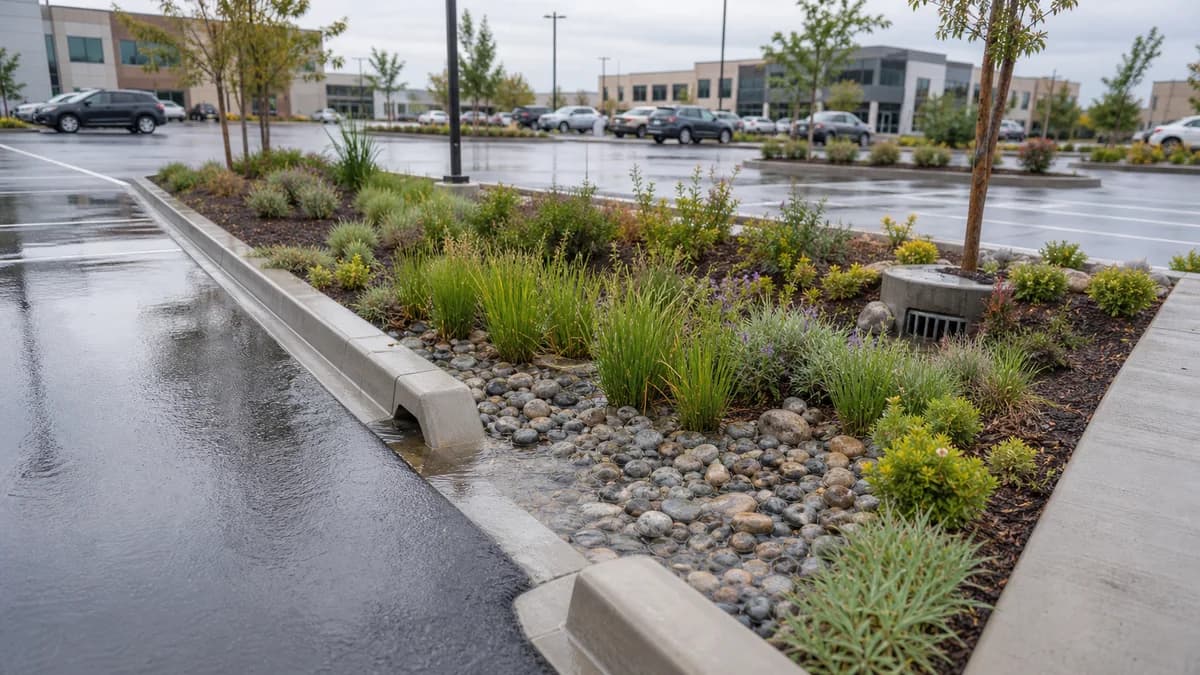
How bioretention works
Runoff enters through curb openings, sheet flow, or another designed inlet. A shallow surface storage zone slows water, vegetation and mulch intercept pollutants, and engineered media filters the flow. Water then infiltrates native soil, enters an underdrain, or follows both paths. An overflow safely carries larger events.
Caltrans describes bioretention as a vegetation and soil-based treatment BMP that uses physical, chemical, and biological processes. The project engineer remains responsible for hydrology, hydraulics, grading, and traffic considerations on Caltrans facilities; private and municipal projects also require qualified design responsibility under their applicable standards.
Bioretention, bioswales, and rain gardens
The terms overlap in casual use, but they should not be treated as identical compliance claims.
| Feature | Primary function | Typical form | Important distinction |
|---|---|---|---|
| Bioretention | Engineered storage and filtration | Basin or planter with specified media and vegetation | Designed and sized to an agency standard |
| Bioswale | Conveyance with filtration and flow reduction | Vegetated channel with longitudinal slope | Often moves water as well as treating it |
| Rain garden | Small-scale capture and infiltration | Shallow planted depression | The name alone does not establish regulatory treatment performance |
| Flow-through planter | Filtration where infiltration is constrained | Contained planter with underdrain | Requires controlled inlet, outlet, and overflow |
Site feasibility and design inputs
The design team evaluates tributary area, water-quality volume or flow, available footprint, grades, native infiltration, groundwater, utilities, foundations, slopes, contaminated soil, traffic exposure, and downstream connection. Agency standards can prescribe media depth, ponding depth, underdrain, liner, vegetation, setbacks, and sizing methods.
A facility that is too high may receive no runoff. One that is too low or lacks overflow can create persistent ponding. Confirm pavement elevations, curb cuts, forebays or energy dissipation, and overflow elevations in the same grading model.
How paving work affects an existing facility
An overlay can raise pavement above an inlet. Grinding can change cross slope. Curb replacement can narrow or move an opening. New striping and wheel stops can redirect vehicles or sweeping patterns. Patching can change the tributary area. These small construction decisions can cause bypass, erosion, or sediment loading.
Locate every approved stormwater facility before bidding. Show protection limits and finished inlet elevations, and require the contractor to restore any disturbed curb, splash block, vegetation, media, underdrain cleanout, or overflow feature to the approved detail.
Construction sequencing and protection
Keep runoff carrying construction sediment out of completed bioretention media. Depending on the approved plan, the basin may be excavated late, protected with temporary controls, or left high until the contributing area is stabilized. Heavy equipment should not compact media or native infiltration areas unless the design specifically permits it.
- Verify underground utilities and outlet elevations before excavation.
- Protect subgrade and media from compaction and contamination.
- Use approved media, aggregate, underdrain, liner, plants, and mulch.
- Stabilize tributary pavement and landscaping before opening inlets.
- Remove temporary sediment and confirm drawdown, inlet, and overflow operation before acceptance.
Inspection and long-term maintenance
Maintenance commonly includes removing trash and sediment, replacing dead plants, controlling weeds, maintaining mulch, repairing erosion, clearing inlets and overflows, and checking for prolonged ponding. The approved operation and maintenance plan controls frequency and performance criteria.
Assign responsibility even when landscaping and pavement vendors are different. A landscape crew should not fill the ponding zone with excess mulch, and a paving crew should not seal a curb opening. Keep inspection and maintenance records when required by the municipality or recorded agreement.
Owner and manager review checklist
Treat the facility as drainage infrastructure, not decorative landscaping.
- Approved plan and operation and maintenance agreement located
- Tributary pavement and flow path verified
- Inlet, ponding, media, underdrain, and overflow elevations coordinated
- Utilities, groundwater, soil, and setbacks resolved
- Construction protection and acceptance inspection specified
- Landscape and drainage maintenance responsibilities assigned
- Access and budget provided for sediment removal and repairs
Editorial sources
This guide was reviewed against primary California sources on August 2, 2026. Use the current municipal standard and approved project documents for design and maintenance.
Frequently asked questions
What is bioretention?
Bioretention is an engineered vegetated system that stores runoff briefly and filters it through soil or engineered media before infiltration, underdrain discharge, or both.
Is a rain garden the same as bioretention?
Not automatically. Rain garden is often an informal term. A regulated bioretention facility must meet the applicable sizing, media, drainage, overflow, planting, and maintenance criteria.
Can bioretention treat parking lot runoff?
Yes, when the tributary area, grading, inflow, treatment capacity, overflow, and pollutant exposure are suitable and the responsible agency approves the design.
Does bioretention always infiltrate water?
No. Some facilities infiltrate, some use an underdrain, and others combine both. Soil, groundwater, setbacks, contamination, and agency criteria affect the configuration.
Why is water bypassing a bioretention area?
Possible causes include incorrect pavement grades, a high inlet, blockage, settlement, curb changes, or more flow than the inlet can accept. A qualified reviewer should diagnose the actual condition.
How long should water pond?
The approved design and local standard set the allowed ponding depth and drawdown time. Persistent ponding can indicate clogging, outlet problems, or a design or construction defect.
Can a paving contractor modify a curb opening?
Only in accordance with the approved drainage design. Moving, narrowing, raising, or sealing an opening can change treatment performance and cause bypass or flooding.
Who maintains bioretention?
The property owner or another party identified in the approval and operation and maintenance agreement is typically responsible, often using coordinated landscape and drainage vendors.
Before you hire: This guide is general educational information, not civil, geotechnical, landscape, stormwater, or environmental design advice. Use the approved plans, current agency criteria, and qualified professionals for sizing, grading, materials, plants, construction, inspection, and maintenance.
For property owners
Looking for a pavement contractor?
Use The Pavement Directory to search asphalt, concrete, sealcoating, striping, ADA access, and pavement maintenance contractors by service and location. Always verify license, insurance, references, and written scope before hiring.
Browse California drainage contractorsFor contractors
Are you a pavement contractor?
Contractors can add or claim a company profile to help property owners find pavement professionals by service, location, and specialty.