

What this guide covers
Common systems include porous asphalt, pervious concrete, and permeable interlocking concrete pavement.
The designer must coordinate surface capacity, open-graded base storage, infiltration or underdrain discharge, overflow, and maintenance.
California does not require permeable pavement for every project. The governing agency and approved design determine whether it satisfies a project requirement.
Related contractor categories
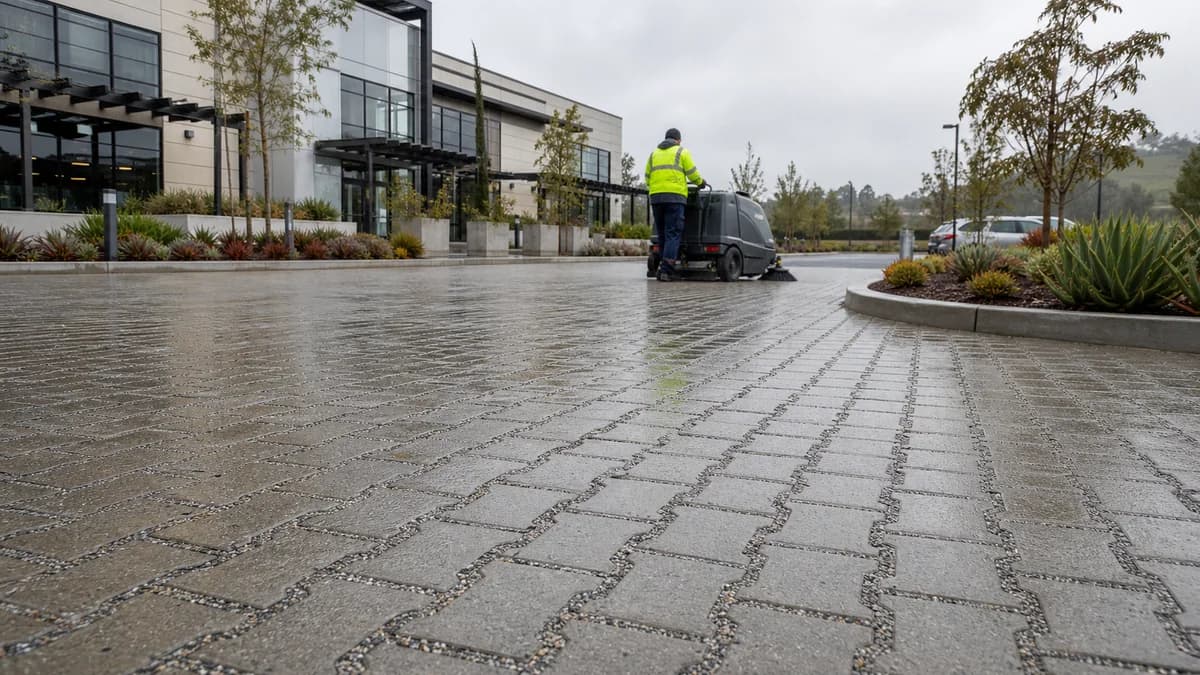
How permeable pavement works
Water enters through connected pores or joints, moves into an open-graded aggregate base, and is stored temporarily. From there it can infiltrate into suitable native soil, leave through an underdrain, or use a combination of both. The surface, bedding, reservoir, subgrade, edge restraint, underdrain, observation port, and overflow operate as one system.
Permeable pavement can reduce runoff volume and rate, filter pollutants, and help manage water near its source. Those benefits depend on correct design and continued infiltration through the surface.
Types of permeable pavement
The surface choice affects appearance, construction methods, structural behavior, repair, and maintenance.
| System | How water enters | Potential applications | Owner review points |
|---|---|---|---|
| Porous asphalt | Through interconnected voids in the asphalt mixture | Parking bays, lots, paths, and suitable low-speed areas | Specialized mix, placement, compaction, reservoir, and raveling risk |
| Pervious concrete | Through an intentionally open concrete matrix | Parking, walks, plazas, and low-speed areas | Batch control, placement, curing, joints, and surface maintenance |
| Permeable interlocking concrete pavement | Through aggregate-filled joints between units | Parking stalls, plazas, walks, and modular layouts | Bedding, joint aggregate, edge restraint, settlement, and unit replacement |
| Grid systems | Through open cells filled with aggregate or vegetation | Overflow parking and selected light-duty uses | Load rating, accessibility, infill, vegetation, and maintenance |
Where permeable pavement may fit
Caltrans guidance identifies parking lots, walkways, and areas without heavy traffic as common candidates. A site can still be unsuitable because of concentrated sediment, high groundwater, poor subgrade, steep slopes, industrial exposure, heavy turning, utility conflicts, nearby foundations, or no safe overflow route.
Use geotechnical and civil input for infiltration testing, subgrade strength, groundwater separation, structural section, reservoir volume, underdrain controls, and setbacks. Local stormwater criteria may be more restrictive than general design guidance.
Infiltration, underdrains, and overflow
A fully infiltrating system releases stored water into native soil. A lined or underdrained system filters and detains water before discharging it. A partial-infiltration system combines those functions. The choice affects sizing, drawdown, groundwater protection, downstream discharge, and credit under the local stormwater program.
Every design needs a controlled response when inflow exceeds storage or the outlet is restricted. Surface ponding, an overflow inlet, downstream conveyance, and adjacent finished-floor elevations should be evaluated together.
Structural and construction requirements
The pavement section must carry anticipated vehicles while preserving void space. Construction traffic, sediment, dirty aggregate, and over-compaction can damage the system before it opens. Plans should specify materials, subgrade preparation, equipment limits, testing, protection, inspection, and acceptance criteria.
Keep sediment-generating work away from the finished surface. Do not stockpile soil on it or route muddy construction runoff across it. Coordinate curbs and pavement elevations so runoff enters only from approved tributary areas.
Maintenance and clogging prevention
Sediment gradually fills pores and joints. Routine inspection and regenerative-air or vacuum sweeping may be needed, with frequency based on loading and local requirements. Conventional sealcoat should not be applied over a permeable surface because it can block the intended flow path.
The owner should know who inspects the pavement, which equipment is permitted, where sediment comes from, how snow or landscape materials are managed, and what performance indicates that restorative cleaning or repair is required.
- Inspect for ponding, sediment deposits, raveling, settlement, and blocked outlets.
- Vacuum or clean using the method approved for the system.
- Control eroding soil, landscape mulch, and construction track-out upstream.
- Keep observation ports, underdrains, inlets, and overflows accessible.
- Document maintenance if the stormwater approval requires records.
Cost and bid comparison
Compare the complete drainage system, not surface unit prices alone. Cost drivers include excavation, export, open-graded stone, liners, geotextiles where specified, underdrains, controls, testing, specialized placement, treatment credits, conventional drainage avoided, and long-term cleaning.
Require bidders to price the same design and identify mix, source, layer thickness, equipment, protection, testing, and warranty assumptions. An apparently low bid that substitutes dense-graded base or omits maintenance access can change system performance.
Property owner decision checklist
Confirm feasibility and ownership obligations before selecting the surface.
- Local stormwater reviewer has accepted the proposed concept and credit.
- Infiltration, groundwater, geotechnical, slope, utility, and setback constraints are resolved.
- Traffic and structural loading are defined.
- Storage, underdrain, outlet, and overflow calculations are complete.
- Construction protection and acceptance testing are specified.
- Maintenance equipment, frequency, access, budget, and recordkeeping are assigned.
- Accessible routes and surface tolerances are addressed by the design team.
Editorial sources
This guide was reviewed against current primary California sources on August 2, 2026. Project criteria must come from the responsible agency and design professionals.
Frequently asked questions
What is permeable pavement?
It is a pavement system that passes water through a porous surface or open joints into an aggregate reservoir, where water is stored, infiltrated, underdrained, or managed through a combination of methods.
Does California require permeable pavement?
Not for every project. A municipal permit or approval may require runoff reduction or treatment, but the accepted measure depends on the site and governing criteria.
What are the main permeable pavement types?
Common types are porous asphalt, pervious concrete, permeable interlocking concrete pavement, and open grid systems.
Can permeable pavement be used in a parking lot?
Yes, parking lots are a common candidate, especially lower-speed and lighter-duty areas. Traffic, subgrade, drainage, sediment, and maintenance conditions still require design review.
Does permeable pavement work in clay soil?
A system may use an underdrain or partial infiltration where native infiltration is limited, but feasibility, storage, drawdown, discharge, and local credit must be designed and approved.
Does permeable pavement need a drain?
Some systems infiltrate without an underdrain, while others require one. All need a designed outlet or overflow response for conditions beyond available storage.
How is permeable pavement maintained?
Maintenance commonly includes inspection, sediment-source control, and vacuum or regenerative-air cleaning appropriate to the system. Requirements vary by surface and approval.
Can permeable asphalt be sealcoated?
A conventional sealcoat can block surface pores and should not be applied as though the pavement were dense-graded asphalt. Follow the designer and system-specific maintenance requirements.
Is permeable pavement always more expensive?
Its pavement section can cost more, but project economics should compare the complete drainage design, treatment facilities avoided, excavation, lifecycle cleaning, and site constraints.
Before you hire: This guide provides general educational information, not civil, geotechnical, stormwater, accessibility, or pavement design advice. A qualified design team and responsible public agencies must determine site feasibility, calculations, permits, materials, construction requirements, and maintenance obligations.
For property owners
Looking for a pavement contractor?
Use The Pavement Directory to search asphalt, concrete, sealcoating, striping, ADA access, and pavement maintenance contractors by service and location. Always verify license, insurance, references, and written scope before hiring.
Browse California pavement contractorsFor contractors
Are you a pavement contractor?
Contractors can add or claim a company profile to help property owners find pavement professionals by service, location, and specialty.