

What this guide covers
Commercial paving requires planning around tenant and customer access, resident parking, emergency access, trash pickup, deliveries, phasing, ADA areas, striping, drainage, and reopening time.
This guide is part of the asphalt paving hiring hub — start with How to Choose an Asphalt Paving Contractor for the full picture. This article focuses specifically on commercial property operations. For driveway work, see Residential Asphalt Paving Contractors; for scope and pricing risk, see Cheap Asphalt Paving Bid Red Flags. For budget planning before bids go out, see asphalt paving cost.
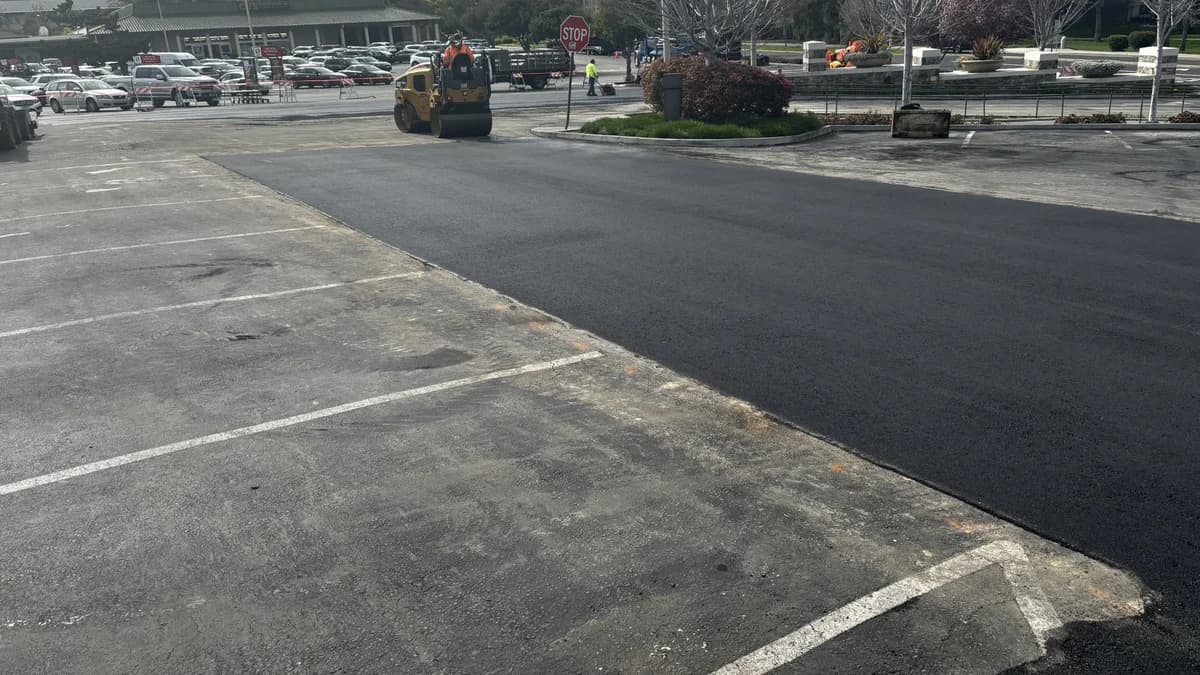
Why commercial paving is different
Commercial paving affects more people than a typical residential driveway. The site may need to remain partially open, tenants may need advance notice, and customers may need access. Trash trucks, delivery vehicles, emergency responders, and employees may all need routes through or around the work.
The paving itself may only take a few days, but poor coordination can create complaints, lost access, and avoidable disruption.
Property types and their access constraints
Each property type has a different access constraint. Know yours before the site walk. Shopping centers need storefronts to stay reachable, and anchor tenants may have lease language requiring minimum open parking counts. Apartment complexes are constrained by overnight resident parking — residents cannot move cars they do not know about. HOA communities need board approval lead time, and residents expect written notice, not a flyer the night before.
Office buildings see peak arrival between 7 and 9 AM, and phasing that blocks morning entry generates the most complaints. Medical office properties can't let ADA access lapse during business hours, since patients with mobility limits cannot park a block away. Warehouses and industrial yards need truck turning radii and dock access to drive the phasing plan, not stall counts.
Schools and churches have work windows defined by the calendar, so summer break and weekdays are your friends. For restaurants and drive-throughs, the drive-through lane is often the highest-revenue square footage on the site, and closing it costs the tenant real money. Hotels and storage facilities carry 24-hour access expectations, meaning no phase can strand a vehicle overnight without warning.
Building a phasing plan
A phasing plan explains how the work will be divided so the property can function during construction. For HOAs and apartments, phasing may be the most important part of the project.
- What areas close first?
- What areas stay open?
- How many phases are needed?
- Where will vehicles park during each phase?
- How will emergency access be maintained?
- How will garbage pickup and deliveries continue?
- When can each phase reopen?
Tenant and resident notices
Property managers should decide who handles notices. As a working baseline, deliver notices at least 72 hours before closure, and 7 days ahead when tow-away enforcement is involved — shorter notice windows produce blocked work areas and towing disputes. A notice plan may include work dates, closed areas, tow-away warnings if applicable, alternate parking, reopening times, contact information, weather delay language, and trash pickup or delivery instructions.
Notices should be simple and specific. Confusing notices lead to blocked work areas.
Customer and business access
Retail centers, medical properties, restaurants, and offices may need access during work. Review storefront access, pedestrian routes, ADA parking availability, delivery windows, fire lanes, customer parking, directional signage, and weekend or night work.
Some commercial properties may require work outside normal business hours. Night and weekend work typically adds 10 to 20 percent to labor cost, so weigh that premium against the cost of daytime disruption.
ADA parking coordination
Commercial paving can affect ADA parking areas because pavement grades, striping, drainage, and accessible routes are connected. Review stall locations, access aisles, slope conditions (accessible stalls and aisles are limited to roughly 2 percent slope in any direction), curb ramps, path of travel, signage, drainage in accessible areas, and the restriping layout.
A paving contractor may perform asphalt work, but ADA compliance may require qualified accessibility review. Related category: ADA Parking Contractors.
Striping coordination
After paving, the lot usually needs striping before it is fully functional. New asphalt typically needs to cure before striping, often 14 to 30 days for final markings, though many contractors place temporary layout marks so the lot can reopen sooner. Confirm stall count, ADA stalls, fire lanes, arrows, crosswalks, stop bars, loading zones, curb painting, wheel stops, and signs. Related category: Parking Lot Striping Contractors.
Drainage and utility coordination
Commercial lots have infrastructure that driveways do not. Review catch basins and whether rims will be adjusted to the new grade, utility lids and valve boxes, trench settlement over past utility work, ponding near loading areas and dumpster pads, and drainage in ADA stalls and access aisles, where standing water is both a hazard and a compliance issue.
If drainage is a known issue, involve Drainage and Sitework Contractors before paving starts. New asphalt placed over a drainage problem inherits the drainage problem.
Frequently asked questions
What makes commercial asphalt paving different?
Commercial paving often requires phasing, traffic control, tenant notices, emergency access, striping, and ADA coordination.
Should a commercial paving project be phased?
Often, yes. Phasing helps keep part of the property usable during work.
How much notice should tenants or residents receive?
Plan for at least 72 hours, and 7 days when tow-away enforcement applies. The property manager usually controls notices, but the contractor should provide schedule and closure details.
Should striping be completed before reopening?
For parking lots, yes, if markings are needed for safe and organized use. Ask whether the reopening layout is temporary or final, since final striping often waits 14 to 30 days for curing.
Can commercial paving affect ADA parking?
Yes. Paving can affect slopes, drainage, transitions, and striping layout. Accessible stalls and aisles have strict slope limits, so verify them after paving, not just before.
Before you hire: The Pavement Directory does not provide legal or compliance advice. ADA and accessibility requirements vary by site, jurisdiction, and project scope. Contractors may perform striping, grading, concrete, or asphalt corrections, while CASp inspectors or accessibility consultants may be needed for compliance review. Consult qualified professionals when compliance is material.
For property owners
Looking for a pavement contractor?
Use The Pavement Directory to search asphalt, concrete, sealcoating, striping, ADA access, and pavement maintenance contractors by service and location. Always verify license, insurance, references, and written scope before hiring.
Search contractorsFor contractors
Are you a pavement contractor?
Contractors can add or claim a company profile to help property owners find pavement professionals by service, location, and specialty.