

What this guide covers
Watch for no written scope, no asphalt thickness, no square footage, no base preparation, no drainage review, no striping scope, no access plan, no exclusions, no warranty language, same-day pressure, or leftover asphalt claims. Those last two are the signature of a door-to-door crew rather than a low bid — see how driveway paving scams work.
This guide is part of the asphalt paving hiring hub — start with How to Choose an Asphalt Paving Contractor for the full picture. This article focuses on risk signals in low paving bids; for a detailed comparison method, see How to Compare Asphalt Paving Bids.
Related contractor categories
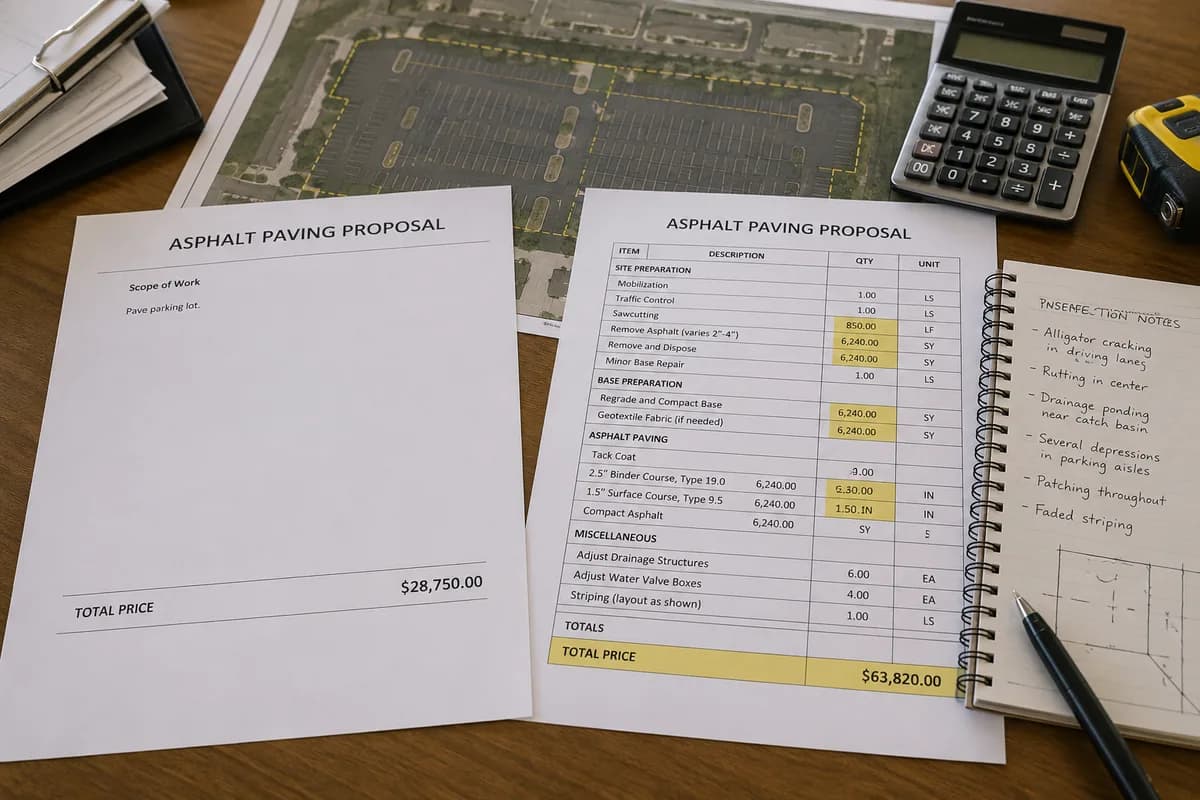
Low price is not the problem
A contractor may have a fair low price because of efficient scheduling, shorter travel distance, available crew capacity, lower overhead, a simpler scope, or competitive pricing. The issue is not the low number — the issue is the missing scope behind the number.
A useful rule of thumb: if one bid comes in more than 20 to 25 percent below the others, assume the scope is different until the paperwork proves otherwise.
Red flag 1: No work limits
A bid should say what area is included. Question vague wording like "pave driveway," "pave parking lot," "repair bad areas," or "asphalt work included." Ask for square footage, marked limits, or a simple site diagram. Without square footage, you cannot compare unit pricing between bids at all.
Red flag 2: No asphalt thickness
A paving bid without thickness is not ready for approval. Benchmarks: passenger driveways are typically 2 to 3 inches compacted, standard parking stalls 3 inches, and drive lanes or truck areas 4 inches or more — a bid quoting less than these without explanation deserves questions.
Ask what thickness is proposed, whether it's compacted thickness (loose asphalt compacts roughly 20 to 25 percent, so the distinction changes what you actually receive), whether thickness varies by area, and whether this is overlay or replacement. Related guide: Asphalt Paving Thickness for Parking Lots.
Red flag 3: No base preparation
Base preparation is a common place where low bids become weak bids. Watch for proposals that don't mention grading, compaction, aggregate base, soft spot repair, removal of unsuitable material, base repair exclusions, or a change order process. Asphalt over weak base may fail early — this is where the low bid becomes the expensive bid, because soft base found during construction becomes a change order priced without competition.
Red flag 4: No drainage discussion
A cheap bid may ignore water problems. If the site has standing water, ponding in ADA areas, or settlement near drains and trenches, the bid should say how that is handled or explicitly exclude it. If water caused the damage, paving alone may not fix the cause. Related category: Drainage and Sitework Contractors.
Red flag 5: Overlay recommended without explaining why
Overlay can be valid, but it should match pavement condition. Be careful when overlay is recommended over widespread alligator cracking, soft pavement, severe potholes, prior failed overlays, drainage problems, or grade conflicts. Related guide: Asphalt Paving vs Asphalt Overlay.
Red flag 6: Striping is missing
For parking lots, the low bid may exclude striping. Ask whether the price includes stall lines, ADA stalls, access aisles, fire lanes, arrows, crosswalks, curb painting, wheel stops, and signs. If striping is excluded, budget separately.
Red flag 7: No access plan
For commercial sites, HOAs, and apartment complexes, access planning matters. A low bid may exclude phasing, barricades, notices, traffic control, weekend work, emergency access planning, or tenant coordination — that may create operational problems later. For what a complete access plan looks like, see Commercial Asphalt Paving Contractors.
Red flag 8: Leftover asphalt offer
Be cautious with same-day offers based on "leftover asphalt." Legitimate contractors rarely have meaningful leftover material, because loads are calculated per job and excess is small. Warning signs include pressure to decide immediately, cash-only demand, no written proposal, no business address, no license or insurance information, no clear thickness, no base preparation details, and no warranty terms. This is especially relevant for residential driveway work — a low price is not the issue, a vague, pressured, undocumented offer is the issue.
Cheap bid review checklist
Run every low bid through this checklist before approving it:
- Work limits listed
- Square footage listed
- Thickness listed, and clarified as compacted
- Base preparation described
- Drainage addressed
- Striping included or clearly excluded
- Access plan included if the property is occupied
- Exclusions listed
- Warranty terms written
- License and insurance reviewed
Frequently asked questions
Is a cheap asphalt paving bid always bad?
No. A low price can be fair if the scope is clear and complete.
What is the biggest red flag in a cheap paving bid?
A missing asphalt thickness or vague work area is a major warning sign. Without square footage and compacted thickness, bids cannot be compared.
Should I reject leftover asphalt offers?
Treat them with caution. Do not approve work without a written scope, thickness, business information, and insurance review.
Can a low bid leave out striping?
Yes. That may be fine if it is clearly excluded and priced separately.
How do I know if a low bid is fair?
Compare the scope, thickness, preparation, drainage assumptions, striping, access plan, exclusions, and warranty against other bids. A gap of more than 20 to 25 percent below the field usually means a scope difference.
Before you hire: The Pavement Directory does not guarantee contractor performance, pricing, licensing, insurance, or availability. Business information may be submitted by contractors or gathered from public sources and should be independently verified before hiring. Always confirm licensing, insurance, references, scope of work, and written contract terms.
For property owners
Looking for a pavement contractor?
Use The Pavement Directory to search asphalt, concrete, sealcoating, striping, ADA access, and pavement maintenance contractors by service and location. Always verify license, insurance, references, and written scope before hiring.
Search contractorsFor contractors
Are you a pavement contractor?
Contractors can add or claim a company profile to help property owners find pavement professionals by service, location, and specialty.