

What this guide covers
The useful answer is not a generic pail count. It is a calculation tied to your driveway measurement, the exact fill volume in each container, the number of coats, and the coverage range printed on the selected product.
For the calculation and whole-pail rounding, use the Sealcoating Calculator. If you do not know the area yet, start with How to Measure a Driveway for Sealcoating.
This guide shows the math and worked examples so you can check the calculator result against the product label before buying material.
Related contractor categories
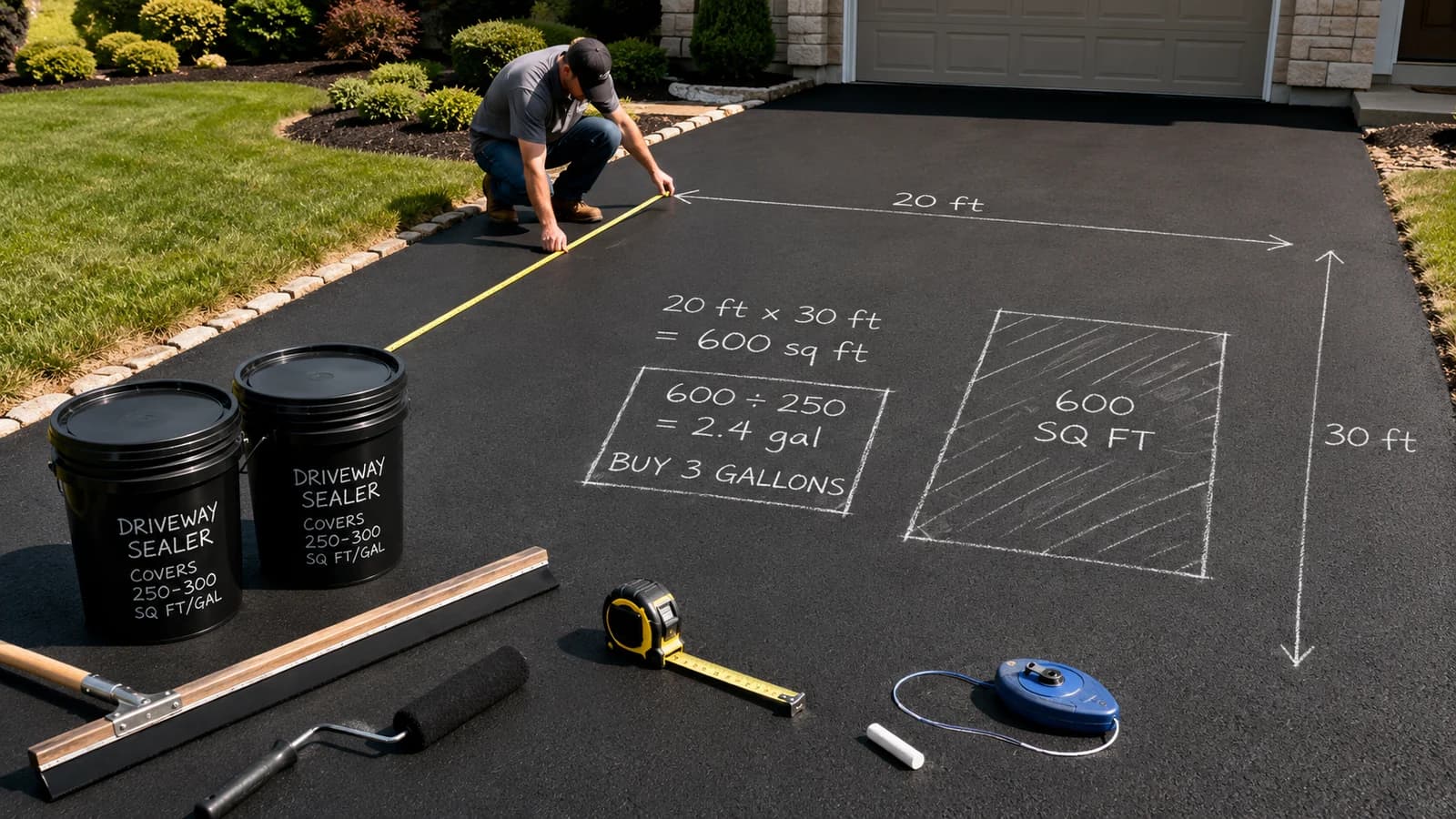
The driveway sealer formula
Use Gallons needed = Driveway area (ft²) × Number of coats ÷ Label coverage (ft² per gallon per coat). If the label gives coverage per pail, divide that coverage by the pail's actual liquid volume first. Then add only the allowance you intentionally choose and round the purchase up to whole containers.
For example, a 1,000 ft² driveway at an illustrative 100 ft² per gallon per coat needs 10 gallons for one coat or 20 gallons for two coats before allowance. That is an example, not a default for every product. Enter the selected label rate in the Sealcoating Calculator for the planning result that applies to your job.
Worked examples by driveway size
The table uses an illustrative rate of 100 ft² per gallon per coat. It deliberately shows theoretical gallons before allowance and container rounding so the assumptions stay visible.
| Driveway area | One coat | Two coats | Calculation at 100 ft²/gal |
|---|---|---|---|
| 200 ft² | 2 gal | 4 gal | 200 × coats ÷ 100 |
| 400 ft² | 4 gal | 8 gal | 400 × coats ÷ 100 |
| 600 ft² | 6 gal | 12 gal | 600 × coats ÷ 100 |
| 1,000 ft² | 10 gal | 20 gal | 1,000 × coats ÷ 100 |
Convert pail coverage into per-gallon coverage
A container marketed as a five-gallon pail may state a smaller actual fill volume. Use the liquid volume on the label, not the name of the container. If a 4.75-gallon pail lists 400 ft² of coverage, the equivalent input is about 84.2 ft² per gallon for that coat: 400 ÷ 4.75.
Coverage can also be a range. The official Latex-ite Ultra Shield technical data sheet, for example, lists different pail coverage ranges for smooth or previously sealed pavement and rough or unsealed pavement. Select the part of the range that matches the surface rather than averaging automatically.
Why rough pavement needs more sealer
Open, porous, weathered, or coarse-textured asphalt usually yields less area per gallon than a smooth, previously sealed surface. That lower coverage means more gallons for the same measured area. Application method and product instructions matter too.
Do not stack an invented roughness multiplier on top of a conservative label rate. Choose the appropriate end of the manufacturer's range, keep the assumption visible, and recalculate. The separate Sealcoat Coverage Rate Guide explains how to read those label statements.
Allowance and whole-pail rounding
The calculated gallons rarely divide evenly into the available container size. Keep three numbers separate: theoretical gallons from the label rate, planning gallons after any explicit allowance, and whole containers to purchase. That separation prevents container rounding from being mistaken for application waste.
A modest allowance can help when the measurement or surface condition is uncertain, but it should be a visible choice rather than a hidden rule. If the driveway is unusually rough or the product label is unclear, confirm the quantity with the manufacturer or a sealcoating contractor before purchasing a large order.
Frequently asked questions
How much sealer do I need for a 1,000 sq ft driveway?
At an illustrative 100 ft² per gallon per coat, 1,000 ft² needs 10 gallons for one coat or 20 gallons for two coats before allowance. Replace that example with the selected product's label coverage.
How many square feet does a five-gallon pail cover?
There is no universal answer. Check both the product's stated pail coverage and its actual fill volume, then choose the coverage range for the pavement condition and application method.
Should I add extra driveway sealer?
A small, explicit allowance can help with measurement uncertainty and unavoidable variation, but use the conservative label rate first and keep allowance separate from whole-pail rounding.
Do two coats require twice as much sealer?
In a basic label-rate calculation, yes: area multiplied by two coats doubles the theoretical gallons. Follow the manufacturer's coat and application instructions because products may specify different procedures.
Before you hire: The Pavement Directory does not guarantee contractor performance, pricing, licensing, insurance, or availability. Business information may be submitted by contractors or gathered from public sources and should be independently verified before hiring. Always confirm licensing, insurance, references, scope of work, and written contract terms.
For property owners
Looking for a pavement contractor?
Use The Pavement Directory to search asphalt, concrete, sealcoating, striping, ADA access, and pavement maintenance contractors by service and location. Always verify license, insurance, references, and written scope before hiring.
Search contractorsFor contractors
Are you a pavement contractor?
Contractors can add or claim a company profile to help property owners find pavement professionals by service, location, and specialty.