

What this guide covers
Coverage rate is a product input, not a constant. Residential pail products and commercial pavement sealers can publish very different rates because their formulations, intended uses, aggregate, and application procedures differ.
Use the Sealcoating Calculator to enter coverage exactly as the product states it—per gallon or per pail—and keep coat count, allowance, and whole-container rounding separate.
If you still need the pavement area, measure it first with the driveway measurement guide.
Related contractor categories
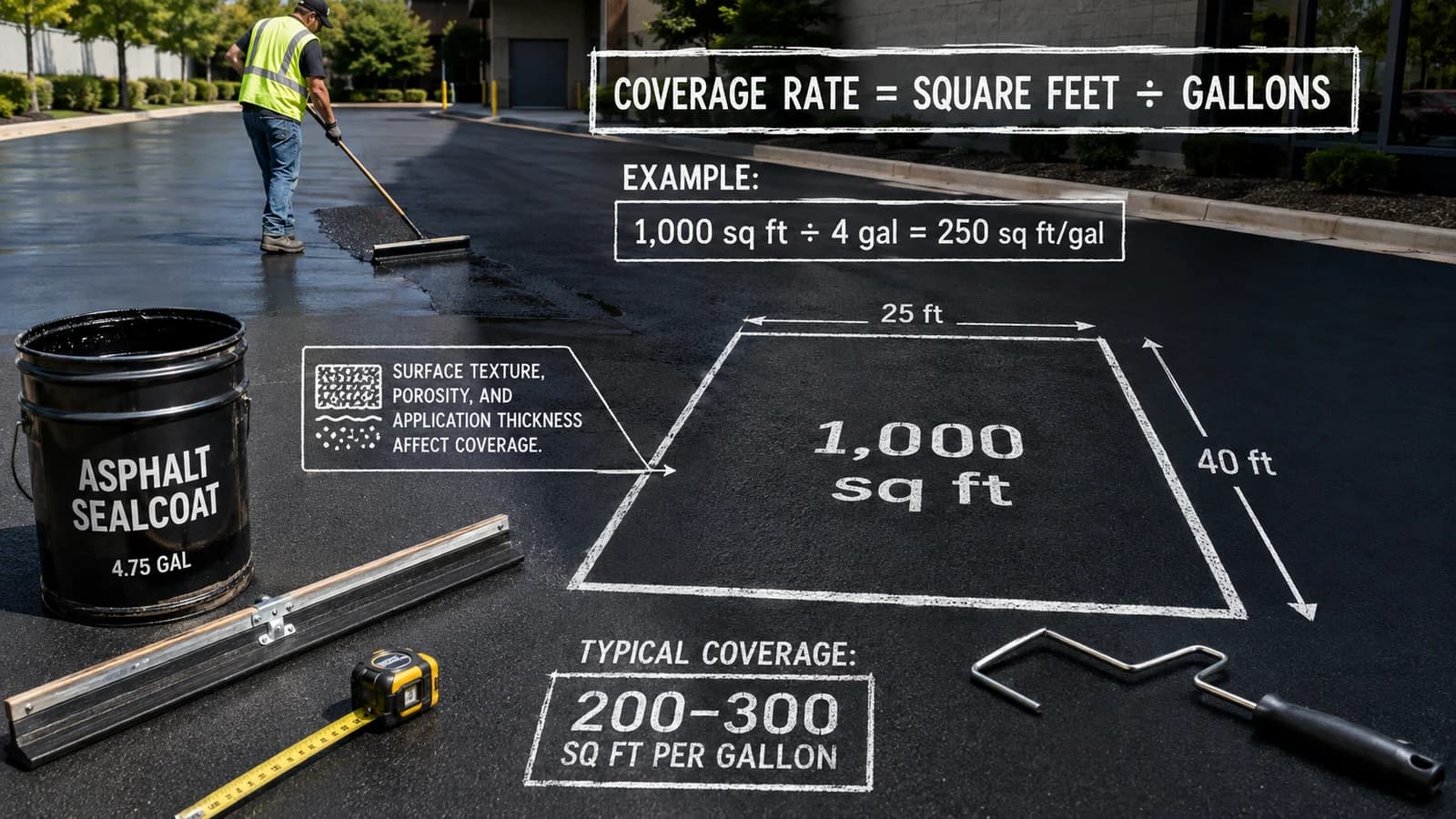
What a coverage statement means
A statement such as “80 to 100 ft² per gallon per coat” describes a range for one coat under the manufacturer's stated conditions. Lower square feet per gallon means heavier material use. For two coats, calculate both coats; do not assume the listed area automatically covers the full system unless the label says so.
A pail statement works the same way but must be paired with the actual liquid volume. If a 4.75-gallon container covers 300 to 400 ft², its equivalent range is about 63.2 to 84.2 ft² per gallon for that coat.
Why there is no universal sealcoat rate
Products are not interchangeable estimating constants. The official Latex-ite Ultra Shield data sheet gives different coverage ranges for smooth or previously sealed driveways and rough or unsealed surfaces. The official SealMaster Liquid Road Ultra road specification publishes a much heavier application rate for that commercial road product and use.
Those examples should not be used to rank products or create a blended average. They demonstrate why the selected product, intended application, current data sheet, pavement condition, and application method must stay attached to the estimate.
Convert the label into a calculator input
If the label states square feet per gallon, enter that number directly. If it states square feet per pail, either use the calculator's per-pail mode or divide pail coverage by actual gallons. When the label gives a range, run both ends to see a material range or use the conservative lower-coverage end for ordering.
Example: a 4.75-gallon pail with 300 to 400 ft² of coverage equals roughly 63.2 to 84.2 ft² per gallon. A 1,000 ft² surface would therefore require about 11.9 to 15.8 theoretical gallons for one coat before allowance and container rounding.
| Label format | Conversion | Calculator entry |
|---|---|---|
| 100 ft² per gallon | No conversion | 100 ft²/gal |
| 400 ft² per 4.75-gal pail | 400 ÷ 4.75 | 84.2 ft²/gal |
| 300–400 ft² per 4.75-gal pail | Each end ÷ 4.75 | 63.2–84.2 ft²/gal |
| 11 yd² per gallon | 11 × 9 | 99 ft²/gal |
Pavement condition changes realized coverage
Rough, porous, oxidized, or unsealed asphalt can absorb and hold more material than smooth, previously sealed pavement. Larger surface aggregate also creates more texture. These conditions usually move the job toward the lower-coverage end of a published range.
Surface preparation still matters. Dirt, loose material, oil contamination, standing water, and unsuitable weather can affect application and performance, but they should be corrected rather than treated as reasons to buy an arbitrary percentage of extra sealer.
Coats, application method, and dilution
Confirm whether the manufacturer calls for one coat, multiple coats, a squeegee, brush, spray, or specialized equipment. Follow any approved mixing or dilution instructions. Adding water outside the specification to stretch coverage changes the applied material and makes the label-rate calculation unreliable.
For contractor proposals, ask for the product, application rate, number of coats, added water and aggregate, and total gallons. Then compare that written scope with How to Compare Sealcoating Bids rather than comparing price alone.
Frequently asked questions
How many square feet does one gallon of sealcoat cover?
It depends on the specific product, pavement condition, coat, and application method. Use the current label rate rather than a universal online average.
What does square feet per gallon per coat mean?
It is the area one gallon is expected to cover for one application coat under the stated conditions. Two coats normally require calculating the area twice unless the product says otherwise.
Should I use the high or low end of a coverage range?
Match the manufacturer's condition descriptions. Rough, porous, or unsealed pavement generally belongs near the lower-coverage end; smooth, previously sealed pavement may fit the higher end.
Can I compare sealcoat products by coverage alone?
No. Coverage is tied to formulation, intended use, coat thickness, solids, aggregate, mixing, and application procedure. Compare complete specifications and suitability, not just the largest square-foot number.
Before you hire: The Pavement Directory does not guarantee contractor performance, pricing, licensing, insurance, or availability. Business information may be submitted by contractors or gathered from public sources and should be independently verified before hiring. Always confirm licensing, insurance, references, scope of work, and written contract terms.
For property owners
Looking for a pavement contractor?
Use The Pavement Directory to search asphalt, concrete, sealcoating, striping, ADA access, and pavement maintenance contractors by service and location. Always verify license, insurance, references, and written scope before hiring.
Search contractorsFor contractors
Are you a pavement contractor?
Contractors can add or claim a company profile to help property owners find pavement professionals by service, location, and specialty.