
The Pavement Directory

Find an Asphalt Plant Near Your Job Site

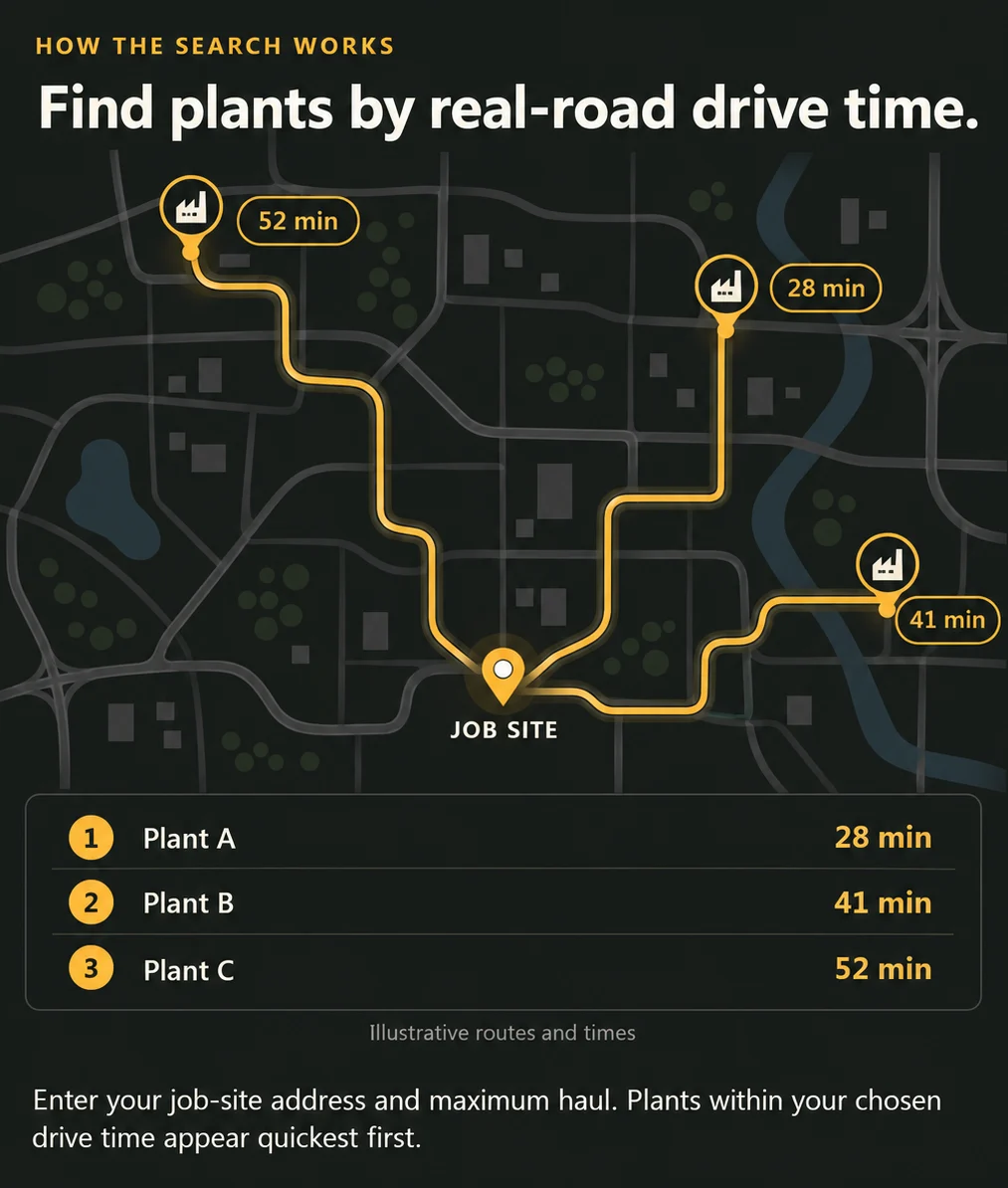
Search 3,194 hot mix asphalt plant locations across all 50 states, plus DC and Puerto Rico by the drive on real roads from the site you are actually paving. Enter the job-site address and a maximum haul to see which plants a truck can reach in time.

  • Real-road drive time
  • Fixed plant locations
  • Detailed supplier data where available
  • 3,194

    Asphalt plants

    Fixed hot mix plant locations

  • 2,266

    Cities

    Where the directory holds a plant

  • 52

    States, DC & territories

    All 50 states, plus DC and Puerto Rico

  • 76%

    California detailed

    78 of 103 California plants have detailed records

4 plants within about 30 minutes’ drive

Driving from Corona, CA (city centre — enter the street address for exact times), by road with typical traffic. Comfortable haul. Mix arrives with temperature to spare, and a second load is quick.

Vulcan Materials Company

Corona Asphalt

Corona, CA · Riverside County

Drive time

7 min

Distance

4.6 mi by road

Vulcan Materials’ Corona Asphalt plant produces hot mix asphalt for highway, municipal, commercial and private paving projects throughout Riverside County and Southern California. The facility supports conventional, recycled and rubberized asphalt production and can manufacture multiple mix designs for project-specific requirements. Contractors should contact the plant or sales team for current pricing, mix availability and loading schedules.

  • Sells to outside contractors
  • On DOT approved list
  • Mixes listed
More details

Plant / Office: 626-856-6156 Sales: 626-221-4293

All American Asphalt – Corona Plant

Corona, CA · Riverside County

Drive time

10 min

Distance

5.4 mi by road

All American Asphalt’s Corona plant supplies hot mix asphalt for commercial, municipal, highway and private paving projects throughout Riverside County and Southern California. The fixed production facility offers conventional, recycled and rubberized asphalt mixes and serves outside contractors from its All American Way location. Customers should call ahead for current mix availability and loading schedules.

  • Sells to outside contractors
  • On DOT approved list
  • Mixes listed
More details

Corona asphalt plant: 951-736-7660 Corona aggregate: 951-736-7658 Corona dump pit: 951-736-7618 Main office: 951-736-7600

R.J. Noble Company — Corona Plant

Corona, CA · Riverside County

Drive time

14 min

Distance

6.2 mi by road

R.J. Noble's Corona facility is a high-capacity continuous HMA plant in Riverside County. Its Astec Double Barrel Green plant can produce up to 500 TPH and stores 1,800 tons in six silos. Caltrans currently approves the plant for LAS and RAP through December 13, 2026, with separate asphalt-rubber blending approval through January 14, 2027.

  • Sells to outside contractors · also sells aggregates
  • On DOT approved list
  • Mixes listed
  • Delivery available
  • Scale on site
More details

Serves Corona · Temescal Valley · Riverside County · Orange County · Inland Empire · Southern California

The Corona plant was converted from a batch plant to an Astec Double Barrel Green continuous plant in 2017. It has six 300-ton silos for 1,800 tons of storage and rated production up to 500 TPH. Small quantities of broken asphalt and grindings may be accepted for RAP processing when capacity allows; customers must call ahead before hauling recycling material.

R.J. Noble Co. – Orange HMA Drum Plant

Orange, CA · Orange County

Drive time

29 min

Distance

26 mi by road

R.J. Noble Company’s Orange HMA Drum Plant is a high-capacity asphalt and recycling facility serving Southern California. The plant operates an Astec Double Barrel Green drum system capable of producing up to 500 tons per hour with 2,400 tons of silo storage. Products include conventional HMA, warm mix asphalt, rubberized hot mix, polymer-modified asphalt, temporary cold mix and recycled paving materials. The site also accepts and processes asphalt and concrete debris.

  • Sells to outside contractors
  • Mon–Fri: 8:00 AM – 5:00 PM (office)
  • On DOT approved list
  • Mixes listed
  • Scale on site
More details

Serves Orange County · Riverside County · Los Angeles County · San Bernardino County · Southern California · Orange · Anaheim · Tustin · Santa Ana · Irvine · Fullerton · Yorba Linda · Brea · Corona

High-capacity contractor asphalt and recycling facility offering conventional, warm-mix, rubberized and polymer-modified asphalt plus RAP and recycled base products. Orange plant throughput is rated up to 500 TPH with 2,400 tons of silo storage. Call ahead for pricing, mix availability and load-out schedule R.J. Noble's Orange facility operates an Astec Double Barrel Green drum asphalt plant capable of producing up to 500 TPH with nine storage silos providing 2,400 tons of storage. The plant produces conventional HMA, WMA, rubberized hot mix and polymer-modified asphalt. The site also operates a major C&D recycling facility accepting broken asphalt, grindings, concrete and road base and producing RAP, Class II Aggregate Base, CMB and recycled sand.

Major producers in the directory

Browse every plant a producer runs, with the nearest plant another company operates beside each one. Counts are plants researched under that name, not a measure of company size.

Detailed asphalt plant listings

79 plants have a page of their own: phone, hours, mixes, whether they sell to outside contractors, and the other plants within a haul. A few of them are below.

  • Pike Industries

    Augusta Aggregrate

    Augusta, ME

    • Sells to outside contractors
    • Hours posted
    • Mixes listed
    • Phone on file
    View plant Augusta AggregrateDetails Checked Sep 18, 2026
  • Granite Construction Company

    Vernalis Facility

    Tracy, CA

    • Sells to outside contractors
    • On DOT approved list
    • Hours posted
    • Mixes listed
    View plant Vernalis FacilityDetails Checked Oct 6, 2026
  • Teichert Materials

    Martis Valley

    Truckee, CA

    • Sells to outside contractors
    • On DOT approved list
    • Hours posted
    • Mixes listed
    View plant Martis ValleyDetails Checked Oct 5, 2026
  • Tahoe Asphalt

    South Lake Tahoe, CA

    • Sells to outside contractors
    • On DOT approved list
    • Hours posted
    • Mixes listed
    View plant Tahoe AsphaltDetails Checked Oct 5, 2026
  • Vulcan Materials Company

    Todd Road Plant

    Santa Rosa, CA

    • Sells to outside contractors
    • On DOT approved list
    • Hours posted
    • Mixes listed
    View plant Todd Road PlantDetails Checked Oct 5, 2026

California asphalt plant directory

The most detailed state in the directory

Detailed California plant information is being expanded to include:

  • Hours and scale hours
  • Mixes and products
  • DOT approval information
  • Outside contractor sales
  • Sales contacts
  • Delivery and pickup
  • Plant type
  • RAP and anti-strip capability
  • Lab and QC notes
  • Seasonal schedules
  • Service areas

76%

of California plants have detailed records

78 of 103 listed plants hold more than the permit record: a phone number, hours, a summary, a sales answer, or a date someone checked them.

Browse asphalt plants by state

Asphalt plant locations across the United States: 3,194 fixed plants in 2,266 cities, with the towns carrying the most records in each state. State and city pages are being built out; until then, the finder above is the fastest route to the plants around a specific job site.

Also in the directory

These states and territories are searchable in the finder above. Their own pages are still being built.

  • Alaska (AK)1 plant
  • Arizona (AZ)52 plants
  • Arkansas (AR)90 plants
  • Delaware (DE)7 plants
  • District of Columbia (DC)3 plants
  • Hawaii (HI)3 plants
  • Idaho (ID)30 plants
  • Iowa (IA)46 plants
  • Kansas (KS)42 plants
  • Louisiana (LA)37 plants
  • Maine (ME)22 plants
  • Montana (MT)4 plants
  • Nebraska (NE)17 plants
  • Nevada (NV)11 plants
  • New Hampshire (NH)18 plants
  • New Mexico (NM)51 plants
  • North Dakota (ND)17 plants
  • Oklahoma (OK)72 plants
  • Oregon (OR)10 plants
  • Pennsylvania (PA)145 plants
  • Puerto Rico (PR)24 plants
  • Rhode Island (RI)4 plants
  • South Dakota (SD)12 plants
  • Tennessee (TN)161 plants
  • Utah (UT)22 plants
  • Vermont (VT)13 plants
  • Washington (WA)69 plants
  • West Virginia (WV)36 plants
  • Wisconsin (WI)9 plants
  • Wyoming (WY)17 plants

Counts come from federal air-permit registrations, and states report to that registry differently. A low count means thin reporting in that state, not that few plants operate there — Alaska and Montana are the clearest examples.

Why asphalt plant distance matters

Most supplier lists sort by name or by state. Neither answers the question that decides whether a plant is usable on a given job: can the mix get there hot, and can trucks keep the crew fed all day?

Mix temperature

Hot mix leaves the plant around 300°F and has to be placed and compacted before it drops to roughly 185°F. Distance is really a temperature budget, and tarps only slow the loss.

Truck cycles

A crew paving continuously needs trucks returning steadily. Doubling the haul does not just add time — it can halve how much you place in a shift, or force you to add trucks to hold the same production.

Plant and scale delays

Distance is only half of the cycle. A busy plant in the morning rush can add 20 minutes at the scale, and traffic through a metro at 7am is not the same road you measured on a map.

Temperature limits, minimum placement temperatures, and haul-time caps vary by state agency and by mix design. Treat the figures above as planning context and work to the specification on your project. To put numbers on the trucking side, the trucking calculator works out cycle times and how many trucks a haul distance needs.

How to choose a hot mix asphalt plant

Distance narrows the list. These are the things to settle on the phone before a haul is scheduled — none of them can be read off a map, and all of them can change week to week.

Mix availability

Confirm the plant actually runs the mix your job calls for, and on which days. A plant a mile away that only runs a base course is no use for a surface lift.

DOT approval

Public work usually requires the producer or the mix design to be on an approved list. Ask before you bid, not after you win — approval is not something you can arrange on the morning of a pour.

Operating hours

Plants fire up for the day's orders, and many northern plants shut down entirely over winter. A 6am start is common; a plant that opens at 8 changes your whole schedule.

Outside sales

Plenty of plants are captive to a parent company and will not load an outside contractor's trucks. This is the single most common wasted phone call in the process.

Pickup and delivery terms

Ask about minimum loads, whether they deliver or you haul, how the scale works, and what account or payment terms apply to a first-time buyer.

Truck access

Check the entrance, turning room, queue length at your intended hour, and whether tarping is required before you leave the yard.

Everything above has to be confirmed with the plant directly. This directory does not hold plant policies, pricing, or approval status, and does not speak for any producer listed in it.

Find hot mix asphalt suppliers near your project

“Plant” and “supplier” are not the same thing. A plant is a production facility. A supplier is a plant that will sell to you — and a significant share of plants are captive, built and run by a paving contractor or a materials group to feed its own crews. Those plants may load an outside contractor when they have capacity, on a limited basis, or never.

Nothing in the public record distinguishes the two, so the listings here should be read as “a permitted plant operates at this location” and treated as a shortlist to call, not as a supplier list. Where a plant has confirmed it sells to outside contractors, the result card says so; where it has not, it says the outside-sales position is unconfirmed rather than guessing.

For most property owners the practical route is the other way round: hire a paving contractor who already has a plant relationship, and use this directory to sanity-check that a supply point exists within a sensible distance of the property.

Operate an asphalt plant?

Help contractors find accurate plant information. Most of what an estimator needs is in no public record — only you know it. Tell us what to add or correct:

  • Hours
  • Mixes
  • Sales contacts
  • Public and contractor availability
  • Delivery and pickup
  • Service areas
Update your plant

No account required.

About our asphalt plant data

The directory holds 3,194 fixed hot mix asphalt plant locations in 2,266 cities across all 50 states, plus DC and Puerto Rico, each at the coordinates of the permitted site rather than a mailing address — a producer's corporate address is often nowhere near the yard your trucks need to reach.

What the records tell you

That a permitted asphalt plant exists at a location, and roughly who holds the permit. Records TPD has researched add the plant's phone, hours, mixes and whether it sells to outside contractors, each shown only where it was actually found.

What they do not

Phone numbers, hours, mix designs and seasonal shutdowns for a registry-only record — and, most importantly, whether a plant sells to outside contractors at all. Plenty are captive to a parent company, and whether a listed plant is operating today is something only the plant can confirm.

Coverage is uneven, because states report differently. A thin result in one state reflects that state's reporting, not the number of plants operating there. Treat this as a starting shortlist to call against, not a verified supplier list — and an empty result means no permit record nearby, not that no plant exists.

Source details and corrections

Plant records are built from US EPA Facility Registry Service data for NAICS 324121 (asphalt paving mixture and block manufacturing). That registry tracks air permits rather than businesses, which is why it covers plants that have no website and no Google listing — common for industrial hot plants — and why it carries no phone numbers, hours or mix lists of its own.

Portable plants are held separately and kept out of the finder and the maps, because their coordinates record where a rig was permitted, not where it is today.

Operate a plant listed here, or know a listing is wrong? Tell us — corrections are how a directory like this gets better than the registry behind it.

Asphalt plant questions

How do I find an asphalt plant near me?

Enter the job-site address — not your office — and choose a maximum haul. The finder asks Google Maps for the drive on real roads, with typical traffic, from that address to the plants around it, and lists them quickest first. Working from the job site matters because the mix has to arrive there hot, so a plant near your yard is irrelevant if the work is 40 miles the other way.

How far can hot mix asphalt be hauled?

There is no fixed limit, because it depends on ambient temperature, load size, whether the load is tarped, and how quickly the crew places it. As a planning figure, most contractors treat about an hour as comfortable and start managing the risk carefully beyond about 90 minutes. Cold weather, small loads, and delays on site all shorten that. Your mix supplier and the project specification are the authorities here, not a general rule.

What is a hot mix asphalt plant?

A facility that heats and dries aggregate, combines it with liquid asphalt binder in measured proportions, and discharges the finished mix hot for immediate delivery. Plants are either fixed installations or portable rigs set up near a large project. Both types produce mix to a design; the difference is whether the plant stays put.

Is an asphalt plant the same as an asphalt supplier?

Not always. Every plant produces mix, but not every plant sells it to outside buyers — many are owned by a paving contractor or a materials group and run primarily to feed that company's own crews. A supplier is a plant that will sell to you, on terms you can work with. That is a commercial question no public dataset answers, so it has to be confirmed with the plant directly.

Can homeowners buy hot mix asphalt directly from a plant?

Sometimes, but it is rarely practical. Plants sell by the ton with minimum loads, expect a suitable truck, and will not advise on placement. Hot mix also has to be spread and compacted within a narrow temperature window, which is difficult without a crew and a roller. For a driveway, hiring a paving contractor who already has a plant relationship is almost always the better route — cold patch is the usual product for small homeowner repairs.

What should I confirm before sending trucks to an asphalt plant?

That the plant is running that day, that it has your mix, that it will sell to you, what the minimum load and payment terms are, how the scale and loading work, and how long the queue is likely to be at the hour you plan to arrive. Confirm it by phone — plant schedules change with the weather and with the orders already booked.

Why does asphalt plant distance matter?

Because hot mix is perishable and trucking is a real line item. Longer hauls mean lower mix temperature on arrival, longer truck cycles, more trucks needed to keep a crew paving, and more exposure to traffic and plant queues. A cheaper price per ton from a distant plant frequently costs more once trucking and lost production are counted.