

What this guide covers
Concrete repair scope depends on the underlying cause of the damage. Use this checklist when evaluating concrete repair contractors for sidewalk, curb, or slab repair.
Related contractor categories
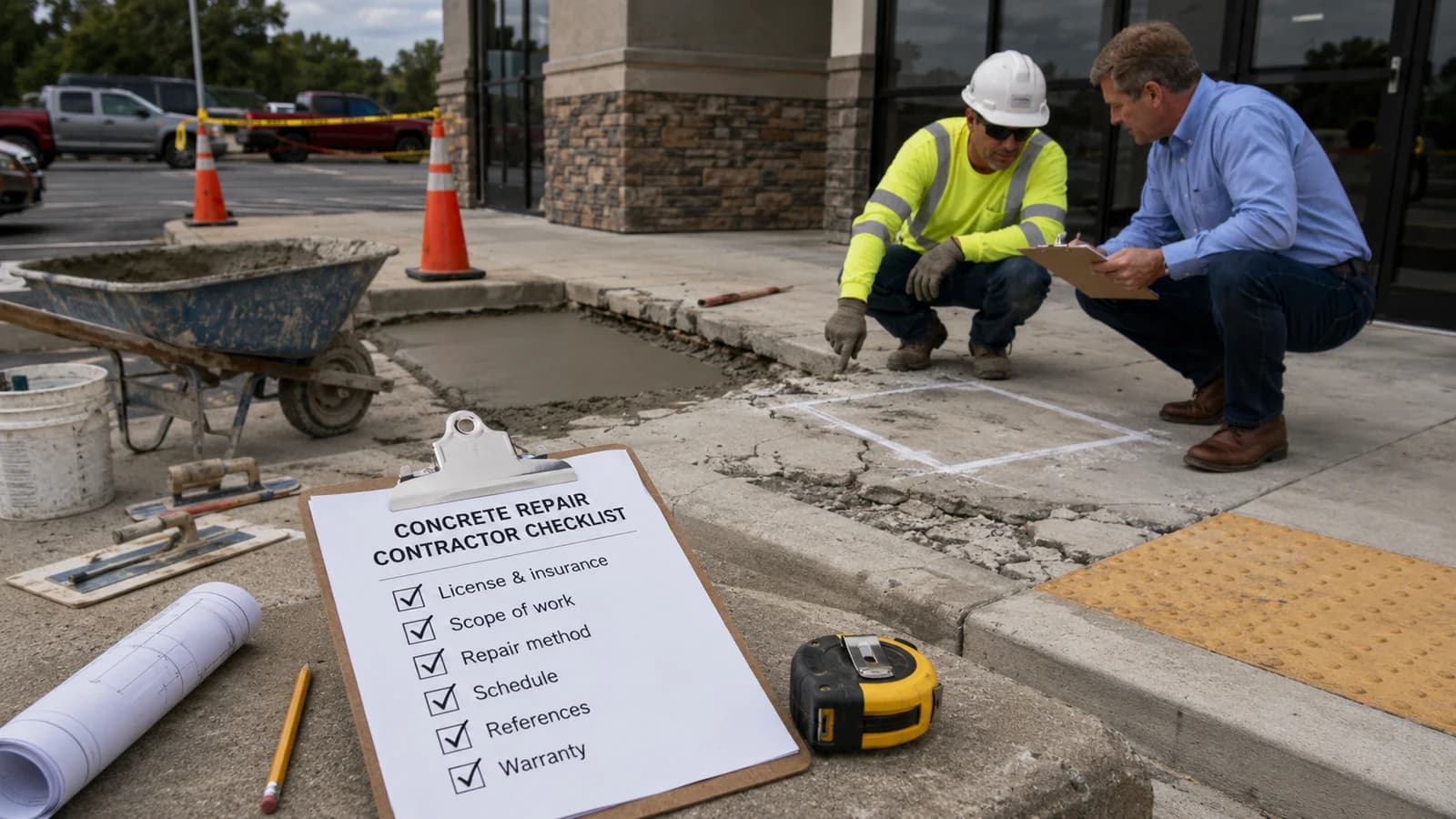
Identify the cause of damage
Ask the contractor to identify whether damage is due to settlement, freeze-thaw cycling, root intrusion, or overload, since the cause affects whether a patch repair will hold or fail again. A patch placed over an area still actively settling, for example, is likely to crack again regardless of workmanship.
Patch repair vs. full-panel replacement
Confirm whether the proposed scope is a patch repair or full-panel replacement, and ask the contractor to explain why that approach is appropriate for the observed damage. Full-panel replacement (removing an entire section between joints) is often more durable for significant cracking than a partial patch.
Trip-hazard and liability considerations
For sidewalks and walkways, ask whether grinding or leveling is an appropriate lower-cost option compared to full replacement, and how the contractor evaluates trip-hazard risk — typically based on the height differential at a joint or crack.
Joint condition
Ask whether control joints and expansion joints will be addressed as part of the repair, since joint failure is a common contributor to recurring concrete damage. Deteriorated joint sealant should generally be replaced as part of a quality repair.
Cure time and traffic restrictions
Confirm the expected cure time before the repaired area can be used, and any restrictions on vehicle or foot traffic during that period. Concrete typically needs several days before foot traffic and longer before vehicle traffic, with full strength reached over several weeks.
Frequently asked questions
How do I know if concrete damage is cosmetic or structural?
Ask the contractor to identify the cause — settlement, freeze-thaw cycling, root intrusion, or overload. Cosmetic cracking often doesn't affect performance, while cause-related damage may return if only patched.
When is grinding a trip hazard better than full replacement?
Grinding or leveling can be a lower-cost option for minor height differences at joints or cracks, but it doesn't address the underlying cause. Full-panel replacement may be warranted for more significant or recurring damage.
How long does concrete need to cure before use?
Cure time varies by mix and weather, but concrete typically needs several days before foot traffic and longer before vehicle traffic. Confirm the contractor's specific timeline before hiring.
Will tree roots keep damaging a sidewalk after it's repaired?
If root intrusion caused the original damage and the roots aren't addressed (through root pruning, a root barrier, or relocation of the affected section), the same damage can recur after a straightforward patch repair.
Before you hire: The Pavement Directory does not guarantee contractor performance, pricing, licensing, insurance, or availability. Business information may be submitted by contractors or gathered from public sources and should be independently verified before hiring. Always confirm licensing, insurance, references, scope of work, and written contract terms.
For property owners
Looking for a pavement contractor?
Use The Pavement Directory to search asphalt, concrete, sealcoating, striping, ADA access, and pavement maintenance contractors by service and location. Always verify license, insurance, references, and written scope before hiring.
Search contractorsFor contractors
Are you a pavement contractor?
Contractors can add or claim a company profile to help property owners find pavement professionals by service, location, and specialty.